Fulltext
The body of the article can be found in the PDF file.
Journal of Medical Education for Future Demands
Former Title: Journal of Medical Education | The Official Journal of School of Medical Education and Learning Technologies
Image Credit:J Med Edu
Authors
Background: Universities and institutes of higher education are always regarded as centers for thinking and disseminating sciences. To improve the scientific quality of such centers, direct their intellectual, religious, and political movements, and ensure that they fulfill their responsibilities and maintain their dynamism, the programs pursued by such centers should undergo constant quality assurance. The major objectives of e-learning are reducing costs, increasing accessibility, and improving quality. The concept of quality, however, is still a challenging issue in electronic and virtual courses and requires lots of research. Despite numerous assessments of e-learning from different perspectives, many experts believe that no comprehensive study has focused on e-learning quality assessment. Thus, the current study was an attempt to conduct a systematic and scientific research with the aim of offering scientific and executive suggestions for improving quality assurance in e-learning in those centers that are implementing or have offered to implement this type of learning.Method: This study adopted a comparative approach by studying papers through case-review. Then, the factors related to quality assurance were extracted, coded, summarized, and combined. Subsequently, using case analysis table, the main factors for e-learning quality assurance were identified.Results: Overall, 27 factors that are related to e-learning were identified and were subsequently reduced to nine factors using case analysis table and summarization and categorization of factors with similar themes.Conclusion: Establishing a proper structure to assess quality is one of the main factors leading to success in assuring quality in higher education. To this end, a suitable organizational structure should be created to assess and improve e-learning educational system. In this study we aimed to identify the main factors influencing e-learning quality assurance. At the end, nine factors were identified.
© 2019, Author(s). This open-access article is available under the Creative Commons Attribution 4.0 (CC BY 4.0) International License (https://creativecommons.org/licenses/by/4.0/), which allows for unrestricted use, distribution, and reproduction in any medium, provided that the original work is properly cited.
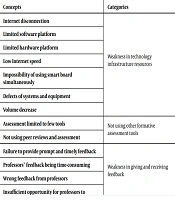
Abbasi Kasani H, Shams Mourkani G, Seraji F, Abedi H. Identifying the Weaknesses of Formative Assessment in the e-Learning Management System. J Med Edu. 2020;19(2):e108533. doi: https://doi.org/10.5812/jme.108533
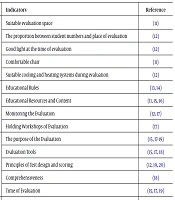
Abbasi Kasani H, Shams Mourkani G, Seraji F, Rezaeizadeh M. The Influential Factors in the Effective Implementation of Evaluation in the Teaching-Learning Process in the Iranian Higher Education System. Educ Res Med Sci. 2020;9(1):e101587. doi: https://doi.org/10.5812/erms.101587
Emami H, Aqdasi M, Asousheh A. Key Success Factors in E-Learning in Medical Education. J Med Edu. 2008;12(3 & 4):e105376. doi: https://doi.org/10.22037/jme.v12i3,4.1250
Hajifathali A, Noori Avarzamani M, Niaie A, Negahban E. External Evaluation: a Requirement for Accountability and Responsiveness. J Med Edu. 2006;8(2):e105248. doi: https://doi.org/10.22037/jme.v8i2.743
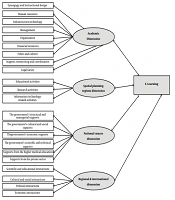
Sajedi R, Khorshidi A, Hamidifar F, Moghaddasi H, Mahmoodi AH. Designing a Conceptual Pattern of E-Learning for Iran’s Universities of Medical Sciences. J Clin Res Paramed Sci. 2021;10(1):e107521. doi: https://doi.org/10.5812/jcrps.107521
Last Update: 1 month ago
Last Update: 1 month ago
Last Update: 1 month ago
Last Update: 6 days ago
Last Update: 10 hours ago
Last Update: 4 days ago