
1. Background
Physician-patient communication is one of the important aspects of therapeutic relationships. Good physician-patient communication provides better diagnosis, treatment, satisfaction, and compliance with the therapeutic plan in patients (1-3). Also, primary communications can establish future relationships between patients and their physicians. This relationship is an impressionable issue and is greatly affected by many factors such as the physician’s character and communication skills, the patient attitude toward his illness, and social factors.
One of these influencing factors is the media in its various forms, such as social media and TV programs. Therefore, the portrayal of this relationship in televised medical dramas could influence the popular attitude toward this relationship. Due to the impact of the media on society’s attitude, it also may shape the perception of the patients and professionals about the standard model of the relationships (4-6). Parsons believed that the physician-patient relationship is a reciprocal encounter that may lead to the superiority of one of them in the absence of partnership and empathy (7). The outcome of this imbalance would be the unapproved models of the relationship, namely paternalistic and technician models (8-10).
On the other hand, some educators advocate that the media and particularly the medical dramas can play an important role in teaching communication issues to medical students (11). However, it is necessary to first measure the potential utility of these movies before assessing their influences on society and medical students. This means that we should know what is actually being portrayed in the media about the physician-patient relationship. Some authors previously described television portrayals of physicians in medical and non-medical dramas (4, 12-14), but none of them focused on the physician-patient relationship.
2. Objectives
Therefore, this study aimed to conduct a systematic analysis of the physician-patient relationship in a medical series named The Nurses (Parastaran) (15), which was produced and showed in the Iranian National TV. We chose the national media with a wide broadcasting area that could well represent the national authorities’ views.
3. Methods
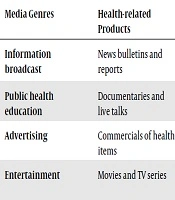
First, we constructed a list of all medical programs broadcasted on the National TV of Iran from 2016 to 2017. Their categorization based on the TV program list is shown in Table 1.
Table 1.
Medical and Health-related Programs in the Iran National TV (IRIB, Islamic Republic of Iran Broadcasting)
| Media Genres | Health-related Products | Program Samples |
|---|---|---|
| Information broadcast | News bulletins and reports | Medical reports (news magazine 20:30 IRIB2) |
| Public health education | Documentaries and live talks | Health network prog. |
| Advertising | Commercials of health items | Cosmetic products |
| Entertainment | Movies and TV series | The nurses (medical drama series) |
Then, we chose the medical drama medium because of its more influence on society. It is necessary to mention that we selected dramas that were produced in Iran since they better reflect the attitudes and perceptions of Iranian people toward the physician-patient relationship and society norms. Furthermore, among the produced medical dramas, the Nurses (Parastaran) drama was the only one produced based on the recommendations and supervision of the Ministry of Health. Therefore, it seemed that it better represented the ministry’s opinion on the issue.
This TV series included two seasons and 51 episodes. We conducted a content analysis of this series, focusing on the scenes that represented physician-patient encounters in clinical settings. For analyzing the show, we developed a series of codes based on the preferred physician-patient relationship criteria that represented the shared decision-making process (Table 2). The checklist of the codes consisted of two parts. The first one contained the prerequisite elements for a good relationship such as rapport, professional manner, eye contact, greetings, active listening, confirmation, and proper reactions to patient emotions. The second part directly measured the shared decision-making process elements. Finally, we concluded on the type of physician-patient relationship.
Table 2.
The Checklist of the Codes Developed for the Assessment of the Physician-Patient Relationship Portrayed in Movies and TV Series
| Checklist of Physician-Patient Relationship Portrayed in Movies and TV series | |||
|---|---|---|---|
| Researcher Name: | Date: | ||
| Name of drama/episode No.: | Time code of the scene: | ||
| Evidence of shared decision-making model of P-P relationship | |||
| Elements | Portrayed in the scene? | ||
| Yes (+)/No (-): Notes | |||
| A. Prerequisite elements of communication | |||
| 1. Maintenance of professional appearance and manner | |||
| 2. Readiness and welcoming | |||
| 3. Rapport and eye contact | |||
| 4. Paying attention to the patient’s comfort during the visit | |||
| 5. Utilizing appropriate body language | |||
| 6. Beginning the visit: greetings (general evaluation of the patient’s life) | |||
| 7. Active listening, confirmations, and proper reactions toward the patient’s emotions | |||
| 8. Noticing the cues | |||
| 9. Taking notes from the patient’s complaints | |||
| B. Elements of shared decision-making | |||
| 1. Explaining the reason behind any action (diagnostic/therapeutic) | |||
| 2. Mentioning the advantages of an action/intervention | |||
| 3. Determining the time of onset before doing the action/intervention | |||
| 4. Informing the patient of the duration of the action/intervention | |||
| 5. Mentioning the disadvantages of the action/intervention | |||
| 6. Other alternative interventions available | |||
| 7. Explaining the necessity for admission, if needed | |||
| 8. Letting the patient know how long the admission lasts | |||
| 9. Considering the patient choice for consulting/support. | |||
| 10. Utilizing comprehensible language for the patient | |||
| 11. Checking the patient’s understanding by asking some questions. | |||
| 12. Repeating and summarizing the explanations | |||
| 13. Inviting the patient to ask other questions he/she may still have | |||
| Conclusion | |||
| Final decision-maker according to the mentioned elements | Patient □ | Physician □ | Both □ |
| The Dominant model of decision-making | Consumerist □ | Paternalism □ | Shared decision-making □ |
| Summary of the scene | |||
After coding, physician-patient relationship incidents were reviewed to distinct the remarkable properties of each incidence regarding the shared decision-making elements. The unit of analysis was scenes. Every physician-patient clinical encounter was examined in each episode.
For the quality assurance and accuracy of the coding, two of the authors coded and discussed two episodes from the first season. This step showed the consistency of coding between researchers. Then, one author (HR) coded each episode. After the initial round of coding, the authors clarified the codes through further discussions. Any questionable incidents were evaluated by all authors to reach consensus.
4. Results
Our analysis of the episodes showed that although the series is categorized under the medical drama programs, its main theme was not the medical issues. Among 51 episodes of the series, we could only find 46 ones in the TV archive. In these 46 episodes, there were 28 scenes of clinical encounters between physicians and patients. From these 28 encounters, 24 represented the paternalistic relationship between the physician and the patient, three represented the technician model of the relationship that left the decision on the patient, and only one scene of the physician-patient relationship represented the elements of shared decision-making. The details of the results are shown in Table 3 for the first season and Table 4 for the second season.
Table 3.
Content Analysis of the Iranian TV Series “The Nurses” (Season 1)
| Content analysis of the Iranian TV series “The Nurses” (Based on the 3PR Checklist for Drama Analysis) | ||
|---|---|---|
| Name of drama | Parastan 1 (the first season of the Iranian TV series “The Nurses”)/988 minutes of medical drama | |
| No. of scenes portraying the physician-patient relationship | 20 | |
| Total No. of episodes | 26 | |
| Elements of shared decision-making model of the physician-patient relationship | Depiction rate | Proportion (%) |
| A. Prerequisite elements of communication portrayed | ||
| 1. Maintenance of professional appearance and manner | 19 | 95 |
| 2. Readiness and welcoming | 4 | 20 |
| 3. Rapport and eye contact | 3 | 15 |
| 4. Paying attention to the patient’s comfort during the visit | 3 | 15 |
| 5. Utilizing appropriate body language | 2 | 20 |
| 6. Beginning the visit: greetings (general evaluation of the patient’s life) | 0 | - |
| 7. Active listening, confirmation, and proper reactions toward the patient’s emotions | 5 | 25 |
| 8. Noticing the cues | 4 | 20 |
| 9. Taking notes from the patient’s complaints | 0 | - |
| B. Elements of shared decision-making portrayed | ||
| 1. Explaining the reason behind any action (diagnostic/therapeutic) | 9 | 45 |
| 2. Mentioning the advantages of the action/intervention | 7 | 35 |
| 3. Determining the time of onset before the action/intervention | 3 | 15 |
| 4. Informing the patient of the action/intervention’s duration | 3 | 15 |
| 5. Mentioning the disadvantages of the action/intervention | 1 | 5 |
| 6. Other alternative interventions available | 0 | - |
| 7. Explaining the necessity for admission, if needed | 7 | 35 |
| 8. Letting the patient know how long the admission lasts | 2 | 20 |
| 9. Considering the patient choice for consulting/support | 3 | 15 |
| 10. Speaking a language comprehensible for the patient | 7 | 35 |
| 11. Noticing the patient’s understanding of his/her reflections and asking about him/her | 3 | 15 |
| 12. Repeating and summarizing the explanations | 0 | - |
| 13. Inviting the patient to ask other questions he/she may still have | 0 | - |
| Dominant model for decision-making | ||
| Paternalism | 17 | 85 |
| Consumerist | 3 | 15 |
| SDM | 0 | - |
Abbreviations: 3PR, portrayal of physician-patient relationship; SDM, shared decision-making
Table 4.
Content Analysis of the Iranian TV Series “The Nurses” (Season 2)
| Content Analysis of the Iranian TV Series “The Nurses” (Based on the 3PR Checklist for Drama Analysis) | ||
|---|---|---|
| Name of drama | Parastan 2 (then second season of the Iranian TV series “The Nurses”)/798 minutes of medical drama | |
| No. of scenes portraying the physician-patient relationship | 8 | |
| Total No. of episodes | 20 | |
| Elements of shared decision-making model of the physician-patient relationship | Depiction rate | Proportion (%) |
| A. Prerequisite elements of communication portrayed | ||
| 1. Maintenance of professional appearance and manner | 7 | 87.5 |
| 2. Readiness and welcoming | 2 | 25 |
| 3. Rapport and eye contact | 0 | - |
| 4. Paying attention to the patient’s comfort during the visit | 1 | 12.5 |
| 5. Utilizing appropriate body language | 1 | 12.5 |
| 6. Beginning the visit: greetings (general evaluation of the patient’s life) | 1 | 12.5 |
| 7. Active listening, confirmation, and proper reactions toward the patient’s emotions | 3 | 37.5 |
| 8. Noticing the cues | 2 | 25 |
| 9. Taking notes from the patient’s complaints | 1 | 12.5 |
| B. Elements of shared decision-making portrayed | ||
| 1. Explaining the reason behind any action (diagnostic/therapeutic) | 3 | 37.5 |
| 2. Mentioning the advantages of the action/intervention | 2 | 25 |
| 3. Determining the time of onset before the action/intervention | 2 | 25 |
| 4. Informing the patient of the action/intervention’s duration | 1 | 12.5 |
| 5. Mentioning the disadvantages of the action/intervention | 1 | 12.5 |
| 6. Other alternative interventions available | 1 | 12.5 |
| 7. Explaining the necessity for admission, if needed | 0 | - |
| 8. Letting the patient know how long the admission lasts | 1 | 12.5 |
| 9. Considering the patient choice for consulting/support | 5 | 62.5 |
| 10. Speaking a language comprehensible for the patient | 4 | 50 |
| 11. Noticing the patient’s understanding of his/her reflections and asking about him/her | 3 | 37.5 |
| 12. Repeating and summarizing the explanations | 2 | 25 |
| 13. Inviting the patient to ask other questions he/she may still have | 2 | 25 |
| Dominant Model for Decision-making | ||
| Paternalism | 7 | 87.5 |
| Consumerist | 0 | - |
| SDM | 2 | 12.5 |
Abbreviations: 3PR, portrayal of physician-patient relationship; SDM, shared decision-making
5. Discussion
The physician-patient relationship is an axial topic in modern medical ethics that has been profoundly influenced by democratic changes in human societies during the 20th century (7, 16). The first dramatic change in the traditional model of the physician-patient relationship was a paternalism to consumerism passage with the transition of power for decision-making from doctors to patients (1, 17). But, according to problems found in this context due to the lack of knowledge that patients need to make the best therapeutic decision on their own, this model gradually has been substituted by an alternative called shared decision-making (2, 18). In the globally accepted model of the physician-patient relationship, the physician should empower his/her patient toward finding his/her core values before reaching the point of decision. Then, the physician and the patient come along together to a shared clinical decision made based on real informed consent (9). Nevertheless, the Hippocratic oath and paternalistic approach are still considered a fundamental framework of physician-patient relationships by many practicing doctors in some countries, including Iran (19).
Also, the increasing use of complex new technologies for a proper and standard clinical approach in modern medicine has elicited ethical dilemmas about the unknown future consequences of these interventions for patients (3). Therefore, effective communication between physicians and patients may be the sole way of overcoming these dilemmas in modern medical sciences, and shared decision-making is the best model to achieve such a relationship. Formal medical textbooks introduced as national residency exams have been selected and targeted toward promoting shared decision-making as the desired type of physician-patient relationship (20, 21). Iranian medical council has also emphasized better communication of the members in its most recent professional codes of conduct to improve the shared physician-patient relationship (22).
Apart from the internal capacity of the medical profession to change the paternalistic behavior of physicians with their patients, there are social factors that may alleviate this transition of our era to a more democratic relationship that is called shared decision-making. Mass media, including popular television programs, have been considered potentially significant tools that can shape public opinion and social interactions in different backgrounds like the physician-patient relationship in clinical settings (23-26).
Clinical studies in recent years showed that more attractive TV programs like dramas might have unwanted negative impacts on the patients’ or their families’ expectations from the emergency cardiopulmonary resuscitation, a routine clinical visit, and even diagnostic imaging departments causing difficulties in this relationship (5, 6, 12). Some researchers also have focused on TV dramas’ value in improving the medical students’ attitude toward the care of patients (11) or the patients’ better perception of moral distress that is really experienced in medical procedures (14).
However, in addition to these approaches, TV medical dramas may be studied through the lens of professionalism and medical ethics. As some researchers emphasized, the assessment of the influence of televised dramas on students or the general public, it seems necessary to know what is really being portrayed in these programs. Content analysis of two popular medical dramas in the United States showed egregious deviations from the norms of professionalism even though all the episodes were depicting bioethical issues (4).
In Iran, the Ministry of Health and Medical Education sponsored an expensive TV medical drama called Parastaran (the Nurses) to be broadcasted in the Islamic Republic National TV Channel One. The current policy of the health system in Iran, as mentioned above, is to promote the shared decision-making type of physician-patient relationship (22, 27). The efficacy of this type of relationship compared to the traditional paternalistic interactions of some Iranian doctors with their patients in decreasing legal files against the medical staff is another major concern among Iranian academics to recommend shared decision-making to all physicians nationwide (2, 28). According to our findings of qualitative content analysis, the Iranian health system sponsored TV series, named Parastaran (the Nurses) represented the paternalistic physician-patient relationship as the dominant portrayal of clinical interactions throughout its broadcasting during two seasons in the period of 2017 - 2018. This frank difference between the formally accepted type of physician-patient relationship (shared decision-making) in the educational system and positive portrayal of another type of physician-patient relationship (paternalistic) during media sponsorship is a paradox to be solved.
5.1. Conclusion
Representation of traditional paternalistic physician-patient relationship in the first and the only medical drama produced and broadcasted in Iran National TV Channel One with the sponsorship of the Ministry of Health and Medical Education was against the formal policies of this institution (27) in the promotion of shared decision-making in the health system.
This paradoxical outcome in such a modern approach to promote health issues through media, particularly medical dramas, indicated that health communication as a newly introduced discipline should be better studied and understood by academic institutions of developing countries to regulate and optimize artistic and scientific interactions for achieving the best results in a media representation. This not only will influence the social perception of good communication but also will affect the health professionals and mainly the future physicians’ (medical students’) understanding of morally acceptable communication with their patients to preserve the patient’s autonomy with shared decision-making.