
1. Background
Organ transplantation is one of the most incredible medical advances in treating patients with organ failure, which had increased the survival rate of such patients (1). It has increased in recent decades due to rapid medical and technological advances (2). Transplant-related technologies are one of the most effective medical advances in the twenty-first century, which are more cost-effective than other alternative therapies. However, the need for transplant organs is still growing more rapidly than their supply (3). This large gap between organ donors and recipients is a significant problem for the main concern of governments (4).
Every year, more than 10% of patients on the waiting lists for transplantation pass away because of the lack of donated organs (5). Organ shortage has become a global phenomenon (6). Unfortunately, the relative recession of organ donation has been nationally observed since 2007. Organ shortage is a public health crisis being deteriorated daily (3). There have been 120,963 patients requiring organ donation in the United States since 2016 (6). In Iran, about 13,000 patients are on the waiting list for organ transplants, and 7 - 10 persons die daily because of organ shortages (7).
According to statistics from the International Registry on Organ Donation and Transplantation in 2015, the total rate of donated organs in Iran was 8.4 per one million persons, while in Spain, the rate was 35.9 (5). According to the Iranian Society of Organ Donation, one person per 10 minutes is added to the organ transplant waiting list, and one patient on the waiting list dies per two hours. In Iran, one person dies from brain death per 70 minutes (8). Individuals with brain death are one of the main sources of organ transplants (9), providing about 30% of organs required for transplantation. Various factors may affect the number of organs, and the main factor limiting the number of available organs still seems to be family dissatisfaction with organ donation (5). Practically, it is highly challenging for families to consent to organ donation (10). Although many religious and Islamic scholars and scientists have approved organ donation, many individuals are still unwilling to do so (11, 12).
In Islam, the violation of the human body, whether alive or dead, is forbidden. However, altruism is also an essential principle in Islam, and saving the lives of human beings is emphasized in the Holy Quran. "If anyone saved a life, it would be as if he saved the life of the whole of humanity" (5: 32). In this moral dilemma, what is valuable is the dominance of necessity over prohibition. From the perspective of Islam, organ donation is a godly movement to help others (13). The Islamic Jurisprudence Assembly Council in Saudi Arabia made a critical decision and approved the donation of an organ from a living or deceased person. In 1988, similar official laws were issued in Egypt, Iran, and Pakistan. Although organ transplants from brain-dead patients have been officially undertaken in Iran since 2002, organ donation statistics in the country are not pleasant (14). Organ donation is often considered a sacrificial and purely altruistic behavior (15). Altruism is introduced as a factor affecting decisions about organ donation (15, 16). Some studies have indicated that attitudes toward organ donation and the desire to receive an organ donation card are associated with various factors such as humanitarian inclinations, voluntary activities, beliefs, religion, empathy, fear, and altruism (17). Altruism and gift-giving have been an integral part of organ transplantation from the beginning. Donation is a gift from the family members of the donor, who suggest donating the organ of their deceased loved one to someone in need. Many healthcare institutions, including the American Society of Transplantation, have clearly stated that organ donation should be altruism-based (18). On the other hand, individuals’ economic and social status, religious tendencies, and level of education also play a critical role in organ donation, and misconceptions about transplantation and organ donation are one of the main obstacles (19). Given that we live in a society where thousands of patients in need of organs are living a painful life waiting for a transplant, detecting factors affecting individual’s attitudes in this regard is of paramount importance.
Accordingly, the present study aimed to detect the relationship between the attitude toward organ donation and altruism to determine what measures should be adopted to reinforce the tendency to donate organs in society.
2. Objectives
This study aimed to investigate the relationship between altruism and attitudes toward organ donation in society
3. Methods
This cross-sectional study was conducted from August 2020 to March 2020 using a web-based survey in Iran. The sample size formula for correlative studies and STATA software were used to determine the sample size. After reviewing previous studies (2, 8, 20), the effect size of the correlation coefficient of exposure and outcome was 0.3. The sample size (n = 368) was calculated at P < 0.05, with the test power of 90% and the 10% dropout rate. Inclusion criteria were age above 18 years, literacy, and ability to answer questions. Incomplete completion of the questionnaire was the exclusion criterion. Questionnaires were completed online, and the participants were selecting using the convenience sampling techniques via social media (e.g., WhatsApp, Telegram, and Instagram). Voluntary participation was considered in this study, and the returned questionnaires were kept confidential. The required data was collected using a demographic characteristics form and two standard questionnaires. Demographic characteristics included age, gender, level of education, marital status, and occupation status.
The second instrument was the Attitude Toward Organ Donation survey, and the third one was the Self-Report Altruism Scale. First, the questionnaires were translated into Persian after receiving permission from their developers via email. Then the research proposal was approved by the vice-chancellor of research of the university
The Attitude Toward Organ Donation survey was first developed by Rumsey et al. (2003), and its psychometric characteristics were evaluated. The questionnaire consists of 20 items scored on a Likert scale ranging from strongly disagree (1) to strongly agree (4). The total score of the questionnaire shows individuals' attitudes toward organ donation. Two items are not included in the final calculation, and four items are scored reversely. The content and construct validity of the scale were also confirmed. The reliability of the questionnaire was calculated using the internal consistency method (α = 0.90) (21). In the present study, the reliability of the questionnaire was calculated using Cronbach's alpha (α = 0.81), and the experts confirmed its content validity index.
The Standardized Self-Report Altruism scale was developed by Rushton et al. (1981), and its psychometric characteristics were evaluated. The questionnaire consists of 20 questions on a five-point Likert scale ranging from never (1) to often (5). The sum of the scores indicates the degree of altruism. The reliability of the questionnaire was calculated (α = 0.89), and its content and construct validity were also confirmed (22). In the present study, the reliability of the questionnaire was approved (α = 0.86). The experts also confirmed the content validity index of the questionnaire. According to the experts' comments, some questionnaire items were modified to be more consistent with Iranian culture. In this regard, Item 1 was changed from "I have helped push a stranger's car out of the snow" to "I helped someone who did not know how to use an ATM." Item 4 was changed from "I have given money to a charity" to "I have donated money to the welfare organization or any charity." Item 6 was changed from "I have donated goods or clothes to a charity" to "I have donated goods or clothes to the welfare organization or any charity." Item 17 was changed from "I have voluntarily asked to look after a neighbor's pets or children without being paid" to "I have volunteered to help my neighbor by taking care of the potted flowers or her baby."
Descriptive statistics were used to describe independent (i.e., altruism), dependent (i.e., attitude to organ donation), and contextual variables. Univariate linear regression was used for the independent variable and potentially intervening variables. Variables with P < 0.2 in univariate analysis were evaluated for further analysis in the multivariate analysis. The collected data was analyzed using STATA16 software.
4. Results
The participants’ mean age was 35.4 years. Most of the participants were women and married, and 66.2% had academic education. Table 1 presents these individuals’ demographic findings.
Table 1.
Participants’ Demographic Characteristics (n = 328) a
| Variables | No. (%) | Mean ± SD | Min. | Max. | Missing Data (%) |
|---|---|---|---|---|---|
| Age | 328 (100) | 35.4 ± 10.9 | 19 | 78 | |
| Gender | |||||
| Female | 194 (59.2) | ||||
| Male | 134 (40.9) | ||||
| Marital status | |||||
| Single | 129 (39.33) | ||||
| Married | 191 (58.2) | ||||
| Other | 8 (2.4) | ||||
| Level of education | |||||
| Academic | 217 (66.2) | ||||
| Non-academic | 111 (33.8) | ||||
| Altruism | 36.6 ± 14.8 | 20 | 100 | 1 (0.3) | |
| Attitudes toward organ donation | 54.0 ± 7.5 | 28 | 69 | 3 (0.9) |
a Values are expressed as No. (%) or mean ± SD unless otherwise indicated.
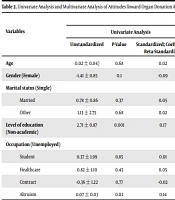
Of the univariate analysis results (Table 2) show that gender, occupation, age, and marital status have no significant relationship with attitudes toward organ donation (P > 0.05), and that the level of education has a significant relationship with attitudes toward organ donation (P < 0.001). In the multivariate analysis (Table 2), variables with a P < 0.2 in the univariate analysis were entered into the model simultaneously. An increase in the altruism score was associated with an increase in the score of attitudes toward organ donation (P < 0.001). By controlling for other variables (gender and level of education), the scores of attitudes toward organ donation increased by an increase in the altruism score (0.17 per score). Moreover, individuals with academic education were more likely to donate than those with non-academic education (B = 0.18, P < 0.001).
Table 2.
Univariate Analysis and Multivariate Analysis of Attitudes Toward Organ Donation Among Participants a
| Variables | Regression Indexes | |||||
|---|---|---|---|---|---|---|
| Univariate Analysis | Multivariate Analysis | |||||
| Unstandardized Coefficients B (Std. Error) | P-Value | Standardized; Coefficients Beta-Standardized | Unstandardized Coefficients B (Std. Error) | P-Value | Standardized; Coefficients Beta-Standardized | |
| Age | 0.02 (0.04) | 0.68 | 0.02 | |||
| Gender (Female) | -1.41 (0.85) | 0.1 | -0.09 | -1.13 (0.83) | 0.18 | -0.07 |
| Marital status (Ref: Single) | ||||||
| Married | -0.78 (0.86) | 0.37 | 0.05 | |||
| Other | 1.13 (2.75) | 0.68 | 0.02 | |||
| Level of education (Non-academic) | 2.21 (0.87) | 0.001 | 0.17 | 2.89 (0.88) | < 0.0014 | 0.18 |
| Occupation (Ref: Unemployed) | ||||||
| Student | 0.37 (1.99) | 0.85 | 0.01 | |||
| Healthcare | 0.82 (1.10) | 0.45 | 0.05 | |||
| Contract | -0.36 (1.22) | 0.77 | -0.02 | |||
| Altruism | 0.07 (0.03) | 0.02 | 0.14 | 0.09 (0.03) | 0.002 | 0.17 |
a Values are expressed as Coefficients B (Std. Error) unless otherwise indicated.
5. Discussion
This study showed that altruism positively correlated with the desire to donate organs. The desire for organ donation increases with an increase in the altruism score, indicating that altruism is a critical component in determining individuals' desire to donate organs. Milaniak introduced altruism as one of the basic factors in individuals’ desire for organ donation. They stated that altruism, humanitarian and benevolent feelings, past voluntary actions, secular and religious beliefs, empathy, and fear could affect individuals’ desire for organ donation. Consequently, they have significant effects on individuals' attitudes toward organ donation and their willingness to register as organ donors (23). Another study revealed a positive relationship between students' altruism scores and their willingness to donate blood, attitudes toward organ donation, and willingness to register as a donor (24). Other studies also documented that altruism was the main incentive for blood donation (25), and that had a relationship with organ donation (2). In a survey by Steele, donors also identified altruistic stimuli as the first reason for donating (26). Another study reported that the mean altruism score was higher in the group of blood donors than in non-volunteers (27). Other studies have often considered the sense of altruism as the basic principle of organ donation (7, 28). A survey on physicians reported a positive and significant relationship between altruism and attitudes toward organ donation (2). These consistent findings, indicating a positive relationship between altruism with positive attitudes and willingness to organ donation, might be caused by the fact that altruism can increase individuals’ motivation to help others and promotes tendency to organ donation (29). This is consistent with Batson's empathy-altruism hypothesis, which regards altruism as a result of understanding the suffering of others and having an empathetic feeling for them (30).
According to these findings, altruism plays a crucial role in organ donation. However, Milaniak et al. surprisingly reported that a highest percentage of the participants intended to receive an organ donation card was at a moderate altruism level (23). Accordingly, although altruism is effective in individuals' tendency to organ donation, it may not play a determining role (23, 31).
Since altruists pay attention to the needs of others in addition to their own needs to satisfy their humanitarian motives (2), it is necessary to strengthen altruism among society members to promote willingness to organ donation in society (2, 4, 32). We should also correlate organ donation with altruism (33). Because human beings are purely social species, they regularly engage in costly behaviors to benefit others (3). Altruism is a high social value and a social duty; hence, its decrease can lead to disorders in society (34).
Another main finding in this study was that academic education correlated with an increased tendency for organ donation. Other empirical evidence suggests that an increase in level of education is significantly associated with an increase in altruism (35). Alex also stated that the population’s educational characteristics could be effective in organ donation decision-making (36). In Neate et al.'s study, the level of education also played an important role in individuals’ consent to donation (37). In this regard, the findings of a review study by Abbasi et al. suggested that organ donation is a complicated and difficult decision for patients and their families. Knowledge and attitudes toward the treatment team, family, and individuals also affect this process (38). Since the increase in the rate of consent to donation requires growing awareness and creating a positive attitude toward this critical issue in society (9), family education can play a vital role in increasing the rate of organ donation across the country (39).
Another finding of the present study was a non-significant relationship between demographic variables, including occupation, marital status, gender, and age, with the desire to donate. However, female dental students in India were more knowledgeable about organ donation than men, while men hold more positive attitudes toward donation (40). In Iran, women living in Arak were more inclined to donate (41). In another study, male students were more likely to apply for donations than female students (41). Nawaz also considered demographic factors such as religion, age, and ethnicity to be important in organ donation rates (39). The inconsistency of the findings might have been caused by the small sample size in the present study. Larger sample sizes are suggested to be addressed in future research.
5.1. Conclusions
The findings of the present study indicate the significant role of altruism and the level of education in individuals’ willingness to donate. We suggest that intervention programs promoting altruism and educational organ donation programs should be designed and implemented for the general population to increase the number of organ donors.
5.2. Limitations
The present study had several limitations. Online sampling was one of the main limitations of the present study, which could affect the results. Due to the COVID-19 pandemic and to preserve the community's health, no other method was possible. The present study used a cross-sectional design to measure altruism and attitudes simultaneously; hence, no causal inference can be made. The authors suggest that the relationship between altruism and attitude toward organ donation be examined in longitudinal studies (cohort). Second, community and culture-based variables can significantly affect attitudes toward organ donation. Unfortunately, the present study disregarded different levels of these variables due to the selected sampling method (online method) restricting the inclusion of community-based variables. Given the nature of this correlational study, which focused only on altruism and some demographic characteristics, it could not predict the main reasons for the desire to donate. Other personality and psychological characteristics should be studied in future research to reach a better understanding of the decision-making processes of organ donation. Fourth, the present study evaluated Altruism in only one dimension. We suggest future researchers investigate the relationship between attitudes toward organ donation and different dimensions of altruism. Finally, the present study used a non-probabilistic sampling method (a convenient sample from the Internet), then the findings may not be highly generalizable to the whole population.