DNA Binding Study of Dihydropyrano [3, 4-C] Chromene Derivative by some Spectroscopic Techniques
Authors
Abstract
This study was designed to examine the interaction of dihydropyranochromene derivative, 2-amino-4-phenyl-5-oxo-4H, 5H-pyrano-[3, 2-c] chromene-3-carbonitrile (4-PC) with calf thymus DNA (ctDNA) by absorption spectroscopy, competitive fluorescence studies, circular dichroism (CD) and viscosity measurements. It was found that 4-PC could interact with ctDNA through non- intercalative mode and the intrinsic binding constant, Kb, for 4-PC with ctDNA was estimated to be 2.74 ×10³ M-1. Methylene blue (MB) displacement studies revealed that 4-PC could not replace ctDNA bounded MB, which is indicative of groove binding mode of 4-PC with DNA. Furthermore, 4-PC induced detectable changes in the CD spectrum of ctDNA as well as changes in its viscosity, corroborate the above experimental results.
Highlights
Copyright
© 2016, Author(s). This open-access article is available under the Creative Commons Attribution 4.0 (CC BY 4.0) International License (https://creativecommons.org/licenses/by/4.0/), which allows for unrestricted use, distribution, and reproduction in any medium, provided that the original work is properly cited.
Similar Articles
Study on the Interaction between Isatin-β-Thiosemicarbazone and Calf Thymus DNA by Spectroscopic Techniques
Pakravan P, Masoudian S. Study on the Interaction between Isatin-β-Thiosemicarbazone and Calf Thymus DNA by Spectroscopic Techniques. Iran J Pharm Res. 2015;14(1):e125264. doi: https://doi.org/10.22037/ijpr.2015.1634
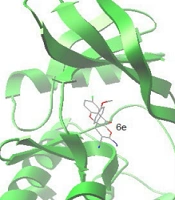
Synthesis, Antioxidant, Cytotoxicity, Induce Apoptosis Investigation and Docking Study of New Halogenated Dihydropyrano[3,2-b]Chromene-3-Carbonitrile Derivatives on MCF-7 Breast Cancer Cell Line
Eslaminejad T, Faghih Mirzaei E, Abaszadeh M. Synthesis, Antioxidant, Cytotoxicity, Induce Apoptosis Investigation and Docking Study of New Halogenated Dihydropyrano[3,2-b]Chromene-3-Carbonitrile Derivatives on MCF-7 Breast Cancer Cell Line. Iran J Pharm Res. 2023;22(1):e132932. doi: https://doi.org/10.5812/ijpr-132932
Chromium (III) Complexes of 4,5-diazafluoren-9-one Ligand as Potential Anti-proliferative Agents: Synthesis, Characterization, DNA Binding, Molecular Docking and In-vitro Cytotoxicity Evaluation
Shahraki O, Ghaznavi H, Akbarzadeh-T N, Shahraki S, Sheervalilou R, et al. Chromium (III) Complexes of 4,5-diazafluoren-9-one Ligand as Potential Anti-proliferative Agents: Synthesis, Characterization, DNA Binding, Molecular Docking and In-vitro Cytotoxicity Evaluation. Iran J Pharm Res. 2021;20(3):e124504. doi: https://doi.org/10.22037/ijpr.2021.114685.14996
Growth inhibition and Induction of apoptosis in K562 Chronic Myeloid Leukaemia cells by the derivatives of dihydropyrano[c]chromenes family
Pejman S, Mahdavi M, Balalaei S. Growth inhibition and Induction of apoptosis in K562 Chronic Myeloid Leukaemia cells by the derivatives of dihydropyrano[c]chromenes family. J Kermanshah Univ Med Sci. 2013;17(7):e74458. doi:
2-Amino-4-(nitroalkyl)-4H-chromene-3-carbonitriles as New Cytotoxic Agents
Zonouzi A, Mirzazadeh R, Safavi M, Kabudanian Ardestani S, Emami S, et al. 2-Amino-4-(nitroalkyl)-4H-chromene-3-carbonitriles as New Cytotoxic Agents. Iran J Pharm Res. 2013;12(4):e125751. doi: https://doi.org/10.22037/ijpr.2013.1396
- Scopus by DOI: 0
Last Update: 4 days ago
- Scopus by Title: 0
Last Update: 4 days ago
- Scopus by Title (Ref): 8
Last Update: 4 days ago
- CrossRef: 0
Last Update: 7 hours ago
- OpenAlex: 0
Last Update: 9 hours ago
- OpenCitations: 0
Last Update: 4 days ago