
1. Background
The surge in cosmetic procedures has sparked concerns about the psychological well-being of those who pursue them. Past research links engagement in aesthetic treatments with disorders such as body dysmorphic disorder (BDD), depression, and anxiety (1, 2). Furthermore, elevated suicide rates after breast augmentation (3) underscore the urgency of mental health assessment in cosmetic surgery candidates (2).
Clients of beauty clinics often demonstrate higher prevalence of depression, social anxiety, and eating disorders compared to general individuals (4, 5). Unrealistic expectations and societal pressures—amplified by media glorification of cosmetic enhancements—can mislead individuals about outcomes (6, 7). Researches found that rhinoplasty seekers often hoped surgery would enhance self-concept. Conversely, individuals with overt psychiatric disorders, such as psychosis, are advised against cosmetic procedures (6, 7).
Given these concerns, a comprehensive comparison with a matched general-population sample is necessary. Our study addresses this gap by evaluating behavioral disorder prevalence in both groups.
2. Methods
2.1. Participants
Four hundred participants (200 beauty clinic clients from Tehran and 200 general-population individuals from local centers) aged 20 - 60 were selected using convenience sampling. All participants provided informed consent.
2.2. Measure
Psychological symptoms were evaluated using the Symptom Checklist-90 (SCL‑90) (8), which assesses nine subscales: Somatization, obsessive–compulsive disorder (OCD), depression, anxiety, phobia, paranoid ideation, psychosis, aggression, and interpersonal sensitivity. Responses are on a 5-point Likert scale. The Persian version demonstrated excellent reliability; Cronbach’s α = 0.98 (9).
2.3. Procedure
Participants completed questionnaires in a quiet room under research supervision.
2.4. Statistical Analysis
SPSS v.25 was used. Descriptive statistics summarized demographics and scores, while chi-square and independent t-tests evaluated group differences. Significance was set at P < 0.05. In addition to univariate analyses, multivariate linear regression analyses were performed to examine group differences in psychological symptom scores while controlling for potential demographic confounders, including age, gender, marital status, and educational level.
3. Results
3.1. Demographic Characteristics
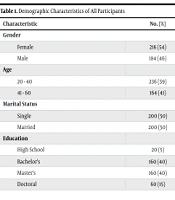
Table 1 displays overall demographics. The sample comprised 216 women (54%) and 184 men (46%), aged mostly 20 - 40 (59%) or 41 - 60 (41%). Education levels included high school (5%), bachelor’s (40%), master’s (40%), and PhD (15%).
Table 1.
Demographic Characteristics of All Participants
| Characteristic | No. (%) |
|---|---|
| Gender | |
| Female | 216 (54) |
| Male | 184 (46) |
| Age | |
| 20 - 40 | 236 (59) |
| 41 - 60 | 164 (41) |
| Marital Status | |
| Single | 200 (50) |
| Married | 200 (50) |
| Education | |
| High School | 20 (5) |
| Bachelor's | 160 (40) |
| Master's | 160 (40) |
| Doctoral | 60 (15) |
Table 2 shows that beauty clinic clients were predominantly female (82%) and married (80%), whereas the general group had more males (74%) and singles (80%). Educationally, clients held bachelor’s or master’s degrees, while the general group included high school (10%) and PhD (30%) holders. All demographics differed significantly (P < 0.001).
Table 2.
Comparison of Demographic Variables by Group
| Characteristic | Beauty Clinic; No. (%) | General Population; No. (%) |
|---|---|---|
| Gender | ||
| Female | 164 (82) | 52 (26) |
| Male | 36 (18) | 148 (74) |
| Marital Status | ||
| Single | 40 (20) | 160 (80) |
| Married | 160 (80) | 40 (20) |
| Education | ||
| High School | 0 (0) | 20 (10) |
| Bachelor's | 120 (60) | 40 (20) |
| Master's | 80 (40) | 80 (40) |
| Doctoral | 0 (0%) | 30 (30%) |
Table 3 compares Symptom Checklist-90 scores. The general group reported higher anxiety (M = 9.16 vs. 5.84, P < 0.001), obsession (M = 13.02 vs. 9.78, P < 0.001), interpersonal sensitivity (M = 8.68 vs. 7.28, P = 0.045), and psychosis (M = 6.80 vs. 5.10, P = 0.019). No significant differences were found in depression, somatization, aggression, phobia, or paranoia.
Table 3.
Psychological Symptoms – Mean Scores by Group
| Domain | Beauty Clinic (Mean ± SD) | General Population (Mean ± SD) | P-Value |
|---|---|---|---|
| Anxiety | 5.84 ± 3.00 | 9.16 ± 8.05 | < 0.001 |
| Obsession | 9.78 ± 4.75 | 13.02 ± 9.82 | < 0.001 |
| Interpersonal Sensitivity | 7.28 ± 3.75 | 8.68 ± 9.11 | 0.045 |
| Psychosis | 5.10 ± 3.52 | 6.80 ± 9.57 | 0.019 |
| Depression | 10.86 ± 4.77 | 11.24 ± 8.90 | 0.612 |
| Somatization | 6.42 ± 3.21 | 6.88 ± 6.94 | 0.488 |
| Aggression | 7.10 ± 3.80 | 7.55 ± 7.62 | 0.531 |
| Phobia | 4.98 ± 2.90 | 5.36 ± 5.84 | 0.462 |
| Paranoid Ideation | 6.12 ± 3.40 | 6.55 ± 6.70 | 0.508 |
After adjusting for age, gender, marital status, and educational level, multivariate analyses indicated that group differences remained statistically significant for anxiety and obsessive–compulsive symptoms, whereas differences in interpersonal sensitivity and psychosis were attenuated and no longer statistically significant.
While effect size measures such as Cohen’s d were recommended, the primary focus of the present analysis was on adjusted group comparisons controlling for demographic variables. Future studies will incorporate standardized effect size estimates to further quantify the magnitude of observed differences.
4. Discussion
Our findings reveal clear demographic and behavioral distinctions between beauty clinic clients and the general population. The overrepresentation of married women among cosmetic clients is consistent with prior research emphasizing the role of gender-related and relational factors in cosmetic decision-making (10, 11). Educational level may also influence access to cosmetic services as well as awareness and informed decision-making processes (12).
Crucially, individuals from the general population reported higher levels of anxiety, obsessive tendencies, interpersonal sensitivity, and psychosis, challenging the common assumption that individuals seeking cosmetic procedures experience greater psychological distress. Despite multivariate adjustment, residual confounding cannot be fully excluded, and the findings should therefore be interpreted with appropriate caution. In particular, substantial demographic differences between the groups—such as gender distribution, marital status, and educational attainment—may have contributed to the observed symptom patterns.
These results are partially consistent with studies suggesting short-term psychological benefits following cosmetic procedures (13). However, it is important to note that certain subgroups, particularly individuals with body dysmorphic disorder (BDD), may remain vulnerable to dissatisfaction and psychological distress despite objectively successful cosmetic outcomes (2, 14). The absence of significant group differences in depression, somatization, aggression, phobia, and paranoid ideation suggests that these psychological symptoms are broadly distributed across the population and are not uniquely associated with cosmetic clinic attendance.
From a clinical perspective, these findings underscore the importance of routine preoperative psychological screening to identify individuals at elevated psychological risk and to guide appropriate psychological support or referral when necessary. Clinicians should remain attentive to potential warning signs, including excessive preoccupation with appearance and unrealistic expectations regarding cosmetic outcomes (2, 15). Finally, future research should employ longitudinal designs and qualitative approaches to better elucidate the temporal relationships, motivations, and mental health trajectories associated with cosmetic procedures.
4.1. Limitations
This study has several limitations that should be considered when interpreting the findings. First, the cross-sectional design limits the ability to draw causal inferences regarding the relationship between cosmetic clinic attendance and psychological symptoms. Second, the use of convenience sampling may restrict the generalizability of the results to broader populations. Third, although multivariate analyses were performed to adjust for key demographic characteristics, residual confounding cannot be fully excluded. Finally, reliance on self-report instruments such as the Symptom Checklist-90 may introduce response bias and may not fully capture clinical diagnoses.
4.2. Conclusion
This study identified psychological and demographic differences between beauty clinic clients and individuals from the general population. Contrary to common stereotypes, cosmetic clinic clients in this sample did not exhibit higher levels of psychological symptoms and, in several domains, reported lower symptom severity compared with the general population.
These findings should be interpreted descriptively rather than causally. Although multivariate analyses were conducted to account for key demographic differences, residual confounding cannot be fully excluded. Therefore, cosmetic interest should not be interpreted as inherently indicative of either psychological vulnerability or psychological benefit. Instead, the observed patterns likely reflect a complex interplay of demographic, sociocultural, and individual factors.
From a clinical standpoint, the results underscore the importance of routine psychological symptom screening in cosmetic settings to identify individuals who may benefit from additional psychological assessment or support. Such screening can facilitate ethically informed clinical decision-making and help manage expectations prior to cosmetic interventions.
Overall, this study contributes to a more nuanced understanding of psychological characteristics among cosmetic clinic clients and challenges pathologizing assumptions surrounding cosmetic behavior. Future longitudinal and mixed-methods research is warranted to clarify temporal relationships and to further explore how psychological well-being, self-concept, and contextual factors interact with cosmetic engagement over time.