Cover image of the article: Case Series of Angioembolization of Genitourinary System Between 2004 and 2016

Image Credit:Multidiscip Cardio Annal

Case Series of Angioembolization of Genitourinary System Between 2004 and 2016

Authors

Ramin Heidari1, Mohaddeseh BehjatiMohaddeseh Behjati ORCID2, Zahra Alizadeh Sani2, 3, Roohallah Alizadehsani4,*
1Department of Cardiology, School of Medicine, Isfahan University of Medical Sciences, Isfahan, Iran
2Echocardiography Research Center, Rajaie Cardiovascular Medical and Research Center, Iran University of Medical Sciences, Tehran, Iran
3Omid Hospital, Iran University of Medical Sciences, Tehran, Iran
4Institute for Intelligent Systems Research and Innovations (IISRI), Deakin University, Geelong, Australia
*Corresponding Author: Institute for Intelligent Systems Research and Innovations (IISRI), Deakin University, Geelong, Australia. Email: r.alizadehsani@deakin.edu.au

Multidisciplinary Cardiovascular Annals:Vol. 14, issue 1; e112695
Published online:Jul 18, 2023
Article type:Research Article
Received:Jan 04, 2021
Accepted:Apr 20, 2023
How to Cite:Heidari R, Behjati M, Alizadeh Sani Z, Alizadehsani R. Case Series of Angioembolization of Genitourinary System Between 2004 and 2016. Multidiscip Cardio Annal. 2023;14(1):e112695. doi: https://doi.org/10.5812/mca-112695

Abstract

Background:

Endourologic or percutaneous interventional treatments in genitourinary (GU) is a growing field of science with the advent of improved imaging techniques and smaller catheters. Hereby, we report case series of endovascular GU angioembolization procedures performed in our center.

Methods:

In this study, we report cases who underwent successful angioembolization. A total of 76 cases of bladder transitionary cell carcinoma cells, 8 cases of bladder and renal arteriovenous malformation (AVMs), 33 cases with hematuria after percutaneous nephrolithotomy (PCNL), 29 cases of renal angio-myolipoma, 3 benign prostatic hyperplasia (BPH) cases high risk for surgery and 5 cases of hematuria in the setting of acute renal trauma had undergone GU endovascular treatment.

Results:

The success rate for angioembolization of bladder transitionary carcinoma cell was 100% but in 2 cases hematuria continued due to another GU source. Coil embolization of bladder and renal AVMs and renal angio-myolipoma were successful in all cases. Cessation of hematuria after PCNL was successful in all cases except one. Coli embolization of BPH and hematuria due to renal trauma were ceased in all cases. Complications included easily controllable hematoma in 3 cases. Contrast induced nephropathy and fever occurred in 12% and 20%, respectively. Pain duration was within 4 - 10 days after embolization of AVM or tumor. Embolization could be done in high output priapism and varicocel but we did not perform these procedures because of no referral.

Conclusions:

Coil embolization of GU system is quite safe and approved method and could be used with high success rate and low failure rate.

Highlights

1. Background

Transcatheter embolization is a growing management approach for the treatment of bleeding due to renal trauma, renal cell carcinoma (RCC), bladder hemorrhage, angiomyolipomas (AMLs), medical renal disease, vascular malformations, complications following renal transplantation, palliation for metastatic renal cancer, symptomatic hematuria preoperative infarction of renal tumors and other urologic disorders (1-3).
Nowadays, this effective and minimally invasive alternative procedure has been used widely and indications are expanding gradually. There are various materials for occlusion and embolization of bleeding vessels. For these purposes, various therapeutic approaches and different materials with vascular sclerosing potential have been used (4). By advancement of more precise embolic agents for embolization of feeding arteries and smaller delivery catheters this method has gained popularity among interventional urologists (1, 5). Despite its simplicity and effectiveness, this approach requires sophisticated skills because undesired side effects may emerge owing to insufficient skill. Each center needs to create its own to understand the success and failure rate of this strategy and to improve applicants' learning curve. Hereby, we report case series of endovascular genitourinary (GU) angioembolization procedures performed in our center.

2. Methods

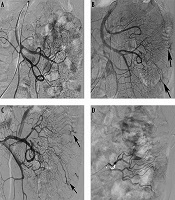
In this study, we report cases who underwent successful angioembolization. In 76 cases of bladder transitional cell carcinoma cells, life-threatening gross hematuria was treated by coil embolization of the bladder artery at two sequential sessions separated by a week to prevent necrosis. Eight cases of bladder and renal arteriovenous malformation (AVMs) underwent coil embolization using injection of water-soluble material in the feeding artery of tumor or AVM via 2.9 F micro catheter or 5-F catheter located in the feeding artery of pathologic site to obstruct vascular supply. We dissolved one bottle of PVA with particle size of 100 - 800 μm in 20 mL of normal saline and 20 mL of contrast agent. This solution was gently infused, allowing the contrast agent to linger in the target tissues. Then, the feeding artery was plugged using many coils to prevent revascularization. In the event that bilateral embolization was required, the side with predominate supply was blocked first, followed by the contralateral side during the second session 10 - 14 days later. Angiograms revealed renal artery pseudoaneurysms in individuals with hematuria (33 cases) following percutaneous nephrolithotomy (PCNL). We only employ pushable coils for closing the blood stream to pseudoaneurysm in location of renal stone after procedures performed on PNCL for closure of feeding artery of pathologic site. Pushable coils have lower cost compared to other types of available coils with filament diameter of 0.035 inches. We also used coils with helical diameter of 1 to 1.5 manifold of vessel diameter. Coil length was also dependent on the length of target vessel needed to be plugged without obstruction of side branch vessels. To deploy coils, coils were connected to 5F catheter or to the microcatheters. Renal angiomyolipomas (29 instances) were treated with coil embolization. In three cases of benign prostatic hyperplasia (BPH) high risk for surgery, coil embolization of main prostate artery was performed. Five cases of hematuria in the context of acute renal damage were also successfully treated with GU endovascular therapy.

3. Results

The success rate for angioembolization of bladder transitionary carcinoma cell was 100% but in 2 cases hematuria continued due to another GU source of bleeding. Coil embolization of bladder and renal AVMs was successful in all cases. Cessation of hematuria after PCNL was successful in all cases except hematuria recurrence in on one case after one week that was closed again successfully. Coil embolization of renal angiomyolipomas was successful in all cases. Coli embolization of BPH reduced urinary symptoms after 3 month. Hematuria due to renal trauma was ceased by coil embolization in all cases. We did not observe serious complications in our case series, but hematoma occurred in 3 cases which was easily controlled. Contrast induced nephropathy and fever occurred in 12% and 20%, respectively. Pain duration was within 4 - 10 days after embolization of AVM or tumor. Embolization could be done in the case of high output priapism and varicocele but we did not perform these procedures because of no referral.

4. Discussions

Therapeutic endovascular embolization of feeding artery or embolotherapy is growing rapidly by the advancement of novel embolic agents (5). Patients with complex urologic manifestations are quite a real challenge for working physicians. Indeed, procedures such as pyeloplasty, laser lithotripsy and endopyelotomy are associated with inherent risk of vascular damage (6). In these cases, trans catheter embolization is effective in the treatment of these vascular injuries. Endourologic interventions have been demonstrated to be valuable in the treatment of acute extravasation in trauma setting, renal AVM, prophylaxis for blood loss before resection of vascular tumors like RCC and angiomyolipomas (7-10). The observed problems are all perioperative in nature, ranging from impaired renal function to embolization of non-target organs, manifesting as renal failure and infarction of the contralateral kidney, coil migration, renal vein and inferior vena cava thrombosis, and so on.
This technique necessitates highly trained internationalists, nurses, and technicians, as well as a well-established center-based team approach with a high success rate. In this study, we have achieved high success rate in the endovascular treatment with lower rate of complications. There are many cases of endourologic problems and percutaneous treatment is a good therapeutic option especially in older or comorbidities. We offer advancement of these techniques especially in centers with high expertise and trained interventionists.

4.1. Conclusions

Coil embolization of the GU system is a relatively safe and approved approach that could be employed in impoverished nations with a high success rate and a low failure rate.
Footnotes

  • Authors' Contribution: Zahra Alizadeh Sani and Mohaddeseh Behjati did critical revision of the manuscript. Ramin Heidari and Roohallah Alizadehsani did study concept and design. Zahra Alizadeh Sani, Ramin Heidari, and Mohaddeseh Behjati did analysis and interpretation of data. All the authors wrote the manuscript.

  • Conflict of Interests: Authors declare no applicable conflicts of interest to this study.

  • Funding/Support: No funding support is applicable.

  • Informed Consent: A written informed consent was taken from all patients in this study.

References

Copyright

Copyright © 2023, Multidisciplinary Cardiovascular Annals. This is an open-access article distributed under the terms of the Creative Commons Attribution-NonCommercial 4.0 International License (http://creativecommons.org/licenses/by-nc/4.0/) which permits copy and redistribute the material just in noncommercial usages, provided the original work is properly cited.

Similar Articles

1
Mar
2016
Congenital and Acquired Renal Arteriovenous Malformations: Curative Embolization with Onyx

Congenital and Acquired Renal Arteriovenous Malformations: Curative Embolization with Onyx

Serkan Guneyli,
Celal Cinar,
Halil Bozkaya,
Mehmet Korkmaz,
Turker Acar,
Mustafa Parildar
,et al.

Guneyli S, Cinar C, Bozkaya H, Korkmaz M, Acar T, et al. Congenital and Acquired Renal Arteriovenous Malformations: Curative Embolization with Onyx. I J Radiol. 2017;14(2):e25672. doi: https://doi.org/10.5812/iranjradiol.25672

9
Jun
2018
Superselective Embolization of Bilateral Inferior Vesical Arteries for the Management of Radiation-Induced Hemorrhagic Cystitis Refractory to Conventional Methods

Superselective Embolization of Bilateral Inferior Vesical Arteries for the Management of Radiation-Induced Hemorrhagic Cystitis Refractory to Conventional Methods

Jung Eun Lee,
Jae Hyun Kwon,
Jungbum Bae

Lee JE, Kwon JH, Bae J. Superselective Embolization of Bilateral Inferior Vesical Arteries for the Management of Radiation-Induced Hemorrhagic Cystitis Refractory to Conventional Methods. I J Radiol. 2018;15(3):e64135. doi: https://doi.org/10.5812/iranjradiol.64135

28
Feb
2014

Prostatic Arterial Embolization to Treat Benign Prostatic Hyperplasia (PAE)

Mohammad Reza Babaei

Babaei MR. Prostatic Arterial Embolization to Treat Benign Prostatic Hyperplasia (PAE). I J Radiol. 2014;11(30th Iranian Congress of Radiology):e21424. doi: https://doi.org/10.5812/iranjradiol.21424

5
May
2020
Evaluation of Transcatheter Arterial Embolization in Treating Gastrointestinal Bleeding Due to Angiodysplasia: A Retrospective Study on Twelve Cases

Evaluation of Transcatheter Arterial Embolization in Treating Gastrointestinal Bleeding Due to Angiodysplasia: A Retrospective Study on Twelve Cases

Qing Zhao,
Jianxiong You,
Jingbing Wang,
Xindong Fan

Zhao Q, You J, Wang J, Fan X. Evaluation of Transcatheter Arterial Embolization in Treating Gastrointestinal Bleeding Due to Angiodysplasia: A Retrospective Study on Twelve Cases. I J Radiol. 2020;17(2):e98439. doi: https://doi.org/10.5812/iranjradiol.98439

27
Feb
2013
Superselective Embolization of Pseudoaneurysm Following Percutaneous Nephrolithotomy (PCNL)- A Case Reort

Superselective Embolization of Pseudoaneurysm Following Percutaneous Nephrolithotomy (PCNL)- A Case Reort

Mohammad Gharib Salehi,
Jamal Hoseini,
Mahdi Mohammadi

Gharib Salehi M, Hoseini J, Mohammadi M. Superselective Embolization of Pseudoaneurysm Following Percutaneous Nephrolithotomy (PCNL)- A Case Reort. J Kermanshah Univ Med Sci. 2013;16(7):e77299. doi:

More by these authors

Ramin HeidariPubMedScholar
Mohaddeseh BehjatiPubMedScholar
Zahra Alizadeh SaniPubMedScholar
Roohallah AlizadehsaniPubMedScholar
Share
Cited by
Metrics