Wound healing is a complex process of 4 stages including: hemostasis, inflammation, proliferation, and remodeling. In proliferative phase, angiogenesis is critical and (
14) VEGF also has powerful and long-time effects on angiogenesis in wounds. It prompts migration and proliferation of endothelial cells and upgrades blood vessels permeability (
27). Resveratrol is a naturally polyphenolic compound derived from grapes (
28).
The current study hypothesized that resveratrol may end in improving wound healing. To the authors ‘best knowledge, topical application of resveratrol at a dose-dependent manner may result in great amount of VEGF expression and increased blood vessels at newly formed granulation tissue. This can lead to greater blood flow to the wound, which causes elevated perfusion of healing factors and it consequently facilitates the healing process.
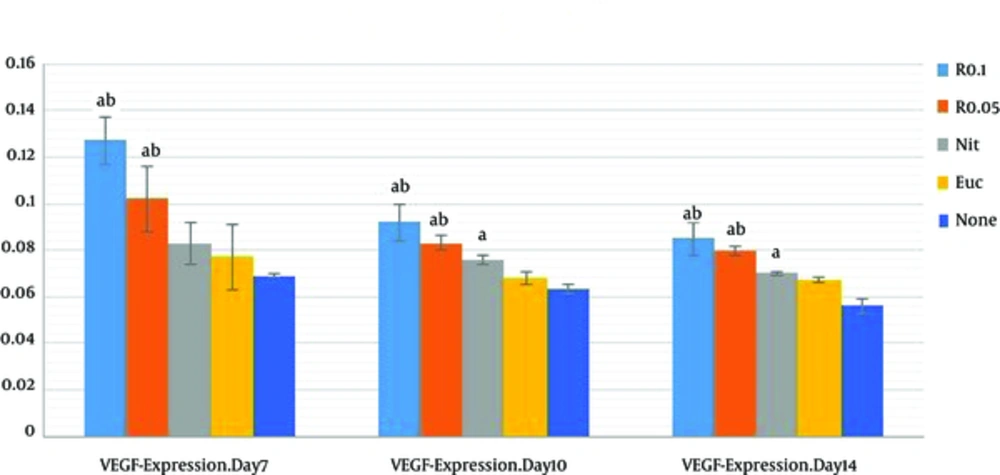
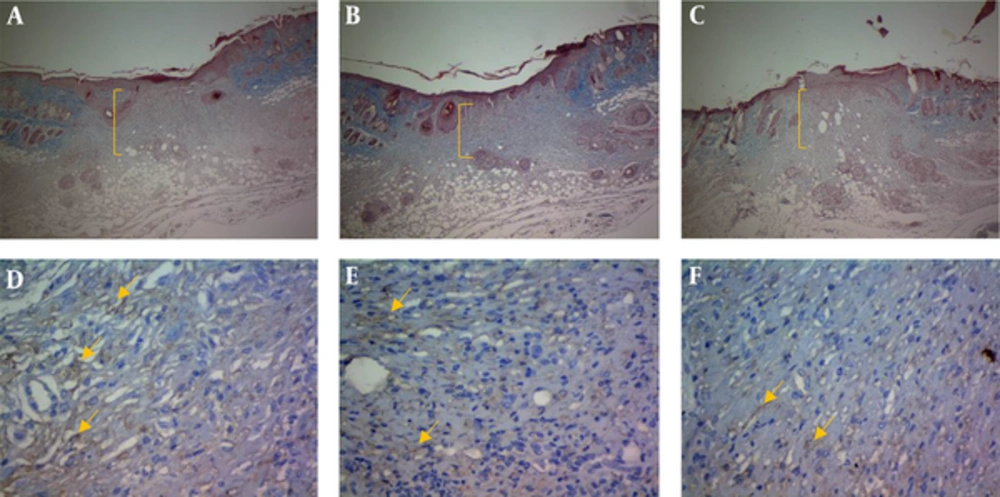
To prove whether resveratrol may increase angiogenesis, the VEGF presence was assayed at wound granulation tissue by immunostaining. Resveratrol-treatment was associated with markedly higher presence of VEGF in a nearly concentration-dependent manner (100 mg) at wound site. Based on the idea that angiogenesis is a specialized feature of proliferative phase of healing, great amount of VEGF expression was observed on the POD 7. The increasing angiogenesis results in richer blood supply to the wound, which causes increased perfusion of healing factors and facilitates the healing process. The VEGF decreased on the PODs 10 and 14 compared with the POD 7. It can be explained that the regression of many of the newly formed capillaries occur on such days and the vascular density of the wound approaches to normal.
Some studies show variable results of resveratrol in angiogenesis. This polyphenolic compound increases endothelial NO synthase (eNOs) activity and stimulates VEGF expression (
14,
27,
29,
30). It is also reported that natural extracts derived from grape seeds facilitate VEGF expression induced by oxidant in keratinocytes (
27). In a murine model of excisional wound in dermis, grape seed extract in combination with 5000 ppm resveratrol remarkably accelerated wound contraction and healing (
29). Grape seed extract containing resveratrol manages transcriptional control of inducible VEGF expression by regulating pathways that are common on both H
2O
2 and TNFα signaling (
27). It is also reported that resveratrol notably develops myocardial angiogenesis in a rat myocardial infarction (MI) model through a thioredoxin-, NO-, heme oxygenase- and VEGF-related method (
31).
On the contrary, some studies showed anti-angiogenetic function of resveratrol to inhibit tumor growth mediated through the suppression of blood vessel growth. The combination of resveratrol (10 - 100 µg/mL) and quercetin affected the apoptosis and proliferation of human tumor and endothelial cells in a dose dependent manner and was suggested as an antitumor drug (
32). Lower tumor growth was also observed due to decreased angiogenesis via reduced extracellular levels of VEGF and increased apoptotic index in ERα-ERβ+ MDA-MB-231 tumors in resveratrol treated MDA-MB-231 cells in breast cancer (at a dose of 25 mg/kg/day) (
33).
The biphasic angiogenetic effect of resveratrol was proved by chick chorioallantoic membrane assessment and it was observed that both AKt and ERK signaling pathways, functional for angiogenesis, become stimulated in response to 5 µM of resveratrol (
25). While resveratrol at low concentrations, from 1 to 10 µM, upregulates the expression of VEGF and promotes angiogenesis, it has opposite effects at high concentrations (20 µM and higher) on angiogenesis (
25).
Since granulation tissue is needed to reconstruct dermal integrity, and it is also required for crucial re-epithelialization, it is essential to assay granulation tissue formation to find the quality of wound healing. Furthermore, granulation tissue is vital for skin graft in surgical operations. It is reported that VEGF initiates the formation of granulation tissue. The formation of granulation tissue is actually due to the accumulation of fibroblast cell, increase in the number of blood vessels, and synthesis of collagen fibers (
17).
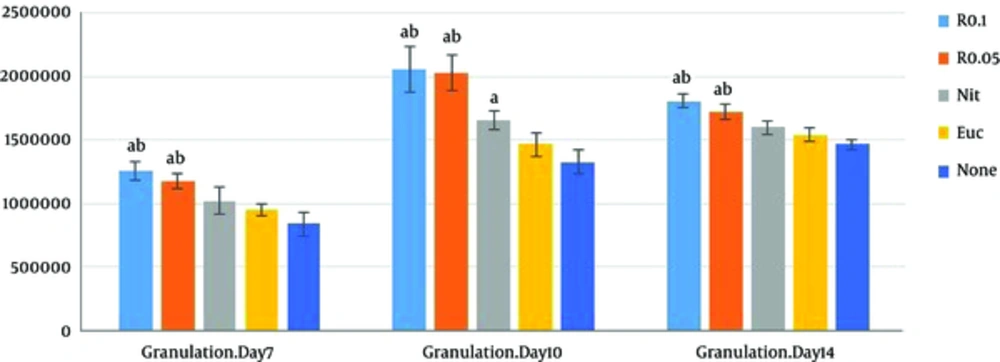
In the current study, the effectiveness of resveratrol on granulation tissue extension was investigated. The results showed that resveratrol improved granulation tissue formation and increased density of granulation tissue by enhancing angiogenesis.
A study by Yaman et al., on skin wound healing in rats showed that oral administration of resveratrol affected fibroblast proliferation, increased the synthesis of collagen fibers, which causes increased granulation extension and improved wound healing (
14). Furthermore, a lot of researches are focused on anti-inflammatory properties of resveratrol and its analogs by modulating secretion of several cytokines and chemokines (
20,
34,
35). The inflammatory cells produce these mediators immediately after injury to initiate the proliferative phase of wound healing. The anti-inflammatory effect of resveratrol by blocking nuclear factor-κB (NF-kB) signaling pathway is emphasized in some studies (
36). All of these reports show that resveratrol may accelerate passing the inflammatory phase to the next proliferation phase by modulating secretion of cytokines and chemokines and shortening the healing proper time frame.
In conclusion, the current study findings confirmed that resveratrol had a positive effect on incisional wound healing. The results of the current study demonstrated that it could confer profits on tissue healing by significant increase of VEGF expression and extensive granulation tissue formation on wound healing process in Balb/c mice. Further clinical investigations are needed to clarify the benefits of resveratrol to promote wound healing.