


1. Background
Nursing professional care is prominent in guarantying high-quality care (1). In other words, without effective nursing staff, health organizations cannot succeed (2). With leadership skills, nursing managers can enhance the clinical competence of nurses and consequently, improve the quality of care. Considering that nurse managers play a vital role in the organization and delivery of nursing services in health centers (3), their importance in enhancing the quality of nursing care is undeniable. Today, the role of nursing managers is more critical due to the high emphasis on resource management regarding cost control, the effectiveness of patient care, quality improvement, accountability, and appropriate care of the patient (4).
Since nursing managers play a critical role in organizational duties including production of services (5) and organization of nursing services in health centers (3), as well as an essential role in improving the quality of nursing care through resource management to control costs, effectiveness, and accountability (6, 7), there is a need for a model incorporating essential scientific features in the selection, recruitment, and training of nursing managers.
Considering that, today, nursing is complex and requires specialized care and nursing management is of great importance (8), there is a need to identify the main factors improving the management conditions in the workplace. In this regard, job analysis is one of the important techniques for identifying needs of nursing managers where information about the existing job needs is obtained based on which, main tasks, behaviors, accountability, activities necessary for the job and its features such as knowledge, skills, and experiences necessary for satisfying this job and the conditions for its achievement are determined (9).
Necessary training can be provided based on these identified needs to empower nursing managers or select qualified individuals. Public and private sectors managers need skills and competencies that will affect productivity, effectiveness, and accountability in delivering health services in a sustainable manner. Management competencies are a set of knowledge, skills, behaviors, and attitudes an individual needs to be effective in a wide range of managerial occupations and various types of organizations (10). Competencies lead to productivity and cost reduction. For scholars, competence is a set of essential factors for success in achieving critical outcomes in a particular job or role in a particular organization (11, 12).
Nursing managers need to be empowered to play managerial and supervisory roles, as their mission to enhance the clinical competence of nurses is undeniable (13). Studies have been conducted in this regard in Iran and other countries. Considering the strategic and applied condition to enroll nursing managers, Shimer argued that 10 years of work experience and having a formal nursing degree are the requirements (14). Cohen reported that, unfortunately, nursing managers have not been empowered to provide nurses with leadership and support behaviors (15). Dehghan Nayeri et al. showed that the low nursing staff productivity is due to the lack of effective management and they emphasized the need for continuous management programs for educating all nursing managers (16). Vincent and Bedouz also emphasized the importance of an understanding of the planning of human resource management for nursing managers (17). Alamneshan and Naji concluded that there was an inverse relationship between decision-making skepticism and management years. Accordingly, they suggested that besides younger managers, high experienced managers should be employed (18).
Considering the literature and challenges related to unclarity of scientific and empirical characteristics required for nursing managers, their role and duties, and the training courses required for them, as well as cultural and social differences, weaknesses, and strengths of management practices of nursing directors in different countries, there is a need for a research to identify and clarify these issues with the nursing managers. Due to the importance of the role, tasks, and scientific and experimental qualities required to obtain a post of nursing manager, there is a need for research to identify and diagnose these issues. Therefore, the present study aimed at reviewing the selection, application, and training of nursing managers in selected countries and Iran.
2. Methods
This research was a mixed-method study with the aim of designing a model for selection, recruitment, and training of nursing managers in Iran, 2017. For this purpose, the present study was carried out in four stages. The first stage was to select countries for a comparative study. Obtaining experts’ opinions, the researcher selected England, America, Canada, Turkey, and Australia from the developed countries of the world, which are leading and successful countries in the field of nursing and the required documents have been published in those countries. They were selected to be compared with Iran. The second stage was to conduct a library study (qualitative study) in Iran and selected countries regarding dimensions and requirements for the selection, training, and recruitment of nursing managers in hospitals and formation of the comparative matrix.
The information needed at this stage was obtained by referring to valid databases such as Scopus, PubMed, Web of Sciences, Springer, and Science Direct for Latin resources and SID, Magiran, and Irandoc for Persian resources. The search time was restricted to the documents published over the past 20 years (1996 - 2016). A data extraction form was used to collect data from the selected countries. For this purpose, the data were entered into a comparative table. Finally, for commonalities and differences analysis, a comparison was made between the main dimensions of training, recruitment, and selection among the selected countries, and the findings were drawn up in the tables for the three main indicators. Content analysis was used to analyze data of the comparative part. The third step was to design a questionnaire and conduct a field study and a survey of experts about the important variables obtained from the previous stage. At this stage, using the information obtained from the previous stage, a questionnaire consisting of 50 items on selection, recruitment, and training of nursing managers was developed. Questionnaire items were scored on a five-point Likert scale (5 = very high, 4 = high, 3 = moderate, 2 = low, and 1 = very low). To assess the validity of the questionnaire, experts’ judgment (20 people) was first used and their views on the content, structure, face, and item writing were asked. Then, by applying expert opinions, a modified questionnaire was tested in a pilot run. Cronbach’s alpha coefficient was used to measure reliability. In this study, the Cronbach’s alpha coefficient was 0.96. The research population consisted of experts in the field of nursing services in the ministry of health, the Iranian nursing organization, the universities of medical sciences and health services (faculty members of nursing and midwifery faculties), and nurse heads. The sample size was obtained by using the following formula with d = 0.05 and p = 0.8. A total of 246 people were obtained as the sample size. Finally, 250 questionnaires were completed.
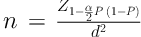
Equation 1.
Stratified random sampling was carried out at this stage. To this end, the country was divided into five regions and the participants were selected from universities of medical sciences and affiliated hospitals using random sampling. The questionnaires were delivered to individuals in person and by email; in both cases, the purpose of the study and the way of answering the questions were explained to the individuals. The fourth step was factor analysis and providing the final model. In the factor analysis, first, Kaiser-Meyer-Olkin measurement (KMO) of 0.96 and Bartlet test significance of 0.01 indicated that the conditions for the factor analysis were provided. Using Amos software, the effective components including selection, recruitment, and training of nursing managers and the impact of each indicator were determined. To select the items, factor loads exceeding 0.4 were accepted as criteria.
3. Results
The findings of the comparative study are presented first in three sections: selection, training, and recruitment of nursing managers in selected countries. In the next part, the findings of factor analysis are presented. Finally, the final model of selection, training, and recruitment of nursing managers in hospitals was presented.
3.1. A: Selection
Selection of nursing managers gives different choices in terms of approach. In Turkey, the selection is carried out through the advisory role of professional associations and nursing system in the country (19). In this country, temporary committees are considered to provide services to qualified staff; it is periodically formed to examine different angles of eligibility and responsibilities (20, 21). In Australia, the ministry of health participates in selection through active sectors and service areas. In this country, nurses with higher work and management experiences are more likely to be selected as nursing managers. Meanwhile, the Australian nursing and midwifery federation also holds courses to enhance communication and management skills of nurses (22, 23). In the United Kingdom, governmental and non-governmental organizations outside the national medical system of the country, such as the center for excellence in services and the national institute of health, carry out research on the characteristics of nursing managers and help them meet selection criteria through a feedback to service delivery units (24, 25). Different universities also play a major advisory role regarding research activities and promotion of knowledge on the factors affecting the selection of nurses (26). In the United States, there is a variety of criteria for selecting nursing managers, which are largely in line with UK standards, with the distinction being made on the multidimensional nature of nursing manager services. For example, research and educational experiences are of higher priority. The selection process in US hospitals is based on senior managers’ selection of qualified nurses active in the hospital or recruiting advertisements, which determine demands and expectations of the hospital from the nursing manager (27, 28).
Canada selection criteria are largely overlapping the UK and US criteria. However, in Canada, individual acceptance among nursing staff in hospitals is one of the important aspects (29). The most comprehensive criteria for selection of nursing managers in Iran have been established in the accreditation standards of the hospital where conditions of nursing managers are precisely defined in each area (Table 1) (30).
Table 1.Selection, Training, and Recruitment of Nursing Managers in Selected Countries
| Dimension | Turkey | Canada | Australia | UK | US | Iran |
|---|---|---|---|---|---|---|
| Selection | Selection through the advisory role of professional associations and nursing system; Selection exclusively by hospitals and the Ministry of Health in Turkey | Overlap with the UK and America; Individual acceptance among nursing staff in a hospital | Selection by the Ministry of Health through active sectors and service delivery areas in the selection of nursing managers | Working experience in management, having the competencies of trusted organizations, as well as professional, ethical, and scientific qualifications | Overlap with the UK; Multi-dimensional nursing manager | Degree; Work experience; Academic rank |
| Training | Traditional lecture method; Training courses on job training and focusing on professional knowledge | Training Courses and congresses; Participating in compulsory retraining courses; Principles of Nursing Management | In-service training courses | Through multi-day courses and workshops through line units and educational institutions Individual and virtual training congresses | Periodic training programs; Nursing in-service training programs | Training Courses and congresses |
| Recruitment | Observing professional ethics | Recruitment Nursing Managers Based on Professional Ethics | A similar approach to Turkey and Canada; Evaluations by hospitals | Nursing manager participation in the development and implementation of strategic plans for the hospital | Individual performance evaluation | Based on the needs assessment and qualification of nursing staff, as well as performance evaluation during work |
3.2. B: Training
In Turkey, an emphasis is placed on the standardization of educational steps and operational phases. There are also retraining courses for health workers in the country and discussions have been held on introducing this training into university education (31). In recent years, Turkey has introduced an in-service training program to improve the educational environment of its hospitals, including periodic nursing managers’ educational courses (32). In Australia, teaching methods are combined with theoretical study, inspirational thinking, and empowerment. Australia always focuses on the multicultural development and focuses more on educating nurses and nursing managers in the humanities and community. There is also a close interaction between practice and theoretical learning (33). There are continuous training courses for nursing managers and the performance of managers after the end of the courses is evaluated. Professional management and ethics training are also included in these programs (34). In the United States, training of nursing managers is conducted continuously and periodically in an educational program using case analysis, scenario simulation, group discussion, participatory learning, multimedia tools, and self-education (35). In addition, university education in nursing management is responsible for transferring nursing education programs to nursing faculty at the master’s level, developing core curricula, and accrediting programs (36).
In England, training courses are provided through temporary courses and workshops, and incentives such as gaining necessary qualifications for extending nursing certifications are considered (37). In Canada, the nursing staff is organized and supported by the Canadian nursing association giving a great importance to nurses and nursing managers training. In Canada, obligatory training courses and congresses are held on a regular and inclusive basis for nursing managers. Participation in other optional courses is also accompanied by retraining points for participants (38). In the Canada curriculum, the principles of nursing management are one of the essential skills required for all nursing managers who are taught along with planned professional ethics training (39). In Iran, there is also in-service training through courses and congresses. Participation in these courses is generally voluntary, some with retraining points and others with certification (Table 1) (40).
3.3. C: Recruitment
In Turkey, starting to work is based on standards on professional ethics for the hospital staff supervised by the Turkish ministry of health (41). Canada and Australia send their nursing managers to work providing following the professional ethics (42, 43). In the UK, observance of professional principles by nursing staff is taken into consideration for their recruitment. In addition, recruitment of nursing managers is conducted as contributing to the development and implementation of strategic plans of the hospital (44, 45). The status of these managers is examined through periodic evaluation in healthcare organizations in Canada and Australia (46, 47).
In the United States, evaluations are carried out through committees in line units, and the type of evaluation varies from 360 degrees to top-down. Involvement of nursing managers in planning and formulating goals, operating nursing programs, compiling, implementing, and monitoring processes and affairs related to the performance indicators of nursing groups are among other responsibilities of nursing managers (25). Nursing managers in the United States must be skillful in manpower and budgeting, human resources transfers and patient transfer processes (27). In Iran, in recruitment nursing managers, various skills and responsibilities consisting of needs assessment and qualification of nursing staff in clinical units, calculation and estimation of required human resources, appropriate placement of human resources in different sectors and shifts, assessment of staff performance during work, determination and announcement of educational policies for nursing staff, determining needs of different financial and physical resources, announcing to relevant authorities, and an annual budget estimate are required (Table 1) (30).
In the following, based on a comparison between similarities in the findings regarding selection, training, and recruitment of nursing managers in the study countries, and based on the content analysis of texts and policies of these countries, items for each dimension are considered in Box 1.
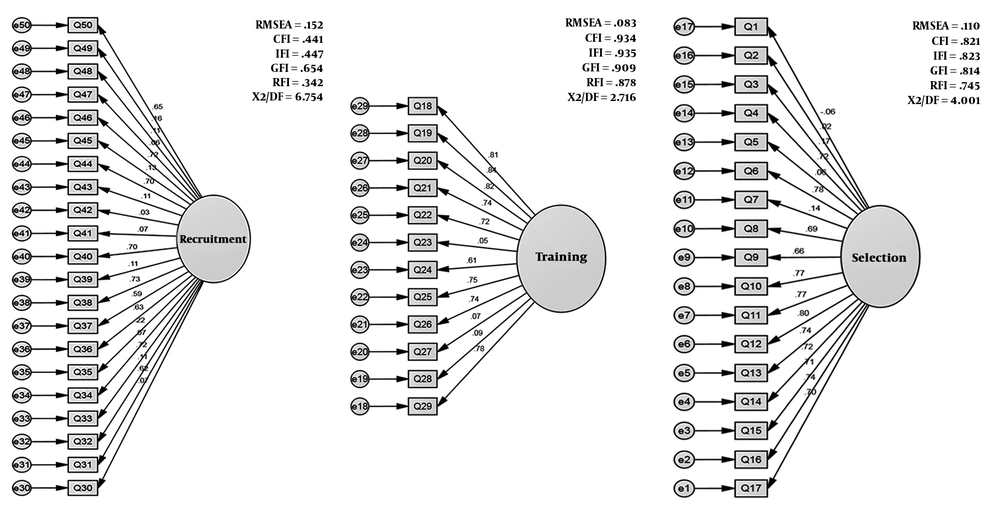
Figure 1.
Standardized path coefficients in the factor analysis model for selection, training, and recruitment of nursing managers
3.4. Factor Analysis Results
As shown in Figure 1, the standardized load factor for the first, second, third, fifth, and seventh items are all below the 0.4 limit concerning effective factors on the selection of nursing managers and as a result, these items were removed. Among the factors influencing the selection of nursing managers, selection based on human skills of the qualified individuals had the highest impact. Regarding the factors influencing the training of nursing managers, the standardized load factor was less than the 0.4% limit for items 23, 27, and 28 and as a result, they were eliminated, as well. Training of specialist principals in nursing university curriculum has the most impact on nursing training. Considering factors affecting nursing managers’ recruitment, standardized factor load (above 0.4) was only obtained for items 31, 33, 36, 37, 38, 40, 44, 46, and 50, and they were used in the final pattern. In this section, a planning committee for job analysis has had the greatest impact on the use of nursing managers.
3.5. Template Presentation
Finally, based on the results of factor analysis, the final model of selection, training, and recruitment of nursing services managers in hospitals was presented as follows (Box 2).
4. Discussion
Nursing management has been considered worldwide. The use of tools is different and each country has used a particular type of model according to the conditions prevailing therein (46). The most important findings in the selection section showed that the existence of research and policy areas in professional associations in the health sector and the effective role of the Ministry of Health in most countries have been acknowledged in the selection of nursing managers. Nursing associations and headquarters in the ministries of health provide the opportunity to make the best use of it. Different governments use this model to meet long-term needs in standards development. The use of temporary or permanent committees in line units is also the other features of attention in selecting a nursing manager in the study countries (48, 49).
Another point is the pioneering role of study countries in introducing criteria for selecting a nursing manager who often has a clear history in applying these concepts (27). The findings of Salam et al. also indicated that there are organizational structures in professional associations for the formulation of criteria that are consistent with the findings of the present study (50). Stern also showed that the task of policy-making in selecting nursing managers is better to be relegated to health system organizations and it is consistent with the current research in this regard (46). Schirmer (14) described the characteristics and criteria for choosing nursing managers and introduced having more than 10 years of work experience and a nursing degree as important criteria. Academic qualifications, professional qualifications of individuals, individual characteristics, human skills of qualified people, management skills of qualified individuals, and ethical qualifications of qualified individuals are among the characteristics that were approved in the present study to select a nursing manager. However, the findings of the comparative section represented degree and work experience and in this respect, there is a consistency with the Schirmer research.
Box 1.Selection, Training, and Recruitment Criteria of Nursing Managers
| Dimension/Item |
|---|
| Selection |
| 1. Related academic degree |
| 2. Work experience and background |
| 3. The opinion of the staff working in the organization |
| 4. Selection by senior hospital managers |
| 5. Selection by taking into account the opinions of the staff and approval of senior hospital managers |
| 6. Selection by specialized organizations such as the nursing system |
| 7. Selection based on entrance exam |
| 8. Selection based on academic qualifications |
| 9. Selection based on professional qualifications |
| 10. Selection based on pilot courses for eligible individuals |
| 11. Selection based on individual characteristics such as age |
| 12. Selection based on human skills of qualified individuals |
| 13. Selection based on the managerial skills of qualified individuals |
| 14. Selection by senior managerial authorities (university nursing manager) |
| 15. Attention to research criteria |
| 16. Attention to educational criteria |
| 17. Attention to ethical qualifications of qualified individuals |
| Training |
| 1. Teaching general principles of management in nursing academic courses |
| 2. Teaching specific principles of nursing management in nursing academic courses |
| 3. In-service training for nursing managers |
| 4. Participating in training courses and general management congresses |
| 5. Participating in training courses and congresses dedicated to nursing |
| 6. Holding a course and workshop |
| 7. Holding a course and workshop for nursing managers by the nursing system |
| 8. Holding virtual and distance course and workshops |
| 9. Having Nursing Services management in higher education |
| 10. Opportunity for simultaneous study and work for nursing service managers |
| 11. Practical training on infection and safety control |
| 12. Profile systems for nursing service managers |
| Recruitment |
| 1. Considering managers commitment to professional ethics |
| 2. Guidelines for nursing managers promotion in the organization |
| 3. Nursing services in the mission and strategic objectives of the organization |
| 4. Degree assessment of nursing service managers |
| 5. Bottom-up assessment of nursing service managers by subordinate staff |
| 6. Top-down assessment of nursing service managers |
| 7. Receiving feedback on nursing service managers in the organization |
| 8. Promoting participation and teamwork |
| 9. Planning a committee for job analysis (setting expectations based on job descriptions) |
| 10. Identifying and introducing key performance processes for employees |
| 11. Identification of performance indicators |
| 12. Monitoring performance indicators |
| 13. Analysis and interpretation of the findings of an evaluation of performance indicators |
| 14. Reviewing the main processes of work and drafting of the corrective action plan |
| 15. Development of the operational plan of the units under review |
| 16. Monitoring of an operational program |
| 17. Prioritization of operational programs |
| 18. Familiarity with inter-organizational and intra-organizational transfers of employees |
| 19. Human resource planning |
| 20. Safety principles (patients and staff) |
| 21. Basic principles of management (planning, controlling, organizing, and leadership) |
Box 2.The Final Model of Selection, Training, and Recruitment of Nursing Services Managers in Hospitals
| Dimension/Item |
|---|
| Selection |
| Selection of nursing managers by senior hospital managers |
| Selection of nursing managers by specialized organizations such as the nursing system |
| Selection of nursing managers based on academic qualifications |
| Selection of nursing managers based on professional qualifications |
| Selection of nursing managers based on piloting courses for qualified individuals |
| Selection of nursing managers based on individual characteristics |
| Selection of nursing managers based on human skills of qualified individuals |
| Selection of nursing managers based on the managerial skills of qualified individuals |
| Selection of nursing managers by the senior authorities (nursing manager of the university) |
| Selection of nursing managers based on the research criteria (publication) |
| Selection of nursing managers based on Training criteria (Teaching) |
| Selection of nursing managers based on ethical qualifications of individuals |
| Training |
| Teaching general principles in the University curriculum of nursing |
| Teaching specialized principles in the University curriculum of nursing |
| In-service training of nursing managers |
| Participating in training courses and congresses |
| Participating in training courses and specialized congresses for nursing managers |
| Holding training courses and workshops for nursing managers by related organizations and associations such as the nursing system |
| Educational needs assessment for improving training courses for the managers |
| Establishing nursing management field in higher education |
| Having a nursing profile system to share experiences |
| Recruitment |
| Nurses promotion guidelines for nursing managers |
| 360-degree evaluation of nursing managers |
| Receiving feedback regarding nursing managers |
| A planning committee for job analysis (determining expectations based on job details) |
| Identifying performance indicators by nursing managers |
| Develop operational plans by nursing managers for units under their supervision |
| Prioritize performance plans by nursing managers |
| Being aware of the critical principles of management (planning, controlling, organizing, leadership) by nursing managers |
Due to the nature of the activity, training in different sectors enables the promotion of individual knowledge. As can be inferred, the diversity of educational methods is evident in the study countries. These countries use curricula and hold training courses and congresses in the health sector. In this regard, the findings of Birden et al. are in line with the results of the present research (51). Salam et al. findings regarding training indicated that academic courses are conducted taking into account training (50). It seems that the lack of research with conforming findings is often due to the weakness of evidence and the lack of relevant research in health systems, and this cannot be regarded as a disagreement over the effectiveness of different teaching methods. The Iranian studies on the training needs of nursing managers also indicated that the need for executive and planning skills, as well as the necessary knowledge about them, is critical needs (52, 53).
On the other hand, issues related to recruitment of health sector managers are particularly relevant to strategic plans and determination of tactics for achieving the goals (46). The findings of this study showed that the health systems of study countries considered strategies of recruitment of nursing managers and their promotion process. However, this issue has not been well documented in the study counties and laws have gradually been taken into consideration in these countries. Finally, although there is no complete informational transparency regarding the selection, training, and recruitment of nursing managers, similarities can be found on general issues. Using these similarities for Iran and other countries can provide more success in this regard. One of the limitations of the present study was the lack of sufficient data and information in some fields that required the presence of a researcher in the environment.
4.1. Conclusion
Selection based on the human skills of qualified people, teaching specific principles of nursing management in the nursing university curriculum, and the existence of planning committees for job analysis had the most impact on the selection, training, and recruitment of nursing managers in hospitals, respectively. Therefore, professional associations under the supervision of the Ministry of Health and paying attention to human skills of qualified people can play an important role in selecting nursing managers. The need for paying attention to appropriate administrative structures, effective teaching methods, human resources, laws and regulations, and assessment considering the principles of nursing in Iran should be taken for granted. The study countries have relatively moved to apply rules and standards for their nursing managers. However, the extent of changes in the study countries varies. In Iran, involved organizations, such as professional associations in human resources, should play an effective role in setting appropriate regulations in this regard. Regarding institutionalization of clear criteria, conditions of each country should be carefully examined and necessary infrastructures to achieve the desired conditions should be established. The necessity of using various educational methods in the standard frameworks is inevitable. Due to the significance of the topic, the use of these methods without transparent rules and structures is not recommended. Furthermore, the existence of an appropriate administrative structure in different sectors is recommended. This article is extracted from a Ph.D. Dissertation in health services administration from Islamic Azad University, Science and Research Branch of Tehran, with the number 559.


