


1. Background
The prevalence of adolescent and childhood obesity has increased progressively in the last three decades (1). The importance of obesity is that it can cause cardiovascular disease, diabetes mellitus, hypertension, gynecological and congenital deformities, and many other complications. The worlds health organization has defined obesity as a disease. Given its increased prevalence worldwide, obesity is still considered a global epidemic (2). Obesity is not only a health challenge, but also an economic problem. Adolescent overweightness might continue to adulthood. Adolescents with obesity have a poor body image, are socially isolated, and have fewer job opportunities (3).
Adolescence is associated with rapid changes in behavioral patterns, which predispose adolescents to high-risk behaviors such as immobility and unhealthy eating habits (4). Consequently, childhood and adolescence are of great importance to the prevention of obesity and non-contagious diseases in adulthood. Dietary factors have been known as a significant risk factor for developing non-contagious diseases (5). Negative changes in dietary regimen and physical activity pattern increase the risk of obesity epidemic (6).
The theory of planned behaviors (TPB) was presented by Fishbein and Ajzen and has been used in different studies for determining diet-related attitudes and behaviors (7). This theory introduced intention as the most important factor behind behavior. Intention, in turn, is determined by three factors. The first factor is attitude towards behavior, which reflects individuals’ positive or negative evaluations about behaviors. The second factor is individuals’ perceptions of significant others’ social pressure to display or avoid behaviors. The third factor is individuals’ perceptions of the easiness or the difficulty of displaying a behavior and is called perceived behavioral control. Perceived behavioral control, in turn, consists of internal and external factors. All these factors may facilitate or hinder behaviors (8).
Studies have shown the effectiveness of the TPB in shaping healthy behaviors among different populations (9, 10). Studies conducted in our country, Iran, also reported similar findings (11, 12). However, our literature search in scientific databases such as Medex, PubMed, and SID by using the keywords ‘obesity’ and ‘theory of planned behavior’ revealed that adolescent obesity has not been investigated in Iran in relation to the TPB. Therefore, the present study was designed and undertaken to evaluate the impact of TPB-based education on high-school female students’ obesity-related activities.
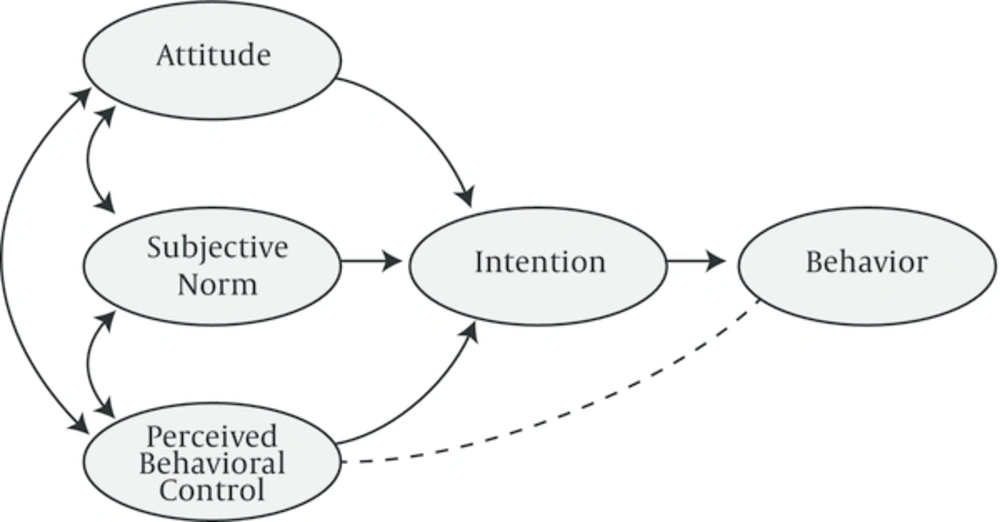
Figure 1.
Theory of Planned Behavior
2. Methods
This randomized controlled field trial was conducted during the 2103 to 2014 school year. The study population consisted of all 392 first-year female students of high schools located in Nehbandan, Iran.
The study sample size was calculated based on the findings reported by Solhi et al. (12), a power of 0.90, and a confidence level of 0.95. The students were recruited through cluster random sampling. Initially, two schools were randomly selected from a total of four female high schools located in Nehbandan. One school was considered as the experimental school and the other as the control school. Then, one class of students was randomly selected from each school and all students in these two classes were considered as the study sample. The inclusion criteria were being a first-year high-school student and having no history of diabetes mellitus, problems treated by growth hormone, and psychological problems such as depression.
As there was no standardized instrument in the area of the study subject, we used a researcher-made instrument in this study and invited ten experts to evaluate its content validity. The instrument was amended based on their comments. The reliability of the instrument was assessed using the test-retest reliability method through which, ten eligible students, who were external to the study, were randomly recruited from the study setting and were asked to complete the instrument twice with a one-week interval in between. The test-retest correlation coefficients of different constructs of the instrument were greater than 0.70.
The instrument included items on the students’ demographic characteristics (such as age, body mass index, parents’ educational and employment status, etc.), attitude (18 items), subjective norms (19 items), perceived behavioral control (11 items), intention (8 items), and behavior (11 items). The items, which were related to the constructs of the TPB, were answered on a five-point Likert-type scale from ‘completely disagree’ to ‘completely agree’, which were scored respectively from one and five. Students’ behaviors were evaluated by ten three-choice questions, which were scored 0 to 2 based on the type of behavior (inappropriate, relatively appropriate, or appropriate). Therefore, the total score of the behavior scale was 0 to 20.
Before the study intervention, the participants were asked to complete the instrument on a self-report basis. Then, the students in the experimental group received an educational intervention, which had been developed based on the materials provided by the Iranian ministry of health and medical education (13). Primarily, the students in the experimental group were divided to two 28-student groups and then, the educational sessions were provided for them by the first author in eight 60-minutes sessions. During seven sessions, educational sessions were provided using a lecture, question-and-answer, and group discussion methods as well as non-light-based educational tools (such as booklets, pamphlets, and poster presentation). However, the final educational session was held through light-based educational technologies and power-point presentation (Table 1).
Table 1.The Outlines of the Educational Sessions
| Session | The Aim and the Title of Session | Contents | Teaching Method |
|---|---|---|---|
| 1 | An overview of obesity | Definition of obesity; factors affecting obesity; the food pyramid, food diversity; nutritional balance; the importance of fruit and vegetable consumption; the role of physical activity in health; and obesity-induced health problems | Lecture, question-and-answer, obesity-related educational package |
| 2 and 3 | Correcting misconceptions and fostering positive attitudes | Healthy and unhealthy snacks; the benefits of healthy snacks; barriers to healthy nutrition and physical activity; and the relationship between obesity and eating or not eating main meals | Group discussion, providing real-world examples of obese adolescents and obesity-related health problems |
| 4 and 5 | Promoting social support and subjective norms | Encouraging students by their teachers to consume healthy foods; providing positive feedbacks to students, who had healthy eating habits; introducing healthy eating patterns; reading obesity-related messages in school morning rituals; hanging posters on school poster boards | Delivering lectures by the teachers of the Physical Training and the Social Sciences courses as well as school manager |
| 6 | Promoting self-efficacy | Identifying barriers to healthy eating, eating breakfast and dinner, and doing physical activity | Group discussion and question-and-answer |
| 7 | Promoting learning | The negative consequences of indifference to unhealthy eating habits and the outcomes of a sedentary life | Memory writing contest, role play, reinforcements and rewards, providing the students with pocket calendars containing messages about healthy lifestyle |
| 8 | In the eighth session, all information, which had been provided in the previous sessions were reviewed by using power-point presentation. Besides, the students’ questions were answered. | ||
The content of the educational sessions was mainly related to adolescent obesity, factors affecting obesity, healthy nutrition, the food pyramid, nutritional balance, food diversity, the importance of fruit and vegetable consumption, and physical activity and its effects on health. These materials were selected from the health promotion guidelines and scientific textbooks, which had been retrieved from www.salem.ir. We also explained the study intervention to the students’ parents and teachers (due to their effects on subjective norms), before the study, distributed educational pamphlets among the students and their families, and hung up educational posters. Moreover, the students in the experimental group were provided with an educational package related to obesity prevention as well as calendars containing messages about healthy lifestyle during the study intervention. A memory-writing contest on obesity and its risks was also held among the students in the experimental group and the best works were rewarded (Table 1). During the study, the students in the control group received no obesity-related education. However, after the study, they were provided with the same educational content provided to the students in the experimental group for the sake of ethical considerations.
This study was undertaken after obtaining formal permission from the institutional review board of Birjand University of Medical Sciences, Birjand, Iran, as well as the administrators of the office for education and training of Nehbandan, Iran, and receiving an introduction letter from the health and treatment network of Nehbandan county. This study was approved by the ethics committee of Birjand University of Medical Sciences with the following code IR.BUMS.1394.101.
The study data were entered to the SPSS software (v. 16.0). Given the normal distribution of the study variables, the data were analyzed through conducting independent-sample t test, the repeated-measures analysis of variance (RM ANOVA), and the least significant difference (LSD) post hoc test at a significance level of 0.05.
3. Results
This study was conducted on 112 first-year high-school female students, which had been evenly allocated to the control and the experimental groups. There was no significant difference between the groups regarding the students’ age and body mass index as well as their parents’ educational and employment status (P > 0.05; Table 2 and 3). Moreover, the difference between the groups concerning the pretest mean scores of attitude, subjective norm and perceived behavioral control was not statistically significant (P > 0.05) while the groups differed significantly from each other in terms of the pretest mean scores of behavioral intention and behavior (Table 3).
Table 2.Comparing the Study Groups Regarding the Students’ Demographic Characteristics
| Variable | Group | P Value | |
|---|---|---|---|
| Experimental Mean ± SD | Control Mean ± SD | ||
| Age, y | 13.81 ± 0.33 | 13.78 ± 0.31 | 0.86 |
| Body mass index | 21.08 ± 2.95 | 21.38 ± 3.18 | 0.61 |
Table 3.Between- and Within-Group Comparison of the Mean Scores of the Constructs of the Theory of Planned Behaviors (TPB)a
| The Constructs of the TPB | Group | Before Education, N = 56, Mean ± SD | Immediately After Education, N = 56, Mean ± SD | Three Months After Education, N = 56, Mean ± SD | The RM ANOVA |
|---|---|---|---|---|---|
| Attitude | Experimental | 66.1 ± 7.4bc | 76 ± 6.6ac | 73.8 ± 7.1ab | P < 0.001 |
| Control | 65 ± 8 | 65.9 ± 8.8 | 63.7 ± 7.9 | P = 0.24 | |
| P value (t-test) | 0.45 | < 0.001 | < 0.001 | ||
| Subjective norm | Experimental | 71.2 ± 8.9b | 76.2 ± 11.4ac | 69.2 ± 9.7b | P < 0.001 |
| Control | 68.5 ± 14.7b | 70.6 ± 12.2ac | 72.9±10.9b | P = 0.02 | |
| P value (t-test) | P = 0.24 | P = 0.013 | P = 0.052 | ||
| Perceived behavioral control | Experimental | 39.2 ± 7.9b | 42.1 ± 5.9ac | 39.9 ± 7.4b | P = 0.005 |
| Control | 39.4 ± 6.6b | 43.6 ± 7.2ac | 40.5 ± 6.1b | P < 0.001 | |
| P value (t-test) | P = 0.92 | P = 0.24 | P = 0.65 | ||
| Behavioral intention | Experimental | 26.7 ± 6.6b | 34 ± 5.1ac | 30.1 ± 4.6b | P < 0.001 |
| Control | 31.2 ± 6.3 | 32.2 ± 6.6 | 31.5 ± 7.4 | P = 0.6 | |
| P value (t-test) | P < 0.001 | P = 0.11 | P = 0.23 | ||
| Behavior | Experimental | 9.9 ± 2.6c | 10.5 ± 2.5 | 10.6 ± 2.3 | P = 0.047 |
| Control | 8.3 ± 2.6bc | 9.6 ± 2.6a | 9.6 ± 2.9a | P = 0.002 | |
| P value (t-test) | P = 0.001 | P = 0.052 | P = 0.045 |
aTime points: Before the intervention, immediately after the intervention, three months after the intervention.
As it is evident from Table 3, the posttest mean scores of attitude and subjective norms in the experimental group were significantly higher than the control group (P < 0.05). However, there was no statistically significant difference between the groups regarding the posttest mean scores of perceived behavioral control (P = 0.24), behavioral intention (P = 0.11), and behavior (P = 0.052). Three months after the study intervention, the mean scores of attitude and behavior among the students in the experimental group were significantly higher than the students in the control group (P < 0.05), while the groups did not differ significantly from each other concerning the mean scores of subjective norms, perceived behavioral control and behavioral intention (P > 0.05).
The results of the RM ANOVA illustrated that in the experimental group, there was a significant difference among the three measurement time points in terms of all constructs of TPB including attitude, subjective norms, perceived behavioral control, behavioral intention and behavior (P < 0.05). Similarly, the difference among the three measurement time points in terms of subjective norms, perceived behavioral control, and behavior was statistically significant in the control group (Table 3). The results of the LSD post hoc test are also shown in Table 3.
The data presented in Table 4 show that in both study groups, the scores of attitude, subjective norms, perceived behavioral control, behavioral intention and behavior increased significantly after the study. However, between-group comparisons revealed that after the study intervention, the study groups differed significantly from each other, only in terms of scores of attitude and behavioral intention constructs (P < 0.001). On the other hand, three months after the study, the mean scores of perceived behavioral control, behavioral intention and behavior increased in both study groups compared with the corresponding pretest values while between-group comparisons showed that the difference between the groups was statistically significant only regarding the mean scores of behavioral intention and attitude constructs (P < 0.05).
Table 4.Between-Group Comparison of the Pretest-Posttest Mean Differences of the Constructs of the Theory of Planned Behaviors (TPB)a
| The construct of the TPB | Time Points | Group | ||
|---|---|---|---|---|
| Experimental, N = 56, Mean ± SD | Control, N = 56, Mean ± SD | P Value the Independent-Sample t Test | ||
| Attitude | Before-after differences | (+) 9.9 ± 10.1 | (+) 0.91 ± 6.5 | P < 0.001 |
| Before-three months after | (+) 7.7 ± 9.3 | (-) 1.3 ± 8.2 | P < 0.001 | |
| Subjective norms | Before-after differences | (+) 5 ± 14.2 | (+) 2.1 ± 12.8 | P = 0.26 |
| Before-three months after | (-) 2.02 ± 12.4 | (+) 4.5 ± 11.8 | P < 0.005 | |
| Perceived behavioral control | Before-after differences | (+) 2.85 ± 7.4 | (+) 4.2 ± 6.5 | P = 0.31 |
| Before-three months after | (+) 0.7 ± 6.1 | (+) 1.1 ± 7.03 | P = 0.72 | |
| Behavioral intention | Before-after differences | (+) 7.3 ± 7.2 | (+) 1.03 ± 7.2 | P < 0.001 |
| Before-three months after | (+) 3.4 ± 6.1 | (+) 0.3 ± 7.8 | P = 0.02 | |
| Behavior | Before-after differences | (+) 0.55 ± 2.2 | (+) 1.3 ± 2.7 | P = 0.11 |
| Before-three months after | (+) 0.6 ± 2.3 | (+) 1.3 ± 2.9 | P = 0.18 | |
aTime points: Before the intervention, immediately after the intervention, three months after the intervention.
4. Discussion
The present study aimed to evaluate the impact of TPB-based education on first-year high-school female students’ obesity-related activities. The study findings revealed a significant increase in the score of students’ attitude toward obesity-related behaviors both immediately after the study intervention (from 66.1 to 76) and three months afterwards (73.8). However, attitude score in the control group did not change significantly neither immediately after nor three months after the study intervention. These findings denote the effectiveness of our educational intervention in improving students’ attitude towards obesity prevention behaviors. In other words, the educational intervention by using the group discussion and the question-and-answer teaching methods significantly improved the score of students’ attitude. It is important to mention that attitude is one of the predictors of behavioral intention. These findings are in line with the findings reported by Mohammadi-Zeidiand Pakpour (2013), Solhi et al. (2012) and Hazavehei et al. (2008). They found that education was effective in improving students’ attitudes towards eating breakfast and healthy snacks (14) and doing regular physical activity (12, 15).
The study findings also revealed that subjective norms (determined particularly by families, teachers and classmates) had no significant effect on obesity prevention behaviors. Kim et al. (2003), de Bruijn (2010), and Ren (2009) also reported a similar finding (16-18). We also found that in addition to the experimental group, the score of subjective norms construct also increased significantly in the control group. Therefore, subjective norms in the present study might have been affected by factors other than our educational intervention. Generally, subjective norms are determined and affected by individuals’ significant others. Consequently, insignificant effects of the study intervention on the students’ subjective norms can be attributed to the facts that the study was conducted in a small city in which there were a close relationship between families and family members. Moreover, the students in the control group might have communicated with the students in the experimental group and also with their teachers and hence, they might have received information about the study intervention from these sources.
Although some studies have reported the significant role of perceived behavioral control in shaping healthy behaviors (19, 20), our findings revealed no significant changes in the score of this construct after the study intervention (P = 0.05). It is noteworthy to mention that there are many real or perceived financial, psychological, environmental, and normative barriers to preventive behaviors. Therefore, alongside implementing educational programs, environmental factors such as expenses and culture should also be taken into account (21). Given the unique cultural context of the study settings, the participating female students were not able to freely opt for and engage in physical activities (such as walking) in public places and hence, they even commuted to small distances by using private vehicles. Such a cultural factor was a barrier to our participants’ engagement in physical activities.
The study findings also indicated that in the experimental group, the score of behavioral intention significantly increased from 26.7 ± 6.6 to 34 ± 5.1 after the study. Three months after the study, this score was equal to 30.1 ± 4.6. The difference between these scores was statistically significant while in the control group, there was no significant difference among the measurement time points regarding the score of behavioral intention. Numerous studies, such as the study conducted by Mohammadi-Zeidiand Pakpour (2013), reported the positive correlation of behavioral intention with other components of the TPB (14). However, in the present study, only the students’ attitude had a significant effect on their behavioral intention.
Our findings also indicated that the score of the behavior component of the TPB significantly increased in both experimental and control group (P = 0.047 and 0.002, respectively). In other words, factors other than our educational intervention might have been effective in changing the students’ obesity prevention behaviors. According to Ahmadi-Tabatabaei (2010), long-term interventions are probably needed for changing complex behaviors such as adopting a healthy eating style and engaging in physical activities (22). Moreover, because a single theory may not cover all complexities of a subject, integrating several theories is needed for behavior modification. On the other hand, our educational intervention lasted for only two months. Increasing the length of this intervention can produce more significant results.
One of the study limitations was the measurement of the study outcomes on a self-report basis, which might have resulted in some degrees of measurement bias. Using different measurement strategies such as self-report instruments, direct observation and parental evaluation, could result in more exact findings. Strategies which can promote students’ obesity prevention behaviors include, but are not limited to, implementing healthy lifestyle programs, placing greater emphasis on the theoretical and practical aspects and concepts of the Physical Training course, supervising school cafeterias and requiring them to provide healthy snacks for students, highlighting the benefits of physical activity, removing barriers to students’ engagement in physical activity, recommending nutritious food materials by school teachers, and monitoring and evaluating these strategies and programs, continuously.
4.1. Conclusion
The findings of the current study indicate that the TPB-based educational intervention has significant effects on adolescent students’ obesity-related attitude, subjective norms and behavioral intention. Therefore, this theory can be used to develop educational school-based programs for preventing adolescent obesity. Moreover, using this theory is recommended for modifying obesity-related behaviors among obese students.
