
1. Background
Multiple Sclerosis (MS) has an unpredictable and progressive nature and usually appears in early adulthood when individuals are in their productive life years. Besides, the disease causes a stressful life for people with MS and primary caregivers (1). Since the disease causes progressive disability, the burden of caregivers increases over time. Caregivers of people with MS are faced with many challenges, including disease-related stress and emotional challenges, adapting to new responsibilities, care and treatment issues, and their quality of life (QoL). Reduced QoL of caregivers, in turn, negatively affects their daily occupations (2). Occupation is a daily activity of life that can encompass different aspects of life and has particular values and meaning for the individual (3). Caregivers perform several care-related activities, which usually form within the framework of patient care (3). Based on the occupational adaptation model, an occupational challenge arises from the interaction between the individual’s (caregiver’s) desire for mastery, environment, and needs of mastery. Therefore, an occupational challenge arises when mastery over one’s (the caregiver’s) occupations is impaired (4). In other words, any change and interruption in an individual’s occupational engagement cause an occupational challenge. Since for patients with chronic and progressive diseases (such as MS), the care can be either short-term or take many years, caregivers have insufficient time to manage their multiple activities, and over time they should spend most of their time for caring the patient, which have negative effects over their daily living (4). For instance, some caregivers have been shown to have difficulty focusing on their job issues, and their job performance is thus impaired. These individuals usually either lose their job or reduce their work hours for the sake of performing their care-related responsibilities (5). Therefore, they are vulnerable and in need of recognition due to the long process of caring for these patients and the fact of enduring great mental stress. There are studies that intended to qualitatively identify and to understand caregivers’ challenges; in other words, to examine MS from a caregiver’s perspective (6, 7).
In the caregiver literature in Iran, the focus tends to be on caregivers’ burden, particularly physical and emotional health problems experienced by informal caregivers due to stressors experienced in the caregiving role (6, 7). Most of these studies have been conducted in the context of nursing and were largely focused on the patient and the process of MS patient care. Hence, the evidence do not contain the support of caregivers, and the main focus and challenges that affect the previous occupations of the caregivers have been largely overlooked.
2. Objectives
In this line, the present qualitative study intended to explore the occupational challenges in the caregivers of people with MS. The results will offer a comprehensive overview of the caregivers’ existing experiences and can be used to design and implement appropriate therapeutic programs and interventions tailored to these challenges.
3. Methods
3.1. Research Design
This qualitative study was conducted on 21 caregivers of MS patients using a content analysis approach. It’s an appropriate methodology to examine people’s experiences and attitudes regarding a particular subject (8). This study was approved by the Ethics Committee of the Iran University of Medical Science (IUMS) (IR.IUMS.REC.1397.742).
3.2. Participants
The samples were recruited using purposive convenience sampling. The sampling was stopped upon reaching data saturation. Initially, 25 eligible caregivers were selected through Health centers affiliated to the IUMS in Tehran and were invited via phone calls to participate in the study. Nevertheless, data saturation was achieved after interviewing with 21 subjects.
The participants were adults aged 18 to 60 years. Inclusion criteria were being primary caregivers for over 4 hours per day for at least six months, not receiving a benefit for providing care, being able to read and speak in Persian, and no history of severe mental illnesses. Participants were excluded if their care recipient was experiencing severe relapse that caused caregivers to experience further stress on vulnerable people.
People with MS that their primary caregivers participated in this study were diagnosed with MS based on the 2010 McDonald Criteria, were aged 18 to 60 years, had a Mini-Mental Status State (MMSE) score over 22, and an EDSS score be between 5-8. We used the EDSS score based on the neurologist's report, and MMSE was completed at a time and location that was convenient for the participants and their patients.
3.3. Data Collection
In the present study, data were collected using semi-structured face-to-face interviews. The interviews were transcribed by the first author (With 12 years of clinical experience). Before each interview, the participants were initially informed about the interview method and objectives of the study. Besides, informed written consent was obtained from them. Then, they were asked to complete the demographic information sheets if they were willing to take part in the study. The interviews were held in a private setting with the presence of the participant and interviewer. Two interviews were initially held to gain a general understanding of the research topic before beginning the research and to ensure the validity and accuracy of the work. The main study questions were "Was there any change in your daily routine when you started providing care? Which part of your daily activities was changed? (In ADL, IADL, work, leisure, social participation), obtained based on the pilot study. The interviews lasted from 45 to 60 minutes and were all audio recorded. In addition to audio recording, field notes were also taken for the greater accuracy of data collection.
3.4. Data Analysis
The content analysis method based on Graneheim’s five steps was used in this study (9). The steps were as follows: determining meaning units, coding, sub-categories, categories, and finally identifying themes. The processes of transcribing the entire interview immediately after each session, reviewing the entire interview text to gain an overall understanding of its content, identifying the meaning units and initial codes, classifying the similar initial codes into more comprehensive categories, and determining the content concealed in the data were thus performed. This study used member checking to evaluate the trustworthiness of the data. For this purpose, the study findings and transcriptions were provided to the participants (9) and their comments were examined by the third and fourth authors. The interviewer also had a long-term relationship with participants before beginning the study for therapeutic purposes, and the participant’s trust was gained for participating in this study. The researchers did their best to select caregivers with different demographic characteristics, and the diversity in these details contributed to the research’s confirmability. The initial analysis of the study was separately performed by the first and corresponding authors. Then, the results were reviewed and approved by members of the research team.
4. Results
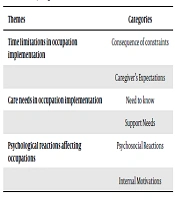
In total, 21 participants (16 females and 5 males) with a mean age of 44.81 years participated in the study (Table 1). After the analysis and classification of the data, three main themes were obtained (Table 2).
Table 1.
Demographic Characters
| Variable | Caregivers (N = 21) | Persons with MS (N = 21) |
|---|---|---|
| Age, mean (SD) | 44/81 (11/38) | 45/43 (6/29) |
| Gender, No. (%) | ||
| Women | 16(76/1) | 5(23/9) |
| Men | 5(23/9) | 16(76/1) |
| Education, No. (%) | ||
| High school or less | 8(38/1) | 10(47/6) |
| University | 13(61/9) | 11(52/4) |
| Relationship of caregiver to care recipient, No. (%) | ||
| Wife | 7(33/4):P6,7,8,9,10,19,20 | |
| Husband | 4(19/0):P2,3,4,12 | |
| Mother | 4(19/0):P1,11,15,21 | |
| Daughter | 2(9/5):P14,18 | |
| Son | 1(4/8):P5 | |
| Sister | 3(14/3):P13,16,17 | |
| Time of caring, No. (%) | ||
| Over 5 years | 9(42/9) | |
| Between 3 and 5 years | 8(38/1) | |
| Between 1 and 2 years | 2(9/5) | |
| Between 6 and 11 months | 2(9/5) | |
| Type of MS, No. (%) | ||
| Relapsing-remitting MS (RRMS) | 5(23/9) | |
| Primary progressive MS (PPMS) | 10(47/6) | |
| Secondary progressive MS (SPMS) | 4(19/0) | |
| Progressive-Relapsing MS (PRMS) | 2(9/5) |
Table 2.
Themes, Categories
| Themes | Categories |
|---|---|
| Time limitations in occupation implementation | Consequence of constraints |
| Caregiver’s Expectations | |
| Care needs in occupation implementation | Need to know |
| Support Needs | |
| Psychological reactions affecting occupations | Psychosocial Reactions |
| Internal Motivations |
4.1. Theme 1. Time Limitations in Occupation Implementation
This theme addresses the challenges related to time limitations to care for people with MS, and contains two sub-categories: “Consequence of constraints” caused by pressure and workload of activities related to care for people with MS; and "caregiver's expectations” to achieve their desires and performing their regular activities that have been challenged due to lack of time in the care process.
4.1.1. Consequence of Constraints
In the caregivers’ experiences, failure to complete the tasks was a major occupational challenge that roots in increased workload. An interview who was taking care of her sister with MS expressed her concerns about maintaining a balance between her responsibilities as a wife and mother and taking care of her sister. She said, “I have two children, and there’s also my husband, and I have my responsibilities as well. I have to take care of my sister on the side too. Taking care of all this work is hard for me ... I’m always worried about completing all my tasks and facing no problems” (P13).
Another occupational consequence of the care process was limited to social relationships. The caregivers mentioned a lack of time and motivation as the main reasons for this limitation. “... I have so much work to do that if I am invited to a party, I won’t have any time for it ... I don’t even want to have any guests because it adds to my workload ...” (P8).
Also, the caregivers described their experiences about reducing their work hours and taking occasional leaves. A man who was taking care of his wife said, “... I have problems with my job too. Sometimes my wife calls me and says that she has fallen on the ground and I have to take leave [from work] to go home....” (P2).
4.1.2. Caregiver’s Expectations
This sub-theme revealed that the challenges faced by caregivers also influenced their expectations and created problems in important aspects of their lives, such as health, meeting personal needs, and achieving their desired goals. A participant involved in taking care of her MS sister noting that, “... I can’t manage my personal affairs ... I had dental caries, but didn’t find time to visit a dentist; I have so little time that I forget to take care of my health ...” (P13).
Some caregivers described their experience about ignoring their goals. A young girl who took care of her mother said, “Now is the time for me to get married ..., well, I don’t think I can leave my mother alone; or I wanted to study and go to college, but I have no energy and time for it” (P18).
4.2. Theme 2. Care Needs in Occupation Implementation
This theme addresses the occupational challenges that arise when caregivers do not meet their patients' care needs. Two categories were extracted from this theme: “support needs” and “need to know”.
4.2.1. Need to know
Caregivers mentioned the lack of access to adequate information as a factor that affects their occupational challenges. Lack of community awareness of the condition of MS patients and their caregivers, as well as lack of access to appropriate information, have intensified the involvement of caregivers in the care process and prevented them from performing their desired activities. A young man who was taking care of his wife with MS said, “One of our problems is the healthcare system defects ... They pay no attention to MS patients and their families; We have not been supported the way they should be…” (P4).
Another participant also discussed the system’s failure to accurately and properly inform the patients and their families about the symptoms they may encounter in the future, “... At the onset of the disease, no one explained to us exactly what MS and its problems are, and we were worried and confused ...” (P5).
4.2.2. Support Needs
In addition to the need for caregivers and community awareness, the lack of access to support resources also increased the caregiver burden and made it difficult for them to engage their occupations. Financial issues, medication costs, the equipment needed, and patient transportation were challenging issues for caregivers. A caregiver described restrictions on her social participation due to financial problems, “My husband is retired, my daughter’s costs are high ... we had to reduce our social hangouts, because, wherever we want to go, we must take a cab, which costs a lot ...” (P15).
In the caregivers’ experience, the inappropriate configurations of buildings and streets, and limited mobility of patients, absence of recreational activities, and, consequently, their mood swings contribute to the family’s stress levels. A young woman who took care of her husband and complained about his bad temper said of her experience,“... It’s been about 19 months now that my husband hasn’t gone out. He has a wheelchair, but the building has no elevators ... This has made him bad-tempered, which messes our life up too” (P9).
4.3. Theme 3. Psychological Reactions Affecting Occupations
This theme is about psychological reactions that affect the motivation of caregivers to perform their daily activities. Two subthemes were extracted: “Psychological reactions” and “internal motivations”. “Internal motivations”: it contains factors that effectively influence the caregivers' internal motivations and their activities.
4.3.1. Psychological Reactions
The caregivers mentioned emotional issues that cause challenges for their activities. One of the caregivers, who took care of her husband, said, “... When we are only concerned about our personal affairs, stress is a little normal, but when one’s priority is someone else, stress will go up ...” (P12).
Because of the long and endless care responsibilities, caregivers could not plan for their life, which causes depression. A husband who had been dealing with her wife’s MS from the beginning of their marriage said, “... The diagnosis of my wife’s disease was very frightening for me at the beginning. My greatest fear was not knowing what would happen to my wife and my life in the future ... or how many years it would last and what would be at the end ...” (P2).
Internal motivations
The lack of appropriate interpersonal relationships between the caregiver and the patient, as well as interrupted relations with the family and society, either cause or exacerbate the caregivers’ occupational problems. A young woman who took care of her husband described her experience, “From the moment I wake up in the morning, I’m stressed out over his bad temper. He was bad-tempered, to begin with, but it’s worse now...” (P9).
Verbal and physical violence against either the caregiver or the patient or other family members often cause limitations for the interpersonal relationships on one hand, and creates challenges for their occupational performance by reducing their energy and motivation, on the other hand. One of the most influential occupational challenges in this area is the interrupted family relationships, which is caused by psychological problems and the burden of care. The experiences of a woman taking care of her husband were as follows,"...When my daughter talks to me, I start arguing with her ..... I have hardly heard her words when I soon begin yelling at her; these behaviors of mine have made us talk less ..." (P20).
A similar experience was reported by a young woman with two young children who was taking care of her husband, “... I have started beating my children ... If they annoy me a bit, or if they shout when playing, I don’t even understand how I begin to beat them ...” (P7).
Some of the characteristics of the caregivers also impeded the care process –characteristics arising from idealism or excessive affection for the patient. A wife who took care of her husband said,"... I could not bear it in the first year at all; and it's still hard for me to accept it now because I've had a very successful life. I'm a very ambitious person, and these problems are a major constraint for me..." (P10).
5. Discussion
This qualitative study examined the experiences of MS patients’ caregivers about the challenges resulting from the care process that disrupts their occupational status. They explained the reasons why engaging in the caregiving process impeded their daily routine activities.
The caregivers reported time limitations as one of the main causes of their occupational challenges that entailed challenging consequences for them, such as work stress and failure to complete the tasks, limitations in social activities, and job-related problems. These consequences had made the caregivers experience changes in their roles and take on new roles that were often complex and difficult (10).
The progression of MS, the recurrence and aggravation of the patients’ health status, and the caregivers’ increased workload had caused problems for their jobs (11). In most cases, the caregivers needed to reduce their work hours so that they could spend more time caring for their patients (12). Decreased work hours and the occasional abandonment of jobs were associated with a decrease in their self-confidence and loss of professional identity, which was a major occupational challenge that could lead to many negative changes (13). Sometimes they were forced to assume new responsibilities and bear a lot of pressure, which in turn led to changes in their lifestyle (14). The changes in the caregivers’ lifestyle could also occur due to financial problems, time limitations, and, consequently, limitations in social and other activities (15). These lifestyle changes were also reported by the caregivers who participated in this study.
The caregivers’ expectations and goals were affected by the problems caused by the lack of time and being engaged in the care process. In some cases, the caregivers found the acceptance of the caregiving role and its challenges contrary to their ideals, which made its management difficult. Evidence suggests that the caregiver’s acceptance of the patient and the illness can be influences by his/her expectations and, ultimately, affects their acceptance of the caregiving role (16).
Community’s and relatives’ awareness (15), access to accurate information resources (17), financial support (18), improving the environment, and using auxiliary equipment (19)were some of the needs that caregivers raised in discussions about their experiences. Ignorance of the society as a whole, and family members and friends have resulted in serious problems for the caregivers (13) that made them feel humiliated by others’ negative attitude (13). In addition to the usual constraints, financial problems were also a barrier to environmental reform for better patient mobility (18, 19). In general, it can be argued that even lack of one of these items may exacerbate the caregivers’ problems and prevent them from fulfilling their occupational involvement in their desired daily activities. The occurrence of MS in the family and the acceptance of the caregiving role influences the dynamics of interpersonal relationships among the family members, caregivers, and patients. This change is usually manifested by decreased interpersonal relationships, increased stress, and conflicts with the patient (18). Some caregivers attributed alternations in their relationships to the loss of intimacy, quality of prior relationships with the patient, and loss of their main role in the family (20). In the present study, the caregivers’ experiences revealed decreased joint activities with the patient and, subsequently, reduced interpersonal relationships. They also mentioned being ignored by the family and taking the role of the mere service provider. In addition to the aforementioned problems, the participants mentioned psychosocial aspects of care for MS patients as factors that effectively influence the occurrence of their challenges. The unpredictable nature of the disease and the uncertain timing of its recurrence or progression made the caregivers face psychological reactions such as stress, anxiety, and depression (21).
Most of the caregivers felt isolated and lonely as a result of having to stay home to fulfill their care responsibilities, at the cost of scarifying their hobbies, recreational activities, and lower engagement in social activities (19, 20). Also, some of the caregivers in the present study reported additional behavioral reactions, such as verbal and physical violence, nagging, and reprisal.
In the present study, participants mentioned their problems associated with caring for people with MS from a different perspective. Most of the previous studies have been focused on improving the patient's condition and the course of MS, but in the present study, the main focus was on caregivers as important members of the treatment team. We hope these results be useful for increasing the knowledge and awareness in this field as well as in the design of occupation-based interventions for caregivers of these patients.
5.1. Limitations
Based on the nature of qualitative research, one of the main limitations of this study is the non-representativeness of the sample. To reduce this limitation, attempts were made to select samples with as many different demographic characteristics as possible. Besides, the sampling continued until data saturation.
In conclusion, according to the results, the caregivers faced a variety of occupational challenges when engaging in the process of caring for people with MS. The time limitations for performing routine and/or desired activities, unmet patient care-facilitating needs, and the occurrence of psychosocial reactions and behaviors were factors contributing to the creation and/or exacerbation of these challenges. Identifying these challenges will be useful for designing interventional programs and assisting caregivers to successfully perform their desired occupations despite the challenges in the care process. The findings of this study and the identification of occupational challenges of caregivers based on the main concepts of the occupational adaptation model are useful to design occupation-based interventions in the field of rehabilitation and occupational therapy. The research team hopes that the findings of the present study be useful for caregivers to look at performing their activates in a new way, despite being involved in the caring process.