
1. Background
The smooth muscles have great importance in medicine as they are involved in many diseases including asthma, hypertension, dysmenorrhea, and gastrointestinal disorders. They are the major target of phytotherapy and related studies. Today, medical herb is considered for treatment of many diseases as they have a few side effects compared to chemical drugs (1). Nevertheless, medicinal herbs also may have side or even toxic effects, so they must be used with caution (2). Damask rose with a scientific name of Rosa damascena (R. damascena) is one of the beneficial plants used in traditional medicine. It has different pharmacological effects including hypnotic, anticonvulsant, anti-depressant, antianxiety, analgesic, nerve growth-promoting, and sedative effects (3-7). In addition, its effect on reduction of blood pressure and breathing rate has been mentioned in previous studies. Other studies have reported antimicrobial and antioxidant effects of the plants (8, 9).
Effects of R. damascena have been reported previously on the respiratory system, as the inhalation of Rosa extract has been shown to reduce the number of coughs in guinea pigs (10). Tracheal smooth muscle contraction induced by methacholine or potassium chloride in the guinea pigs reduced with the use of hydro-alcoholic extract of Rosa flowers, indicating its dilation effect on respiratory tract (11). Also, a potent relaxant effect for ethyl acetate fraction of R. damascena (but a relatively weak relaxant effect for aqueous and n-butanol fractions) on tracheal smooth muscles has been shown, which was comparable to the theophylline effect (12). A combination has been taken from flower bud (known as cyanidin-3-O-β- glucoside) inhibiting the angiotensin-converting enzyme (13). In addition, R. damascena extract at microgram concentrations could show the stimulatory effect on ileum smooth muscles while at milligram concentrations, it showed an inhibitory effect. This displays the presence of different components in the extract (14).
Dysmenorrhea is a cyclic pain that affects many females in their menstrual cycle. The primary dysmenorrhea frequently begins with ovulation and usually causes severe pain and social problems like individual’s absence from daily activities. Thus, research to better understand and treat dysmenorrhea has a high priority of study. In a recent study, the effect of ethanol extracts of R. damascena leaves has been studied on the trachea, aortic, and uterine smooth muscles of rats. The results showed contractile effects of the plant extract on all types of smooth muscle (15, 16). That is somewhat in contrast to earlier findings. Moreover, in a new study, the effect of R. damascena extract was studied on primary dysmenorrhea in 92 girls showing that the dietary extract of R. damascena and Mefenamic acid had similar effects on pain intensity of primary dysmenorrhea (17). R. damascena and its products like rose water are commonly used as air freshener and flavors. There are limited studies on R. damascena effect on uterine smooth muscle contraction and dysmenorrhea with inconsistent results.
2. Objectives
To gain a better understanding of the effect of R. damascena on uterine smooth muscle contraction, this study was performed to examine the effect of alcoholic extract of R. damascena on amplitude, duration, and frequency of basal and oxytocin-induced contraction in uterine of virgin rats.
3. Methods
3.1. Laboratory Animals
In this experimental study, 30 virgin female Wistar rats (180 - 220 g) were prepared from animal house of Semnan University of Medical Sciences, Semnan, Iran. The animals were housed in individual cages in a 12-h light/dark cycle at 22 - 24°C, with food and water available ad libitum. The experimental protocol was approved by the ethics review board of Semnan University of Medical Sciences. All the experimental trials were conducted in agreement with the national institutes of health guide for care and use of laboratory animals.
3.2. Experimental Groups
The 30 female Wistar rats were randomly divided into 3 experimental groups with equal members as follows:
In group one named the control group (n = 10), the effect of the vehicle of extract or oxytocin on the variables of smooth muscle contraction including tension, duration, and frequency of contraction was recorded.
In group two or the extract group (n = 10), the effect of cumulative R. damascena (1, 2, and 4 mg/mL) on the uterine horn contraction was measured.
In group three (n = 10), the effects of oxytocin (4 mU/mL) and subsequently R. damascena (1, 2, and 4 mg/mL) on the uterine horn contraction were recorded. The flow chart of the study is illustrated as following:
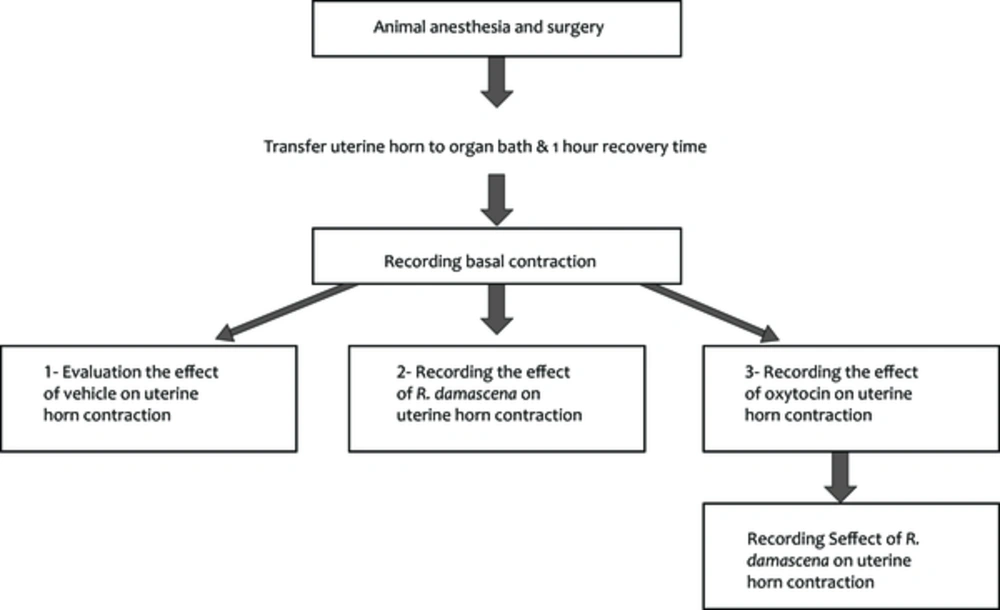
Figure 1.
The Flow Chart of the Study
3.3. Preparation of rat Uterine Horn and Recording Isometric Contraction
The female rats were anesthetized with thiopental sodium (80 mg/kg, IP, Kwality Pharmaceutical Pvt. Ltd. India). The inferior lateral part of the abdomen was opened and a segment of the uterine horn was dissected and placed in Petri dishes containing cold (4°C) De Jalon solution. The composition of De Jalon solution in mmol/L was: NaCl: 154, KCl; 5.63, CaCl2: 0.64, NaHCO3: 5.95, and Glucose: 2.77 (all purchased from Sigma-Aldrich), pH: 7.4 and temperature: 36 ± 1°C). Then, the uterine horn segment (about 15 mm) was attached to an isometric force transducer (F60, Narco Bio Systems, USA) coupled to the physiograph (Narco Bio Systems, USA) for contraction recording. Organ bath (Double Tissue Bath-Harvard) containing De Jalon solution was constantly gassed with 95% O2 and 5% CO2 and renewed every 15 minutes. The uterine horn segments were placed under 1.0 g resting tension for 60 minutes to reach the equilibrium. Uterine horns responses to vehicle, alcoholic extracts of R. damascena flower with the cumulative concentrations of 1, 2, and 4 mg/mL, or oxytocin (4 mU/mL) followed by alcoholic extracts of R. damascena flower were recorded in different groups. Oxytocin was prepared in the form of ampoule from Caspian Tamin pharmaceutical Co., Iran. For vehicle preparation, the ampoules were boiled for half an hour in order to damage the oxytocin peptide.
3.4. Measurement of Contraction Variability
Uterine horns responses to the vehicle of extract or oxytocin were recorded. The physiograph was calibrated before any recording as follows: the sensitivity of instrument changed to the level that 1g load moved up recording pen 25mm. Amplitude or tension of contraction was measured as the pen displacement compared to calibrated size. As the speed of recording paper was 0.05 cm/s, the duration or interval of contraction was calculated by measuring the length of contraction wave (duration) or the length between two contractions.
3.5. Plant and Extract Preparation
The plant R. damascena was obtained from the organization of promotion, education, and agricultural research center, Semnan, in summer 2015. The flowers of R. damascena were dried in shadow, ground, and its hydroalcoholic extract was prepared by soxhlet apparatus via repeated distillation methods in 12 hours. The solution was then filtered and dried in oven at 40°C and finally stored at 4°C.
3.6. Statistical Analysis
The results were presented as mean ± standard error of the mean (SEM); the criteria for statistical significance was P < 0.05. The between-groups differences were analyzed using paired or unpaired Student’s t-test or repeated measures ANOVA for multiple comparisons (SigmaStat.3.0- Germany).
4. Results
4.1. The Effect of R. damascena on the Uterine Smooth Muscle Contraction in the Absence or Presence of Oxytocin
At first, basal smooth muscle contractions of the isolated virgin uterine horn were recorded. Then, either vehicle or alcoholic extract of R. damascena was added to the organ bath in stepwise increasing concentrations of 1, 2, and 4 mg/mL with 1-minute intervals. Vehicle and lower concentrations of the extract had not significant effects on the basal uterine contractions; however, R. damascena (4 mg/mL) reduced uterine contraction significantly compared to the base and lower concentrations of the extract (P = 0.004, Figure 2).
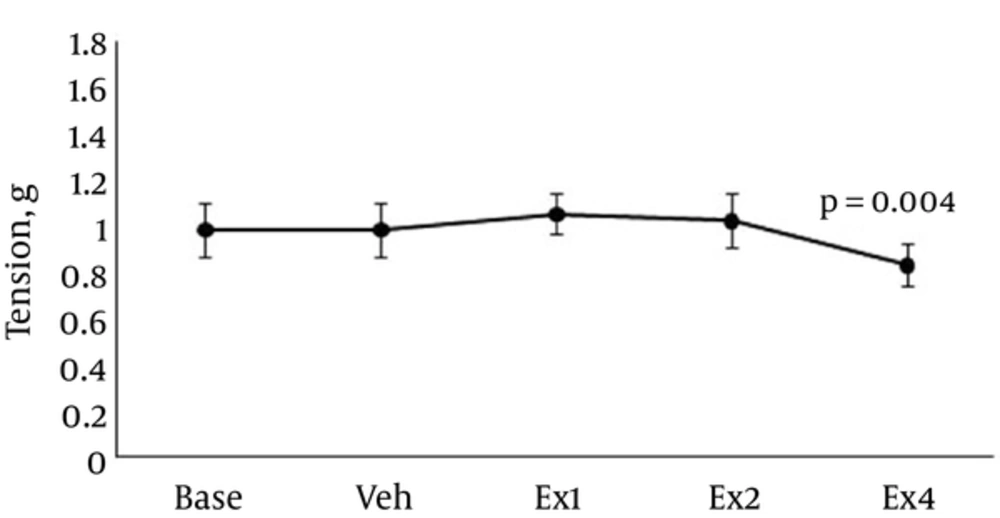
Figure 2.
R. damascena (4 mg/mL) reduced uterine contraction significantly. Veh: vehicle, Ex1, Ex2, and Ex4 are the R. damascena extracts with the concentration of 1, 2, and 4 mg/mL, P = 0.004 compare to other groups.
In the oxytocin group, the vehicle of oxytocin had no significant effect on the basal uterine smooth muscle contractions, but oxytocin (4 mU/mL) increased uterine contractions significantly from 0.91 g to 1.49 g (P = 0.001, Figure 2). Then, the cumulative extract of R. damascena was added to the organ bath in stepwise increasing concentrations: 1, 2, and 4 mg/mL; R. damascena (4 mg/mL) reduced uterine contractions induced by oxytocin (P = 0.026, Figure 3).
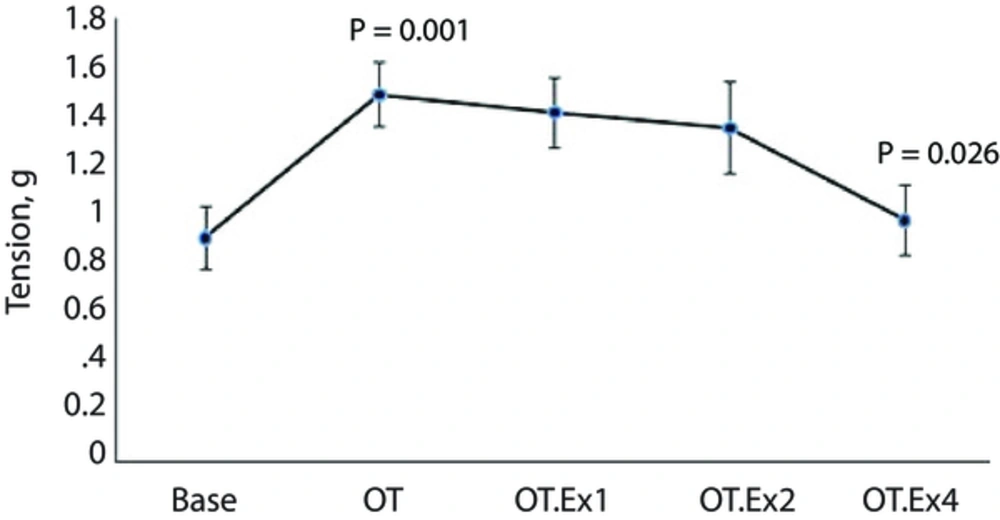
Figure 3.
Oxytocin increased uterine contraction while it reduced significantly by R. damascena (4 mg/mL). OT: oxytocin, OT.Ex1, OT.Ex2, and OT.Ex4 are the oxytocin plus R. damascena with concentrations of 1, 2 and 4 mg/mL, respectively. P = 0.001 compared to base and P = 0.026 compared to oxytocin.
4.2. The Effect of R. damascena Extracts on the Uterine Smooth Muscle Contraction Interval in the Absence or Presence of Oxytocin
Initially, basal frequency (reverse of the interval) of uterine smooth muscle contractions was recorded. Then, either vehicle or alcoholic extracts of R. damascena was added to the organ bath in stepwise increasing concentrations 1, 2 and 4 mg/mL with 1-minute intervals. Vehicle and lower concentrations of the extract had no significant effects on the basal frequency of contractions while R. damascena extract at 4 mg/mL concentration significantly reduced the frequency of contraction compared to the base and extract 1 (P = 0.006, Figure 4).
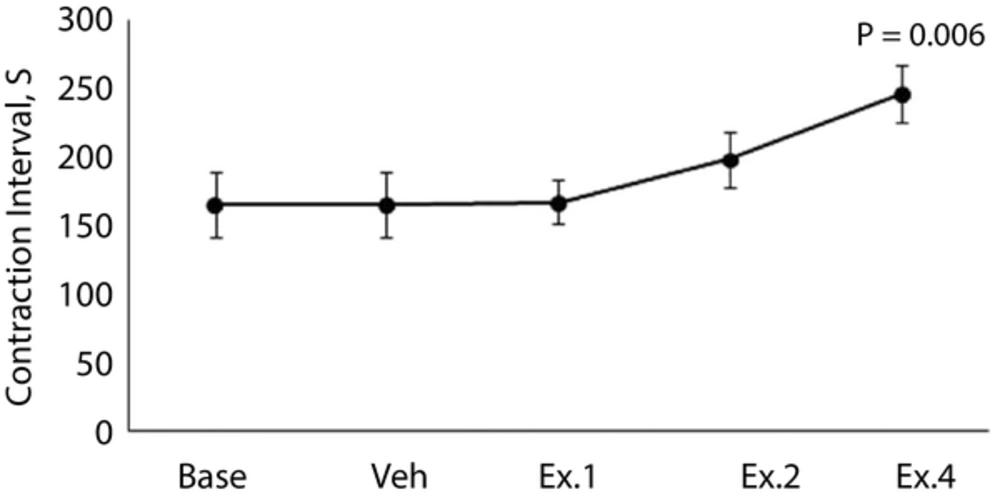
Figure 4.
R. damascena (4 mg/mL) reduced the frequency of uterine contraction significantly. Veh: vehicle, Ex.1, Ex.2, and Ex.4 are the R. damascena extracts with the concentration of 1, 2 and 4 mg/mL, P = 0.006 compared to base.
The vehicle of oxytocin had no significant effect on the basal frequency (reverse of the interval) of uterine contraction, but oxytocin (4mU/mL) increased the frequency of contractions significantly. Then, cumulative concentrations of R. damascena extract were added to the organ bath in stepwise increasing concentrations of 1, 2 and 4 mg/mL; R. damascena (2 and 4 mg/mL) could reduce the frequency of uterine contractions significantly (Figure 5).
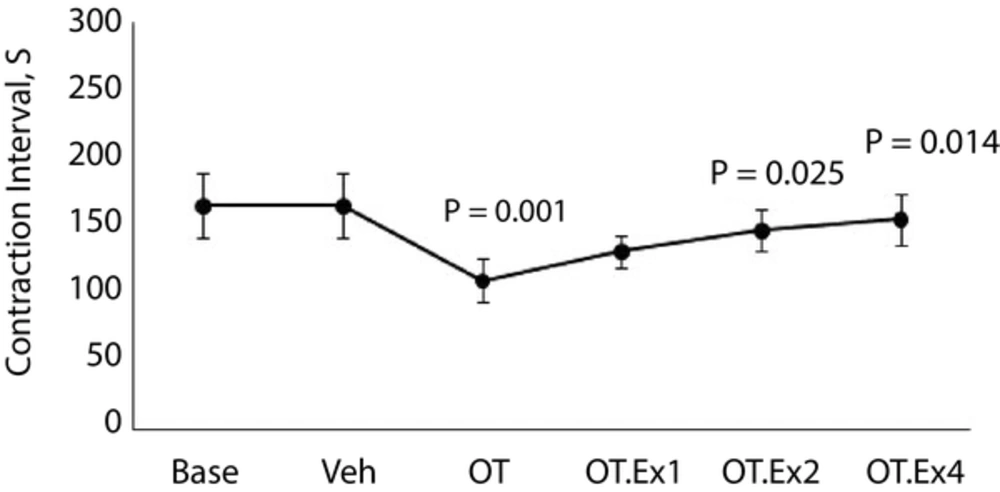
Figure 5.
Oxytocin increased the frequency of uterine contraction while it reduced significantly by R. damascena (2 and 4mg/mL). Veh; Vehicle, OT: oxytocin, OT.Ex1, OT.Ex2, and OT.Ex4 are the oxytocin plus R. damascena extracts with the concentrations of 1, 2 and 4 mg/mL, P = 0.001 compared to vehicle and P = 0.025 and 0.014 compared to oxytocin.
4.3. The Effect of R. damascena on the Duration of Uterine Smooth Muscle Contraction in the Absence and Presence of Oxytocin
In the beginning, the basal uterine contractions were recorded. Then, either vehicle or alcoholic extract of R. damascena was added to the organ bath in stepwise increasing concentrations of 1, 2, and 4 mg/mL with a 1-minute interval. Neither vehicle nor extracts had significant effects on the duration of contraction (Figure 6).
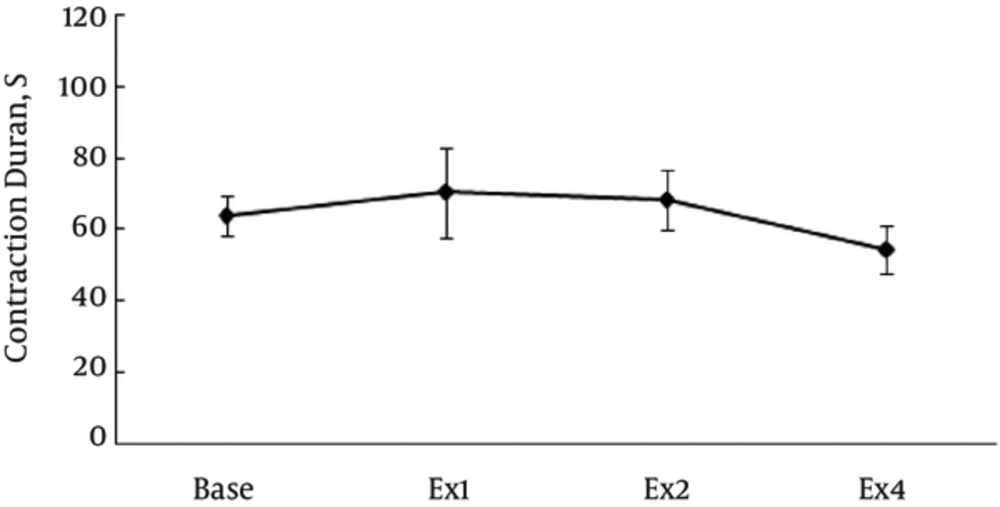
Figure 6.
R. damascena had no significant effect on duration of uterine contraction. Ex1, Ex2, and Ex4 are the R. damascena extracts with the concentrations of 1, 2 and 4 mg/mL.
Oxytocin increased the duration of contraction in uterine smooth muscle, but it has not any significant difference with basal duration. Extracts of R. damascena were added to the chamber solution in stepwise increasing concentrations of 1, 2 and 4 mg/mL with a 1-minute interval. The Rose extract had no significant effect on the duration of uterine contractions induced by oxytocin (Figure 7).
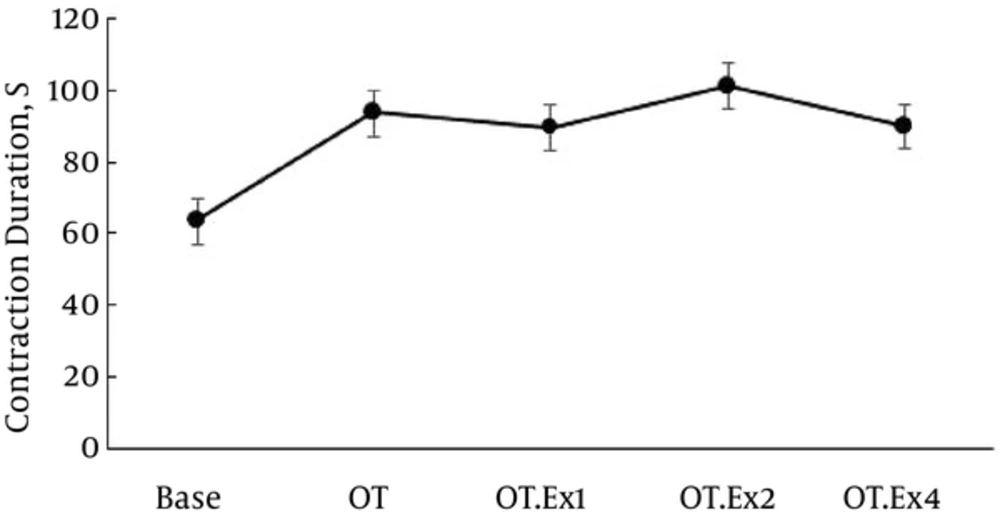
Figure 7.
It did not show any significant effect on the duration of contraction. OT: oxytocin, OT.Ex1, OT.Ex2, and OT.Ex4 are oxytocin plus R. damascena extracts with the concentrations of 1, 2 and 4 mg/mL.
5. Discussion
Our results showed that ethanol extract of R. damascena at a concentration of 4 mg, reducedbasal and oxytocin induced contractions in uterine horn. Also R. damascena extracts at 4mg/ml concentration, reduced the basal frequency of uterine contraction and those contractions induced by oxytocin, but did not show significant effects ontheduration of contractions. No study had previously been performed on the effect of R. damascena on the tension, duration and the intervals between contractions (contraction frequency) in the uterus of rat. However, in few researches the effect of R.damascena leaf or flower extraction on uterine contraction or pain has been studied. Sedighi and colleague reported that hydro-alcoholic extract of R. damascena Mill leaf (0.5, 0.75 and 0.75 µg/ml), induced contraction in the rat's trachea, aorta and uterus smooth muscle dose dependently (15). Our results was in contrast to that report, which might be due to the consequences of differences in the types of plant extracts, methods of work or especially in the concentrations of extracts had been used in these studies. The extract may have produced different effects with low or high concentrations. Sadraei et al. had also reported the various effects of R. damascena extract on ileum contractions induced by KCl and Ach. Rosa damascena (10-100 mg/ml) induced contraction in rat isolated ileum, while at 1mg/ml concentration it had relaxant effect. That is might be because of the presence of different components in the extract (14). Smooth muscle relaxation requires a decreased intracellular calcium concentration and increased myosin phosphatase activity, both mediate through a detailed intracellular pathway involving cAMP, cGMP and calcium channels blockers (18). Inhibitory effect of R. damascena extract on uterine contraction maybe produced through the interaction with these processes. For instance, it has been reported that R. damascena has potent relaxant effect on tracheal smooth muscle of guinea pigs ( 11) that may have been produced by β-adrenergic receptors stimulation, inhibition of histamine (H1) receptors or calcium channel blockage (10, 11). Moreover ethanolic extract of R. damascena has a relatively potent inotropic and chronotropic effect on isolated guinea-pig heart that probably is mediated by β-adrenergic receptor stimulation (19). Several components were isolated from R. damascena including terpenes, glycosides, flavonoids, and anthocyanins, myrcene, vitamin C, kaempferol and quarcetin. Flowers also contain a bitter principle, tanning matter, fatty oil and organic acids (12, 20-24). Furthermore analyses of rose absolute extract show that phenyl ethylalcohol, citrenellol, nonadecane and geraniol, ethanol, and heneicosane are the main constituents (25). The medicinal functions of Rosaceae are partly attributed to the phenolics compound which have antioxidants, free-radical scavengers, anti-cancer, anti-inflammatory, anti-mutagenic, and anti-depressant effects (26). Other functions of R. damascena have been reported. As Sedighi et al results indicated that R. damascena Mill decreased ileum contractions induced by KCl dose-dependently probably through stimulating the β-adrenergic receptors and inhibition of voltage-dependent calcium channels in the rat (15). The basic phasic nature of uterine contraction is critically dependent on calcium influx and on membrane potential (27-29) and R. damascena may affect calcium channels. Cyclic AMP relaxant effect on uterine smooth muscle is mediated through inhibition of calcium mobilization and the contractile apparatus (30,31). In myometrium adenylyl cyclase’s activity is induced by agonists like catecholamines and prostaglandins operating through β2-adrenoceptor and prostaglandin E2 receptor (32). So cyclicAMP signaling pathways may be the other possible way affected by R. damascena on uterine relaxant effect. Resting membrane potential is largely established by the activation of K channels of the smooth muscles. There are many different types of K channels and their isoforms. The main effect of increased K conductance is to decrease excitability (33). There is not any report on the effect of R. damascena on K channels, and unfortunately we did not study it, this one of the failure in this study, which remains for further clarifications.
5.1. Conclusion
Uterine smooth muscle is involved in pathological conditions such as dysmenorrhea. Clearly, factors affecting the uterine contractions can be effective in the treatment or controling this problem. In this study, R. damascena reduced tension and frequency of uterine contraction, which it may also serve to relieve dysmenorrhea and premature labor, which needs further studies for more clarification.