
1. Background
Osteoporosis is a chronic debilitating disease that poses a serious challenge to humanity. Osteoporosis and its related complications impose huge direct costs on the health system (1). The prevalence of osteoporosis among women over 50 years in Australia was estimated at 23% (2). The total annual cost of osteoporotic fractures in 2005 surpassed $19 billion, which is projected to increase to $25.3 billion by 2025 (3). In women with menopause, osteoporosis and bone mineral density (BMD) loss is a major public health concern (4), which is related to estrogen deficiency (5).
Postmenopausal estrogen deficiency can result in muscle weakness and bone fragility and increase the risk of falls and fractures (6). The prevention and treatment of osteoporosis have attracted the growing attention of researchers. There are several approaches to prevent and treat osteoporosis; however, their prescription is limited due to complications and low benefits (7, 8). The first treatment of choice for hormone-associated osteoporosis is hormone replacement therapy (HRT) (3).
Hormone replacement therapy has some adverse side effects, such as the increased risk of cardiovascular disease and breast cancer (7, 8), which have hampered their usage (9). This issue highlights the need for alternative bone protection strategies and novel therapies, including phytoestrogens, which can be found in plant products.
A number of randomized controlled trials (RCTs) have utilized herbal therapy and demonstrated its bone protection (10, 11). According to the results of two meta-analyses, there is no statistically significant difference between isoflavones and phytoestrogens with HRT in improving osteoporosis. Both interventions seem to have yielded similar outcomes. Phytoestrogens might be safer than hormonal therapy to treat postmenopausal bone loss (12, 13). Therefore, new bone protection options have encouraged alternative therapies, such as using phytoestrogens (14, 15).
2. Objectives
The current study aimed to investigate the effects of herbal medicine on bone turnover markers in peri-postmenopausal bone loss.
3. Methods
3.1. Search Strategy
Three main databases [MEDLINE, Scopus, and Cochrane Central Register of Controlled Trials (CENTRAL)] were searched to explore published meta-analyses regarding the effect of herbal medicines on bone turnover markers in pre- and peri/postmenopausal women up to April 2022. The search keywords included English terms (bone OR osteoporosis) AND (isoflavone, phytoestrogen, Genistein, daidzein, Glycitin, soy, soya, soybean, soymilk, bone) AND (bone-specific alkaline phosphatase or Osteocalcin OR Pyridinoline OR Deoxypyridinoline OR Osteoprotegerin OR C-Telopeptide, and N-Telopeptide OR bone mineral density OR bone mass OR bone turnover OR Daidzein OR bone remodeling) AND (meta-analysis). Two reviewers searched the titles and abstracts independently. Figure 1 shows the PRISMA 2009 flow diagram.
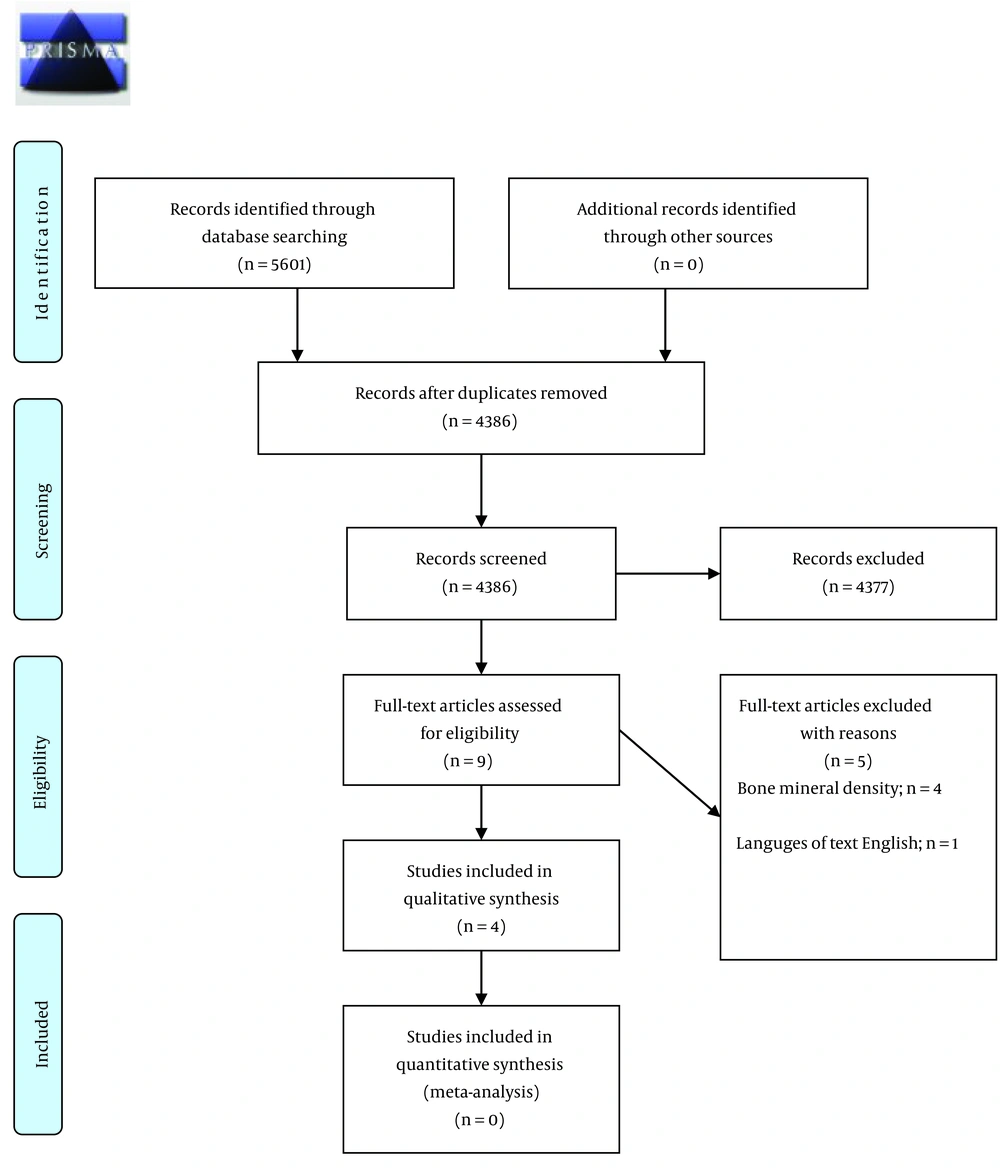
Figure 1.
PRISMA 2009 flow diagram
3.2. Inclusion Criteria
All meta-analyses on prospective, randomized, controlled trials that assessed the effect of herbal medicines on bone turnover markers in pre- and peri/postmenopausal women were eligible for the study. The control groups in these studies received a placebo. The meta-analyses that involved cell lines or animal models were excluded from the overview.
3.3. Outcome Measurement
The most widely reported markers of bone remodeling were bone-specific alkaline phosphatase, osteocalcin, pyridinoline (Pyd), deoxypyridinoline (Dpyd), osteoprotegerin, C-telopeptide, and N-telopeptide.
3.4. Data Extraction
A pre-designed form was used by the reviewers to extract data from the meta-analyses. The form included the year of publication, intervention duration, name of the first author, the number of trials included in the meta-analysis, and the type of intervention used for the treatment and control groups. Table 1 shows the demographic and clinical characteristics of meta-analyses included in this overview. Outcome measures are shown in Table 1.
Table 1.
Clinical and Demographic Characteristics of Four Meta-analyses Included in the Overview
| First Author, Year | Urinary Bone Resorption Markers | Reign Subgroup | Years of Menopause Subgroup | BMI Subgroup | Dosage Subgroup | Duration Subgroup | Supplement Subgroups | Total Results |
|---|---|---|---|---|---|---|---|---|
| Akhlaghi et al. (18), 2019 | C-telopeptide | West MD = -0.17, P = 0.32; Asia MD = -0.06, P = 0.13 | < 1 year ; MD = -0.07, P = 0.14; ≥ 1 year; MD = -0.14, P = 0.07 | BMI ≥ 25 kg/m2; MD = -0.11, P = 0.02; BMI < 25 kg/m2; MD = - 0.01, P = 0.70 | ≥ 90 mg/day; MD = -0.01, P = 0.31; < 90 mg/day MD = 0.12, P = 0.02 | MD = -0.08 g/mL, P = 0.043 | ||
| Deoxypyridinoline (Dpyd) | West MD = 1.01,; P = 0.01; Asia MD = 0.23, P = 0.72 | < 1 year MD = -1.04, P = 0.02; < 1 year MD = -0.00, P = 0.99 | MD = -0.54,P = 0.1; Isoflavones MD = -0.54, P = 0.1 | |||||
| Pyridinoline (Pyd) | Asia MD = -8.00, P < 0.001; West MD = -4.71, P = 0.001 | <1 year MD = -7.25, P < 0.001; ≥ 1 year MD = -3.84, P = 0.02 | BMI ≥ 25 kg/m2 MD = 11.11, P = 0.03; BMI < 25 kg/m2 MD = 0.49, P = 0.36 | < 90 mg/day MD = -9.37, P = 0.002; ≥ 90 mg/day MD = -1.75, P = 0.36 | Isoflavones MD = -5.13, P < 0.001 | |||
| N-telopeptide | MD = -2.27 nmol/mmol, P = 0.33 | |||||||
| Osteoprotegerin | MD = 5.79 pg/mL, P < 0.001 | |||||||
| Alkaline phosphatase | MD = 0.14, P = 0.79 | |||||||
| Osteocalcin | MD = 0.08 ng/mL, P = 0.85 | |||||||
| Wei et al. (17), 2012 | Deoxypyridinoline (Dpyd) | Postmenopause WMD = -0.25, P = 0.21; Peri-menopause WMD = 0.00 CI: -0.82-0.82 | < 6 months WMD = -0.30, CI: -0.53, -0.07; > 6 months WMD = -0.13, CI: -0.62, 0.36 | Isoflavones extract WMD = -0.30, CI: -0.53, -0.07; Soy foods with isoflavones WMD = -0.13, CI: -0.62, 0.36, P = 0.13 | SMD: -0.23, 95% CI: -0.44, -0.02 | |||
| Ma et al. (16), 2008 | Deoxypyridinoline (Dpyd) | West WMD = 2.03 g/cm2, 95% CI: 4.27-0.22; Asia WMD = 2.79 g/cm2 95% CI: 4.55-1.02, P = 0.56 | Postmenopause WMD = 2.47, P = 0.05; Peri-menopause WMD = -1.50, CI: -4.45-1.45 | WMD = -2.03 g/cm2 95% CI: -3.20, -0.85; > 3 months WMD = -3.36 g/cm2 P < 0.05 | Isoflavone tablet WMD = -4.59 g/cm2, P = 0.05; Isolated soy protein WMD = 0.23, P = 0.05 | WMD = -2.08, 95% CI: -3.82, -0.34 | ||
| Salari Sharif et al. (1), 2011 | Deoxypyridinoline (Dpyd) | Phytoestrogens WMD = -0.818582, 95% CI = -1.247758, -0.389407 | ||||||
| Pyridinoline (Pyd) | Phytoestrogens WMD = -9.780623, P < 0.001 |
Abbreviation: West, western; BMI, body mass index; MD, mean difference; SMD, standardized mean difference; Asia, Asian; WMD, weighted mean difference; CI, confidence interval.
3.5. Methodological Quality
The methodological quality of meta-analyses in the present overview was assessed by the measurement tool for the assessment of multiple systematic reviews (AMSTAR). This checklist contained 12 items, which are listed in Table 2. The methodological quality was rated by two independent reviewers.
Table 2.
Quality Assessment of Four Meta-analyses Included in the Overview
| First Author, Year | 1 | 2 | 3 | 4 | 5 | 6 | 7 | 8 | 9 | 10 | 11 | 12 |
|---|---|---|---|---|---|---|---|---|---|---|---|---|
| Wei et al. (17), 2012 | Yes | Yes | Yes | Yes | Yes | Yes | Yes | Yes | Yes | Yes | Yes | Yes |
| Ma et al. (16), 2008 | Yes | Yes | Yes | Yes | Yes | Yes | Yes | Yes | Yes | Yes | Yes | Yes |
| Akhlaghi et al. (18), 2019 | Yes | Yes | Yes | No | Yes | Yes | Yes | Yes | Yes | Yes | Yes | Yes |
| Salari Sharif et al. (1), 2011 | Yes | Yes | Yes | Yes | Yes | Yes | Yes | Yes | Yes | Yes | Yes | Yes |
| Questions | ||||||||||||
| (1) Did the study address a clearly focused question? | ||||||||||||
| (2) Was a comprehensive literature search conducted using relevant research databases (e.g., ABI/INFORM, Business Source Premier, PsycINFO, and Web of Science)? | ||||||||||||
| (3) Was the search systematic and reproducible (e.g., Were searched information sources listed or search terms provided)? | ||||||||||||
| (4) Has publication bias been prevented as far as possible (e.g., attempts made to collect unpublished data)? | ||||||||||||
| (5) Are the inclusion and exclusion criteria clearly defined (e.g., population, outcomes of interest, and study design)? | ||||||||||||
| (6) Was the methodological quality of each study assessed using predetermined quality criteria? | ||||||||||||
| (7) Are the key features (i.e., population, sample size, study design, outcome measures, effect sizes, and limitations) of the included studies described? | ||||||||||||
| (8) Has the meta-analysis been conducted correctly? | ||||||||||||
| (9) Were the results of different studies identical? | ||||||||||||
| (10) Is the effect size practically relevant? | ||||||||||||
| (11) How precise is the estimate of the effect? Were confidence intervals provided? | ||||||||||||
| (12) Can the results be applied to your organization? Do you have any reason (Do you have any reason to believe that your population of interest is different from that in the trial. If so, in what way?) | ||||||||||||
4. Results
A total of 5601 articles were identified through database search, and 4386 articles remained after duplicates were removed. Nine full-text articles were assessed for eligibility. Finally, four articles were included.
4.1. Effect of Phytoestrogens on Pyd
A significant reduction was observed in Pyd in the phytoestrogens group in comparison to the placebo group (weighted mean difference [WMD] = -9.780623; 95% confidence interval [CI] = -14.240401 to -5.320845; P < 0.001, heterogeneous; P < 0.0001) (1).
4.2. Effect of Isoflavones on Pyd
In Akhlaghi’s meta-analysis, women receiving soy isoflavones were reported to experience a significant decrease in Pyd, compared to those in the control group (mean difference [MD] = -5.13; 95% CI: -7.76 to -2.50 nmol/mmol; P < 0.001; 9 trials; heterogeneity; I2: 96.8%) (18). The subgroup analysis was based on the place of trial, participants’ body mass index (BMI), isoflavone dose, and intervention duration.
4.3. Effects of Isoflavones Based on Population and Duration
Effects of Isoflavones on Pyd level were effectiveness regardless of study population (Asian; MD = -8.00; CI: -10.83 to -5.17; P < 0.001; 1 trial) or (western; MD = -4.71; CI: -7.46 to -1.95); P < 0.00; 97%; 8 trials) and duration of treatment (< 1 year; MD = -7.25; CI: -11.26 to -3.25; P < 0.001; I2 = 66.0%; 4 trials) or (≥ 1 year; MD = -3.84; CI: -6.95 to -0.74; P = 0.02; I2 = 98.1%; 5 trials) (18).
4.4. Effects of Isoflavones on Pyd Based on Weight and Dosage
The subgroup analysis revealed that using soy isoflavones significantly decreased in women with BMI ≥ 25 kg/m2 (MD = -11.11; CI: -21.02 to -1.19; P = 0.03; I2 = 92.5%; 4 trials) and women taking isoflavone with a dose of < 90 mg/day (MD = -9.37; CI: -15.27 to -3.47; P = 0.002; I2 = 95.3%; 5 trials); however, this change was non-significant in doses ≥ 90 mg/day (MD = -1.75; CI: -4.27 to 0.78; P = 0.36; I2 = 66.2%; 4 trials) and doses < 25 kg/m2 (MD = 0.49; CI: -0.57 to 1.56; P = 0.36; I2 = 66%; 9 trials) (18).
4.5. Deoxypyridinoline (Dpyd)
4.5.1. Effect of Phytoestrogens on Dpyd
The treatment with phytoestrogens significantly reduced Dpyd compared to the placebo group (WMD = -0.818582; 95% CI = -1.247758 to -0.389407).
4.5.2. Effect of Isoflavones on Dpyd
Isoflavones significantly reduced urinary Dpyd concentration, compared to the control group, as reported in Ma et al.’s meta-analysis (WMD = -2.08 nmol/mmol; 95% CI: -3.82 to -0.34 nmol/mmol; 10 trials) (16) and Wei et al.’s meta-analysis (standardized mean difference = -0.23; 95% CI: -0.44 to -0.02; heterogeneity; I2: 19%; 8 trials) (17). However, the results of another meta-analysis by Akhlaghi et al. on 23 trials revealed that this reduction was non-significant (MD = -0.54; 95% CI: -1.19 to 0.11); P = 0.1; heterogeneity; I2: 93.1%; 23 trials) (18).
4.5.3. Effects of Isoflavones on Dpyd Based on Population Subgroups
Isoflavones significantly reduced Dpyd in postmenopausal women as reported by Wei et al. (soy isoflavones; WMD = -0.25; CI: -0.48 to -0.02; 68 women; heterogeneity; P = 0.21; 436 women; 7 trials) (17) and Ma et al. (WMD = 2.47; CI: 4.31, 0.52; P = 0.05; heterogeneity; P < 0.05; 366 women) (16). Nevertheless, the drop was not significant in peri-menopausal women, as reported by Wei et al. (soy isoflavones; WMD = 0.00; CI: -0.82 to 0.82; 68 women; 1 trial) (17) (WMD = 1.50; CI: 4.45 to 1.45; heterogeneity; P < 0.05; I2:88%; 66 women) (16).
According to the results of a meta-analysis by Akhlaghi et al., trials in Western countries have shown that isoflavones can significantly decrease Dpyd (MD = 1.01; CI: 1.78 to 0.23; P = 0.01; I2 = 89.3%, 14 trials) (18). In contrast to the above-mentioned meta-analysis, another meta-analysis by Ma et al. demonstrated an insignificant drop in Dpyd in trials conducted in Western countries (WMD = 2.03 g/cm2; 95% CI: 4.27 to 0.22; heterogeneity; P < 0.05) (16). The meta-analysis by Ma et al. showed that soy isoflavones significantly changed Dpyd in trials conducted in Asia (Asian; WMD = 2.79 g/cm2; 95% CI: 4.55 to 1.02; P = 0.56) (16). Contrary to the above-mentioned meta-analysis, a non-significant decrease in Dpyd was observed in trials conducted in Asia (MD = 0.23; CI: 1.00 to 1.45; P = 0.72; I2: 95.8%; 9 trials; 150 women; 9 trials) (18).
4.5.4. Effects of Isoflavones on Dpyd Based on Population Subgroups
Isoflavones significantly reduced Dpyd in postmenopausal women, as reported by Wei et al. (soy isoflavones; WMD = -0.25; CI: -0.48 to -0.02; 68 women; heterogeneity; P = 0.21; 436 women; 7 trials) (17) and Ma et al. (WMD = -2.47; CI: -4.31 to -0.52); P = 0.05; heterogeneity; P < 0.05; 366 women) (16); nonetheless, the decrease was not significant in peri-menopausal women, as reported by Wei et al. (soy isoflavones; WMD = 0.00; CI: -0.82 to 0.82; 68 women; 1 trial) (17) and Ma et al. (WMD = -1.50; CI: -4.45 to 1.45; heterogeneity; P < 0.05; 0.88; 66 women) (16).
The results of a meta-analysis by Akhlaghi et al. showed that isoflavones significantly decreased Dpyd in trials conducted in the West (MD = -1.01; CI: -1.78 to -0.23; P = 0.01; I2 = 89.3%, 14 trials) (18). In contrast to the above-mentioned meta-analysis, another meta-analysis by Ma et al. showed an insignificant decrease in Dpyd in trials conducted in Western countries (WMD = -2.03g/cm2; 95% CI: -4.27 to 0.22; 6 trials; heterogeneity; P < 0.05) (16). The meta-analysis of Ma et al. showed that isoflavones significantly changed Dpyd in trials conducted in Asia (WMD = -2.79 g/cm2; 95% CI: -4.55 to -1.02; I2 = 0.56; 3 trials) (16). Contrary to the results of the above-mentioned meta-analysis, a non-significant decrease in Dpyd was observed in trials conducted in Asia (MD = 0.23; CI: -1.00 to 1.45); P = 0.72; I2: 95.8%; 9 trials) (18).
4.5.5. Effects of Isoflavones on Dpyd Based on Intervention Duration Subgroups
Isoflavones significantly reduced Dpyd in interventions that lasted less than a year (MD = -1.04; CI: -1.90 to -0.90; P = 0.02; I2 = 95.4%; 2 trials), less than 6 months (WMD = -0.30; CI: -0.53 to -0.07; 5 trials; 504 women; I2: 0.53) (17), and less than 3 months (WMD = -2.03 g/cm2; 95% CI: -3.20 to -0.85; heterogeneity; P < 0.05; n = 282; 6 trials) (16) in Akhlaghi et al.’s study (18). However, the aforementioned study failed to demonstrate a larger decline in Dpyd for higher doses. In the meta-analyses by Akhlaghi et al. (< 1 year; MD = -0.00; CI: -1.09 to 1.08; P = 0.99; I2 = 95.4%; 10 trials) (18), Wei et al. (> 6 months; WMD = -0.13; CI: -0.62 to 0.36; I2 = 0.13; 3 trials: 358 women) (17), and Ma et al. (> 3 months; WMD = -3.36 g/cm2; 95% CI: -8.72 to 1.99; P < 0.05; n = 150; 3 trials) (16), isoflavones demonstrated greater efficacy in shorter treatment (16-18) than in longer treatments (16-18). Disparities in meta-analyses could be attributed to differences in the number of studies included in the meta-analysis, heterogeneity level, and statistical methods.
4.5.6. Effects of Isoflavones on Dpyd Based on Supplement Subgroups
Isoflavone extract (WMD = -0.30; CI: -0.53 to -0.07; 5 trials; 504 women; P = 0.30; heterogeneity; P = 0.11; 5 trials) (17) and isoflavone tablet (WMD = -4.59 g/cm2; 95% CI: -8.35 to -0.83; P = 0.05; n = 199; 4 trials) led to a significant drop (16). However, studies that used soy foods with isoflavones, such as Wei et al.’s study (WMD = -0.13; CI: -0.62 to 0.36; P = 0.13; 3 trials: 358 women) (17), and isolated soy protein (WMD = -0.23 g/cm2; 95% CI: -1.02 to 0.57; P = 0.05; n = 233; 5 trials), such as Ma et al.’s study, failed to show a significant decrease in Dpyd (16).
4.6. Effect of Isoflavones on C-telopeptide
C-telopeptide was significantly lower in the group using soy isoflavones than in the control group (MD = -0.08 g/ml; 95% CI: 0.16 to -0.00; P = 0.043; heterogeneity; I2 = 96.5%; P = 0.02; 13 trials). However, when the subgroup analysis was conducted based on the trial region and intervention duration, soy isoflavones had no impact on C-telopeptide in studies performed in both Western or Asian countries or trials lasting < 1 or ≥ 1 year.
The treatment with isoflavones significantly decreased C-telopeptide in women taking < 90 mg/day (MD = -0.12; CI: -0.22 to -0.02); P = 0.02; I2 = 95%; 8 trials) and in women with BMI ≥ 25 kg/m2 (MD = -0.11; CI: -0.20 to -0.01; P = 0.02; I2 = 97.6%; 9 trials). However, this change was non-significant in women with < 25 kg/m2 (MD = -0.01; CI: -0.08 to 0.05); P = 0.70; I2 = 0%; 4 trials) and in women taking ≥ 90 mg/day (MD = -0.01 CI: -0.03 to 0.01; P = 0.31; 5 trials; heterogeneity; I2 = 0%) (18).
4.7. Effect of Isoflavone on Serum Osteocalcin
The bone formation marker of serum osteocalcin was not significantly different between isoflavones and the control group (MD = 0.08 ng/ml; 95% CI: -0.72 to 0.88 ng/ml; P = 0.85; 22 trials; heterogeneity; I2 = 85.7%) (18).
4.8. Bone-Specific Alkaline Phosphatase
Bone-specific alkaline phosphatase was not significantly different between isoflavones and the control group (MD = 0.14; 95% CI: -0.87 to 1.14; P = 0.79; heterogeneity; I2 = 97.3%) (18).
4.9. Osteoprotegerin
Osteoprotegerin was significantly higher in soy isoflavones than in the control group (MD = 5.79 pg/ml; 95% CI: 3.08 to 8.51 pg/ml; P < 0.001; heterogeneity; I2 = 51.4%; 3 trials) (18).
4.10. N-telopeptide
N-telopeptide was non-significantly lower in soy isoflavones than in the control group (MD = -2.27 nmol/mmol; 95% CI: -6.80 to 2.27; P = 0.33; heterogeneity; I2 = 54.1%; P = 0.02; 10 trials) (18).
5. Discussion
Isoflavones (18) and phytoestrogens (1) significantly reduced urinary Pyd compared to the control group. The isoflavones significantly reduced urinary Pyd regardless of the study population and treatment duration. Soy isoflavones caused a significant decrease in Pyd in women with BMI ≥ 25 kg/m2 and women taking isoflavone with a dose of < 90 mg/day. However, this change was non-significant in doses ≥ 90 mg/day and BMI < 25 kg/m2 (18). The findings on Dpyd have been controversial (16-18). Pyridinoline and Dpyd were positively affected by phytoestrogens (1).
Isoflavones significantly reduced urinary Dpyr concentration, compared to the control group, in two meta-analyses with 10 trials (16) and 8 trials (17). However, another meta-analysis with 23 trials revealed that this reduction was non-significant (18). The gap between meta-analyses might be related to the diversity of methodological approaches, the number of studies included in the meta-analysis, and heterogeneity levels.
Isoflavone extract (17) and isoflavone tablet caused a significant decrease in Dpyd (16). However, studies using soy foods with isoflavones and isolated soy protein have failed to show a significant decrease in Dpyd (16). It seems that isoflavones alone were more effective than isoflavone in combination with other components of soy protein products or soy foods. The C-telopeptide level changed significantly in women taking < 90 mg/day of isoflavone. However, the changes were non-significant in women taking ≥ 90 mg/day (18). A possible explanation is that isoflavone had a dose-dependent effect on C-telopeptide, with lower doses (90 mg/day >) yielding more effective outcomes. Another possible reason for this disparity might be heterogeneity and the number of studies included in the meta-analyses. The treatment with isoflavones significantly decreased C-telopeptide in women with BMI ≥ 25 kg/m2 (MD = -0.11; CI: -0.20 to -0.01; P = 0.02; I2 = 97.6%; 9 trials); nevertheless, this change was non-significant in women with < 25 kg/m2 (18).
Isoflavones were associated with a significant drop in trials conducted in the West; however, changes were not significant in Asian countries. The habit of consuming soy among Asian women might explain the restricted beneficial effect of isoflavones in Asian women (18). The bone formation markers of bone-specific alkaline phosphatase, N-telopeptide, and osteocalcin were not significantly different between soy isoflavones and the control group. Osteoprotegerin was significantly higher in isoflavones than in the control group (18).
The effect of isoflavones on turnover markers was moderated by menopause, drug dosage, place of trial, type of isoflavone supplement, and intervention duration. After receiving soy-rich meals, genistein might show estrogenic activity comparable to endogenous estradiol. In addition, it demonstrated activities analogous to the endogenous estradiol for genistein after receiving soy-rich meals (18). This effect is especially remarkable in estrogen-deficient individuals, such as in postmenopausal women for whom isoflavones can be used as an alternative to HRT (12, 13). Isoflavones significantly reduced Dpyd in postmenopausal women (16, 17); however, the decrease was not significant in peri-menopausal women (16, 17).
Isoflavones were associated with a significant drop in trials conducted in the West; nonetheless, the change was not significant in Asian countries. The habit of consuming soy among Asian women might explain the lower effect of soy isoflavones in Asian women (18). However, as reported by another study, there is scant evidence that Asian women, as opposed to non-Asian women, responded differently to soy foods (19).
The main phytoestrogens include isoflavones, genistein, and daidzein (20). Soybean ethanol extract enhances the function of osteoblastic MC3T3-E1 cells (21) and inhibits the production of interleukin 6 (IL-6) and prostaglandin E2 (PGE2), suggesting that soy plays an important role in bone remodeling (22). In line with the findings of cell culture, the current overview showed that bone turnover markers were affected by isoflavones. Cell culture revealed a biphasic dose-response of daidzein in which higher concentrations (30 μM) had an inhibitory effect so that the lower concentrations of daidzein (below 20 μM) stimulated osteogenesis and decreased adipogenesis (23).
The above-mentioned findings regarding the biphasic effect of daidzein are consistent with those obtained from the rat models. A biphasic response of genistein was reported in an ovariectomized, lactating rat model. A low dose of genistein acts as an agonist at the estrogen receptor locus; however, higher doses of genistein are less beneficial and have deleterious side effects on bone cells (24). Such biphasic dose-dependent response of isoflavones has also been observed in humans. The effect of isoflavones on Pyd (18), Dpyd (16, 17), and C-telopeptide (18) suggests that menopausal women receiving lower doses might stand to gain more benefits than those receiving higher doses of isoflavones (> 90 mg/day).
Bone remodeling consists of five phases, namely osteoclast activation, bone resorption, osteoblast recruitment, bone matrix formation, and mineralization (i.e., the termination phase). The first three phases lasted approximately 6 weeks. The resorption phase lasted 2 weeks, and the formation and mineralization phases each lasted about 16 weeks (18). C-telopeptide was not affected by soy isoflavones (18). This might be due to population size disparity, which affected the study and subgroup analysis. In addition, it could not be attributed to intervention duration because it lasted for 1 month, which is longer than the bone resorption phase.
5.1. Study Limitations
There are several limitations that need to be addressed. Firstly, moderate-high heterogeneity was observed with regard to the effect of isoflavones and phytoestrogens on bone turnover markers in all meta-analyses investigated in the overview. However, the heterogeneity remained after conducting the subgroup analysis. The resolved heterogeneity can be explained by several possible reasons. Additionally, the meta-analyses failed to conduct a meta-regression to examine high heterogeneity due to the small number of studies, treatment duration, dosage, weight, ethnicity, different types of isoflavones (e.g., glycosides or aglycones), isoflavones composition (i.e., the proportion of different flavonoids in supplements), and treatment type (i.e., pure compounds vs. soy foods).
Among phytoestrogens, coumestrol (40 nM) and genistein (50 nM) have been reported to demonstrate the highest binding activity among all known phytoestrogens, which are comparable to medicinal estrogens. After using daidzein (100 nM) and naringenin (300 nM) with moderate binding activity, the weakest activity was observed with formononetin (10 μM), kaempferol, and quercetin (both 50 μM) (25). Moreover, some meta-analyses included peri-postmenopausal women who had varying endogenous estrogen levels. However, as shown in previous studies, a slight difference in endogen estradiol serum levels in elderly women determines BMD, bone remodeling, rate of bone loss, and response to treatment (13).
A major shortcoming of mega-analysis is data dependence or the overlap of individual studies used in different meta-analyses. If the overlap is high, mega-analysis would be significantly impacted by these individual studies that are repeatedly used in meta-analyses (26). The overlap between meta-analyses is considered the main limitation of the overview. Therefore, the results of the overview should be interpreted with caution.
5.2. Conclusions
This overview presented that isoflavones could decrease some urinary bone resorption markers. However, they had no significant effect on bone formation markers. The effect of isoflavones on turnover markers was modified by menopause, isoflavone dose, place of trials, type of isoflavone supplement, and intervention duration. As a final note, the findings should be interpreted with caution due to the heterogeneity of studies.