
1. Background
Casting and splinting are commonly used for fractures and orthopedic injuries of the upper limb (1). This procedure is also applied to both upper and lower limbs in the treatment of chronic and acute neurological conditions, including stroke, multiple sclerosis, Parkinson's disease, and cerebral palsy, among others (2, 3). Such interventions are recognized for contributing to favorable rehabilitation outcomes and alleviating symptoms of these diseases (4-7).
Although immobilizing the upper limb is effective in rehabilitation and symptom alleviation for certain conditions, research indicates that casting or splinting can substantially alter the biomechanical aspects of walking, affecting kinetics, kinematics, and spatiotemporal variables (8-11). These alterations include changes in step length, stride, and walking speed, shifts in the body’s center of mass (as detailed in my research), adjustments in the lower limb's joint angles (12, 13), and variations in the forces exerted on the lower limb (14). Dreyfuss et al. explored the effects of different casts on temporospatial walking parameters, finding significant differences in gait when casting the dominant hand compared to the non-dominant hand (8). Yancosek et al. examined the impact of upper limb prostheses on gait, observing noticeable temporal-spatial and kinematic differences when patients wore the upper limb prosthesis (9). McNee et al. analyzed the influence of serial casting on the gait of children with cerebral palsy, identifying minor but significant changes in passive and dynamic kinematics, though no changes in functional measures were noted (12).
Mechanical power is a pivotal biomechanical parameter in this area of study, integrating both kinetic and kinematic factors to offer a holistic biomechanical perspective on activities, notably walking (11, 15-17).
Prior research has delved into the dynamics and implications of mechanical power during walking (15, 18), revealing that this variable manifests in both absorptive and propulsive capacities across the lower limbs. This duality plays a crucial role in either controlling or propelling each limb throughout the walking process (19, 20). Notably, the ankle joint, among the three joints of the lower limb, is recognized for its significant contribution to limb propulsion during walking. It also exhibits phases of control, aiding in the overall balance of the body (21-23).
However, most existing studies focusing on mechanical power during walking have concentrated on individuals with either healthy or impaired conditions without considering the condition of their upper limbs. A comprehensive examination of the influence of upper limb immobility on the mechanical power in the lower limbs, particularly at the vital ankle joint, has yet to be conducted.
2. Objectives
This study aimed to explore the effects of unilateral casting of both the dominant and non-dominant upper limbs on the maximum three-dimensional mechanical power at the ankle joint during walking.
3. Methods
In this quasi-experimental study, 30 healthy women were selected through convenience sampling and agreed to participate. The research protocol received approval from the Ethics Committee of the Center for Research in Motor Sciences (ID Code IR. KRC. REC.1000.103). All participants were fully briefed on the testing procedures and provided informed consent before taking part in the study. Individuals with musculoskeletal injuries or a history of chronic neurological or orthopedic disorders affecting gait were excluded. Only healthy women who demonstrated sufficient cooperation for the walking trials and could walk unaided, with both their dominant upper and lower limbs on the right side, were included. Methods such as ball throwing, writing, opening a jar, hitting a ball, and single-leg jumping were employed to identify the dominant limb (15). The entire data collection and questionnaire completion was carried out under the supervision of a professional expert in rehabilitation and clinical biomechanics.
Three-dimensional data of the participants' lower limbs during walking along a 10-meter path were captured using a Vicon motion capture system equipped with ten cameras (MX-T40-S 120 Hz, manufactured in England) and two force plates (Kistler models 9260AA3 and 9260AA6, 50 × 60 cm and 50 × 30 cm, 1200 Hz, manufactured in Switzerland). The Plug-in-Gait three-dimensional marker model was applied to identify the trunk and lower limb joints.
Data collection took place in the morning at the gait lab analysis facility of the Movafaghian Research Center at Sharif University in Tehran. To acclimatize to the lab environment and ensure accurate positioning on the force plates, participants walked the designated path several times before the commencement of data collection.
The testing procedure involved participants walking under three different conditions: Without immobilization, with immobilization of the dominant upper limb, and then with immobilization of the non-dominant upper limb across the force plate pathway in view of the cameras. An ordinary supportive upper limb splint, commonly used for fractures and other orthopedic or neurological conditions, was employed to immobilize the targeted arm from the shoulder to the wrist for each condition. Participants were instructed to walk at their natural pace barefoot for each trial, completing three trials in total. Data were specifically analyzed from trials where all lower limb markers were visible to the cameras, and the participants' lower limbs were accurately positioned on the force plates.
Kinematic data were obtained using external markers to evaluate joint coordinates and estimate the center of rotation for each participant's joints. The Nexus software filter (Woltring filter at MSE and level 10) was utilized to minimize camera noise and refine force plate data. Upon completion of each toe-off phase, data pertaining to the superior (right) leg of each participant were captured from the cameras, and the ground reaction force from the force plates was analyzed. Lower limb segments were identified using markers placed on anatomical landmarks, facilitating the kinematics analysis of both superior and non-dominant ankle joints. These calculations followed the standards set by ISB and winter (21), employing Matlab software. The instantaneous muscle power (P) at the ankle joint (Aj) in each plane (k) was calculated as the product of the joint moment (M) and its angular velocity (ω), as described in the following equation (Equation 1) (21):
Equation 1.
For statistical analysis, means and standard deviations were calculated, and the Shapiro-Wilk test was applied to evaluate the normality of the data distribution. Additionally, a repeated measures analysis of variance (ANOVA) was utilized to identify significant differences, with a significance level set at P ≤ 0.05. All statistical analyses were conducted using SPSS software version 22.
4. Results
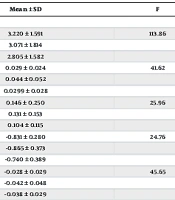
This study involved 30 healthy women with an average age of 29.5 ± 3.45 years (ranging from a minimum of 22 to a maximum of 35 years) and an average body mass index (BMI) of 25.3 ± 0.06 kg/m2. The Shapiro-Wilk test confirmed the normal distribution of the data. Furthermore, descriptive statistics such as mean and standard deviation, alongside inferential statistics like variance testing through repeated measures, are detailed in Table 1. The results, as displayed in Table 1, reveal that all parameters related to maximum power generation and absorption at the ankle joints underwent significant modifications across different arm positions. This suggests the involvement of both dominant and non-dominant limbs in muscle power dynamics.
Table 1.
Descriptive and Repeated Measures Analysis of Power of Ankle Joint During Walking with Different Upper Limb Immobilization a
| Mean ± SD | F | Sig b | |
|---|---|---|---|
| Left ankle mechanical power | |||
| PTXNO | 3.220 ± 1.591 | 113.86 | 0.00 |
| PTXND | 3.071 ± 1.814 | ||
| PTXNND | 2.805 ± 1.582 | ||
| PTYNO | 0.029 ± 0.024 | 41.62 | 0.00 |
| PTYD | 0.044 ± 0.052 | ||
| PTYND | 0.0299 ± 0.028 | ||
| PTZNO | 0.146 ± 0.250 | 25.96 | 0.00 |
| PTZD | 0.131 ± 0.153 | ||
| PTZND | 0.104 ± 0.115 | ||
| PJXNO | -0.831 ± 0.280 | 24.76 | 0.00 |
| PJXND | -0.865 ± 0.373 | ||
| PJXNND | -0.740 ± 0.389 | ||
| PJYNO | -0.028 ± 0.029 | 45.65 | 0.00 |
| PJYD | -0.042 ± 0.048 | ||
| PJYND | -0.038 ± 0.029 | ||
| PJZNO | -0.142 ± 0.123 | 46.37 | 0.00 |
| PJZD | -0.15 ± 0.13 | ||
| PJZND | -0.133 ± 0.120 | ||
| Right ankle mechanical power | |||
| PTXNO | 3.103 ± 1.040 | 243.68 | 0.00 |
| PTXND | 2.974 ± 1.258 | ||
| PTXNND | 2.780 ± 1.146 | ||
| PTYNO | 0.042 ± 0.040 | 33.14 | 0.00 |
| PTYD | 0.039 ± 0.046 | ||
| PTYND | 0.036 ± 0.040 | ||
| PTZNO | 0.088 ± 0.056 | 54.87 | 0.00 |
| PTZD | 0.110 ± 0.097 | ||
| PTZND | 0.092 ± 0.083 | ||
| PJXNO | -0.794 ± 0.269 | 185.46 | 0.00 |
| PJXND | -0.813 ± 0.362 | ||
| PJXNND | -0.753 ± 0.385 | ||
| PJYNO | -0.043 ± 0.037 | 50.31 | 0.00 |
| PJYD | -0.039 ± 0.034 | ||
| PJYND | -0.032 ± 0.030 | ||
| PJZNO | -0.162 ± 0.149 | 65.88 | 0.00 |
| PJZD | -0.160 ± 0.111 | ||
| PJZND | -0.127 ± 0.090 |
a P, muscle power; T, propulsion; J, attraction; X, sagittal plane; Y, frontal plane; Z, horizontal plane; NO, normal walking; ND, non-dominant arm; D, dominant arm.
b Sig: P ≤ 0.05.
5. Discussion
The objective of this study was to explore the impact of unilateral immobilization of the dominant and non-dominant upper limbs with a brace on the maximum three-dimensional mechanical power of the ankle joint during walking. The findings indicated significant alterations in all parameters of maximum power generation and absorption at the ankle joint across all three planes under both conditions. The natural oscillatory and reciprocal movement of the upper limbs in relation to the lower limbs is a fundamental aspect of walking (1, 13). Given that mechanical power is derived from the product of a kinetic and a kinematic variable, it follows that alterations in mechanical power consequently affect the kinetic and kinematic parameters of walking. Thus, changes in this biomechanical parameter during upper limb immobilization should be taken into account in rehabilitation programs by clinical biomechanics specialists and medical staff. Previous research in this field has demonstrated that inducing oscillation in the upper limbs contributes to enhanced stability and balance during walking, lowers energy expenditure, and impacts spatiotemporal variables (8). Although this study is novel in directly examining the effect of upper limb immobility on the mechanical power of the lower limbs, related research has been conducted on similar lower limb parameters, which will be further discussed.
In a related study, Bahrilli and Topuz explored the dominant and non-dominant aspects of upper limbs and assessed spatiotemporal variables along with walking speed in healthy participants (24). Their findings align with those of this study, noting that immobilization of the upper limbs affects kinematic parameters such as stride length, step width, and walking speed (24). Speed, a crucial kinematic parameter in walking that incorporates the mechanical power parameter of angular speed, experienced significant alterations when restrictions were applied to the movement of both the dominant and non-dominant upper limbs. Bruijn et al. investigated the influence of arm oscillation on overall stability, balance across body regions, and balance recovery during walking, concluding that while arm oscillation may not critically affect walking stability, it significantly impacts balance recovery and bodily control (25). This study's findings, highlighting notable effects on the control phases of walking across all three joints of the lower limb, regardless of limb immobility, suggest a consistency with the insights provided by Bruijn et al. (25).
In a related study, Dreyfuss et al. explored the impact of different brace placements on the dominant and non-dominant upper limbs concerning walking parameters (8). Their research, which focused on the spatiotemporal aspects of walking following various upper limb brace placements, aligns with the findings of the current study. They noted the most substantial changes with brace placement above the elbow and the least with placements below the elbow or during natural arm oscillation. Given that the upper limbs in this study were immobilized from the shoulder area, the results were in agreement regarding the type of brace placement. However, discrepancies were observed in walking speed and cadence between the two studies, potentially due to differences in the participants' age and levels of physical activity. In a study closely related to the current research, Umberger examined the effects of upper limb immobility and arm oscillation on kinetic, kinematic, and energy consumption parameters (26). He found no significant differences in the lower limbs' kinetic and kinematic parameters, except for ankle torque under two conditions, showing a divergence from the findings of this study. This difference might stem from variations in the method of immobilizing the upper limbs, as Umberger’s study involved immobilizing both upper limbs during walking, whereas the current study immobilized each upper limb individually (26).
The generalizability of this research is limited due to the small sample size and the absence of diverse age groups and genders, particularly older adults. Additionally, the study did not use EMG devices to measure muscle activity during walking with upper limb immobilization. Future research should examine biomechanical parameter changes during the immobilization of the trunk, head, and neck during walking and extend the investigation to other activities like running across different participant groups.
5.1. Conclusions
The objective of this study was to assess the effects of unilateral immobilization of the dominant and non-dominant upper limbs on the maximum three-dimensional mechanical power of the ankle joint during walking. The findings revealed significant alterations in all parameters of ankle power across all three planes. The immobilization of both the dominant and non-dominant upper limbs influences the mechanical power across all lower limb joints. Given that mechanical power reflects both kinetic and kinematic parameters, these insights should interest rehabilitation experts, therapy teams, and patients themselves to mitigate potential walking issues during the use of upper limb braces.