


1. Background
Spinal curvatures are essential for maintaining upright human bipedal posture (1). Among these curvatures, lumbar lordosis is recognized as a distinctive curvature in humans (2). The anatomical structure of lumbar lordosis plays a vital role in bearing and distributing vertical loads (3-5). Lumbar hyperlordosis refers to an excessive inward curvature of the lower spine (6). Estimates suggest that it affects approximately 10 - 30% of the general population, with rates varying according to age, physical activity, and biomechanical factors (7). The condition typically develops when the muscles and soft tissues of the core region, spanning the pelvis, abdomen, and spine, become weak or tight, creating an overall imbalance (8). According to the kinesiopathology model, disruption of one part of the movement system can progressively lead to broader musculoskeletal problems (9). In individuals with lumbar hyperlordosis, these muscle imbalances around the lumbopelvic region commonly produce anterior pelvic tilt, an overly pronounced lumbar curve, and reduced core stability (10). Therefore, strengthening and stabilizing the lumbar core is widely regarded as critical (11), not only to support healthy lower limb movement but also to improve overall spinal stability and reduce the risk of injury in the lumbopelvic region (12).
Lumbar core stability is widely recognized as a fundamental element for the optimal performance of lower-extremity movements. In previous studies, core stability exercises (CSE) have been considered an important clinical intervention for improving postural alignment, underscoring the role of CSE in enhancing lumbopelvic control and reducing complications associated with the lumbar region (13). Accordingly, lumbopelvic stability is closely related to overall postural alignment and can be impaired by spinal deviations, particularly lumbar hyperlordosis (14). Recent evidence suggests that alterations in spinopelvic alignment can significantly influence the anticipatory activation patterns of trunk-stabilizing muscles (15), indicating a close interaction between postural alignment and neuromuscular control mechanisms (16). Moreover, evidence indicates that CSE is significantly associated with improved neuromuscular control and increased intra-abdominal pressure (17).
Sport-specific training has been introduced as a novel approach in clinical interventions. A recent systematic review and meta-analysis demonstrated that Olympic combat sports can improve flexibility and various components of physical fitness, highlighting the potential role of such training in enhancing neuromuscular and postural function (18). In this context, taekwondo, a combat sport characterized by complex rotational trunk movements and high demands on balance and coordination, particularly within the lumbopelvic region, represents a functionally integrated training modality (19). Furthermore, taekwondo has specific biomechanical skill characteristics, involving diverse techniques performed in an open kinetic chain, and its dynamic nature requires high levels of neuromuscular coordination and lumbopelvic stability (20-21). Researchers have also developed various methods and tools to assess movement patterns, including the Functional Movement Screen (FMS), which is designed to evaluate the quality of functional movement patterns and identify individuals who may be at risk of injury (22-23). Although the biomechanical and physiological characteristics of taekwondo have been investigated in previous studies (24), evidence regarding the effectiveness of taekwondo-based CSE remains limited. Recent evidence suggests that taekwondo-based CSE interventions may positively influence postural characteristics in individuals with hyperlordosis. For example, Ebrahimi et al. (19) reported improvements in spinal alignment following NASM-based core stability training in males with hyperlordosis. However, the impact of such interventions on functional movement quality remains unclear. Functional movement patterns, assessed using the FMS, provide clinically relevant information on movement competency, mobility, and stability that cannot be inferred solely from postural alignment measures.
2. Objectives
Therefore, this study aimed to extend previous findings by simultaneously examining changes in spinal alignment characteristics and functional movement performance following a taekwondo-based core stability exercise program.
3. Methods
3.1. Study Participants
The present study used a non-randomized quasi-experimental design with pre- and post-test assessments. The study population comprised male individuals diagnosed with lumbar hyperlordosis at AJA University of Medical Sciences in Tehran. Participants were assigned to either the experimental (n = 15) or control (n = 15) group using a non-random convenience allocation approach. After enrollment, participants were assigned based on institutional scheduling availability and access to the training sessions rather than randomization. Individuals who were able to attend the supervised taekwondo-based training sessions were allocated to the experimental group, whereas those who were unable to attend regular sessions or who preferred not to participate in structured training were allocated to the control group. Based on a previous study, G*Power software was used to determine an appropriate sample size, applying a significance level of 0.05, a statistical power of 0.80, and an effect size of 0.78, yielding 15 participants per group. To be eligible, participants had to meet the following criteria: male sex; age 18 - 25 years; lumbar hyperlordosis (defined as a curvature exceeding 51 degrees); and no physical impairments, mental health conditions, prior surgeries, or ongoing use of specific medications. Participants were excluded if they had any medical condition restricting physical activity; were unable to complete the required assessments; reported lower limb pain during testing; or had experienced a lower limb injury in the preceding six months that either altered their training routine or required at least a one-week break from sport. Before participation, all procedures were explained in accordance with the Declaration of Helsinki, after which written informed consent was obtained from each participant. Participants then received clear instructions on how to correctly perform each test. The study was conducted after ethical approval was obtained on 19 January 2025 (IR.AJAUMS.REC.1403.225). Recruitment and eligibility screening were conducted between February and March 2025. Baseline (pre-test) assessments were completed in March 2025, followed by the 8-week intervention period from March to May 2025. Post-test assessments were conducted immediately after completion of the intervention in May 2025.
3.2. Procedure
First, demographic information was recorded for all participants. This was followed by measurement of the reduction in lumbar sagittal curvature using a Spinal Mouse device (IDIAG M360) and assessment of FMS scores using a standardized FMS kit. All data collected at this stage were documented as each participant’s pre-test results. Group allocation was performed after baseline (pre-test) assessments, ensuring that reduction in lumbar sagittal curvature and FMS scores were recorded before group assignment. The experimental group then participated in an 8-week CSE incorporating taekwondo movements. In parallel, the control group did not participate in any structured exercise program and was instructed to maintain their usual daily activities throughout the study period. To monitor potential confounding physical activity, participants reported any engagement in new or structured exercise during the intervention period using weekly self-report activity logs. No participants reported initiating new structured training programs during the study period. After completion of the 8-week program, participants underwent reassessment of both reduction in lumbar sagittal curvature and FMS scores, and these findings were recorded as post-test data.
3.3. Assessment of Sagittal Spinal Curvature and Hyperlordosis
The Spinal Mouse (SM) is a non-invasive handheld instrument used to measure spinal curvature, including lumbar lordosis, and has demonstrated high reliability (r = 0.94). Before the assessment, the examiner explained the procedure to all participants and ensured that they understood how to use the device correctly, minimizing the likelihood of errors or inaccurate readings. Detailed guidance on operating the accompanying software was also provided. Each participant removed their shirt and stood with their back to the examiner, with arms relaxed at their sides, while the software was set up on a portable laptop or computer. To maintain a consistent posture throughout the assessment, participants were asked to fix their gaze on a stationary point directly ahead. The examiner then initiated the spinal curvature measurement by locating and marking two anatomical landmarks on the skin: the spinous process of C7 as the starting point and the sacrum (S3) as the endpoint, identified by palpation and marked with a pencil. The C7–S3 assessment range was selected in accordance with the standard operating procedure of the Spinal Mouse device for evaluating sagittal spinal alignment in standing posture. Although the scanning path includes the thoracic and lumbar regions, the primary outcome extracted for analysis was the lumbar curvature parameter generated by the device software. The outcome analyzed in the present study was the lumbar curvature parameter automatically generated by the Spinal Mouse software after the C7–S3 scan. Although data acquisition was performed across the entire C7–S3 spinal profile, the software calculates regional spinal parameters based on predefined anatomical segments. Specifically, the lumbar curvature parameter represents the sagittal curvature of the lumbar region derived from the software’s internal segmentation algorithm rather than the global C7–S3 spinal curve. Therefore, the variable analyzed in this study reflects lumbar sagittal alignment characteristics rather than total spinal curvature across the entire scanned region. Because the Spinal Mouse is a surface-topography assessment system, the resulting lumbar curvature value should be interpreted as a non-invasive estimate of lumbar sagittal alignment rather than a radiographic measurement of vertebral lumbar lordosis. In individuals with lumbar hyperlordosis, alterations in lumbar lordosis are closely associated with overall spinopelvic and thoracolumbar alignment; therefore, assessment across the C7–S3 segment was considered appropriate to capture functional postural adaptations related to lumbar curvature. Similar approaches have been reported in a previous study using non-invasive spinal assessment systems. To locate the C7 vertebra, participants were asked to tilt their head forward while standing, making the most prominent vertebra (C7) visible and easily identifiable for marking. To identify S3, the examiner first palpated the posterior superior iliac spines (PSIS), bony projections in the lower back near the iliac crest corresponding to the level of S2. The examiner then moved their fingers slightly downward and toward the midline to palpate the sacral spinous processes, with S3 located just below S2 along the sacrum’s midline. After both landmarks were marked, the device was guided slowly and smoothly along the spine, maintaining consistent contact between both wheels and the skin throughout the entire recording. After the measurement, the examiner ended the recording by pressing the device’s left button, and a confirmation sound indicated that the data had been successfully transmitted to the computer. As the SM is rolled along the spine, it captures data points at 1.3 mm intervals, producing a sampling rate of approximately 150 Hz. Each lumbar lordosis measurement was performed three consecutive times, and the mean of the three trials was used for statistical analysis to improve measurement reliability and reduce random error. The outcome assessor was blinded to group allocation during post-test assessments. Although complete blinding to the assessment phase (pre-test vs. post-test) was not feasible due to the repeated-measures design, the assessor did not have access to participants’ previous scores during post-test evaluations, thereby reducing potential scoring bias. Participants were coded using identification numbers, and the assessor conducted measurements without access to group assignment (experimental or control), thereby reducing potential measurement bias.
3.4. FMS Assessment Protocol
The FMS kit was used to evaluate participants’ FMS scores. The assessment comprises seven movement-based tests: the Deep Squat (DS), Hurdle Step (HS), In-Line Lunge (ILL), Shoulder Mobility (SM), Active Straight Leg Raise (ASLR), Trunk Stability Push-Up (TSPU), and Rotary Stability (RS) (25-26). Each of the seven movement tests is rated on a scale from zero to three, with higher scores indicating better performance. Specifically, a score of 3 indicates that the movement was performed fully and correctly; a score of 2 indicates compensatory movement patterns; a score of 1 is assigned when the participant cannot complete the movement; and a score of 0 is recorded if the participant experiences pain during the test (27-28). The total FMS score was calculated by summing the scores of all seven individual tests, yielding a possible range from 0, indicating pain across every movement, to 21, indicating flawless performance throughout. Research has reported moderate intra-rater and inter-rater reliability for FMS assessments (29-30). In addition,demonstrated sufficient capability of the FMS to predict injury (31). To ensure accurate scoring, the examiner was required to observe and evaluate each participant from the front, back, and side during the tests. The same trained examiner conducted all pre-test and post-test measurements for both reduction in lumbar sagittal curvature and FMS assessments to minimize inter-rater variability and ensure measurement consistency across time points. Before data collection, the examiner underwent standardized training in FMS administration and scoring procedures based on the official FMS guidelines. Pilot assessments were conducted before the study to familiarize the examiner with scoring criteria and improve scoring consistency across movement patterns.
3.5. Intervention
The training program is presented in Table 1. All exercises were structured according to the FITT principle (frequency, intensity, time, and type), consisting of three sessions per week lasting 30 - 45 minutes and including a 5- to 10-minute warm-up and cool-down at the beginning and end of each session. The program was developed by a certified federation coach based on a prior study and comprised core muscle stability exercises incorporating taekwondo movements, specifically kicking techniques (PALCHAGI) targeting the lower limbs (Figure 1). The exercises adhered to the principles of overload and progressive development, with gradual increases in repetitions, sets, and duration over the course of the program. A circuit-based format was adopted, and intensity was individually tailored for each participant according to previous findings and individual tolerance (32). Attendance and adherence were recorded at each training session by the supervising coach. Adverse events, exercise-related pain, and musculoskeletal discomfort were monitored throughout the 8-week intervention period. Before and after each training session, participants were asked to report any pain, excessive fatigue, dizziness, discomfort, or injury associated with the exercises. Sessions were supervised by the certified coach and the researcher to ensure safety and correct execution. No serious adverse events or exercise-related injuries were reported during the intervention period. Participants in the experimental group showed high compliance with the intervention program, with an overall attendance rate of 93.3% (mean attendance: 22.4 out of 24 sessions). Minor missed sessions were mainly due to academic or scheduling conflicts. No participant missed more than four sessions, and all participants completed the minimum required exposure to be included in the final analysis. To ensure intervention fidelity, the coach used a standardized exercise protocol checklist based on the predefined training program. All sessions were supervised by the same certified taekwondo coach, and the exercises were delivered in a consistent sequence, with intensity progression and duration aligned with the FITT principles. The researcher periodically monitored sessions to ensure adherence to the protocol and consistency of execution across participants. At the outset, the coach provided practical demonstrations of all exercises to ensure correct performance. Within the program, some exercises required participants to hold static positions for a set duration measured in seconds, whereas others involved repeating movements for a specified number of repetitions. In addition, the examiner provided individualized feedback and real-time corrections to accommodate varying skill levels, thereby promoting confidence and gradual improvement without compromising safety or program integrity.
Table 1.Experimental Group Training Program a
| Exercises | Set*reps (secs) | |||
|---|---|---|---|---|
| 1st and 2nd Weeks | 3rd and 4th Weeks | 5th and 6th Weeks | 7th and 8th Weeks | |
| 1) Kneeling lunge + Apchagi | 3 × 10 s + 6 kicks | 3 × 15 s + 8 kicks | 4 × 10 s + 10 kicks | 4 × 15 s + 12 kicks |
| 2) Bridging + Apchagi | 3 × 10 s | 3 × 15 s | 4 × 10 s | 4 × 15 s |
| 3) Extended child’s pose + Ditchagi | 3 × 10 s + 8 kicks | 3 × 15 s + 10 kicks | 4 × 10 + 12 kicks | 4 × 15 s + 15 kicks |
| 4) Abdominal pushups + Yupchagi | 3 × 10 s | 3 × 15 s | 4 × 10 s | 4 × 15 s |
| 5) Plank + Ditchagi | 3 × 15 s + 8 kicks | 3 × 20 s + 10 kicks | 4 × 20 s + 12 kicks | 4 × 25 s + 15 kicks |
| 6) Side plank + Yupchagi | 3 × 15 s + 8 kicks | 3 × 20 s + 10 kicks | 4 × 20 s + 12 kicks | 4 × 25 s + 15 kicks |
a Abbreviations: sec, seconds; wk, week; reps, repetitions. set x reps indicates the number of sets multiplied by repetitions or holding duration.
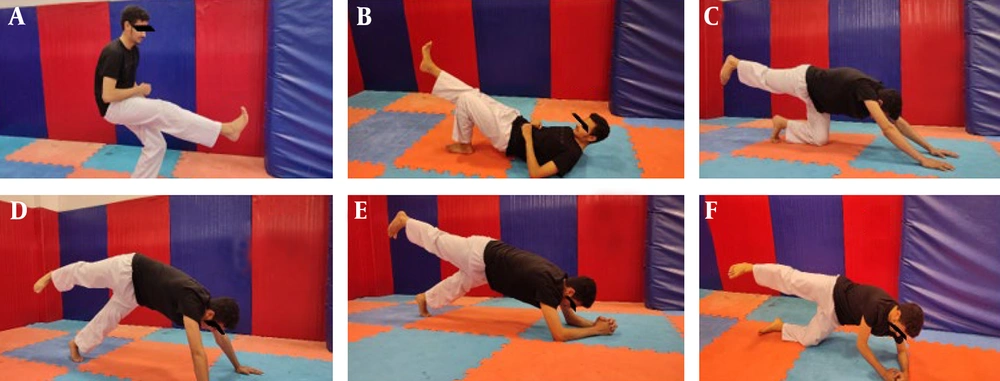
Figure 1.
Illustration of the taekwondo-based core stability exercise intervention program used in the experimental group
3.6. Statistical Analysis
The Shapiro-Wilk test was used to assess the normality of the data distribution, after which inferential statistical analysis was performed using analysis of covariance (ANCOVA), with the significance level set at P < 0.05. In all ANCOVA models, baseline (pre-test) values of each dependent variable were entered as covariates. ANCOVA assumptions were evaluated before hypothesis testing. Homogeneity of variances was examined using Levene’s test. Importantly, the homogeneity of regression slopes assumption was tested by examining the interaction between group and baseline scores, and no significant interactions were observed. Effect sizes for the ANCOVA analyses were calculated using partial eta squared (ηp2). Values of ηp2 of approximately 0.01, 0.06, and 0.14 are typically interpreted as small, medium, and large effects, respectively. Given the multiple FMS subcomponents analyzed, the potential for Type I error inflation was considered. However, no formal Bonferroni correction was applied because the FMS components were treated as functionally related outcomes within a unified movement screening construct rather than as independent primary endpoints. Instead, interpretation was based on ηp2 and consistent directional changes across outcomes. All statistical analyses were performed using SPSS software, version 27.
4. Results
Table 2 presents the demographic characteristics of participants in both groups and shows no significant between-group differences in demographic variables. In addition, the Shapiro-Wilk test confirmed that the data were normally distributed.
Table 2.Demographic Characteristics of Participants a
| Data and Group | Mean ± SD | P-Value |
|---|---|---|
| Age | ||
| Experimental | 20.48 ± 2.55 | 0.29 |
| Control | 21.12 ± 2.03 | 0.29 |
| Height | ||
| Experimental | 179.67 ± 4.04 | 0.17 |
| Control | 178.80 ± 3.29 | 0.17 |
| Weight | ||
| Experimental | 64.26 ± 4.14 | 0.42 |
| Control | 62.13 ± 4.74 | 0.42 |
| BMI | ||
| Experimental | 20.98 ± 0.96 | 0.97 |
| Control | 20.19 ± 0.97 | 0.97 |
a Abbreviations: BMI, body mass index; SD, standard deviation.
Table 3 shows significant differences between the experimental and control groups in all FMS components (P < 0.05) and in lumbar sagittal curvature (P = 0.003). These findings indicate that the taekwondo-based CSE significantly affected FMS scores and lumbar sagittal curvature.
Table 3.ANCOVA Results Comparing Experimental and Control Groups for Functional Movement Screen Scores and Lumbar Sagittal Curvature (Adjusted for Baseline Values) a
| Variables and Stages | Experimental | Control | Adjusted Mean Difference (95% CI) | F (Group effect, adjusted) | ηp2 | Mean square | P Value b |
|---|---|---|---|---|---|---|---|
| Deep Squat | |||||||
| Pre-test | 2.15 ± 0.38 | 1.80 ± 0.79 | 0.68 (0.11 to 1.25) | 5.87 | 0.17 | 190.934 | 0.022 |
| Post-test | 2.60 ± 0.51 | 1.87 ± 0.77 | 0.68 (0.11 to 1.25) | 5.87 | 0.17 | 190.934 | 0.022 |
| Hurdle Step | |||||||
| Pre-test | 2.12 ± 0.69 | 1.90 ± 0.47 | 0.53 (0.15 to 0.91) | 8.59 | 0.24 | 350.209 | 0.004 |
| Post-test | 2.50 ± 0.51 | 1.94 ± 0.54 | 0.53 (0.15 to 0.91) | 8.59 | 0.24 | 350.209 | 0.004 |
| In-Line Lunge | |||||||
| Pre-test | 1.90 ± 0.83 | 2.01 ± 0.47 | 0.64 (0.31 to 0.97) | 17.19 | 0.38 | 787.350 | 0.001 |
| Post-test | 2.55 ± 0.52 | 1.88 ± 0.46 | 0.64 (0.31 to 0.97) | 17.19 | 0.38 | 787.350 | 0.001 |
| Shoulder Mobility | |||||||
| Pre-test | 2.07 ± 1.05 | 2.30 ± 0.73 | 0.49 (0.18 to 0.80) | 14.02 | 0.34 | 600.116 | 0.002 |
| Post-test | 2.59 ± 0.50 | 2.07 ± 0.52 | 0.49 (0.18 to 0.80) | 14.02 | 0.34 | 600.116 | 0.002 |
| Active Straight Leg Raise | |||||||
| Pre-test | 1.85 ± 0.75 | 2.28 ± 0.44 | 0.32 (0.11 to 0.53) | 13.02 | 0.32 | 509.407 | 0.002 |
| Post-test | 2.32 ± 0.45 | 1.99 ± 0.41 | 0.32 (0.11 to 0.53) | 13.02 | 0.32 | 509.407 | 0.002 |
| Trunk Stability Push-Up | |||||||
| Pre-test | 1.90 ± 1.15 | 1.89 ± 0.50 | 0.96 (0.58 to 1.34) | 27.57 | 0.50 | 132.523 | 0.001 |
| Post-test | 2.75 ± 0.49 | 1.75 ± 0.46 | 0.96 (0.58 to 1.34) | 27.57 | 0.50 | 132.523 | 0.001 |
| Rotary Stability | |||||||
| Pre-test | 1.85 ± 0.59 | 1.90 ± 0.54 | 0.76 (0.41 to 1.11) | 20.62 | 0.43 | 737.859 | 0.001 |
| Post-test | 2.50 ± 0.49 | 1.71 ± 0.50 | 0.76 (0.41 to 1.11) | 20.62 | 0.43 | 737.859 | 0.001 |
| Lumbar lordosis angle | |||||||
| Pre-test | 57.33 ± 3.59 | 56.59 ± 3.65 | -3.94 (-5.61 to -2.27) | 67.05 | 0.71 | 55.80 | 0.003 |
| Post-test | 52.20 ± 3.00 | 56.27 ± 3.40 | -3.94 (-5.61 to -2.27) | 67.05 | 0.71 | 55.80 | 0.003 |
a Values are expressed as mean ± SD unless otherwise indicated. Adjusted mean differences and corresponding 95% confidence intervals were derived from ANCOVA models controlling for baseline values. Abbreviations: CI, confidence interval; ηp2, partial eta squared.
b A P value ≤ 0.05 was considered statistically significant.
5. Discussion
The results of the present study indicate that participation in taekwondo-based CSE was associated with improvements in FMS scores and a reduction in lumbar sagittal curvature in men with lumbar hyperlordosis. By simultaneously engaging balance, force production, and trunk control, taekwondo-based CSE may facilitate motor learning processes and improve neuromuscular control (33). In individuals with lumbar hyperlordosis, who typically present with inefficient movement patterns and muscle imbalance (34), these exercises may promote dynamic core stability and enable the retraining of correct movement patterns (35). Unlike conventional abdominal strengthening exercises such as crunches, taekwondo-based CSE emphasizes maintenance of a neutral pelvic position and inhibition of compensatory movements, thereby improving coordination between deep and superficial muscles and enhancing feedforward mechanisms (36). Regular performance of these exercises may improve performance on tests such as the Deep Squat (due to better control of the center of gravity) and the Trunk Stability Push-Up (due to increased endurance of the trunk-stabilizing muscles). Thus, motor learning may directly contribute to improvements in FMS scores on these tests (32).
Weakness of the core muscles, including the transversus abdominis, diaphragm, multifidus, and pelvic floor, in individuals with lumbar lordosis imposes unbalanced pressure on the facet joints, the sacroiliac joint, and the hip joint, leading to low back pain and range of motion limitation (37, 38). Taekwondo-based CSE, through simultaneous activation of these muscles and increased intra-abdominal pressure, reduces stress on the joints and intervertebral discs and increases load-bearing capacity during movement (39). Another mechanism by which taekwondo-based CSE may increase the FMS score is improved distribution of load and pressure across the joints, enabling a full range of joint motion (40). By restoring balanced pressure distribution on the joints and preventing compensatory patterns resulting from range of motion limitation, taekwondo exercises may directly improve performance on the remaining components of the FMS test, such as Shoulder Mobility and Hurdle Step. Improvements in individual FMS components suggest enhanced movement quality; however, the clinical significance of these changes should be interpreted with caution. Although several components improved by approximately 0.5 to 1 point, it remains unclear whether these changes exceed thresholds associated with meaningful reductions in injury risk or functional limitation.
Taekwondo represents an effective approach for addressing postural and musculoskeletal imbalances, including lower limb abnormalities and body alignment issues, through its wide range of techniques and movements. Consistent with this, one study examining the impact of recreational taekwondo training on the musculoskeletal systems of children found improvements in specific conditions such as foot alignment, which is consistent with the results of the present study (41). Similarly, another study found that the Apkoobi (front stance) position had a meaningful positive effect on correcting pelvic inclination and hyperlordosis angles, aligning with the results of the present study (42). Further research has shown that taekwondo training enhances leg length, leg inclination, and trunk slope through strengthening muscles that support both the lower limbs and the spine (43). These findings indicate that a training program built around fundamental taekwondo movements can effectively correct postural deformities. The underlying mechanism may involve activation of lower limb movements characteristic of taekwondo, such as Juchumseogi, which stimulate eccentric contractions of key muscles, including the gluteus maximus (44), semimembranosus, semitendinosus, and adductor magnus. At the same time, this movement also triggers concentric contractions in a range of muscles, including the quadratus lumborum, pectineus, tensor fasciae latae, adductor brevis, adductor longus, adductor magnus, rectus femoris, and sartorius (45). Taken together, these findings suggest that taekwondo movements can strengthen the muscles responsible for correcting abnormal body alignment. Although the reduction in lumbar sagittal curvature was statistically significant, its clinical relevance should be interpreted cautiously. The mean reduction in the experimental group (approximately 5° from baseline) may be considered moderate in magnitude and, while it may contribute to improved spinopelvic alignment, it remains unclear whether this degree of change is sufficient to produce clinically meaningful reductions in symptoms or long-term biomechanical risk. Therefore, the observed change should be interpreted as a potentially meaningful postural adaptation rather than a definitive structural correction.
5.1. Study Limitations
Despite the promising findings, several limitations should be acknowledged. First, the quasi-experimental design without randomization may introduce selection bias and limit causal inference. Second, the relatively small sample size and the use of convenience sampling from a single institution reduce the generalizability of the results to broader populations. In addition, the study included only male participants, which restricts the applicability of the findings to females, older adults, or clinical populations with different characteristics. Furthermore, although validated tools such as the Spinal Mouse and FMS were used, potential measurement bias and inter-rater variability cannot be entirely excluded. In addition, spinal curvature was assessed using a non-invasive, surface-based measurement system across the C7–S3 region rather than radiographic segmental lumbar measurements. Therefore, the findings should be interpreted as reflecting functional sagittal spinal alignment and lumbar curvature characteristics rather than isolated vertebral lumbar sagittal curvature. The lack of control over participants’ daily physical activities and lifestyle factors may also have influenced the outcomes. Another important limitation is the non-randomized allocation of participants, which may introduce selection bias and limit internal validity. Because group assignment was influenced by availability and participant preference rather than randomization, baseline equivalence cannot be fully guaranteed, despite no statistically significant differences in demographic variables. Finally, the absence of comparison with other established exercise interventions makes it difficult to determine whether taekwondo-based CSE is superior to conventional rehabilitation approaches. Future studies with larger, randomized samples, longer follow-up periods, and comparative intervention designs are recommended to confirm and extend these findings.
5.2. Conclusions
The findings of this study suggest that taekwondo-based CSE may be associated with improvements in functional movement patterns and reductions in lumbar sagittal curvature in men with hyperlordosis, highlighting its potential as an integrative and functional rehabilitation approach. However, these results should be interpreted with caution because of limitations such as the small sample size, non-randomized design, and restricted participant characteristics.


