1. Background
Most people have short hamstrings as a result of spending a long time seated every day. A study indicated that 75% of males and 35% of females over the age of 10 proved to have such short hamstrings (1). These short hamstrings may cause stress in other parts of body, causing postural disorders and chronic pain (2). Short hamstrings can lead to posterior rotation of pelvis and flat back (3). Reduced hamstring extensibility is often associated with hip and knee joint movement dysfunction (4, 5) and lumbosacral postural changes (6). This may be confirmed by induced hamstring shortening, which causes gait abnormalities in healthy people (7). Imbalances in apparent muscle extensibility between the right and left hip extensors, including the hamstrings, may also predispose athletes to injury (8). Currently, effective interventions for improvement of hamstring shortness are limited. The stretch technique has been employed to increase range of motion( ROM), (9), improve short muscles (10), aid muscle flexibility (11), and treat osteoarthitis pain (12). In a recent study, Goldman and Jones indicated that stretching as a sole intervention did not prevent hamstring injury (13). In another study, Bakhtiary and coworkers found that localized application of vibration improved short hamstrings in female university students (14). A number of studies compared different methods for improvement of short hamstrings. Puentedura and coworkers compared hold relax (HR) and static stretch methods (15), Kumar compared cyclic loading and HR (16), and Taylor and coworkers studied stretch with superficial thermal modalities (17); they reported a variety of results. Application of stretch with other modalities in rehabilitation appeared to have worthwhile benefits in patients with shortening muscles. Several combinations have been suggested: stretch in conjunction with superficial and deep heating (18), receiving stretch and ultrasound (US) simultaneously (19), static stretch and heat (20), and heat and active exercise prior to stretching (21). In a previous study, Draper and colleagues investigated stretch with shortwave diathermy for flexibility of hamstrings and reported that shortwave diathermy did not have greater effects than the stretching alone (22). Because of the potential role of the use of US in movement and muscle dysfunction, a range of interventions, intended to improve muscle extensibility, have been investigated (19, 23, 24). Reed and colleagues compared US and stretching to improve the knee ligament extensibility and reported that heating with US did not augment the muscle length more than stretching alone (23). A study on the effects of US in improvement of short hamstring muscle in healthy males reported that it was effective on increasing the muscle length (25). A similar study conducted on hamstring muscles; it is employed stretch and US and reported that stretch with US improved the muscle length more than static stretch alone (24). However, these reports were opposed by another research which showed that US therapy had no effect on muscle length (23, 26). To our knowledge, US as an adjunct to stretching has not been fully investigated in a randomized control trial.
2. Objectives
The purpose of this study was to examine the effects of adding US therapy to passive stretching on muscle length in people with hamstring shortening.
3. Patients and Methods
A randomized control trial was approved by the Ethical Committee of Semnan University of Medical Sciences and included; 34 male university students participated in the study. Eligibility was determined one week before group allocation; thus, allowing concealed allocation. After that, the participants were randomly allocated to experimental or control groups by flipping a coin. Afterwards, the subjects in the experimental group were randomly allocated to either group one (US and stretch), or group two (HR program), again by flipping a coin. The experimental groups undertook five weeks of intervention program, while the control group carried out its normal daily living activities.
3.1. Participants
A sample of 34 students were eligible; the mean age was 21.65 years old (SD = 1.84) and the age range was 18-24. The subjects were included if they had short hamstrings, as indicated by their straight leg raise (SLR) values. Values lower than 65 degrees were classified as indicating short hamstrings. Subjects were excluded if they had any orthopedic, neurologic, cardiovascular or skin diseases. All participants were informed about the procedure of experiment and signed consent form.
3.2. Intervention
Group one received static stretch and US. In this group, stretch was performed whilst subjects were in the supine position, lying on a treatment bench. The pelvis and the opposite leg were fixed using a strap; then, the therapist moved the experimental leg to 90 degrees of the hip flexion and the end of full extension of the knee ROM. When the knee was fully extended, the US procedure was applied over the medial and lateral hamstring tendons, above the knee extension. The parameters of US were determined based on the previous studies which reported improvement of muscle length (25, 27, 28). This group received stretching with 3 MHz of continuous US (1.5 W/cm2) for four minutes (four minutes of US with a four-minute static stretch of hamstrings, five times per week for a five-week period). US was applied on the tendon of medial and lateral hamstrings, two minutes each. Group two received HR. The participants received four cycles of HR training including 20 seconds of contraction and 10 seconds of relaxation. The HR technique was performed in supine position. The hamstring muscle was passively taken to the end of the range. The maximum contraction of hamstring was carried out against resistance by the therapist. This was continued for at least 20 seconds. The muscle was then relaxed, taken to a new range and held for about 20 seconds. The process was repeated three times. The parameters of HR training were determined based on the previous studies which reported improvement of muscle length (15, 25). The experimental groups undertook five weeks of the intervention program, while the control group carried out their normal activities of daily living.
3.3. Outcome Measurement
Outcomes were measured at baseline and after the five-week intervention by two physiotherapists with more than five years of clinical experience who were blinded to group allocation throughout the study. The participants were not blinded to group allocation. All the subjects showed a SLR of the right lower extremity beyond 65 degrees. Hamstring flexibility and range of motion were measured using SLR and passive knee extension (PKE) tests before and after the treatment. SLR test was carried out based on Kendal and colleagues (29) results. The client was positioned supine on a couch with one limb resting straight out (hip in neutral position and knee in extension), whilst the tester passively flexed the hip, trying to keep the knee extended. If the hamstrings were tight, the subject was unable to achieve around 90 degrees. A handheld goniometer was used to measure the hamstring flexibility during a passive SLR. This test was used because of its high reliability; all the goniometric tests were carried out through the same method and the same testers (29). The axis of the goniometer was aligned with the hip joint at a neutral position. With the stationary arm parallel to the trunk, and the moveable arm parallel to the longitudinal axis of the femur, with the knee held straight, the subject’s leg was moved passively into the hip flexion until tightness was felt. At that point, the tester read and the range of motion were recorded. Each test was carried out three times and the average was recorded as data.
Test of PKE was carried out based on a study (30). The subjects were placed supine on a couch, with the contralateral leg extended and held firmly against the plinth by use of a seat belt across the upper and lower thigh. A handheld goniometer was placed at the lateral side of the knee and was centered on the knee joint; one arm was aligned with the greater trochanter of the femur and the other with the lateral malleoli of the fibula. The subject was positioned in a way that the leg to be measured was in 90 degrees of hip and the knee flexion and the plantar flexion of the foot were relaxed. The tester’s one hand maintained the subject’s anterior thigh against the cross bar of the adjustable hurdle while the other hand extending the knee passively. The knee joint angle was measured using the preplaced universal goniometer to the nearest degree when the subject reported slight tension within the hamstring muscle group or when the tester observed the hamstring muscles beginning to extend the hip joint. Afterwards, the tester read the goniometer and the range of motion was recorded. Each test was carried out three times and the average was recorded as data.
3.4. Data Analysis
The effects of adding US to a regimen of stretching were examined using the mean (95% CI) between the groups difference of pre-to-post intervention changes of hamstring shortening, using SLR and PKE tests. Only observed differences consistent with the direction specified by our hypothesis were tested for their statistical significance, using a t-test for range of motion measures.
4. Results
4.1. Flow of Participants Through the Trial
After four sessions of intervention, two participants were excluded from the study at their requests.
4.2. Compliance With the Trial Method
All the participants in group one (US and stretch) received US and stretching at all the scheduled sessions and all the participants in group two (HR group) received a cycle of contraction/relax at all the scheduled sessions. The control group received no special intervention and carried out its normal daily living activities.
4.3. Baseline Measurements
Tests for demographic characteristics and the baseline of SLR and PKE tests showed that there was no significant difference between the groups (the experimental and control groups) (Tables 1 and 2).
| Participants, n = 34 | |||
|---|---|---|---|
| Ex US, n = 12 | Ex HR, n = 12 | Con, n = 10 | |
| Age, y | 21.67 ± 1.95 | 21.92 ± 1.91 | 21.29 ± 1.73 |
| Weight, kg | 70.58 ± 6.31 | 68.16 ± 8.53 | 69.40 ± 6.68 |
| Height, cm | 172.16 ± 6.04 | 169.41 ± 9.15 | 173.90 ± 7.03 |
aAbbreviations: Con, control group; Ex, experimental; HR, hold relax; US, ultrasound.
bData are presented as mean ± SD
| US 1 (n = 12) | US 2 (n = 12) | HR 1 (n = 12) | HR 2 (n = 12) | Cont 1 (n = 12) | Cont 2 (n = 12) | |
|---|---|---|---|---|---|---|
| SLR, Deg | 46.5 ± 8.68 | 54.08 ± 10.04c | 49.83 ± 10.07 | 54.66 ± 11.04c | 49.50 ± 8.83 | 50.30 ± 10.26d |
| PKE, Deg | 139.00 ± 3.01 | 160.75 ± 8.17c | 139.41 ± 3.17 | 155.83 ± 7.06c | 139.5 ± 4.35 | 140.7 ± 4.48d |
aAbbreviations: Cont, control group; Deg, degrees; HR, hold relax; PKE, passive knee extension; SLR, straight leg raise; US, ultrasound.
bData are presented as mean ± SD. All the data belong to weeks 0-5.
cSignificant differences.
dNot significant differences.
4.4. Effects of Intervention
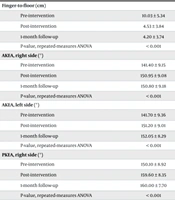
Intervention data at two measurement times (weeks 0 and 5) as well as within and between-intervention data are presented in Tables 2 and 3. The mean increase in SLR in group one (US with stretch) was 7.75 ± 4.59, while it was 4.91 ± 2.60 in group two (HR). The mean difference of increase of SLR in groups one and two was 2.84 (P = 0.08) (95% CI); the effect size was 79%, which is high. The mean increase of PKE in group one (US with stretch) was 21.75 degrees (SD = 7.28), while it was 16.41 degrees (SD = 7.5) in group two. The mean difference in increase of passive knee extension due to US with stretch regime was 5.34 (P = 0.09). The effect size was 72%, which is high. The mean changes of SLR and PKE tests in the two experimental groups indicated that there were significant differences within the groups (P < 0.05), while no significant differences was seen between the experimental groups. However, the comparison of mean changes between the two experimental groups and the control group showed significant differences in terms of SLR and PKE tests (P < 0.05), while the comparison of pre- and post- SLR and PKE test showed no significant difference within the control group (P > 0.05).
Table 3.
Mean ± SD (95% CI) Difference Between the Groupsa
| Outcome | Groups, Week 5 Minus Week 0 | Differences Between the Groups | ||
|---|---|---|---|---|
| US | HR | US minus HR | P value | |
| SLR (Deg) | 7.75 ± 4.59 | 4.91 ± 2.60 | 2.84 (0.33-5.99) | 0.08b |
| PKE (Deg) | 21.75 ± 7.28 | 16.42 ± 7.50 | 5.34 (0.98-11.5) | 0.09b |
aAbbreviations: HR, hold relax; Deg, degrees; PKE, passive knee extension; SLR, straight leg raise; US, Ultrasound.
bNot a significant difference.
5. Discussion
In this study, no differences were found between the two groups treated with US and stretch or HR exercises. However, both techniques improved the muscle length. A number of studies have compared different treatment methods such as HR and static stretch (15), diathermy and stretch (22), surface heat and stretch (17) and cyclic loading and hold relax (16), to increase the extensibility of short muscles. Their reports were similar and no significant differences were reported between the two methods, as we found in this study. In a previous study, the authors employed HR and contract relax-antagonist contract (CRAC) techniques; they reported that the two techniques of proprioceion neromuscular facilitation (PNF) were almost equal in their clinical effectiveness for improving hamstring flexibility and either of the techniques may be used in clinical practice for improving hamstring flexibility. The reason could be the theoretical basis of the technique; ie, two physiological mechanisms are engaged during the application of PNF-CRAC stretching, which are autogenic inhibition via recruitment of the golgi tendon organs (GTOs) and reciprocal inhibition, which causes inhibition of the target muscle following contraction of the opposing muscle (31).
However, in a study comparing the two techniques including HR and static stretch, they reported that HR was more effective in increasing hamstring flexibility than passive stretching. As the present study revealed, HR was effective in flexibility of short hamstring (32). In addition, the results of this study were similar to those of Draper and coworkers, who employed US with stretch to improve ankle ROM, and reported that the effects were short-term and were not greater than the ROM gained from stretching alone (19). In another study, it is applied US and stretch on short hamstrings and reported that muscle extensibility did not increase during or following a 3-MHz US treatment of muscle (33). Their subjects were male and female university students. In the present study, all the subjects were male students and the frequency of US was set at 3 MHz. Our findings were not in agreement with the work of a study (24) and Shadmehr and Nadimi (25), who employed US to improve muscle length and reported an increase in muscle length. The differences may be attributed to assessment and treatment methods as well as treatment parameters. In a study it is employed 1-MHz US for the first seven minutes of 10 minutes of static stretch for five consecutive days (24). Shadmehr and Nadimi applied 1-MHz US for a four-minute period for 12 sessions (25). It seems that this should not omit further investigation of US as a potential preventive tool against hamstring shortness in this population. The effect of US on short hamstrings may be effective, because it is assumed that temperature causes a decrease in muscle stiffness (23). Previous studies demonstrated that different levels of relative tissue temperature change from baseline produce a variety of effects, including extensibility, 4ºC or greater increased extensibility of collagen, and decreased stiffness (28). It is noted that in the current study, US with stretch was more effective than HR, although not statistically. It is not obvious why US did not significantly increase the effects of muscle stretching; one possibility is that the US parameters including duration and mode of application were inadequate. However, there has been no study to define the standard US parameters that may affect the muscle length. Some previous studies employed a variety of parameters for US; ie, the period of application of US varied between 2.5-10 minutes: seven minutes (24), four minutes (34) and 2.5 minutes (23); in the present study, four minutes. They reported a variety of results, which might cause controversy in the effect of using US for hamstring shortening. However, a relatively high power was found in our data calculation, indicating no superior effect due to the use of US. In conclusion, US combined with stretch did not have a statistically significantly greater effect on short hamstrings than the HR technique. However, both techniques resulted in improved muscle length.