
1. Background
Cancer is regarded as a major health problem for the present century, and its growth over the past two decades along with its negative effects on the physical, psychological, social, and economic aspects of human life has become increasingly a concern for health professionals (1). Deka et al. (2), reported that cancer is a life-threatening disease, killing more than 7.6 million people annually. Breast cancer is the most unsettling of women’s health problems. According to a 2012 report, it is the second most prevalent type of cancer after lung cancer and the second leading cause of cancer deaths among women. Accounting for about 23% of all cancers, breast cancer annually affects 1.38 million new cases worldwide (3). Based on estimates conducted in 2009, the prevalence of breast cancer will reach 10 - 15 million by 2020 (4). In addition, according to the statistics released in 2009, about 12% of US women (i.e., 1 out of 8) develop this condition in their lifetime (5).
Breast cancer is the most widespread malignancy among Iranian women (6), accounting for about 32% of all cancers in females (7). The most common age in Iranian women for getting this disease is 47, which is one decade below developed countries (8). With the aging of the population and higher life expectancy, more cases of cancer are expected to occur in Iran (9). Women with breast cancer undergo treatments such as chemotherapy, radiotherapy, as well as surgery and suffer from side effects like hair loss, nausea, and sexual problems. While it is an orthodox treatment in cancer patients, chemotherapy gives a rise to many complications and can adversely affect the level of physical, psychological, and social function; ultimately, it diminishes patient’s quality of life and discourages him/her from completing the treatment (10, 11). Chemotherapy is a systemic approach, unlike the topical methods of radiotherapy and surgery, women with breast cancer who receive it develop numerous side effects such as fatigue, nausea, vomiting, sleep problems, altered bowel function (diarrhea or constipation), and taste disorder (12). Depending on the severity of side effects, the patient may sometimes need to be hospitalized and receive special care (13). Patients undergoing outpatient chemotherapy require proactive measures to control treatment-related complications (14). In this regard, long-term therapies threaten women’s ability to perform their social roles, either as a housewife or a working woman, thus, affecting their quality of life (15). Given that women are one of the most fundamental pillars of the family and society, improving the quality of life of those females who have breast cancer not only prolongs their survival but also enhances the quality of life of the family as a whole (16). The role of the treatment team in improving patients’ quality of life is pivotal; in this context, the nurses’ part in treatment is more prominent than other personnel (17). Nurses can provide self-care services to raise patients’ quality of life and maintain their health; they may also help clients adapt to the effects of the disease (18). Shaban et al. (19), studied patients with different types of cancer and observed that 34% of subjects had poor quality of life. Thus, extending patients’ life is a vital but not sufficient objective, because patients do not simply want to survive but want to live (20). In this regard, health care services provided to people with cancer increasingly involve developing interventions, such as self-care programs, which could both extend the lifespan of patients and raise their quality of life (21). Providing cancer patients with information about diagnosis, treatment, and reducing complications enables them to better participate in the decision-making process and eventually improve their quality of life (22). Promoting self-care can assist patients to achieve independence, prevent frequent hospitalization, and lower staggering costs [of treatment] (23).
Being a strategy for adapting to life’s stressful events, self-care promotes health and independence and includes specific activities that could relieve symptoms if implemented (24). Many studies have been carried out into the impact of self-care education on various diseases (24, 25). The interventions employed in each research has exerted substantial effects on controlling the disease in question (24, 25). It is crucial to pay special attention to breast cancer due to it being one of the most prevalent cancers among women in Iran (22). As an indispensable axis of family, women’s physical and mental health could tremendously influence other members of the family. Meanwhile, women will be able to fulfill their role as spouses and mothers, provided that they are capable of taking care of themselves and maintaining their independence. Hence, reinforcing women’s self-care capacity could translate into improving living conditions both for themselves and their families, who are constantly involved in the treatment/care process. As a result, teaching appropriate solutions to these patients is essential to cope with the experience of the disease and to overcome the pathological aspects of the diagnosis, treatment, and follow-up. Indeed, training is a pharmaceutical, non-invasive, and low-cost method for controlling physical and psychological problems in general.
2. Objectives
This study aimed at investigating the impact of self-care education on the quality of life of women with breast cancer receiving chemotherapy at teaching hospitals affiliated with Zahedan University of Medical Sciences in 2019.
3. Methods
After obtaining necessary permits from the Ethics Committee of Zahedan University of Medical Sciences (code: IR.zaums.REC.1397.375), the authors performed this quasi-experimental study on 90 women with breast cancer undergoing chemotherapy at teaching hospitals affiliated with Zahedan University of Medical Sciences between January and June 2019. The sample size was estimated at 40 for each group with a confidence of 95% and a power of 80% based on the results of a similar study by Salehi et al. (26), who addressed the quality of life of patients with breast cancer in 2016 (S1=13.91),
Using colored cards, individuals meeting the inclusion criteria were randomized into the experimental and control groups. The cards were put into a container and each eligible patient picked one card; thus, patients taking pink cards were allocated to the experimental group and those taking yellow cards were assigned to the control group. The inclusion criteria were: age between 20 - 60 years, lack of metastasis, no known heart disease and mental illness, having a history of at least one chemotherapy session, and no history of participation in any formal training or counseling program in the past three months. On the other hand, the exclusion criteria were: skipping more than one training session, occurrence of any life-threatening event during the study such as metastasis and death.
Data collection consisted of two parts: demographic questionnaire (age, marital status, number of children, and education level) and a 53-item quality of life questionnaire. The latter included the European Organization for Research and Treatment-QOL and Breast Cancer Specific Module questionnaire (EORTC QLQ-C30 and EORTC QLQ-BR23). The EORTC QLQ-C30 is a multi-dimensional 30-item questionnaire, which evaluates quality of life based on five functional scales (physical, role, cognitive, emotional, and social functioning) and three symptom scales (fatigue, pain, and nausea/vomiting). The questionnaire also includes six other scales: dyspnea, insomnia, appetite loss, constipation, diarrhea, and financial difficulties (27). The EORTC QLQ-BR23 comprises of two functional scales (sexual functioning and body image) and three symptom scales (arm symptoms, breast symptoms, and systematic therapy side effects). Other items evaluate sexual pleasure and shock due to hair loss. EORTC QLQ-BR23 needs to be completed along with EORTC QLQ-C30. The scores obtained in both questionnaires range from 0 to 100. Higher scores of symptom scales indicate more severe symptoms and lower quality of life, whereas higher scores in the functional scales represent a greater quality of life. The reliability and validity of the Persian version of both instruments were confirmed (Cronbach’s alpha = 0.72 - 0.92) by Montazeri et al. (28). In the present study, test re-test method was employed to ascertain the reliability of the questionnaires. The questionnaires were presented to 10 patients twice, two weeks apart. Then, the correlation between the results was analyzed (r = 0.85).
Once patients’ informed consent was acquired, qualified samples were recruited using convenience sampling. At first, the demographic form and quality of life questionnaires were completed by both groups. The control group received only routine care. On the other hand, patients in the experimental group along with their primary caregivers were provided with both routine care and three group educational sessions on self-care behaviors related to potential and actual problems. Each of these weekly sessions lasted for 45 minutes. These question-and-answer sessions were held face to face using a pamphlet (Table 1).
Table 1.
Content of Educational Sessions
| Session | Title | Topic | Duration |
|---|---|---|---|
| 1 | Introduction to breast cancer | Orientation, discussing cancer, chemotherapy, identifying patient’s self-care requirements, etc.; Significance of caring for oneself | 45 minutes |
| 2 | Recognizing adverse effects and their solutions | Gastrointestinal complications (nausea, vomiting, diarrhea, constipation, loss of appetite, weight loss, osteomatitis, mucositis); skin complications (alopecia), pain, suggesting solutions for mitigating adverse effects | 45 minutes |
| 3 | Self-care and Self-efficacy | Importance of self-care and self-efficacy and proposing solutions for their reinforcement | 45 minutes |
At the end of the sessions, the educational booklet was provided to the patients, followed by weekly phone calls during the six weeks of the intervention. During this period, the researchers answered patients’ questions and made sure that the instructions were accurately implemented. After six weeks, both groups filled out the questionnaires for the second time. At the end of the study, the educational booklet was given to the control group as well. Data were analyzed in SPSS-21 using independent t-test, Shapiro Wilk test, chi-square test, and paired t-test. P values below 0.05 were considered statistically significant.
4. Results
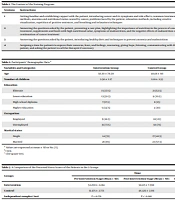
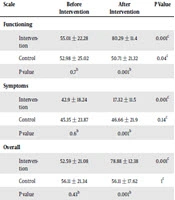
Finally, 90 participants completed the study. The findings showed that the two groups were not significantly different in terms of demographic characteristics including age, number of children, duration of disease, number of chemotherapy sessions, education level, disease stage, ethnicity, and caregiver’s relationship with the patient (Table 2). Similarly, the two groups did not differ significantly with respect to the mean and standard deviation of the functional scales of general cancer quality of life (P = 0.7); however, the results indicated a significant variation in the two groups after the intervention (P = 0.001). Furthermore, concerning the symptoms scales of cancer quality of life, the results revealed a significant difference between the two groups after the intervention (P = 0.001). Overall, the general cancer quality of life was significantly different in the two groups after the intervention (P = 0.001) (Table 3).
Table 2.
Social and Personal Characteristics of Patientsa
| Variable | Intervention | Control | P Value |
|---|---|---|---|
| Age | 46.66 ± 9.97 | 43.24 ± 9.87 | 0.49b |
| Number of children | 3.2 ± 1.85 | 2.82 ± 2.18 | 0.27b |
| Duration of disease, mo | 12.57 ± 11.08 | 13.17 ± 9.18 | 0.78b |
| Number of chemotherapy sessions | 7 ± 6.03 | 9.57 ± 5.58 | 0.38b |
| Education level | 0.41c | ||
| Below high school diploma | 28 (62.2) | 26 (57.8) | |
| High school diploma and above | 17 (37.8) | 19 (42.2) | |
| Disease stage | 0.4c | ||
| 1 | 10 (22.2) | 6 (13.3) | |
| 2 | 31 (71.1) | 32 (71.1) | |
| 3 | 4 (8.9) | 7 (15.6) | |
| Main caregiver | 0.33c | ||
| Spouse | 33 (73.3) | 24 (53.3) | |
| Child | 10 (22.2) | 11 (24.4) | |
| Others | 2 (4.4) | 10 (22.2) | |
| Ethnicity | 0.45c | ||
| Balouch | 19 (42.2) | 28 (62.2) | |
| Fars95 | 26 (57.8) | 17 (37.8) |
aValues are expressed as mean ± SD or No. (%).
bIndependent t-test.
cChi-square test.
Table 3.
Comparing the Mean and SD of Patients’ General Cancer Quality of Life in the Two Groupsa
| Scale | Before Intervention | After Intervention | P Value |
|---|---|---|---|
| Functioning | |||
| Intervention | 55.01 ± 22.28 | 80.29 ± 11.4 | 0.001c |
| Control | 52.98 ± 25.02 | 50.71 ± 21.32 | 0.04c |
| P value | 0.7b | 0.001b | |
| Symptoms | |||
| Intervention | 42.9 ± 18.24 | 17.32 ± 11.5 | 0.001c |
| Control | 45.35 ± 23.87 | 46.66 ± 21.9 | 0.14c |
| P value | 0.6b | 0.001b | |
| Overall | |||
| Intervention | 52.59 ± 21.08 | 78.88 ± 12.38 | 0.001c |
| Control | 56.11 ± 21.34 | 56.11 ± 17.62 | 1c |
| P value | 0.43b | 0.001b |
aValues are expressed as mean ± SD.
bIndependent t-test.
cPaired t-test.
While the two groups did not differ significantly in terms of the mean and standard deviation of the functional scales of breast cancer-specific quality of life (P = 0.86), they exhibited a significant difference in this regard after the intervention (P = 0.001). As for the symptoms scales of breast cancer-specific quality of life, a significant difference was found between the two groups after the intervention (P = 0.001) (Table 4).
Table 4.
Comparing the Mean and SD of Patients’ Breast Cancer-Specific Quality of Life in the Two Study Groups
| Scale | Before Intervention | After Intervention | P Value |
|---|---|---|---|
| Functioning | |||
| Intervention | 61.85 ± 13.78 | 76.75 ± 11.46 | 0.001c |
| Control | 61.20 ± 21.81 | 63.79 ± 18.41 | 0.03c |
| P value | 0.86b | 0.001b | |
| Symptoms | |||
| Intervention | 44.04 ± 19.81 | 21.38 ± 13.74 | 0.001c |
| Control | 51.7 ± 23.44 | 52.19 ± 21.04 | 0.57c |
| P value | 0.09b | 0.001b |
aValues are expressed as mean ± SD.
bIndependent t-test.
cPaired t-test.
5. Discussion
Based on the results of this study, women with breast cancer undergoing chemotherapy had a low quality of life at the beginning of the study but acquired a better quality of life after the self-care intervention. It appears that group-based self-care education coupled with consistent presentation of educational materials and continuous follow-up can increase patients’ empowerment, facilitate management of complications, improve various dimensions of quality of life, and boost women’s participation in self-care programs (22). The results of some previous studies are in line with those of the present research. Baghaei et al. (12), studied women with breast cancer undergoing chemotherapy in Urmia, north west Iran. After two cycles of chemotherapy, patients in the experimental group were given a booklet containing instructions on controlling chemotherapy side effects. It turned out that using these guidelines had led to a reduction in symptoms scales and a rise in functioning scales of quality of life (12). This is in good agreement with the results of the present study, and it seems that training patients with chronic diseases like cancer could enhance various aspects of their quality of life. Patients’ self-efficacy and quality of life will improve if they are able to handle their problems and control the adverse effects of the illness after receiving necessary training. Additionally, there is evidence suggesting that group-based, rather than individual, education exerts a greater impact on patients with chronic diseases. In the present study, thanks to group education, patients were able to finally promote different dimensions of their quality of life. In the same vein, Karimoi et al (17), reported that planned group counseling could alleviate the symptom dimensions of quality of life in women with breast cancer undergoing chemotherapy in Tehran. Some authors have proposed that even addressing and managing one aspect of patients’ problems can lead to a better quality of life. Thus, the results of a study by Patella et al. (29) in Italy demonstrated that nutritional measures and educational training about anorexia and gastrointestinal problems following chemotherapy increased the physical and psychological well-being of patients and their families (30). The results of another research by Safarzade et al. (30), substantiated the effectiveness of stress management and relaxation training in mitigating negative affect and enhancing some subscales of quality of life in women with breast cancer.
The current study explored the effect of [self-care] training in the short term, and longer follow-up studies are required to ensure the effectiveness of education so as to deal with the impact of education with greater certainty. Numerous investigations have been reported about the influence of self-care education on the quality of life of cancer patients, and all have emphasized the beneficial outcomes of this training. In China, Jiang et al. (31), inferred that conducting a self-care training program based on Orem’s model could effectively amplify the postoperative quality of life of women with breast cancer undergoing radiotherap. Salehi et al. (26), analyzed the effect of supportive and educational nursing care on the quality of life of women with breast cancer in Isfahan; the results displayed that all four dimensions of quality of life improved after eight educational sessions, which is in keeping with the findings of the present study. Therefore, educational interventions aimed at raising quality of life should be comprehensive and take into account all aspects of general well-being of individuals and societies.
The present study considered various dimensions of quality of life when designing the educational content; more precisely, the researchers attempted to empower patients to manage complications and ameliorate their quality of life by controlling and promoting self-care. To this end, the follow-up program was conducted both face-to-face and over telephone, which ultimately led to the improvement of both general and specific aspects of quality of life. Conversely, Ajh et al. (32), examined the impact of education about cancer treatment and routine care on the quality of life of women with breast cancer in Qazvin. Their intervention included four sessions attended by patients and their companions; the program covered the disease and its treatment alongside relevant counseling. The results illustrated that the intervention had not brought a significant effect on the quality of life of patients (32), which contradicts the present study. Perhaps one of the reasons for the difference between this research and the present study is that participants in the other study did not receive a comprehensive training package and the instructions were presented orally and in a non-targeted method. It seems that one can heighten the impact of self-care education by means of comprehensive training packages, which was fulfilled in the present study based on the physical and psychological problems of the subjects. This point can justify the effectiveness of our intervention as opposed to that of Ajh et al. (32). Other studies dealing with the impact of self-care education on the quality of life of other patients have similarly reported favorable results. In this regard, Masoudi et al. (33), found that developing and implementing self-care training programs based on educational needs of MS patients and with respect to the principles of patient education can lead to ameliorating the psychological aspects of quality of life. While the study population of this study differs from that of the present research, its methodology and results are compatible with ours; it can be concluded that using self-care education can produce positive effects in patients with other chronic diseases as well. Omatreza et al. (34), evaluated the impact of Orem’s self-care education on the quality of life of migraine patients in Tehran. They reported that the mean scor participation in self-care programs e of health functions improved in physical and mental terms after training as compared to the baseline (34). Davoodi et al. (35), in Tabriz explored the effect of self-care training on the quality of life in patients with gastric cancer after gastrectomy; it was observed that in addition to improving patients’ overall quality of life, as assessed based on a questionnaire designed specifically for gastric cancer patients, the program could enhance some aspects of mental, emotional, and general well-being, and reduce physical problems as well as eating disorders (35). Based on the results of the present study, it could be inferred that developing a coherent program by oncology nurses could result in a significant improvement in the quality of life of women with breast cancer undergoing chemotherapy.
5.1. Conclusions
The results of this study established that self-care education, as a low-cost and simple method, can positively affect the quality of life as well as physical and mental health. Therefore, it is suggested that the instruments used in this study be employed to assess the quality of life of patients with breast cancer who undergo chemotherapy. It is also recommended that self-care education be integrated into nurses’ tasks in health care centers.
Given that the present study was performed over a short period of time, it is suggested that future studies investigate the impact of our educational intervention on patients’ quality of life in the long term (about six months after the intervention) in order to determine the sustainability of such programs.
This research was conducted on women with breast cancer. Considering the high prevalence of cancer, it is recommended that other types of cancers be approached using the tools applied in this research.