
1. Background
In recent years, childbirth has been considered a risky process, and the need for interventions and cesarean sections has increased. The cesarean section is a life-saving procedure when natural childbirth is not possible, and the mother or the baby is at risk. Therefore, the use of the cesarean section is limited, and it is not the preferred method for childbirth (1). However, many women request cesarean sections for non-medical reasons including fear of labor pain (2). In response to the global increase in cesarean section rates, the World Health Organization (WHO) has considered the ideal rate for cesarean sections to be 10 - 15%. The rate of cesarean sections in Iran was 41.9% in 2010, which raised to 88% in private hospitals and 47% in public hospitals (3, 4). In response to this steady increase, the Iran Ministry of Health has implemented the promoting natural childbirth program (PNCP) since 2014 (5). The program develops various actions for the promotion of natural childbirth, such as optimization of the birth environment, preparation for birth classes, provision of incentive payments for staff including gynecologists, midwives, and anesthesiologists in government centers, and free-of-charge natural childbirth (6). In this program, pregnancy and birth have been considered pleasant experiences. To increase the willingness of gynecologists to natural birth, preferential tariffs for natural birth have been considered. Therefore, the most appropriate financial strategy was applied to control the increasing trend of cesarean sections in Iran (6, 7). Given that this program is novel, research can provide practical interventions to improve it. Research about implementing a program and its policies has an essential role in creating public accountability culture.
2. Objectives
This study aimed to explain the factors affecting the implementation of PNCP, prioritizing them by TOPSIS, and suggesting a model for its effective implementation.
3. Methods
A mixed study was carried out to determine and prioritize the factors affecting the implementation of PNCP and present a model. In the qualitative phase, we determined the effective factors for the implementation of PNCP based on key stakeholders’ views by examining the views of 15 gynecologists, anesthesiologists, midwives, and managers at the Zabol Medical Sciences University of Iran in 2019. Data were collected from semi-structured individual and focus group interviews between May 2019 and October 2019 in Zabol, Iran. The study participants were sampled purposively among experts of varying experiences and professions involved in PNCP. All participants were familiar with the program.
The inclusion criteria of the study were as follows: Midwives employed in hospitals, education, and health sections, gynecologists, managers, and anesthesiologists. They had at least 10 years of work experience and participated in this study with informed consent. The exclusion criterion was no reluctance to continue for any reason. None of the participants refused. Following two pilot semi-structured interviews, a preset guide was provided. The sample questions of interviews were as follows:
-What concepts should be considered for PNCP?
-What are the challenges of PNCP?
-So far, what has happened to it?
-What are the facilitators of and barriers to PNCP?
Each interview lasted 45 - 85 minutes and was conducted face-to-face at a time and place that were convenient, such as the participant’s office. Since participants were selected from different sections, focus group interviews were conducted to express their views. Five to six people participated in these sessions.
After conducting the fifth interviews and analyzing the data simultaneously, the researcher concluded that gynecologists and midwives had more information about the program. Thus, the next participants were selected from these two groups with a maximum variation in age, type of work (healthcare section, treatment section), and work experience. The interviews and focus groups were audio-recorded, transcribed verbatim, and checked for accuracy. Data were collected until data saturation was achieved.
Data analysis was performed with MAXQDA16, simultaneously with data collection, based on framework analysis. In this method, codes and classes were extracted directly and inductively from the raw data. Immediately after each interview, the audio content was transcribed verbatim. To identify semantic units, each interview was studied and reviewed several times. We shared primary findings with and gave feedback from the participants. Subsequently, semantic units were reviewed several times and classified according to conceptual similarity. Themes and sub-themes were compared together and extracted. For the credibility and validation of the findings, the member checking was used. Peer check was also used for the reliability of data. The full texts of the interviews with related codes, concepts, and categories were checked with six colleagues and supervisors to be analyzed and verified. This study is part of a Ph.D. thesis aiming at evaluating the PNBP. Therefore, the same researcher collected and analyzed all the data, with the regular discussion of the findings with a mentor.
In the second phase, we used the Technique for Order Performance by similarity to ideal solution (TOPSIS) as a quantitative approach to confirm and prioritize the themes. As known, TOPSIS is one of the most reliable scientific and managerial decision-making methods, especially in new programs, and it is very useful for policymaking (8). The information received included criteria, weights, options, and decision matrix data. This software implements six steps: 1- Naturalizing the decision matrix; 2- weighting the naturalized matrix; 3- determining the ideal solution and the negative solution; 4- obtaining the size of the distances; 5- calculating the relative proximity to the ideal solution to rank the options and solve the TOPSIS method. A questionnaire was prepared using the themes from the qualitative phase. A Likert scale was employed in the questionnaires to provide uniform input data. Ten experts were asked to identify their levels of agreement or disagreement using a score from 1 to 9. Ten faculty members participated in this phase. They were program executives with at least 10 years of management experience. They participated in this phase by written consent. We used smart BT TOPSIS solver software in this phase. We received ethical approval from the ethics committee of Semnan branch, Islamic Azad University, for this study (approval number IR. IAU.Semnan.REC.1396.9).
4. Results
Data were collected from 15 and 10 experts in the first and second phases of the study, respectively. Their demographic characteristics are provided in Tables 1 and 2.
Table 1.
Demographic Characteristics of Participants in the Qualitative Phase
| No. | Job Title/Sex | Job Category | Work Experience/Mean (y) | Age/Mean (y) |
|---|---|---|---|---|
| 9 | Midwife/female | Health section: 2; Treatment section: 4; Education department (faculty): 3 | 21.7 (13 - 31) | 45.4 (53 - 33) |
| 3 | Gynecologist/female | Associate professor: in Gynecology, 2; Gynecologist, 1 | 19.3 (12 - 24) | 48.3 (45 - 53) |
| 2 | Manager/male | Associate professor | ||
| 1 | Anesthesiologist/male | Associate professor |
Table 2.
Demographic Characteristics of Experts in the Quantitative Phase
| Variables | No. (%) |
|---|---|
| Sex | |
| Female | 8 (80) |
| Male | 2 (20) |
| Education | |
| Master of science | 2 (20) |
| Specialist/associate professor | 8 (80) |
| Work experience (y) | |
| 10 - 15 | 1 (10) |
| 15 - 20 | 3 (30) |
| 20 - 25 | 3 (30) |
| 25 - 30 | 3 (30) |
| Job title | |
| Midwifery faculty member | 6 (60) |
| Anesthesiologist | 1 (10) |
| Gynecologist | 3 (30) |
In the first phase, 1,601 initial codes were obtained, which were divided into 332 axial codes. After merging, 50 subcategories and 18 categories were obtained. Eventually, by continuously reviewing the extracted codes, eliminating duplicates, and merging similar codes, six main subjects were extracted to be approved and prioritized in the quantitative phase by the experts. They included creating a culture for natural childbirth, strong and committed leadership, empowerment, education for all, comprehensive support, and optimization (Table 3 and Figure 1).
Table 3.
Proximity Coefficients and Prioritization of Topics and Categories Based on TOPSIS Technique
| Subjects | Proximity Coefficients | Categories | Proximity Coefficients |
|---|---|---|---|
| Creating a culture for natural childbirth | 0.9881 | Midwife as trustee of natural childbirth | 0.5635 |
| Social value of natural childbirth | 0.5 | ||
| Naturalcy: The essence of childbirth and midwifery | 0.4437 | ||
| Strong and committed leadership | 0.8442 | Financing | 0.6432 |
| Policy-making | 0.3571 | ||
| Supervision | 0.1644 | ||
| Empowerment | 0.5032 | Awareness of the mother and family | 0.8161 |
| Reducing the fear and stress of the mother and family | 0.5521 | ||
| Facilitating decision-making on childbirth method | 0.2628 | ||
| Education for all | 0.4885 | Mother and family education | 0.8161 |
| Caregiver education | 0.5521 | ||
| Public education | 0.2628 | ||
| Comprehensive support | 0.4293 | Mother and family support | 0.5858 |
| Care provider support | 0.4142 | ||
| Psychological and emotional pleasure | 0.8333 | ||
| Optimization | 0.3936 | Physical optimization | 0.4383 |
| Continuity of care | 0.4059 | ||
| Reducing labor pain | 0.371 |
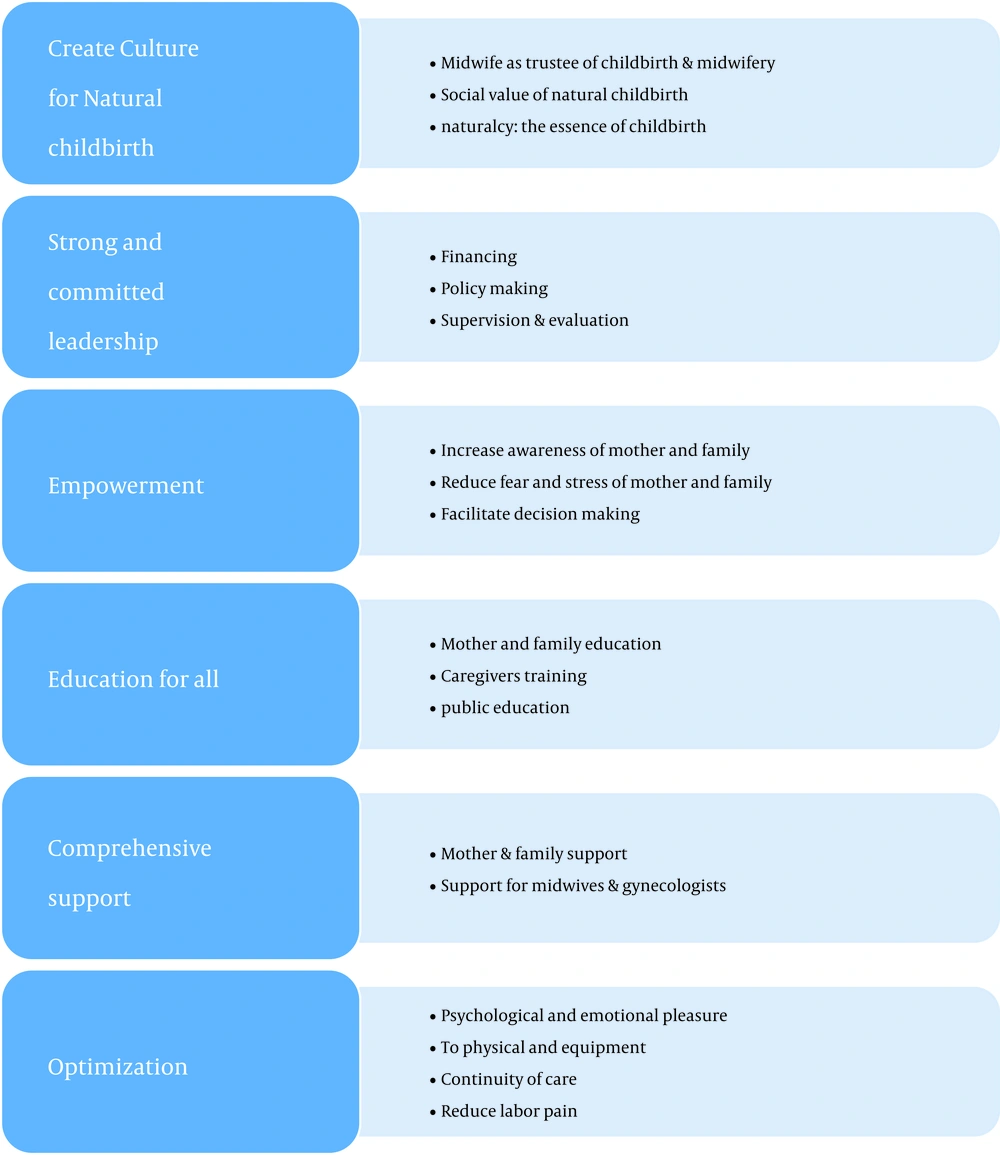
Figure 1.
The final model of implementing promoting natural childbirth program
4.1. Creating Culture for Natural Childbirth
Cultural factors and beliefs affect natural childbirth. The emphasis on the normalcyof labor pain makes women consider pain tolerance a natural process. However, too much emphasis on reducing labor pain makes women think that labor pain is abnatural and should be treated with interventions or cesarean sections.
“The culture of society has changed. Just a few years ago, women had accepted labor pain, but now they want interventions or cesarean sections to eliminate the labor pain.” (A gynecologist, 45-years-old)
They emphasized the midwife role as the trustee of natural childbirth: “Midwives have natural and divine work because they are "Guardian of Creation”.” (A midwife, 43-years-old)
They expressed that all, especially mothers and care providers, should believe that childbirth is a natural process. They believed that naturalness is neglected in the true sense of the word, and every vaginal birth is considered natural.
"We have to precisely define the concept of natural birth. Everyone thinks the vaginal birth is natural, while this is not the case. There should be no intervention at all. “(A gynecologist, 48-years-old)
Unfortunately, the Ministry of Health applies extreme medical paternalism, and underestimates midwives: "Medicine overcoming exists in our health system: medical paternalism. Midwives are not allowed to work independently." (A midwifery faculty member, 57-years-old)
They believed technological overcoming and interventions have caused women to think pregnancy and birth should be treated as a disease.
"Now, women think that pregnancy and birth are dangerous and we have to do something for them. They come to my office and say: Do we need any medication?" (A gynecologist, 43-years-old)
Many women prefer a cesarean section because they think it is a fashion or a sign of modernity. Unfortunately, the desire of gynecologists and midwives for cesarean sections as role models challenges the belief that childbirth is natural.
"We should create natural birth culture. It takes time. Cultural change is difficult, especially with this generation who sees modernity in cesareans." (A gynecologist, 48-years-old)
Creating culture by choosing natural childbirth by celebrities and holding natural childbirth festivals may increase the value of natural childbirth in the community.
4.2. Strong and Committed Leadership of the Ministry
In this case, five participants reported that the program supervision was weak, while the ministry's expectations should be on facilities.
“When you talk about natural birth, look at the environment. Look at what is happening in this program. Are your expectations consistent with the facilities and conditions of the maternity settings?” (A manager, 43-years-old)
However, a participant said about good ministry’s supervision on the cesarean rate and indications.
“The Ministry has a lot of supervision on cesarean rates. My cesarean rate is almost 19 - 20%. Therefore, no one has warned me so far. But authorities warned my colleagues that they did too many cesareans with no scientific indication...” (A gynecologist, 46-years-old)
Participants said about the ministry's role in providing infrastructure, defining job descriptions.
“There is no doubt that natural birth is better than cesarean delivery, but the infrastructure is not satisfying. The boundaries of tasks are not clear. The autonomy of a midwife is undermined.” (A manager, 43-years-old)
There are some national protocols the Ministry of Health has published for maternity care. Participants shared their views on the need to establish clear, practical, and localized protocols.
“Wrong policies are one of the main challenges; our practices are not protocol-based. It should be on precise and localized protocols.” (A gynecologist, 46-years-old).
The participants talked about the poor availability of birth preparation classes, shortage of staff, beds, and hospital spaces, and lack of facilities for natural childbirth
“As there are not enough rooms in the hospital, three mothers are in a room. There is no space for an attendant. Now, we have three patients with a midwife, which is not enough. In order to promote natural childbirth, birth rooms should be optimized. Care should be one-to-one.” (A midwifery faculty member, 54-years-old)
Electronic health record systems such as SIB have been developed in Iran’s health system to improve maternity care.
“Since 2015, we have had electronic records. Every household has an electronic record... We have a system called SIB. Of course, there are problems with the infrastructure; sometimes, the system gets disconnected, or the internet gets interrupted.” (A midwife, 53-years-old)
They also reported that the funding of the program was initially well, but over time, the government faced budget inadequacy. Its inability to pay timely causes a delay in staff payments, equipping hospitals, and building birth units.
"We have a nine-month delay in paying staff salaries. We need about 1,000 billion Rials to pay off staff demands.” (A manager, 43-years-old)
All of the participants welcomed the national health insurance in the program.
“Right now, our medical insurance status is very great. All of the people have medical insurance.” (A manager, 42-years-old)
Some participants believed that free-of-charge childbirth promotes natural childbirth.
4.3. Empowerment
The Promoting Natural Childbirth Program focuses on empowering women to choose their childbirth method through early counseling, preparation for birth classes, and reducing their fears and stress. Reducing stress and fear of childbirth increases mothers' ability to make decisions. Fear of labor pain, maternity environment, loneliness, and interventions can cause a fear of childbirth. The fear of childbirth can be reduced by using pain relief methods, providing a pleasant environment, presence of mother companion., avoiding inappropriate interventions, and empowering the mothers to choose the method of childbirth. Also, making them aware of the body's function and ensuring that they are strong enough for natural delivery empowers women for it. Unawareness of the childbirth process, the condition of the amniotic sac, and how the baby is born can cause fear and anxiety, disrupt the childbirth process, and lead to a cesarean or intervention.
"If we inform them about the childbirth process and examinations in the labor room, there will be no problem. She is not bothered during labor pain. She is not afraid when she gives birth because she has already been educated, and she knows it." (A faculty member, 54 -years-old)
"If we allow an attendant or a doula to be with the mother, her fear of childbirth will decrease, and she will endure the pain better... In the maternity facility, the attendant is with her most of the time. We do physiological childbirth in the facility without intervening. But in the hospital, the mother is alone, and they not allowed an attendant to be with the mother." (A facility midwife, 39-years-old)
4.4. Education for All
Educating mothers, families, and the community is the strength of the program.
"We have to educate the mother from 20 weeks of gestation; we have to educate her husband, her mother, her mother-in-law ..., even her family, and we have to educate society. When did we talk on radio and TV that natural childbirth is better?” (A gynecologist, 47-years-old)
The participants emphasized the importance of preparation birth classes and considered them as the strengths of the program:
“Knowledge is very important. I think natural childbirth should be taught to the mother and her family... If the advantages and disadvantages of natural birth and cesarean delivery are taught, natural birth has more likely to happen, especially for young mothers. (A midwife and a faculty member, 54-years-old)
Continuous training of midwives and gynecologists is important for promoting natural childbirth.
"Staff needs to be trained. Good training for gynecologists, midwives, and hospital managers." (A gynecologist, 57-years-old)
4.5. Comprehensive Support for Natural Childbirth
The participants discussed that the supporting of the mother, family, and caregivers, as well as social support, in three dimensions of informational, emotional, and physical counseling, is essential.
“Emotional and physical support of a mother and paying attention to her beliefs and priorities during labor and birth will facilitate this program.” (A midwife, 46-years-old)
Insufficient staffing, multiple duties, and ambiguity in the role of a midwife can lead to burn-out. In addition, the legal protection for gynecologists and midwives reduces the fear of litigation and facilitates natural childbirth.
“…I believe that an appropriate level of legal support is offered to professionals. As a gynecologist, I have been indirectly advised by different authorities -the Maternal Death Committee or organization of a medical system- that not to accept the risk of natural childbirth, and let them give birth by cesareans. This is because we are not supported legally…” (A gynecologist, 46-years-old)
4.6. Optimization of Natural Childbirth
The birth environment should be physically, emotionally, and socially attractive for mothers and staff. The hospital constraints can affect the natural process of birth; for example, physical barriers due to inadequate and inappropriate rooms and beds, staff burn-out, and multiplicity of midwife duties can increase the medical interventions or cesareans.
A crowded maternity ward in educational hospitals and the presence of medical and midwifery students are considered obstacles to program implementation.
"Unfortunately, most dissatisfaction is with the maternity ward. The mothers are complaining of frequent examinations; they are tired of the improper behavior of the staff, lack of attention to their demands, lack of accountability of staff, repeated history-taking, and examinations by students. All of these make patients complain." (A manager, 53-years-old)
5. Discussion
We found that “creating a culture for natural childbirth” is the most valuable approach for the successful implementation of the PNCP, followed by “strong and committed leadership of the Ministry of Health” and “empowerment for natural childbirth”. Therefore, the Ministry of Health should emphasize the role of midwives as the trustees of natural childbirth and provide a detailed job description for gynecologists and midwives to separate the work boundaries between them. It seems that midwives are valuable sources of maternal care in the country, and the services provided by them are as effective as the gynecologists’ services. Therefore, they should put to good use by building their capacity through training and support and covering their services with insurance.
We found that childbirth, as a powerful personal event in life, is an important social experience for women that is different in each culture and society. Therefore, traditions, culture, and modernism have influenced the choice of women (9). According to the International Confederation of Midwives, we have to try to create a culture to promote natural childbirth (10). The midwife, as the trustee of natural childbirth, knows and can manage natural childbirth. She is a specialist in it, believes it, and transmits this belief to the woman and increases her ability for natural childbirth.
Respecting the autonomy of midwives and gynecologists is reported as an important factor in promoting natural childbirth (11, 12). The findings showed that there are a hierarchical system and medical paternalism between professionals, which disrupt effective communication and teamwork between them and affect the autonomy of midwives. In Sweden, the Netherlands, and the United Kingdom, midwives have more autonomy in midwifery services (13). The medicalization of childbirth is due to the view that pregnancy is dangerous, and gynecologists have to intervene. This makes childbirth deviating from its natural process and increases the rate of cesareans. Studies also show that 30% of cesareans are due to unnecessary interventions (14).
In today's world, the role of women in society has changed, and some socio-cultural contexts such as social class, level of education, and religious beliefs have affected the patterns of pregnancy and childbirth. This has caused significant differences in the rate of cesareans in different regions (15). The leadership of the Ministry of Health plays an important role in the effective implementation of this national program through supervision, funding, and policy-making. Natural childbirth promotion programs in other countries, such as Australia and the United Kingdom, have also emphasized the importance of leadership (16, 17). In addition, the electronic information systems for recording pregnancy and childbirth care are considered as a strong point of the program (16).
The findings showed that although the program reduced the rate of cesareans to some extent, this reduction did not meet the projections. Zarei et al. also reported that only a 2% reduction occurred in the rate of cesareans (18). The promoting natural childbirth program in the UK led to a slight reduction in the rate of cesareans because the tariff of cesareans was higher than the tariff of natural childbirth and gynecologists had more willingness to perform a cesarean (19). However, in our program, the tariffs for cesareans are low, and close to the natural delivery tariff, and the willingness of gynecologists to perform cesarean is less.
Providing clear job descriptions and task-shifting between staff can promote natural childbirth (16). According to the World Health Organization, the lack of norms and standards related to midwives, for example, job descriptions, has been cited as one of the problems of midwifery staff (20). Every health program must have strong financial support to have an executive guarantee and achieve the goals. In the Australian national maternity services program, the government failed to supply the program's funding shortages and staff shortages (17). Government financial support (21), an appropriate payment structure (11), public insurance, and free-of-charge childbirth can also promote natural childbirth (22).
Numerous centers for complaints, judges' ignorance of medical problems, and the law on paying ransoms or blood money, and lack of legal support especially for midwives were mentioned as challenges in the implementation of the program (23, 24). However, Panda et al. (2018) reported that staff was not afraid of legal consequences (15), which is not consistent with our study findings. This is due to differences in the policies and laws between Sweden and Iran. In our study, gynecologists stated that to avoid legal consequences and complaints, they preferred to choose cesareans and avoid accepting the risk of natural childbirth (16).
Empowerment of the mother and family through raising the awareness of the benefits of natural childbirth was considered important to promote natural childbirth. Empowerment is due to a relationship based on trust in caregivers. The awareness of the body's function during childbirth empowers the mother to give birth naturally. A mother's body strength is affected by how she manage and deal with pain (21). Early pain management and maternal preparation for childbirth are important factors in promoting natural childbirth (13). Fear of labor pains is the most important factor in requesting a cesarean section (14). Participants emphasized that effective communication, painless childbirth facilities, the presence of visitors, respecting privacy, refraining from repeated examinations, and providing a safe place can promote natural childbirth (21). To support natural childbirth, the childbirth environment should be optimized physically, mentally, emotionally, and socially for the woman and staff (13). Providing high-quality midwifery care needs to facilitate trust and provide emotionally sensitive care in a safe and comfortable place (25). Promoting professionalism and making a good relationship between midwives and gynecologists are also important (21). There were disrespects, the domination of gynecologists, and non-recognition of the role of midwives in the Australian maternal care system (26), which is in line with our study.
5.1. Conclusions
The first step to creating any growth in every health program is to gain an understanding of the issues at hand. Thus, we developed a mixed study to understand the current situation of the promoting natural childbirth program (PNCP) five years after its implementation in Iran. We described effective factors in PNCP by a qualitative study and then ranked them using a multi-criteria decision-making process and designed the model for implementing the program. This model can provide useful insight for decision-makers to make more qualified decisions, determine the status quo, allocate resources, and enforce policies. It can also be useful in identifying the strengths and weaknesses of the program and help managers assess its performance. Furthermore, by assigning the weights in a TOPSIS approach, unfair comparisons and their consequent managerial mistakes can be avoided.