




1. Background
Cancer refers to a group of cellular organs with malignant characteristics (1). Leukemia, sarcoma, and central nervous system tumors are common childhood cancers originating from embryonic cells (2). Annually, in Iran, 100,000 to 110,000 individuals, including 3,500 children, are diagnosed with cancer (3). Although cancer is rare in childhood, it is the second leading cause of death in children under 14 years of age (4). Given that children are human capital, it is crucial to develop and implement careful healthcare policies to maintain their health. The primary goal of cancer treatment is to eradicate the disease. If this goal is not achieved, the subsequent aim is to alleviate symptoms and maintain self-esteem throughout the patient's life (5).
Chemotherapy is a common cancer treatment method. Unfortunately, as the primary treatment, chemotherapy causes numerous side effects and complications (6). Studies indicate that 59% of children and adolescents with cancer report that chemotherapy side effects are more painful than the cancer itself. The development of cancer in children and their prolonged admission and treatment in the hospital's cold and soulless environment have profound psychological effects, leading to sadness and depression (6). Moreover, cancer threatens a person's independence and ability to play an effective role in the family and community, resulting in feelings of incompetence and reduced self-confidence (7).
Self-esteem is a crucial factor that shapes a person's psychological constructs, protects against anxiety, and provides mental comfort. Low self-esteem in cancer patients is a significant risk factor that can lead to anxiety, fear, and non-compliance with treatment (8). Researchers' focus on self-esteem is significant due to its potential health impact. Studies on self-esteem effects show that damaged self-esteem reduces the ability to endure difficult situations and challenges, leading to harmful psychological and physical consequences (9). Some diseases and treatment complications, especially chronic diseases with their long and unpredictable nature, alter the patient’s mental image and self-esteem. Cancer, despite advances in diagnosis and treatment, is associated with pain, restrictions, physical changes, and death. Repeated hospitalization separates children with cancer from family, school, and social environments, leading to negative consequences (10).
Therefore, medical staff must assess and improve the general and specific self-esteem of children with cancer. Nurses play a vital role in this process, as they are responsible for caring for cancer patients and can provide education and emotional support to patients and family members (11). Several approaches exist to improve the self-esteem and mental and physical condition of children, one of which is laughter therapy. Research shows that laughter therapy can reduce disease-related stress by activating nitric oxide release, positively affecting vascular wall function, and effectively controlling pain. Laughter reduces physical tension, increases health and adaptability, and improves self-esteem. It promotes positive thinking, increases peace and energy, and consequently enhances self-esteem. Laughter increases brain endorphins, which are natural morphines, making it easier for patients to endure physical pain (12).
According to Pasquali, laughter as a comprehensive nursing intervention affects all biological, cognitive, psychological, social, physical, and spiritual aspects of a person. Laughter-based nursing interventions enable children to adapt to and tolerate treatment more efficiently (13). Additionally, when the laughter therapist is part of the healthcare team, they become more effective by connecting with children's lives and treatment goals, strengthening cooperation with medical staff (14). Given their constant contact with patients and key role in the treatment process, nurses can effectively improve children's morale and self-esteem through laughter therapy programs, creating a positive hospital environment, and reducing worries (15).
Laughter therapy can be implemented in various ways, including through the mobile health (mHealth) app, which presents a novel and engaging method for children. In recent decades, mobile phones have become a popular leisure activity among children and adolescents, with children aged 6 to 12 widely using mobile phones (16). Additionally, these children spend an hour or more daily on their cell phones or tablets (17). Current scientific and technological advancements are pervasive in all aspects of human life. It is widely believed that science and technology can offer solutions to numerous problems and play a crucial role in promoting human well-being. The widespread presence of mobile phones in the community, their ease of use, and high popularity among children indicate that this technology can be an effective tool to assist children with cancer (18).
Telenursing refers to the use of information technology in providing nursing services to children with cancer. In this type of care, nursing services are delivered through communication tools such as videos, the Internet, and mobile phones (19). Among telecommunication tools, mobile phones are most frequently used. According to the International Telecommunication Union, 5.9 billion of the world's 7 billion people use mobile phones, with this number growing, particularly in developing countries (20). Given the importance of self-esteem in children with cancer, nurses and other healthcare workers need to conduct interventions with minimal complications and maximum efficiency for these children. Laughter therapy with the mHealth app is utilized as a new and effective method in many countries. However, few studies have explored the effect of laughter therapy on the complications of cancer and chemotherapy in children. An extensive literature review did not find scientific evidence regarding the effectiveness of laughter therapy in Iran. Therefore, the present study aimed to examine the effect of laughter therapy with the mHealth app on the self-esteem of children with cancer undergoing chemotherapy.
2. Methods
This quasi-experimental study was conducted in 2023 on children aged 6 to 12 years with cancer admitted to the hematology department of a teaching hospital in Zahedan. Following a similar study by Fazelnia and Hosseini (21), the sample size was estimated to be 13 participants with a 95% confidence interval using the following formula:
However, considering the possibility of participant dropout, the sample size was increased to 35 individuals per group (21). A total of 70 children were selected using convenience sampling. Initially, data were collected from participants in the control group, with the first 35 children assigned to this group. After conducting the post-test for the control group, participants for the intervention group were selected. Inclusion criteria included being aged 6 - 12 years, having attended at least one chemotherapy session, suffering from leukemia, possessing a mobile phone or tablet, and not having a mental disability, hearing impairment, or other chronic diseases. Exclusion criteria included absence or non-participation in more than one session, death, or illness of the child.
A demographic information questionnaire was used to assess the children's demographic characteristics (gender, age, duration of illness, frequency of chemotherapy, type of cancer, family history of cancer) and the demographic information of the caregiver parent (age, education, marital status, place of residence, and ethnicity). Additionally, the Coopersmith Self-esteem Inventory (CSEI) (1967) was used to measure the general self-esteem level of the children. The instrument contains 58 items and 4 main subscales (general, social, family, and academic self-esteem) along with a lie detector. Items 4, 8, 9, 14, 19, 20, 27, 28, 29, 33, 37, 38, 39, 42, 43, and 47 are scored as 1 (yes) or 0 (no). The remaining items are scored in reverse (yes = 0 and no = 1), resulting in minimum and maximum scores of 0 and 50 (excluding the lie detector).
The reliability of the inventory was assessed by Ivarsion, with a Cronbach’s alpha value of 0.87 for the entire scale, and corresponding values of 0.80, 0.84, 0.64, and 0.71 for the general, family, social, and academic subscales, respectively. Additionally, the correlation between the inventory scores and the scores obtained from its administration was 0.81, confirming the instrument's validity (22). Khaledian et al. confirmed the instrument's reliability with a Cronbach’s alpha of 0.88 (23). In the present study, the instrument's reliability was confirmed with a Cronbach's alpha of 0.82.
After familiarizing themselves with the children and their parents and obtaining informed consent, the study's objectives and intervention procedures were explained to both the children and their parents. Parents were assured of the intervention's safety and the confidentiality and anonymity of their information. Participants were informed that they could withdraw from the study at any time. Initially, the questionnaires were administered to the control group participants as a pre-test, and two weeks later, the self-esteem inventory items were completed as a post-test through interviews with the child in the presence of their parents.
Following the completion of the post-test for the control group, participants for the intervention group were selected. After conducting the pre-test, the intervention group attended sessions held over two weeks. Two intervention sessions were conducted per week, each lasting one hour in the hematology department's playroom, using a mobile app developed by the researcher. Children's songs were played in the playroom to welcome the children and capture their attention. To encourage participation and cooperation, children were given interesting and funny masks and hats themed around their favorite cartoons to wear during the intervention.
During each session, children sang various funny songs, listened to and repeated different sounds of children's laughter, watched humorous and comedy clips suitable for school-age children, and listened to music themed around jokes and laughter for 30 minutes. These activities were embedded in the application. Subsequently, the children participated in happy and fun competitions. To motivate participation and active involvement, they received gifts such as humorous poetry books, funny caricature stickers, or humorous masks.
In the next phase, children played games within the application under the researcher's supervision. The application contained four games and seven sections. The first section featured balloons that played funny sounds of children's favorite cartoon characters, such as Party Kid, Kolah Ghermezi and Pesar Ammeh Za (an Iranian fictional puppet character), SpongeBob SquarePants, Patrick, Pat and Matt, and Pink Panther. Children were tasked with identifying the character whose sound was playing on the moving balloons on the app screen and bursting the balloons. When the balloons burst, laughter was heard from the app. Bursting balloons helped children with cancer express their feelings about facing cancer and its treatment, symbolically bursting and destroying tumors.
In the second game, cancerous and healthy cells were displayed, and the child destroyed the cancerous cells by throwing arrows to replace them with healthy cells. When cancer cells were destroyed, the app played sounds of laughter and happiness. The game was designed as a gyroscope to prevent fatigue, with the arrow-throwing ship moved by tilting the phone screen.
The third part of the app focused on nursing Little Danny. In this section, the challenges faced by children with cancer during chemotherapy were depicted on Little Danny, and children were asked to make Little Danny happy by solving his problems and winning the game. For example, one challenge is hair loss. In the third game, Little Danny's hair fell out, and children were instructed to put hair or a hat on him according to their preferences to make Danny happy. Children were also advised that they could use hats and wigs during treatment to maintain their self-esteem. There were three hairstyles, hats, and wigs in six different colors (18 styles in total), which the child could place on Little Danny’s head. After putting on the hair or wig, Little Danny laughed, and the child won the game.
The second section of the third game addressed anorexia in children with cancer, with the task: "Little Danny has lost his appetite, give him his favorite foods". A diet suitable for children with cancer was selected from reference books. These foods were associated in Little Danny's mind, and the child provided them to solve the problem of anorexia and make Little Danny happy. In the third section, Little Danny experienced pain due to cancer, and the child had to distract him and make him happy by playing cheerful and funny songs. The fourth section focused on issues such as fatigue and impatience, common in children with cancer, with the prompt: "Little Danny is tired and bored. Play funny cartoons for him to make him happy". Consequently, cartoons like SpongeBob SquarePants, Boss Boy, and Party Kid were played from the app. The suitability of these cartoons and songs for this age group was confirmed by an expert and two staff members from the Institute for the Intellectual Development of Children and Young Adults.
The children learned the instructed content and, by simulating their situation with Little Danny's, attempted to implement these practical and important instructions during their illness. The fourth part of the game featured a game phone, where happy and funny songs and poems were played by dialing the phone numbers of children's favorite cartoon characters. The phone ringing sound was laughter. Two weeks after the last session, the questionnaire was completed through interviews with the children in the presence of their parents.
To comply with ethical protocols, laughter therapy sessions were also conducted for the children in the control group, and the application was installed on their mobile phones or tablets. The normality of the collected data was assessed using the Shapiro-Wilk test. Data analysis was performed with SPSS version 27 software, utilizing descriptive statistics and inferential statistics (paired samples t-test for intragroup comparisons, independent samples t-test for intergroup comparisons of variables, chi-square test, and Fisher's exact test). A significance level of 0.05 was used for data analysis.
3. Results
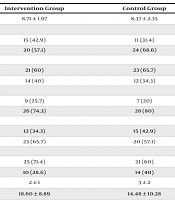
The mean age of the children in the intervention group was 8.71 ± 1.97 years, while the mean age in the control group was 8.37 ± 2.35 years. Other individual characteristics of the participants in both groups are presented in Table 1. There was no significant difference between the two groups regarding demographic and clinical variables (Table 2). As shown in Table 1, the mean scores for different dimensions of self-esteem in the intervention group increased significantly compared to before the intervention (P < 0.05). However, the mean scores for the children in the control group showed no significant difference in the dimensions of self-esteem before and after the intervention (P > 0.05).
Table 1.The Participants’ Demographic Characteristics a
| Variables and Categories | Intervention Group | Control Group | P-Value |
|---|---|---|---|
| Child age | 8.71 ± 1.97 | 8.37 ± 2.35 | 0.51 b |
| Gender | |||
| Female | 15 (42.9) | 11 (31.4) | 0.32 c |
| Male | 20 (57.1) | 24 (68.6) | |
| Leukemia cancer | |||
| ALL | 21 (60) | 23 (65.7) | 0.33 c |
| AML | 14 (40) | 12 (34.3) | |
| History of cancer in the family | |||
| Yes | 9 (25.7) | 7 (20) | 0.38 d |
| No | 26 (74.3) | 28 (80) | |
| Ethnicity | |||
| Fars | 12 (34.3) | 15 (42.9) | 0.46 c |
| Baluch | 23 (65.7) | 20 (57.1) | |
| Place of residence | |||
| City | 25 (71.4) | 21 (60) | 0.31 c |
| Village | 10 (28.6) | 14 (40) | |
| Number of siblings | 2 ± 1 | 3 ± 2 | 0.051 b |
| Disease duration (month) | 18.60 ± 8.89 | 14.48 ± 10.28 | 0.07 b |
| Chemotherapy sessions | |||
| 1 | 6 (17.1) | 8 (22.8) | 0.48 c |
| 2 | 16 (45.7) | 18 (51.4) | |
| 3 | 7 (20) | 4 (11.4) | |
| 4 | 6 (17.1) | 5 (14.2) | |
| Parent (caregiver) education | |||
| Illiterate | 17 (48.6) | 16 (45.7) | 0.68 c |
| Lower education | 11 (31.4) | 14 (40) | |
| Diploma | 6 (17.1) | 5 (14.3) | |
| Higher education | 1 (2.9) | 0 (0) | |
| Parental age | 33.80 ± 4.99 | 31.02 ± 13.58 | 0.51 b |
| Parent’s (caregiver’s) marital status | |||
| Married | 31 (88.6) | 30 (85.7) | 0.89 c |
| Divorced | 2 (5.7) | 2 (5.7) | |
| Widow | 2 (5.7) | 3 (8.6) |
a Values are expressed as No. (%) or mean ± SD.
b Independent samples t-test.
c Chi-square test.
d Fisher’s exact test.
Table 2.The Descriptive Statistics for Self-esteem and Its Dimensions in the Two Groups a
| Dimensions of Self-esteem | Pre-intervention | Post-intervention | ||||
|---|---|---|---|---|---|---|
| Intervention Group | Control Group | P-Value b | Intervention Group | Control Group | P-Value c | |
| General | 12.97 ± 2.26 | 12.14 ± 2.13 | 0.12 | 17.54 ± 3.6 | 12.05 ± 2.57 | < 0.001 |
| Family | 3.62 ± 1.61 | 3.88 ± 1.15 | 0.44 | 4.77 ± 1.59 | 3.68 ± 0.99 | 0.001 |
| Social | 3.57 ± 1.42 | 3.97 ± 1.52 | 0.59 | 5.17 ± 1.46 | 4.22 ± 1.37 | 0.007 |
| Academic | 3.00 ± 1.23 | 3.14 ± 1.03 | 0.60 | 4.02 ± 1.36 | 3.48 ± 1.24 | 0.04 |
| Total | 22.94 ± 4.52 | 23.51 ± 3.94 | 0.57 | 31.45 ± 5.48 | 23.42 ± 2.90 | < 0.001 |
a Values are expressed as mean ± SD.
b Independent samples t-test.
c Paired samples t-test.
4. Discussion
The findings from the present study indicated that the laughter therapy intervention significantly increased the self-esteem scores of children in the intervention group compared to the control group. In other words, laughter therapy was effective in improving the self-esteem of children with cancer undergoing chemotherapy. Although many studies have addressed the effect of various non-pharmacological interventions on the psychological disorders of children with cancer, very few have investigated the effect of laughter therapy on the self-esteem of these children, and most studies abroad utilize traditional methods of laughter therapy. Moreover, no study in Iran has explored the effectiveness of laughter therapy using new technologies and applications.
Kim et al. examined the effect of laughter therapy on the mood and self-esteem of cancer patients undergoing chemotherapy and found that laughter therapy can improve mood and self-esteem, serving as a useful and non-invasive intervention for cancer patients in clinical settings (24). Kim et al. reported that anxiety and stress levels were significantly reduced in patients who attended laughter therapy sessions (25). Loveimy and Safarzadeh examined the effectiveness of story therapy on shyness, depression, and self-esteem in preschool children in Ahvaz. This clinical trial involved 40 preschool children, with the intervention group attending 12 story therapy sessions of 60 minutes each, while the control group received no intervention. The findings showed that story therapy positively affected reducing children's shyness and depression and was effective in improving self-esteem and its subscales, including the overall self, social self, self as a family member, and academic self (26).
Contrary to the findings of the present study, Kato showed that although participants in the intervention group had more information about cancer and the role of disease management (P = 0.03), the computer game did not affect their stress control and quality of life (27). These conflicting findings can be attributed to age differences, sample size, the type and content of the application, and cultural and social differences in the studied populations.
This study was conducted with some limitations. For instance, it was carried out in a hospital ward on a limited number of patients. Additionally, the sampling method could limit the generalizability of the findings. Therefore, it is essential to conduct more studies in different settings and over longer periods.
4.1. Conclusions
This study found that laughter therapy delivered through an mHealth app enhanced self-esteem in children aged 6 to 12 years who are undergoing chemotherapy for cancer. Nurses, as key members of the care team with extensive and close interactions with children, can adopt the laughter therapy app as a non-medicinal, cost-free, innovative, and appealing method for children. Additionally, creating a playroom in hematology departments could support the use of the laughter therapy app for children. Although the study confirmed the app's effectiveness, further research with larger sample sizes, conducted in various settings and over longer periods, is necessary. Future research should also examine the effects of laughter therapy with the mHealth app on other psychological and physical aspects.