



1. Background
Treatment adherence is the degree of success of patients in following treatment and preventive recommendations proposed by health professionals (1). This health model and behavior is the product of various overlapping variables that may change over time (2-4). Adherence to long-term treatments for chronic diseases is a challenging issue because chronic diseases have a progressive course, and poor cooperation causes the faster progression of the disease and treatment failure (5).
Chronic kidney disease (CKD) is a major public health problem that has an unfavorable prognosis and can progress to end-stage renal disease (ESRD) (6). The prevalence of this disease is increasing at an alarming rate. More than 2 million people worldwide suffer from this disease, and more than 1.4 million people undergo kidney replacement therapy (dialysis or kidney transplant) (7).
The most common treatment alternative for patients with ESRD is hemodialysis (HD) (8, 9). Successful hemodialysis depends on treatment adherence (5, 10, 11) because the affected people face a wide range of complications and problems due to the disease-related difficulties and the loss of hope to continue life, which in turn leads to treatment non-adherence and increased mortality among them (2, 11, 12).
Despite the major role of treatment adherence in improving the quality of life, reducing symptoms, and increasing physical performance and knowledge among patients, studies yield conflicting results regarding the level of treatment adherence in patients due to cultural differences and diverse methods for evaluating the level of treatment adherence and have reported differences in the training provided by the treatment staff (3, 11, 13-17). Some studies have observed good treatment adherence (13, 15, 16), while others have found poor treatment adherence among these patients and reported that they are prone to non-adherence (11, 17). However, changing behaviors such as treatment adherence is a very complex process, and there are several risk factors such as educational level, sex, impaired social relationships, psychological disorders such as anxiety and depression, and physical complications (2, 3, 7, 12, 14, 18).
Since identifying non-adherence risk factors cause can improve the well-being of patients (3, 19, 20), further research is needed to investigate the causes of non-adherence and the factors affecting the improvement of treatment adherence by predicting measurable parameters (21-23).
The present study is important as it investigates the role of effective factors and identifies a model that increases treatment adherence. Considering the many factors that contribute to treatment adherence, using the structural equation modeling (SEM) approach allows the researcher to simultaneously test a set of regression equations, identify the relationship between different variables, and compare the effect of predictor variables (24).
2. Objectives
This was a study with the SEM design that aimed to investigate treatment adherence based on general health and demographic characteristics among hemodialysis patients.
3. Methods
3.1. Design
This was a descriptive-correlational study with a SEM design. We provided a readily available strengthening the reporting of observational studies in epidemiology (STROBE) checklist to ensure a clear presentation of what was planned and conducted in our study. The research population included all patients with CKD in Tehran, Iran, of whom 200 patients undergoing hemodialysis admitted to 2 medical centers in Tehran from September to March 2022 were selected by convenience sampling.
3.2. Sampling
There are different opinions regarding the sample size in studies with the SEM design. Some consider a sample size of n = 200 people (25). Wolf states that 10 to 15 people are needed in modeling research for each overt variable (26). Therefore, the sample size was estimated to be 200 people based on the available variables, and sampling was performed using the nonprobability convenience sampling method.
Inclusion criteria: Age over 18 years and undergoing dialysis 1 to 3 times a week for more than 3 months.
Exclusion criteria: Unwillingness to participate and the patient's death or transfer to another hemodialysis center for any reason.
3.3. Data Collection
The data collection instruments included a demographic information questionnaire, the General Health Questionnaire (GHQ-28), and the End-Stage Renal Disease Adherence Questionnaire (ESRD-AQ).
3.3.1. Demographic Information Questionnaire
It included questions on age, sex, marital status, level of education, and duration of dialysis treatment.
3.3.2. General Health Questionnaire
This questionnaire consists of 28 questions in 4 areas, including somatic symptoms (questions 1 to 7), anxiety (questions 8 to 14), social dysfunction (questions 15 to 21), and depression (questions 22 to 28). A four-point Likert scale is used for scoring (0 - 1 - 2 - 3), and the maximum score is 84. Lower scores indicate healthy conditions, and vice versa (27). The reliability of GHQ-28 is higher than 0.74 based on Cronbach's alpha of all the subscales (28).
3.3.3. The End-Stage Renal Disease Adherence Questionnaire
This questionnaire consists of 5 main sections, including general information (5 questions), acceptance of hemodialysis treatment (14 questions), acceptance of drug treatment (9 questions), fluid restriction (10 questions), and recommended diet (8 questions). The possible score range is 0 to 1200, and the total score of treatment adherence is calculated by summing the scores of these 5 sections. Higher scores indicate better treatment adherence, which is finally categorized based on the Likert scale, where 1 standard deviation (SD) above and below the mean in adherence to the overall treatment and its dimensions is regarded as moderate treatment adherence, and lower and higher scores are regarded as poor and acceptable treatment adherence, respectively (29). The validity and reliability of this questionnaire were calculated as 0.98 and 0.85, respectively (30).
3.4. Statistical Analysis
Data analysis was carried out using descriptive statistics, including frequency distribution and percentage, central tendency indicators, and dispersion indicators in SPSS v. 19 (IBM Corp., Armonk, NY, USA). P-value < 0.05 was considered as the significance level.
The SmartPLS v. 3 statistical software and partial least squares structural equation analysis method based on variance (PLS-SEM) were used to test the hypothesized research model. This method allows the researcher to test the acceptability of the models in a particular population using correlation data.
Before confirming the structural relations, one should ensure the appropriateness and goodness of fit of the model. The four parameters of the reliability and validity test in the external model include the reliability index (outer loading), construct reliability (Cronbach's alpha and composite reliability), and construct validity average variance extracted (AVE).
In the research model, differential validity was used for diagnostic validity (Fornell-Larcker criterion).
3.5. Ethical Considerations
The research objectives and process were explained to the subjects, and written informed consent was obtained from them. The subjects were assured of the confidentiality of the information; they did not need to write their names and could withdraw from the study at any stage without any consequences.
4. Results
According to the results, the participants were men in 64% of the cases. The age range of the patients was 20 - 92 years, and its mean ± SD was 59.48 ± 13.72 years. The patients were undergoing hemodialysis treatment for 1 to 5 years in 75% of the cases (Table 1). The mean ± SD of the total score of treatment adherence and general health was 891.86 ± 154.75 and 26.85 ± 13.23, respectively (Table 2).
Table 1.Demographic and Clinical Features of the Sample (N = 200)
| Variables | Absolute Frequency | Relative Frequency |
|---|---|---|
| Age (y) | ||
| 20 - 50 | 46 | 23 |
| 51 - 71 | 112 | 56 |
| 72 - 92 | 42 | 21 |
| Sex | ||
| Male | 128 | 64 |
| Female | 72 | 36 |
| Marital status | ||
| Married | 166 | 83 |
| Single | 17 | 8.5 |
| Widowed or divorced | 17 | 8.5 |
| Level of education | ||
| Elementary | 61 | 30.5 |
| High-school diploma | 84 | 42 |
| University | 55 | 27.5 |
| Duration of dialysis treatment | ||
| Less than 1 year | 20 | 10 |
| 1 to 5 years | 151 | 75.5 |
| More than 5 years | 29 | 14.5 |
Table 2.Mean and Standard Deviation of General Health and Treatment Adherence Scores
| Variables | Mean ± SD |
|---|---|
| General health | |
| General health score | 26.85 ± 13.23 |
| Somatic symptoms | 7.09 ± 3.55 |
| Anxiety symptoms and sleep disorder | 7.82 ± 5.32 |
| Social dysfunction symptoms | 8.89 ± 3.89 |
| Depression symptoms | 3.05 ± 3.66 |
| Treatment adherence | |
| Overall score of treatment adherence | 891.86 ± 154.75 |
| Score of diet adherence | 158.99 ± 41.24 |
| Adherence to fluid restriction | 75.03 ± 70.40 |
| Adherence to the dialysis program | 564.51 ± 107.25 |
| Adherence to medication regimen | 181.17 ± 38.02 |
Abbreviation: SD, standard deviation.
The values of the fit index were within an acceptable range. Therefore, the model showed a good fit and was approved (Tables 3 and 4).
Table 3Factor Validity and Reliability: PLS-SEM a and Values of Goodness of Fit Indices of the Assumed Model
a Partial least squares structural equation modeling.
b Average variance extracted.
c Composite reliability.
Differential validity indicated the existence of partial correlations between the indices of one structure and the indices of other structures. All the indices were reliable and valid for measuring the respective constructs (Table 5). Therefore, the internal model test (structural model) could be used.
Table 5.Matrix of Correlation Coefficients of Research Variables
| Variables | Age | Duration of Dialysis | Education | Sex | General Health | Marital Status | Treatment Adherence | P-Value |
|---|---|---|---|---|---|---|---|---|
| Age | 1 | 0.017 | ||||||
| Duration of dialysis | -0.155 | 1 | 0.78 | |||||
| Education | -0.443 | -0.042 | 1 | 0.373 | ||||
| Sex | 0.143 | 0.194 | 0.316 | 1 | 0.589 | |||
| General health | 0.003 | -0.131 | 0.055 | -0.089 | 0.823 | 0.001 | ||
| Marital status | -0.589 | -0.127 | 0.387 | -0.078 | -0.033 | 1 | 0.904 | |
| Treatment adherence | 0.353 | -0.148 | -0.274 | -0.033 | 0.573 | -0.282 | 0.612 |
The hypothesized model of the relationship between independent and dependent variables included 6 independent variables (age, sex, level of education, marital status, duration of dialysis treatment, and general health) and 1 dependent variable (treatment adherence behavior) (Figure 1).
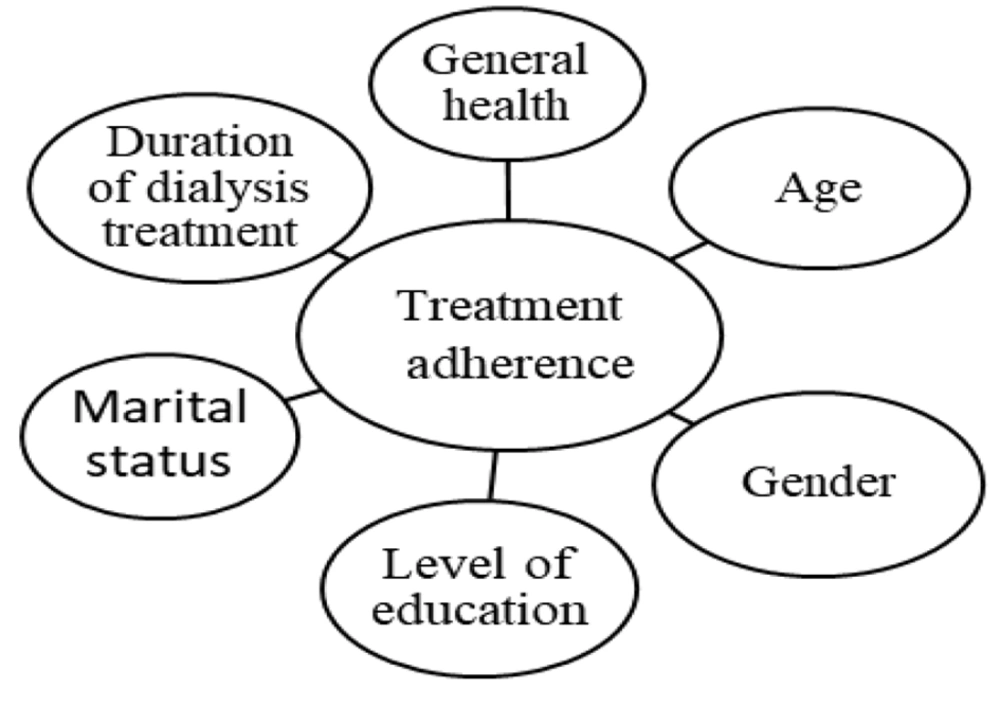
Figure 1.
Hypothesized model of the relationship between independent and dependent variables
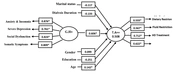
There were significant relationships based on the hypothesized model and the data collected from the studied patients (P < 0.05). The changes in treatment adherence were determined by demographic and general health variables in 50% of the cases. The results showed the direct and significant effect of general health (β = 0.6, P = 0.001) and age (β = 0.14, P = 0.017) on treatment adherence; with a 1-unit increase in the general health of the patients, the mean treatment adherence score increased by 0.6, and treatment adherence increased by 0.1 with increasing age. There was no significant relationship between the other variables (sex, level of education, marital status, and duration of dialysis treatment) and treatment adherence (Figure 2 and Table 5).
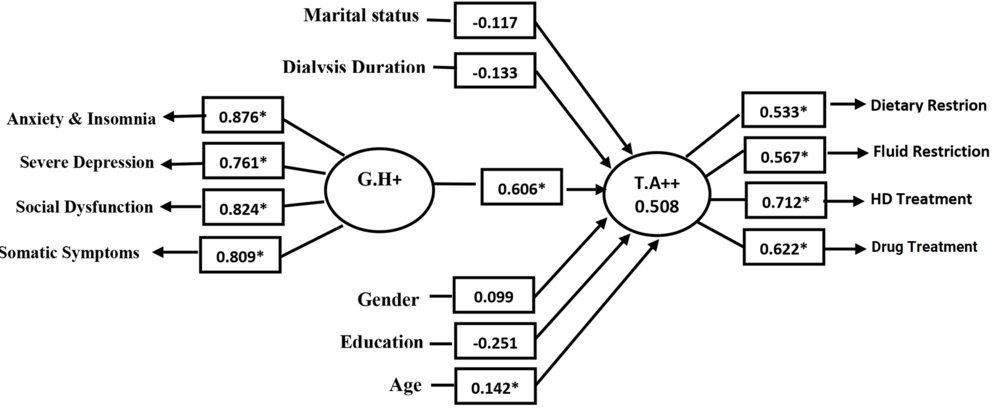
Figure 2.
Research model in explaining treatment adherence based on general health and demographic characteristics. *: Significant value; +: General health; ++: Treatment adherence.
5. Discussion
This study used the SEM design to investigate treatment adherence based on demographic characteristics and general health among hemodialysis patients who visited the selected hospitals in Tehran.
According to the results, the path analysis of the 6 independent variables was confirmed according to the standard coefficients of the path and numbers. There was also a significant relationship between age, general health, and treatment adherence. However, there was no significant relationship between the other variables (sex, marital status, level of education, and duration of dialysis treatment) and treatment adherence. The general health components in this study included the evaluation of somatic symptoms, anxiety, and insomnia, symptoms of social dysfunction, and depression (27). Thus, patients who undergo HD experience a high level of depression, hopelessness, severe anxiety, and social isolation (31, 32).
Qualitative and review studies have reported that it is possible to improve the treatment adherence of patients undergoing HD by promoting social support, reducing depression, and alleviating anxiety (10, 33). In a systematic review, Tayebi et al. attributed treatment non-adherence among dialysis patients to psychosocial problems, especially depression (10), while Fotaraki et al. reported no significant relationship between depression and treatment adherence (34). Martinez and Ramirez-Orellana emphasized the important role of general health in patient satisfaction in a study with the SEM design (35). The important role of general health in these people may be because the progressive metabolic changes associated with CKD negatively affect the general health of patients (36), and these progressive metabolic changes lead to poor treatment adherence by prolonging the treatment process (4, 10, 12, 34). Patients who undergo HD are usually unwilling to ask for help, health professionals focus on their physical discomfort more frequently, and the symptoms are rarely diagnosed (37). Therefore, paying attention to psychological factors, social support, and the personality of patients and including them in treatment adherence interventions can improve their treatment adherence (38).
Another effective factor that positively and significantly predicts treatment adherence in the presented model is age, such that treatment adherence increases with age. The results of the present study are consistent with the studies by Mukakarangwa et al. and Zher and Bahari (7, 39). Elderly patients follow a more structured lifestyle and use problem-solving-based adaptation methods because of their vast experience in facing problems. Therefore, they exhibit better adaptation and treatment adherence (14, 33). However, younger patients consider themselves less vulnerable to negative health outcomes, face more problems when integrating complex treatment needs into their lifestyle, and show poorer treatment adherence (14).
The present study showed no significant relationship between sex and treatment adherence, which is consistent with various studies (7, 15, 39). Other studies have reported a significant relationship between sex and treatment adherence; for example, treatment adherence was higher in Turkish women, and male gender has been introduced as a risk factor for non-adherence to HD treatment (2). Still, the results of a study in Saudi Arabia showed poor treatment adherence among women (14). The different results of studies in terms of the relationship between sex and treatment adherence may be rooted in sociocultural factors.
The present study also showed no significant relationship between marriage and treatment adherence. Although unmarried patients are significantly less adherent to treatment than married, divorced, and widowed ones, and married women show a higher treatment adherence (14), the results of other studies indicate no significant relationship between marriage and treatment adherence (2, 14, 15, 30, 39).
In various studies, a higher treatment adherence has been reported in people with a university degree, but there was no significant relationship between the level of education and treatment adherence (2, 14, 30), which may be because not all people follow what they know (13). Perhaps it is difficult for patients with higher education to adhere to treatment due to their obligations and social-occupational status; the percentage of treatment non-adherence is reported to be higher among educated people than illiterate ones in some cases (2). Knowledge increases treatment adherence in hemodialysis patients, but this increasing knowledge level does not lead to an increase in treatment adherence, and behavior change requires something beyond the acquisition of new knowledge (3).
There was also no significant relationship between the duration of dialysis treatment and treatment adherence, which was consistent with the study by Sultan (15).
Al-Khattabi also found that the longer the duration of dialysis, the less the treatment adherence (14), perhaps because the long dialysis duration makes HD patients misunderstand the related restrictions (9) or their level of adherence differs due to the presence or absence of serious and accompanying diseases, such as diabetes, hypertension, and cardiovascular diseases (2, 12). However, Ozen et al. showed that a longer duration of HD reduces the risk of treatment non-adherence because a longer treatment period usually leads to more interactions with other patients and healthcare workers, and patients learn to cope with disease complications easily (2).
A limitation of the present study was the use of self-report questionnaires. Self-report tools are of particular importance in such studies because they are easy to use and more affordable, but because patients tend to give socially friendly answers, this problem may impact the results of the study. It is suggested that mixed-methods research be conducted. In fact, these methods have emerged to overcome the limitations of quantitative and qualitative research methods alone. Moreover, since the research population comprised only patients undergoing hemodialysis in Tehran, caution should be exercised when generalizing the results to other cities.
5.1. Conclusions
Several reasons may be involved in treatment non-adherence among hemodialysis patients. As the results of the present research showed, the model path analysis confirmed the hypothesis, i.e., the age and general health of patients play effective roles in adhering to treatment and having favorable dialysis; these variables have a stronger prediction accuracy than other demographic variables and play a more important role in improving treatment adherence. Therefore, it is crucial to pay attention to the age and general health of hemodialysis patients to improve treatment adherence. Obviously, improving treatment adherence in these patients requires understanding the effective cultural and behavioral factors, adopting appropriate strategies, and planning the necessary clinical general health interventions.