1. Introduction
Lymphangioma is a common benign tumor especially in children, and is most commonly observed in neck, mediastinum, and mesentery of intestine (1). Adrenal lymphangioma is a rare tumor and with the improvement of imaging techniques more cases are discovered; since the first report of an adrenal lymphangioma in 1962 (2), only 50 cases are reported in the English literature (3). Most of the reported cases were discovered incidentally during surgery, autopsy or imaging studies for other reasons (4).
Herein is the report on a case of adrenal cystic lymphangioma in a middle aged lady who presented hypertension. To the best of the authors' knowledge such an occurrence is very rare.
2. Case Presentation
A 43-year-old female presented headache, palpitation, and intractable hypertension. Her physical examination including heart and lung examination were completely unremarkable. Abdominal examination was also normal.
Laboratory examination showed white blood cell count: 5500/µL, hemoglobin: 12.3 gr/L, platelet: 176000/µL. Glucose, lipids, liver function tests and kidney function tests were all normal. Hormonal studies including urine epinephrine (15.45 IU, normal < 20), norepinephrine (75.23 IU/L, normal < 90), metanephrine (155.3 IU/L, normal < 350) and dopamine (452.16 IU/L, normal < 600) were all normal. Also 17-OH progesterone and cortisol were all normal.
Her blood pressure was 130/90 mm Hg, pulse rate: 88/minute, respiratory rate: 18/minute and temperature = 37°C. Her past medical history showed surgery of total abdominal hysterectomy (TAH), and bilateral salpingoophorectomy (BSO).
During the work up for her hypertension, an abdominal sonography was performed, which showed an anechoic to hypoechoic mass lesion measuring 2.5 cm in diameter in left adrenal gland with cystic degeneration and without calcification. Abdominal Computed Tomography (CT) scan showed an adrenal tumor, measuring 2.5 cm in diameter, which was well-circumscribed, had low density, with very slight enhancement, and without calcification (Figure 1).
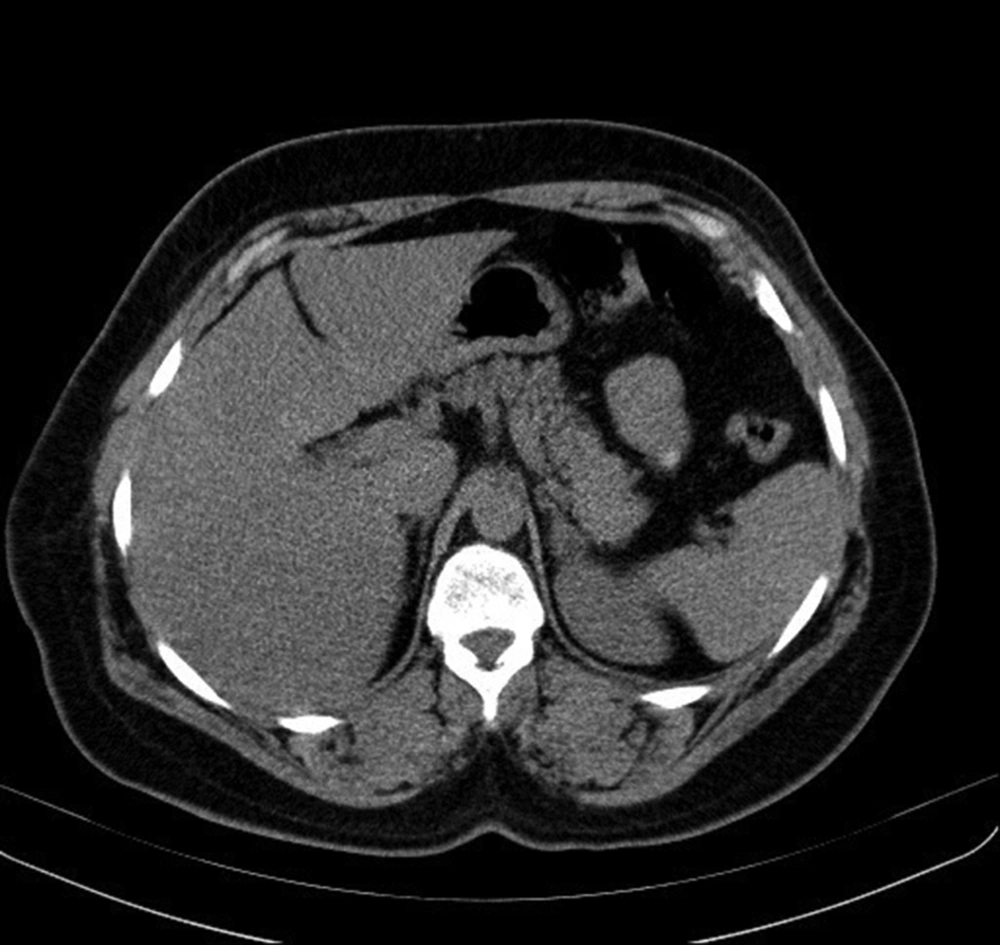
Figure 1.
Abdominal CT scan shows an adrenal mass 2.5 cm in diameter
With the impression of an adrenal tumor with the possibility of adenoma or pheochromocytoma, adrenalectomy was performed on her. The specimen received in the pathology lab showed left adrenal gland with a well-defined mass measuring 2.5 × 2.5 × 1 cm, with solid and cystic appearance (Figure 2).
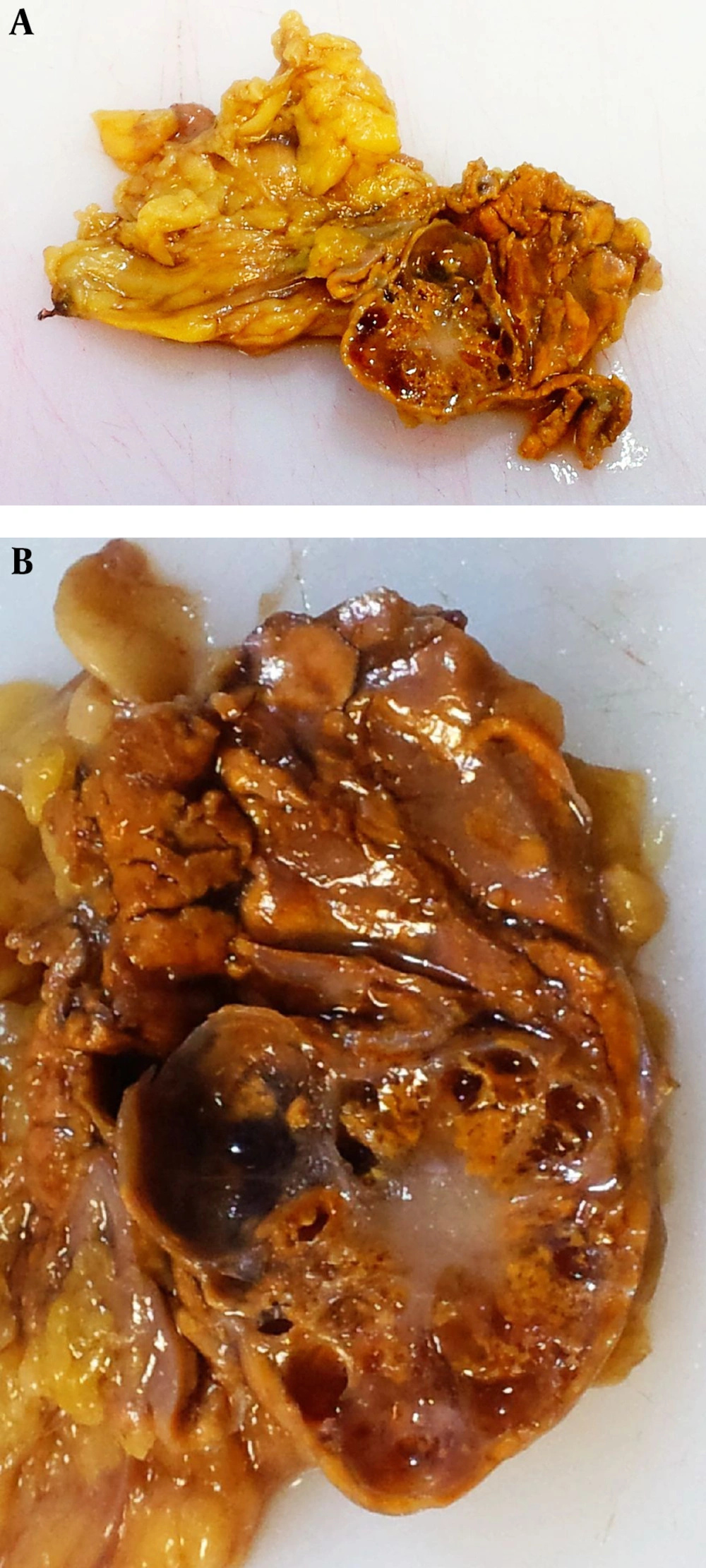
Figure 2.
Gross of the Resected Adrenal Mass With Cystic Spaces
Histologic sections of the adrenal mass showed a solid cystic mass. The cysts were lined by flat and bland endothelial cells, which were all positive by CD 31 and CD 34, but negative with cytokeratin (Figure 3). The diagnosis of adrenal cystic lymphangioma was made.
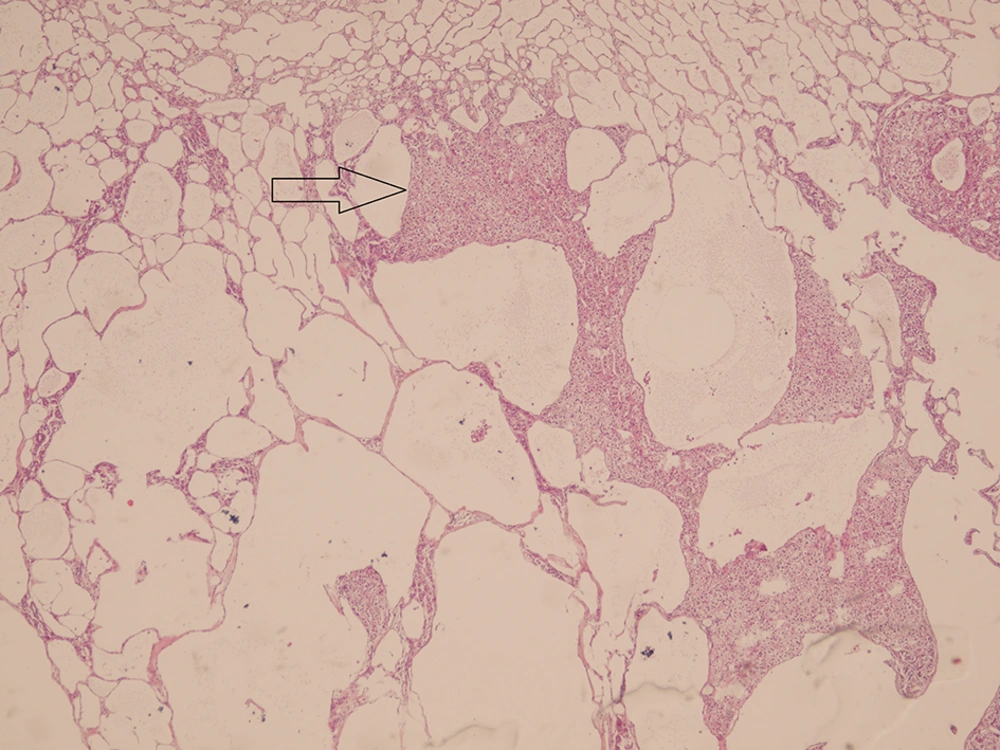
Figure 3.
Microscopic Sections of the Adrenal Mass Show Cystic Spaces Lined by Flat and Bland Endothelial Cells. Foci of normal adrenal tissue can be observed between the cysts (arrow).
The patient is now under follow up for about six months, during her visits, her blood pressure was always normal, and no sign of recurrence or any other abnormality was observed.
3. Discussion
Lymphangioma is the most common vascular neoplasm in children; but it may be observed in many other age groups. Adrenal cystic lymphangioma is a very rare tumor; the largest series of the reported cases were nine cases in the period of 24 years reported by Ellis et al. (5). The etiology of this tumor is controversial and vascular malformation; ectasia and the obstruction of lymphatic channels are currently the most favored mechanisms (6, 7).
Most of the patients with adrenal lymphangioma are asymptomatic and according to the previous literature, these lesions were primarily found at autopsy, but they are currently detected during imaging work-up for unrelated causes and are mostly operated with the preoperative diagnosis of other adrenocortical or adrenal medullary neoplasms such as adenoma or pheochromocytoma (8).
The patient under study was a middle aged female who presented hypertension. During work up for hypertension a CT scan of the abdomen and pelvis was performed which showed an adrenal mass. Therefore, she was operated with the primary impression of hypertension and adrenal mass.
As already mentioned, most of the cases of adrenal cystic lymphangioma are asymptomatic and rarely do they present signs and symptoms of mass pressure effect such as palpable mass, gastrointestinal disturbances, and pain (1). To the best of the authors’ knowledge only one case of adrenal lymphangioma is reported with labile hypertension similar to the current case (2). It is issued that mass effect of the tumor was the cause of hypertension; therefore, the blood pressure returned to normal after removal of the adrenal mass.
Imaging modalities Ultrasonography (US), Computed tomography (CT) and Magnetic resonance imaging (MRI) have the major role in preliminary diagnosis of adrenal cystic lymphangioma. Ultrasonography shows well marginated and anechoic lesions; while CT scans demonstrate hypodense and non-enhancing masses. On MRI, adrenal lymphangioma is visible as low intensity signals on T1-weighted images and high intensity signals on T2-weighted images (8).
Another diagnostic modality in the previous studies was fine needle aspiration cytology of the cystic fluid taken under the guide of imaging such as sonography or CT scan. Although this procedure can exclude malignancy, however the numbers of cells is usually too low to make a definite diagnosis (4). After operation, the pathologic study of the resected mass is the most accurate diagnostic procedure. There are cystic spaces lined by flattened endothelial cells with no atypia and no mitosis. The Hematoxylin and eosin slides of the tumor are diagnostic and enough for definite diagnosis, however, these cells are reactive with CD31, CD34 (endothelial specific markers) and D2-40 (lymphatic markers) (9).
In most cases, the clinical management of adrenal cysts depends on the findings of imaging studies. Several authors recommended managing the uncomplicated cysts with smooth wall linings and no thickening by aspiration instead of surgical excision. However, the aspiration of cystic content has several shortcomings including potentially unidentified histological type, and high incidence of the re-accumulation of cystic fluid. Nonfunctioning and small cysts of a benign nature can be treated conservatively. However, surgical excisions are recommended for cysts that are large, symptomatic, parasitic, and considered likely to be malignant (9).
As a conclusion, adrenal cystic lymphangioma is a very rare tumor, which should be considered in the differential diagnosis of cystic masses of adrenal.