


1. Background
Sleep is known as one of the most fundamental needs of humans (1). People with sleep disorders not only suffer from fatigue but also have defects in cellular repair, impaired memory and learning, increased anxiety and reduced quality of life (2). Restless leg syndrome is a sensory-motor disorder, which occurs with a strong desire to move the legs or other parts of the body. This can be accompanied by discomfort, pain, tingling and numbness in the affected area that can be exacerbated by rest and inactivity (3). This syndrome has a prevalence of 2%–15% and is seen particularly in middle age and old age (4). The etiology of RLS is unknown, but idiopathic (primary) and secondary restless leg syndrome are two of the proposed pathophysiological mechanisms. Primary restless leg syndrome is a central nervous system disorder, with psychological factors and stress playing a role in its intensity (5, 6). Increased urea and creatinine levels before dialysis and iron deficiency due to kidney failure have been mentioned as causes of the disease (7). Other underlying conditions and diseases associated with RLS include iron deficiency (3), folate deficiency (8), kidney failure and end stage renal disease (ESRD) (3). An increased urea and creatinine before dialysis have been noted as possible causes of increase in frequency of this syndrome (9). In other studies, iron deficiency due to kidney failure has been a suggested cause (10, 11). A high frequency of family history is seen in this disease that suggests the existence of a genetic factor in the primary form of the disease (12, 13). This syndrome causes confusion and inability to rest, which has negative impacts on quality of life such as lack of comfort, sleep disorders, fatigue and stress and secondarily undermines the individual’s performance and impacts social and occupational activities, as well as family life (14). Sleep disorders, such as changes in sleep structure, sleep apnea syndrome, periodic limb movements, restless leg syndrome, insomnia and increased daily sleep can be seen more in patients on dialysis than the normal population (15-17). It seems that these disorders have a negative effect on quality of life in hemodialysis patients, as well as their clinical outcome (18-20). Recent studies have expressed a potential connection between sleep deprivation, lack of sleep, sleep disorders and an increased mortality and reduced quality of life (21-23). The evaluation and treatment of insomnia, as an effective criterion for quality of life, should be a priority, because this treatment can improve the quality of life and can be associated with important clinical outcomes. Insomnia can also be a warning sign and a criterion for diseases and mental disorders that indicate the necessity of considering insomnia as an indicator of underlying disease (24). In a study by Kazemi et al. performed on patients in the internal and surgical wards, 49.1% of the patients stated that their sleep quality was reduced (1). Use of medications and special care are the principles of this syndrome’s treatment (25).
2. Objectives
Recently, many studies in dialysis clinics based on finding an explanation for RLS risk factors have been conducted, but since these studies have been widely variable, this study is designed to examine the prevalence of insomnia and restless leg syndrome in patients undergoing chronic hemodialysis.
3. Patients and Methods
This is a descriptive cross-sectional study, which started by inviting 45 (all) patients under hemodialysis in the dialysis unit of Rafsanjan Ali Ibn Abitaleb Hospital in 2011. Data gathering lasted for eight months. Two questionnaires were used in this study. The first questionnaire was the Insomnia Severity Index and included five questions related to insomnia. This questionnaire gives a 0 – 28 score, and a higher score indicates more severe insomnia. This instrument was previously validated and used by Heidari and colleagues (26). The second questionnaire was for restless leg syndrome and is called the Restless Leg Syndrome Screening Questionnaire. This instrument includes seven questions that screen for the main symptoms of the disorder. This questionnaire gives a 0–10 score, and a score greater than seven is considered positive. This questionnaire was validated and used by Dehghan and colleagues (27). Information about the participants’ demographic characteristics, including gender, age, marital status, education level, blood group, duration of dialysis, number of dialysis sessions per week, each session based on time, underlying disease and dialysis adequacy were gathered. Diagnostic criteria for restless leg syndrome are arranged according to the International Study Group criteria for the syndrome, based on the DSM-5TR (28). For each participant, the symptoms of RLS have been diagnosed during dialysis sessions by an interviewer face to face on the basis of the clinical criteria of RLS (5, 28) published by the International Restless Leg Syndrome Study Group (IRLSSG). Along with other clinical information, basic demographic data and laboratory findings were recorded in the checklist for each participant (5).
The four basic criteria for RLS are as follows:
- The urge to move the legs, usually accompanied by an uncomfortable and unpleasant feeling in the legs or causing this feeling in them
- The urge to move or unpleasant sensations, which start or become worse during periods of rest or inactivity such as lying or sitting
- The urge to move or unpleasant sensations that go away partially or completely, at least for the duration of a continuous activity of moving such as walking or stretching
- The urge to move or unpleasant sensations, which become worse in the evening and at night than during the day, or only occur in the evening and night
Exclusion criteria included:
- Patients who had undergone a kidney transplant
- Patients with an amputated foot
- Patients who had a subjective feeling (Akathisia) of restless leg syndrome due to taking medications such as SSRIs.
In this study, statistical analysis was performed using SPSS version 17 and variables related to baseline demographic data, clinical information and laboratory findings were collected and compared between participants with RLS and controls using Chi-square test and Fisher’s Exact test. The significant P-value was considered as P ≤ 0.05.
4. Results
Of 45 patients invited to participate, one refused to participate. Among the 44 patients who took part in this research project, 23 patients were women and 21 were men (Figure 1). The average score calculated for RLS in this population was 6.23±2.331, and according to the threshold (which was considered seven), 54.5% of participants were diagnosed with RLS (Figure 2).
Figure 1.
Frequency of Gender of Study Participants
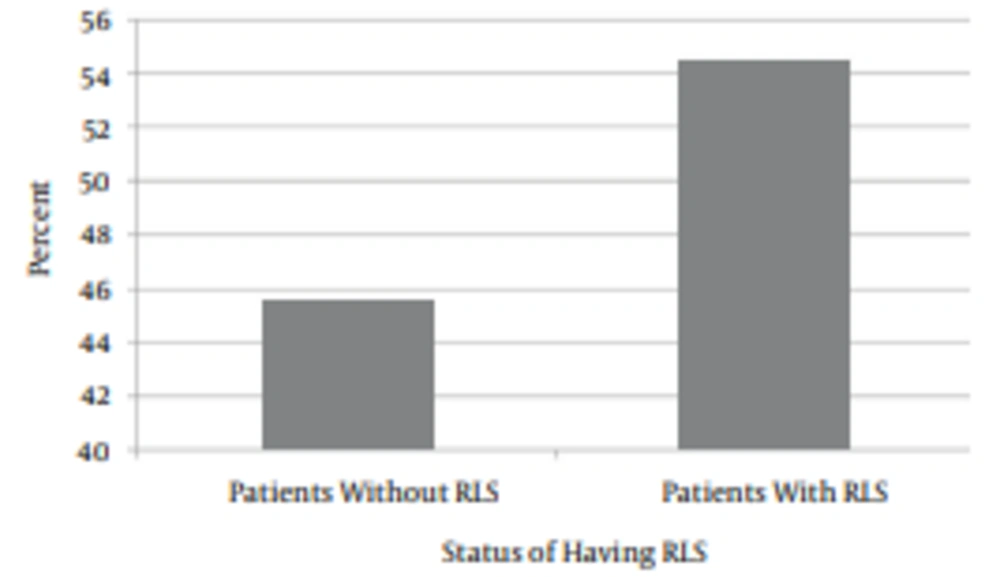
Figure 2.
Frequency of Restless Leg Syndrome in Patients on Chronic Hemodialysis
Also, 29.5% of participants mentioned a family history of RLS. The average number of dialysis treatments per week in these patients was 2.51 ± 0.644. The most common blood group was group A, seen in13 patients and the least common was group AB, seen in three participants. Also, 88.2% of patients had a positive Rh blood group. Of the women who participated in this study, 65.2% had RLS, while this statistic was 42.9% for men. Although in accordance with results of this research and previous studies, the prevalence of this complication among women is higher than men, the difference is not significant (P < 0.05). Of patients with RLS, 29% had blood group A, blood group O constituted 23% of patients with RLS, and for blood groups B and AB this amount was much lower (Figure 3).
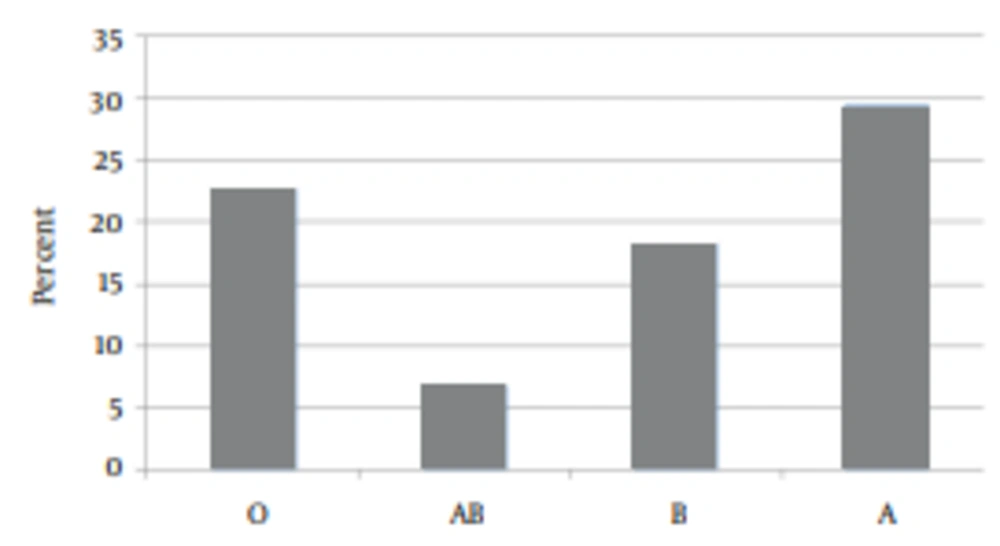
Figure 3.
Frequency of Blood Groups in Patients Under Hemodialysis
Based on the results of this study, no significant correlation was found between the incidence of RLS and blood group. This result was also true for having RLS and the Rh blood group. Of the study participants, 29.5% reported a family history of RLS and 45.8% of this group had RLS. Also, it should be noted that 90% of those without a family history of RLS, did not have RLS. The association between RLS and family history was considerably significant (P < 0.05). There was no significant correlation between RLS and the factor of age or between the level of BUN, creatinine, calcium, potassium, phosphorus, iron or ferritin. However, the association between RLS and the number of dialysis treatments (P < 0.05) and the Insomnia Severity Index was significant (P < 0.01). Also, the Insomnia Severity Index and creatinine levels, as well as the number of dialysis treatments were significantly correlated (P < 0.05). We found no other significant relationship between the Insomnia Severity Index and other factors.
5. Discussion
The results of this study show a frequency of 54.5% for restless leg syndrome in patients on dialysis in Rafsanjan Ali Ibn Abitaleb Hospital, which is remarkable, whereas, this prevalence is reported as 28% by Kim et al. (29), 8.45% by Siddiqui S and colleagues in England (30), 10.18% by Curgunlu A and colleagues (31), 14.5% by Soyoral in Turkey (32) and 20.3% by Salman in Syria (33). The prevalence in some other areas was reported as follows: 22.96% in Central Serbia (34), 14% in Budapest (35), 21.5% in Italy (36), 1.5% to 6.6% in India (37, 38) and 14.8% in Brazil (39). In Iran, the reported prevalence by Salimi-Pour in Bushehr (7) (33.1%) and by Molla Hosseini in Tehran (61.5%) (40) was less than the result of the present study.
The result of this study did not show any relation between iron levels and restless leg syndrome and is congruent with Shahidi’s study (14) but does not match O’Keefe’s results (41). The type of patients under study, as Collado-Seidel verifies, can be a justifying factor (42).
This study showed that blood group can be associated with RLS, especially blood group type A. This result does not fit Shahidi’s study (14) that considered RLS related to the Rh blood group. According to this study, serum creatinine level was not correlated with restless leg syndrome, which is not consistent with Soyoral’s study (32) in Turkey. It can be concluded from this study that the occurrence of restless leg syndrome in patients on hemodialysis in Rafsanjan Ali Ibn Abitaleb Hospital is considerable. On the other hand, there is no significant relationship between blood biochemical factors such as iron, urea, calcium, phosphorus, potassium, creatinine, TIBC, TIBC/serum iron and restless leg syndrome. Thus, we concluded that all patients on chronic hemodialysis should be evaluated in terms of restless leg syndrome and effective therapeutic measures should be taken to improve their quality of life.
