In this study, we demonstrated that early hyperbaric oxygen (HBO) therapy suppressed apoptosis with proliferative reaction after renal ischemic reperfusion injury (I/R) in rats. Renal I/R is a common factor in the development of acute kidney injury (AKI), which has been recognized as resulting in high morbidity and mortality. Reperfusion is vital for the ischemic renal tissue but has the potential to aggravate tissue injury (
12). Several studies have shown the beneficial effects of HBO on the histopathological changes after renal I/R (
13,
14). Cellular death that occurs after I/R injury was morphologically divided into apoptosis and necrosis, both of which are positioned as different types of cellular death (
15,
16). There were no reports about the effects of HBO on apoptosis and repaired pathway after renal I/R, to the best of our knowledge.
The apoptotic cells showed the various morphological changes as chromatin aggregation, fragmentation of DNA, and cell membrane blebs (projections) in the early stage and finally, disappearance by phagocytosis. Meanwhile, necrosis develops as degradation of the nucleus, the cytoplasm and lysosomal membrane in the cells and causes an inflammatory response. Schumer et al. (
16) described morphologically that sustained necrosis developed just by renal ischemic injury, and reperfusion after renal ischemia significantly induced apoptosis.
By continuing the death of two types of cells, renal failure is sustained and leads to poor prognosis. In the caspase cascade, the initiator and effector are stimulated to cause activation of the cascade and induce irreversible apoptosis (
17,
18). That the distal tubule is easily injured by I/R is consistent with a previous study by Kreisberg et al. (
19) however, the exact mechanism might not be fully explained at the moment.
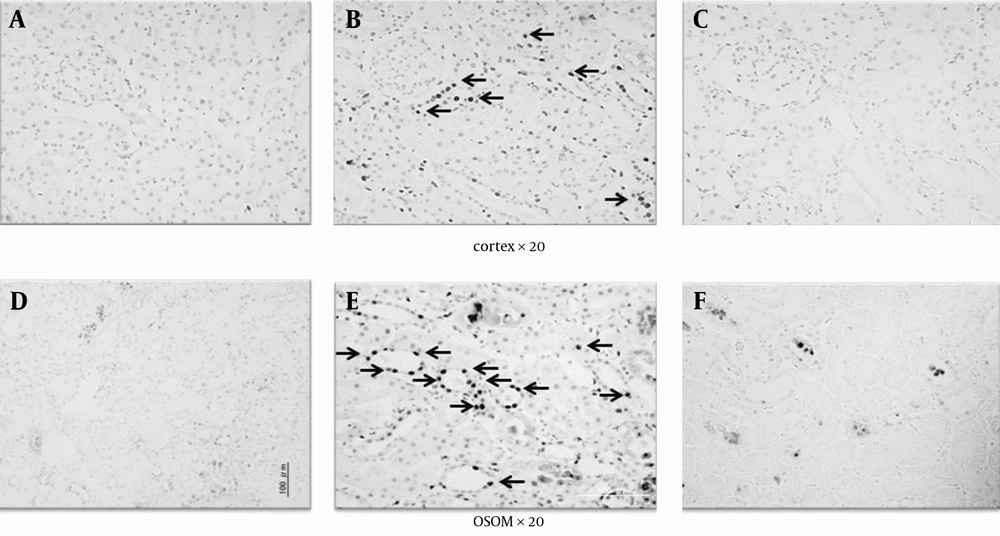
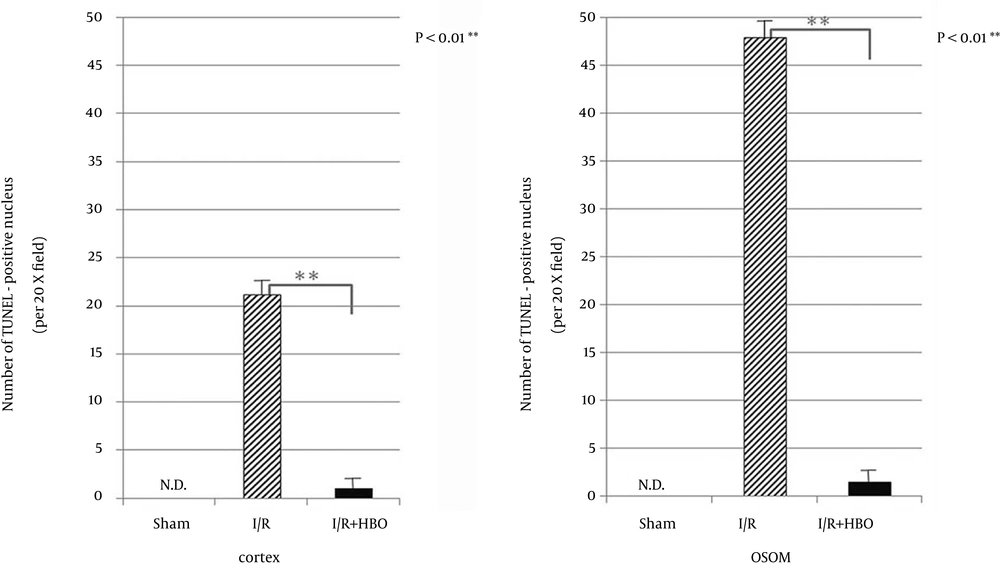
Apoptotic cells, 24 hours after I/R injury, were significantly observed by the TUNEL method in the distal tubule of the cortex and the medulla in the I/R groups, but were not observed in the I/R + HBO group, suggesting that HBO treatment inhibited the activity of caspases.
The following studies support our findings regarding inflammation, apoptosis and proliferation after the injury.
Sharples et al. reported, biochemically and histologically, that erythropoietin prevented caspase-3,-8 and -9 activation
in vivo and reduced apoptotic cell death caused by renal I/R in rats (
1).
Wang et al. showed that netrin-1, a diffusible laminin-related protein, protected renal tubular epithelial cells against renal I/R by suppressing apoptosis and increasing proliferation in transgenic mice (
20). In addition, suppression of apoptosis induced by renal I/R prevented inflammation using a murine model (
2).
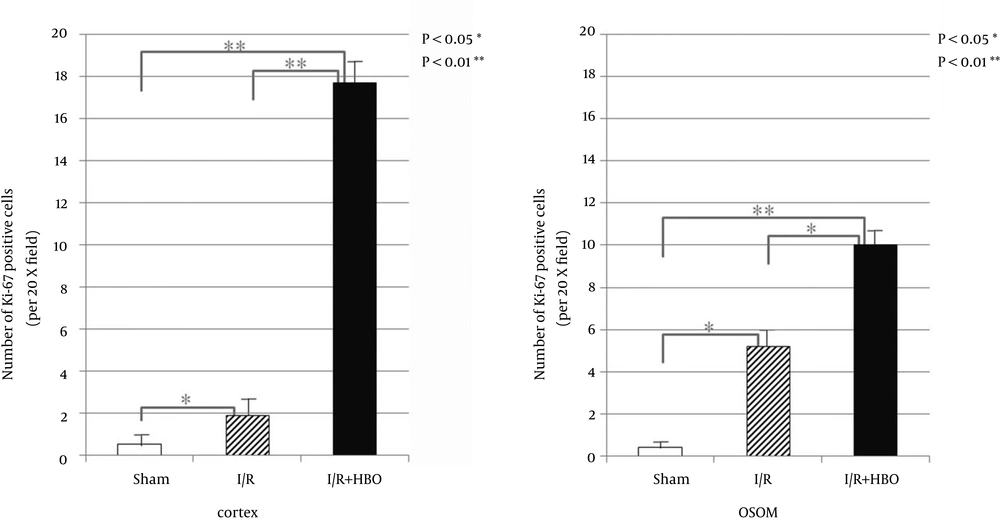
Wen et al. described tubular cell regeneration and proliferation as an important element of renal recovery in acute renal injury. The mechanisms involved in the protection by HBO against renal I/R remain unclear. However, HBO therapy would suppress apoptosis through the caspase cascade after I/R injury in the ischemic region (
4).
Although biochemical analysis was not simultaneously determined in this study, we previously examined the values of serum creatinine (Cr) and blood urea nitrogen (BUN) in the same fashion, with or without HBO therapy in rat models (not published). Significant decreases in Cr (3.8 ± 0.2 vs. 2.7 ± 0.1 mg/dL) and BUN (120 ± 2.2 vs. 105 ± 2.5 mg/dL) were found 24 hours after renal I/R injury between the I/R and I/R + HBO groups, respectively. These results were matched with another study of Ramalho et al. (
14) describing the significantly lower levels of Cr and BUN, suggesting that HBO therapy ameliorated renal function after the injury.
This study has some limitations because the number of animals was too small to understand fully the profiles of the histological benefit of HBO after the injury. Further studies will be necessary to elucidate the precise mechanism of HBO therapy and repaired pathway, including apoptosis after renal I/R injury.
In conclusion, in this study, we have demonstrated that hyperbaric oxygen (HBO) therapy attenuated the expression of apoptosis induced by renal I/R injury and promoted renal tubular regeneration.