1. Background
Healthcare workers are exposed to many potential occupational hazards, including injuries from needles, sharp objects, and exposure to patient secretions (1). Needlestick injuries are penetrating skin injuries caused by sharp medical devices contaminated with blood or patient secretions (2). Evidence has shown that needlestick injuries often occur during blood transfusions and blood products, sampling, disposal of needles, and collection of excreted material (3). Moreover, hospital waste is one of the important sources of needle stick contamination during their management and disposal (4). Studies have shown that twenty blood pathogens, including hepatitis B, hepatitis C, and HIV immunodeficiency, can threaten the health of healthcare workers (5). The World Health Organization has reported that needlestick injuries are responsible for 40% of hepatitis B and hepatitis C infections and 2.5% of HIV infections among healthcare workers worldwide (6). In addition, needlestick injuries include direct costs imposed on diagnostic tests for hepatitis B, hepatitis C, and HIV antibodies and indirect costs such as post-exposure prophylaxis costs and employee absenteeism (7). On the other hand, according to the World Health Organization and the International Council of Nurses report, healthcare workers are estimated to be around 35 million people worldwide, which constitute 12% of the working population. Therefore, special attention to the health of healthcare workers is considered one of the important needs of the medical community (8). In order to prevent the transmission of pathogens through needle sticks among health workers, national public health policies should promote tools with high safety features, strengthen health education, and implement safety protocols and training programs. However, needlestick is reported abundantly in both developing and developed countries, indicating the presence of needlestick in healthcare workers as a global problem (9). Therefore, further studies are needed to find the reasons for the high rate of needle sticks among health workers and low knowledge of safety practices and guidelines.
2. Objectives
The present study was designed to investigate the factors affecting the proper disposal of special medical waste with needle sticks among health workers in hospitals at the Iran University of Medical Sciences.
3. Methods
This research is a descriptive-analytical study that has been done retrospectively and cross-sectionally using the data of autumn 2019 after obtaining the necessary permits from the Research Council and the Research Ethics Committee (IR.IUMS.REC.1399.1152). All medical and service staff of Iran University of Medical Sciences government hospitals have been employed in this research. One of the criteria for inclusion in the study was personnel who somehow came into contact with sharp objects and needle sticks. Among 6119 medical-service staff, 180 subjects have been exposed to a needle stick at least once. In addition, all staff was educated against needle sticks and proper waste management. Then, the data was collected using the census method. Toward this end, a form with two separate parts was designed to collect data. In the first part of this form, demographic information about the studied hospitals was designed. Then, the information about the collection of particular medical waste and the needle stick level of employees was designed in the second part of the form. It is noteworthy that in the related section of personnel information in the questionnaire, questions about gender, age, marital status, working area, work shift, and needle sticking time are included. Data collection this study was done by completing the data collection form by visiting the studied hospitals' environmental health, infection control, and occupational health units in one step. Also, the information needed to measure the amount of hospital waste was obtained from the recorded data in the environmental health unit of the hospitals.
First, in all public/general/educational/specialized and sub-specialized hospitals, detailed information about the waste disposal process and needle stick statistics was obtained by completing the data collection form. After collecting the desired information, the data were classified and analyzed using SPSS 25 software.
4. Results
According to Figure 1, the highest percentage of needle sticks are related to the operating room (24.44%), surgery (22.22%), emergency (15%), internal (10%), para-clinic (8.33%), ICU (5%), Blood (1.67%), angiography (1.11), clinic (1.11). However, the percentage of needle sticks in the CCU, NICU, delivery block, kidney transplant, dialysis, cancer, eradication, and laundry departments is less than one.
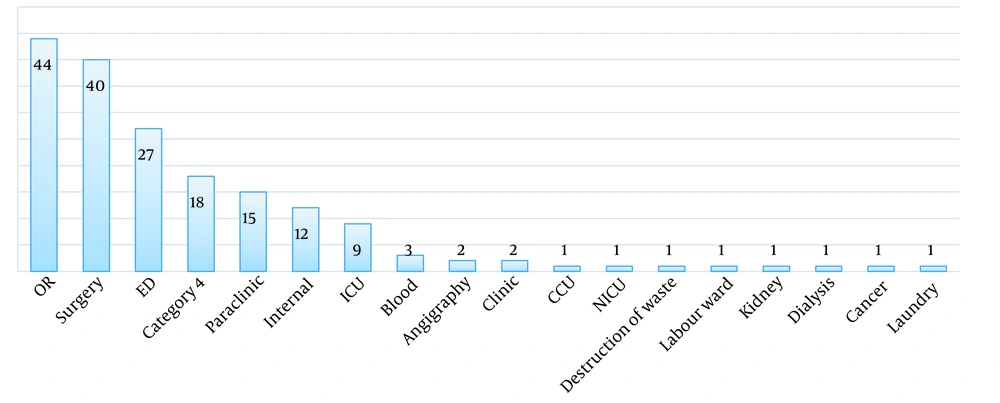
Figure 1.
Number of needle sticks by sections
In this study, we found that the mean age of needled people is 35 years, with a standard deviation of 10.53. Besides, the results showed that 0.56% of the studied people are in the age group of fewer than 20 years, 47.2% of them are in the age group of 20 to 30 years, 25% of them are in the age group of 30 to 40 years, 7.22% of them are in the age group of 40 to 50 years, and 1.67% of them are in the age group above or equal to 50 years (as shown in Table 1).
Table 1.Analysis of the Age of the Studied Subjects
| Age | No. (%) | Mean ± SD |
|---|---|---|
| Less than 20 years | 1 (0.56) | 19 ± 0 |
| Larger equals 20 and less than 30 years | 85 (47.22) | 24.50 ± 3.03 |
| Larger equals 30 and less than 40 years | 45 (25) | 34 ± 2.74 |
| Larger equals 40 and less than 50 years | 13 (7.22) | 44.12 ± 2.90 |
| Greater than or equal to 50 years | 3 (3) | 54 ± 2 |
In addition, examining the number of needlesticks on different work shifts showed that the highest number occurred on the morning shift. 52.8% of needle counts occurred on the morning shift, 27.8% on the night shift, and 19.4% on the evening shift (Table 2).
Table 2.The Number and Percentage of Needle Sticks in Different Work Shifts
| Shift Work | No. (%) |
|---|---|
| Morning | 50 (27.8) |
| Afternoon | 95 (52.8) |
| Night | 35 (19.4) |
According to Table 3, the mean number of needle sticks in the studied hospitals was 13.9, and the mean amount of waste produced in hospitals was 47223 kg. The analyzed results showed that the number of needle sticks is associated with the volume of waste in the studied hospitals. In other words, it can be predicted that the probability of needle sticks increases with an increase in waste volume.
Table 3.Association Between the Rate of Staff Sticking and the Volume of Hospital Waste
| Title | Month | Number of Hospital | Total Observe | Mean ± SD | P-Value |
|---|---|---|---|---|---|
| Number of needles (person) | Oct | 13 | 63 | 4.83 ± 7.32 | < 0.01 |
| Waste mass (kg) | 13 | 213428 | 16417.50 ± 21912.50 | ||
| Number of needles (person) | Nov | 13 | 58 | 4.74 ± 9.41 | < 0.01 |
| Waste mass (kg) | 13 | 203457 | 15650.60 ± 20606.80 | ||
| Number of needles (person) | Des | 13 | 57 | 4.46 ± 7.52 | < 0.01 |
| Waste mass (kg) | 13 | 197008 | 15154.50 ± 19674.70 | ||
| Number of needles (person) | Fall | 13 | 181 | 13.9 ± 23.9 | < 0.01 |
| Waste mass (kg) | 13 | 613894 | 47223 ± 62118 |
5. Discussion
In this study, we tried to investigate the association between medical waste management and needle sticking of health staff in hospitals at the Iran University of Medical Sciences. Towards this end, we found that the five wards, including the operating room (24.4%), surgery (22.2%), emergency (15%), internal (10%), and para-clinic (8.33%), have the highest needle sticks among their health staff. In line with this, medical instruments, including needles, angiocatheters, ampoules, suture needles, scalpels, and razor blades, are healthcare workers' most common injury means (10). Furthermore, several studies have shown that needle sticks are the most common cause of injury (10, 11). Also, Smith et al. reported that syringe needles are the highest common devices in needlestick events (12). Additionally, Schmid et al. confirmed that needlestick injuries are the most common injuries among employees and medical students (13). In addition, another study has reported that suturing is the most common activity leading to staff injury, which is in line with the results of our study, which showed the highest number of needle sticks in the operating room (14). However, other studies have often mentioned venipuncture and capping as the most harmful activity for healthcare workers (15-17). However, recent studies have shown that using safety equipment and standard precautions can significantly reduce needlestick injuries and the risk of bloodstream infections (18, 19).
In addition, the results of the investigation of the age group of people injured by needle sticks in the current study showed that the highest rate was in the age group of 20 - 30 years old (35 ± 10.53). This study showed that 58.3% of needled people were women. The educational nature of the studied hospitals is one of the reasons for the increase in the level of needle sticks in the age group of 20 - 30 years old, which may be due to the lack of experience among trainees and staff. It has been hypothesized that work experience, skills, and experience increase with age, reducing the likelihood of injury. In consist with our results, various studies reported young age and low work experience as risk factors associated with needlestick injuries (12, 14, 16).
For example, Farzadkia et al. found that older age can be a protective factor against needle stick injury (20). Also, another study has shown that 67% of the studied nursing students were exposed to needle sticks at least once due to a lack of work experience and poor knowledge of job protection (21). Young nurses appear to be more vulnerable due to less work experience, lower practical skills, and higher workloads, while older nurses with longer work experience appear to have managerial positions or fewer tasks. Moreover, the results of this study showed that 52.8% of the number of needles occurred on the morning shift, 27.8% on the night shift, and 19.4% on the evening shift. In this regard, Fisman et al. reported that long working hours and sleep deprivation increase the risk of needle and sharps injuries (22). According to Lotfi and Gashtasbi’s study, the number of night shifts is one of the most important risk factors for injury (16).
On the other hand, the results of this study showed that the total waste produced per bed in the hospitals of Iran University of Medical Sciences was equivalent to about 205 kg per active bed in the fall season, which is approximately equivalent to 2.27 kg per day. In line with this, a conducted study in Sari hospitals in 2013 reported that the amount of waste for each active bed was 2.19 kg (23). In addition, many studies investigated the amount of waste in different hospitals in various cities of Iran and reported slight differences (20, 23-25). On the other hand, the results of Diaz et al.'s study show that the total amount of produced waste in selected hospitals in developing countries is in the range of 0.16 to 3.23 kg per active bed per day (26). Based on the results of this study, a significant relationship exists between the volume of produced waste and the rate of needle sticks. In other words, the probability of needle sticks increases with sharp tools and the generation of sharp waste. Also, the increase in the amount of waste leads to an increase in the possibility of exposure to employees responsible for waste disposal. Moreover, a recent study reported that needlestick injuries occurred mainly during waste disposal, needle removal, and recapping needles (27). In line with our study, Saadeh et al. conducted a study to investigate the ratio of needle sticks and sharps injuries among healthcare workers in a medical center in Amman, Jordan. They found that the needle stick ratio was the highest among nurses and cleaners, and injuries occur mostly during medical waste collection (9).
However, the limitation of this study is that the used data were reported by health workers, which could only include those who were aware of the impact of needlestick on the quality of health care and may not be representative of all people who were exposed to needlestick.
5.1. Conclusions
It is noteworthy that following the standard guidelines for separating normal waste from other hospital waste, which can be done by increasing the level of awareness of employees on how to deal with waste, has the greatest role in reducing the volume of special waste. In addition, reducing the volume of hospital waste leads to a decrease in needlestick statistics. Moreover, special control in not mixing sharp waste with other hospital waste, especially infectious waste, is one of the main priorities of needle stick prevention. Also, the results showed that the number of workers' records and work shifts plays a role in the amount of needle stick personnel. In this regard, there is a hypothesis that the targeted training of personnel to increase the skill and control the distribution of admission of patients, especially in the morning shift, will decrease the number of needle sticks on the staff. Toward this end, it is suggested to prioritize using more experienced medical service personnel in the operating room, surgery, and emergency departments, respectively.