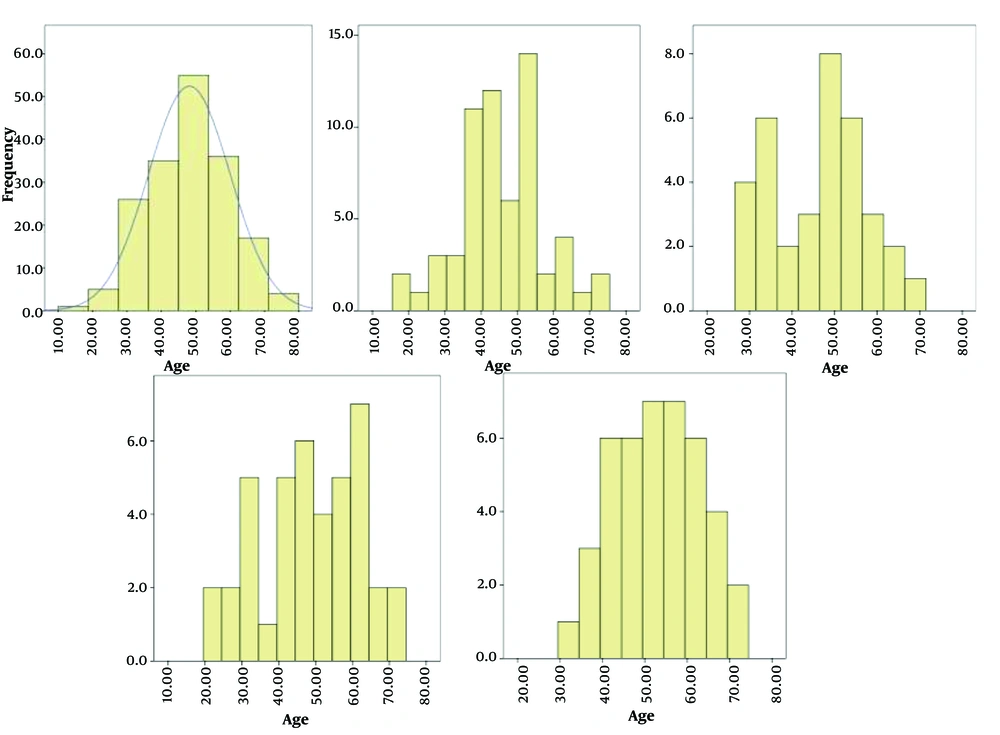
In this study, 552 files of patients with uveitis referring to the specialized retina-uveitis clinic of the …, Iran and specialized clinics affiliated with the … were investigated from April 2016 to October 2022. Among these patients, 194 patients with pediatric uveitis were excluded from the study, and 358 patients’ files were assessed, of whom 170 were female (47.48%) and 188 were male (52.51%). The uveitis patients’ mean age at the diagnosis time was 48.14 years (18 - 72 years) (SD: 11.91); the patients with anterior uveitis had the lowest mean age (45.4 years), and the patients with panuveitis had the highest mean age (52.9 years) at the diagnosis time (
Table 2). In general, the involvement in the fifth decade of life was at a maximum level (
Figure 1).
| Variables | Ant. Uveitis | Int. Uveitis | Post. Uveitis | Panuveitis | Overall |
|---|
| Number of Patients | 122 (34) | 70 (20) | 82 (23) | 84 (23) | 358 (100) |
| Female/Male | 62 (51)/60 (49) | 39 (56)/31 (44) | 33 (40)/49 (60) | 35 (42)/49 (58) | 170 (47.48)/188 (52.51) |
| Age | 45.47 ± 11.54 (18 - 72) | 46.28 ± 11.03 (29 - 67) | 48.82 ± 13.60 (22 - 72) | 52.90 ± 10.14 (32 - 72) | 48.14 ± 11.91 (18 - 72) |
| Binocular | 55 (45 | 64 (91) | 42 (51) | 51 (61) | 212 (60) |
| Monocular involvement | 67 (55) | 6 (9) | 40 (49) | 33 (39) | 146 (40) |
| Non-granolomatousis/granulomatousis | 122 (100)/0 (0) | 68 (97)/2 (3) | 74 (90)/8 (10) | 77 (92)/7 (8) | 341 (95)/17 (5) |
| Infectious/Non-infectious | 32 (26.22)/90 (73.77) | 0 (0)/70 (100) | 36 (43.91)/46 (56.09) | 22 (26.19)/62 (73.81) | 90 (25.13)/268 (74.86) |
| Primary BCVA | 0.73 ± 0.53 (0 - 1.85) | 0.68 ± 0.58 (0 - 1.85) | 0.89 ± 0.56 (0 - 1.85) | 0.77 ± 0.63 (0.02 - 2.30) | 0.76 ± 0.58 (0 - 2.3) |
| Last BCVA | 0.24 ± 0.40 (0 - 1.85) | 0.42 ± 0.60 (0 - 2.30) | 0.55 ± 0.70 (0 - 2.30) | 0.63 ± 0.58 (0 - 1.85) | 0.44 ± 0.58 (0 - 2.3) |
Abbreviation: Ant. Uveitis, anterior uveitis; Int. Uveitis, intermediate uveitis; Post. Uveitis, posterior uveitis; SD, standard deviation; BCVA, best corrected visual acuity.
a Values are expressed as No. (%) or mean ± SD (range).
Age distribution of uveitis patients at the time of diagnosis overally, in anterior uveitis, intermediate uveitis (up row in order from left to right), posterior uveitis, and panuveitis (low row in order from left to right)
The prevalence of the disease was 53% in males and 47% in females, respectively, which were highly close to each other, and no significant difference was observed between anatomical pattern these two groups (P = 0.129). Although anterior uveitis and intermediate uveitis were slightly more common in females, posterior uveitis and panuveitis significantly involved males.
The findings indicated that the most common anatomical pattern of involvement in the west of the country was anterior uveitis (34%), followed by other similar types of uveitis, including panuveitis (23.4%), posterior uveitis (22.9%), and intermediate uveitis (19.5%) (
Table 2). In general, most patients with uveitis experienced binocular involvement and difference was significant (P < 0.001) (60% binocular involvement vs. 40% monocular involvement); however, involvement in anterior uveitis was often observed as monocular (55% monocular involvement vs. 45% binocular involvement). On the other hand, monocular involvement in intermediate uveitis scarcely observed in only 9% of the patients (
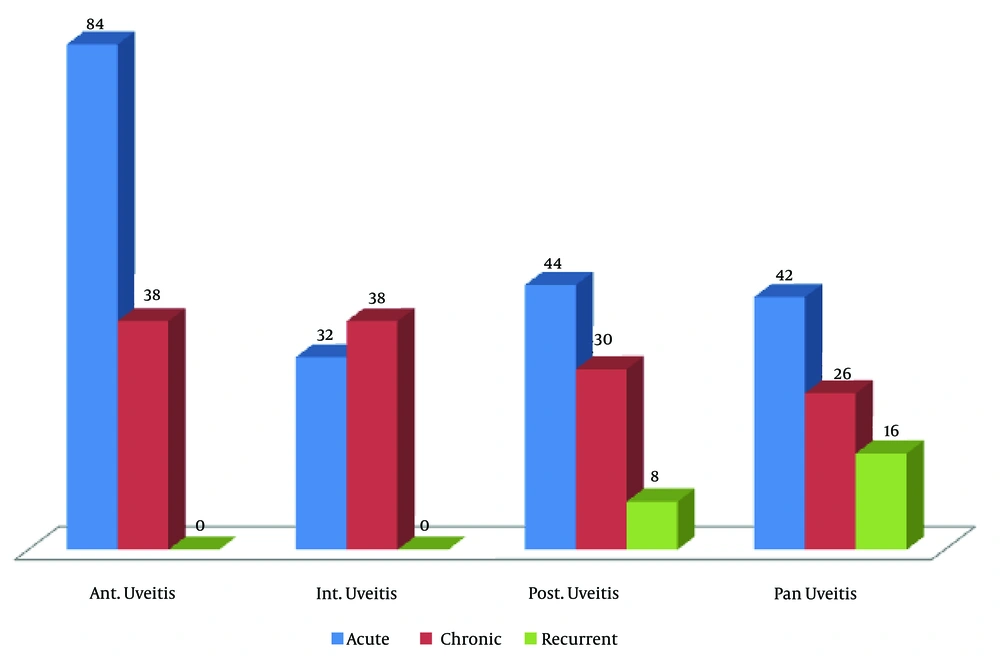
Table 2). Between clinical course and types of uveitis significant difference was observed (P < 0.001). Concerning the clinical course, acute uveitis is generally the most common type of involvement in different types of anterior uveitis (68.85%), posterior uveitis (53.65%), and panuveitis (50%); however, intermediate uveitis involvement is often observed as chronic (54.28%) (
Figure 2). Ocular involvement is mainly non-granulomatous, involving 100% of anterior uveitis, 97% of intermediate uveitis, 90% of posterior uveitis, and 92% of panuveitis (P = 0.004) (
Table 2). Among 70 patients with intermediate uveitis, only two patients diagnosed with sarcoidosis had granulomatous involvement, and in posterior uveitis, four patients diagnosed with sarcoidosis and four patients diagnosed with tuberculosis (TB) had granulomatous uveitis. Moreover, in panuveitis, five patients out of 84 persons had TB, and two people had sarcoidosis. In all anatomical involvements of uveitis, non-infectious causes were more common than infectious. There was no infectious cause in intermediate uveitis; and posterior uveitis had the most cases of infectious etiology (44%).
Clinical course of uveitis in different anatomical types of involvement (Ant. Uveitis: Anterior uveitis, Int. Uveitis: Intermediate uveitis, Post. Uveitis: Posterior uveitis).
Figure 2 clinical course of uveitis in different anatomical types of involvement (Ant. Uveitis: Anterior uveitis, Int. Uveitis: Intermediate uveitis, Post. Uveitis: Posterior uveitis).
The patients’ mean visual acuity at the referral time was 0.76 (SD: 0.58) (0 - 2.3) in general, 0.73 (SD: 0.53) (0 - 1.85) in the anterior uveitis, 0.68 (SD: 0.58) (0 - 1.85) in the intermediate uveitis, 0.89 (SD: 0.56) (0 - 1.85) in posterior uveitis, and 0.77 (SD: 0.63) (0.02 - 2.30) in panuveitis. Furthermore, the patients’ visual acuity at the last referral (after treatment measures) was 0.44 (SD: 0.58) (0 - 2.3) in general and 0.24 (SD: 0.40) (0 - 1.85) in anterior uveitis, 0.42 (SD: 0.60) (0 - 2.30) in intermediate uveitis, 0.55 (SD: 0.70) (0 - 2.30) in posterior uveitis, and 0.63 (SD: 0.58) (0 - 1.85) in panuveitis. After treatment, the patients experienced an overall improvement in visual acuity of 0.32 (P < 0.001, SD: 0.73), and in the subgroup analysis, those patients with anterior and posterior uveitis had an improvement in visual acuity by 0.49 (P < 0.001, SD: 0.67) and 0.34 (P = 0.003, SD: 0.69), respectively. The difference between these two groups was statistically significant; however, despite improvement in visual acuity in intermediate uveitis by 0.26 (P = 0.053, SD: 0.77) and in panuveitis by 0.13 (P = 0.265, SD: 0.76), no statistically significant difference was noticed between them. Accordingly, the best post-treatment visual prognosis belonged to patients with anterior uveitis, and the worst prognosis was for panuveitis.
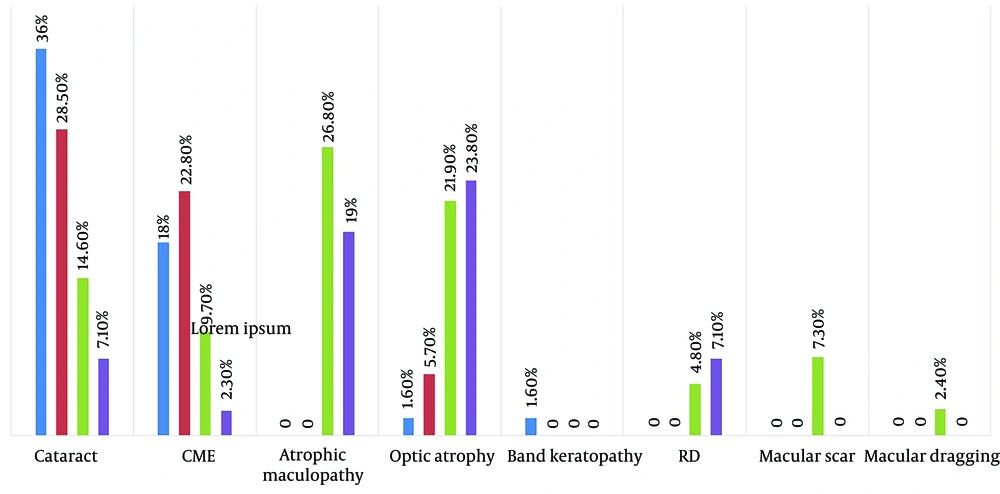
The most common complications of this disease were the cataract formation (in 36% of patients with anterior uveitis and 28.5% of those with intermediate uveitis) and cystoid macular edema (in 22.8% of intermediate uveitis and 18% of anterior uveitis). However, atrophic maculopathy and optic atrophy were more common in posterior uveitis and panuveitis (
Figure 3). The rhegmatogenous retinal detachment (RRD) complication was observed only in patients with posterior uveitis and panuveitis and not in those with anterior and intermediate uveitis. This complication was observed in four patients with posterior uveitis (4.87%), two patients with acute retinal necrosis (ARN), two patients with Eales disease, and also six patients with panuveitis (7.14%); all six patients had ARN. Furthermore, two patients with ARN had manifestations of posterior uveitis and got RRD; 10 patients with panuveitis had ARN etiology, of whom six patients got RRD (60%). In general, the risk of RRD in ARN was 66%. Those patients with RRD experienced the worst visual prognosis, and optic atrophy and atrophic maculopathy were then the worst prognosis symptoms, respectively.
This figure shows the complications of uveitis in different anatomical types of involvement. As illustrated, the most common complications of this disease are cataract formation and cystoid macular edema, which are prevalent in anterior and intermediate uveitis.
According to the findings, the leading causes of uveitis in this center were idiopathic (37.4%) in general, followed by traumatic etiologies (9.49%), Behçet’s disease (9.49%), toxoplasmosis retinochoroiditis (7.82%), Fuchs’ heterochromic iridocyclitis (FHI) (5.58%), and sarcoidosis (3.91%). In this regard, most of ocular involvements had non-infectious etiologies (74.86%).
Table 3 presents and describes types of underlying etiologies in detail.
| Type of Uveitis | Ant. Uveitis | Int. Uveitis | Post. Uveitis | Panuveitis |
|---|
| Etiologies (%) | Idiopathic (40.98) > traumatic (22.95) > FHI (16.39) > herpetic (9.83) > Behcet’s disease (6.55) > seronegative S.A.= posner-schlossman (1.63) | Idiopathic (60) > MS (11.42) > traumatic = Behcet’s disease (8.57) > sarcoidosis = seronegative SA (5.71) | Toxoplasma chorioretinitis (34.14) > idiopathic (17.07) > serpiginous chorioretinitis (12.19) > sarcoidosis (7.31) > presumed tuberculosis = APMPPE = Behcets’ Syn. (4.87) > SLE = VKH = sympathetic Ophthalmia = ARN = CMV = Eales disease (2.43) | Idiopathic (33.33) > Behcets’ disease (19.04) > ARN (11.90) > VKH (9.52) > endogenous endophthalmitis (7.14) > presumed tuberculosis = sarcoidosis = MCP (4.76) > sympathetic ophthalmia = syphilis (2.38) |
Abbreviation: Ant. Uveitis, anterior uveitis; Int. Uveitis, intermediate uveitis; Post. Uveitis, posterior uveitis; FHI, Fuchs’ heterochromic iridocyclitis; Seronegative S.A., seronegative spondylo arthropathy; MS, multiple sclerosis; APMPPE, acute posterior multifocal placoid pigment choroiditis; SLE, systemic lupus erythematosus; VKH, vogt-koyanagi-harada; ARN, acute retinal necrosis; CMV, cytomegalo virus; MCP, multifocal choroiditis and panuveitis.
The assessment of the anatomical types of involvement revealed the following findings: Idiopathic etiology (40.98%), followed by traumatic (22.95%) and FHI (16.39%) are the most common causes in anterior uveitis ; idiopathic etiology (60%), followed by multiple sclerosis (MS) (11.42%) and traumatic/Behçet’s disease (8.57%), are the most common causes in intermediate uveitis; toxoplasmic chorioretinitis (34.14%), followed by idiopathic (17.07%) and serpiginous chorioretinitis (12.19%), are the most common causes of posterior uveitis; and idiopathic etiology (33.33%), followed by Behçet’s disease (19.04%) and ARN (11.90%), are the most common causes in panuveitis (
Table 3).