


1. Background
Type 1 diabetes (T1D) is characterized by autoimmune T-cell mediated destruction of beta cells in the pancreas. However, after decades of investigation, the definitive etiology of T1D has not been determined (1). The estimated prevalence of T1D is approximately 8.4 million worldwide, and 18% of patients are children and adolescents younger than twenty (2). The Global Burden of Disease reports indicate that the overall trends in the incidence, prevalence, morbidity, and mortality of T1D have increased globally over the past decades (1). Adolescent T1D patients are at greater risk of poor glycemic control and severe adverse outcomes (3). Lifestyle characteristics, including sleep quality, sedentary behaviors, and family support, contribute to T1D children’s and adolescents’ health and glycemic status (3-6).
Sleep disorders are more prevalent among patients with T1D than among nondiabetic individuals (7). Approximately 77% of adolescents with T1D have insufficient sleep (3). Regarding the potential association between sleep and glycemic control, recent research has recommended improving the quality and duration of sleep as standard medical care for diabetic patients (7, 8). Nevertheless, the majority of available evidence originates from studies on patients with type 2 diabetes, and not much is known about T1D patients (7). The duration of sleep was discovered to be significantly shorter among children and adolescents with T1D than among their healthy peers (9). A recent meta-analysis in 2023 reported an insignificant decline in hemoglobin A1c (HbA1c) levels in T1D patients with longer sleep durations (10). In addition to glycemic control, sleep disturbances might cause further difficulties for adolescents with T1D, including adverse academic outcomes and neurocognitive and behavioral impairments (7, 11). Furthermore, both short sleep duration and poor sleep quality worsen diabetes management and adherence to medications in T1D teens (7, 11). Glycemic control and sleep seem to have a bidirectional and complex relationship in T1D patients, although the available research findings are conflicting (9, 10).
Sedentary behavior is a dominant feature among children and adolescents (12). Sedentary activities, including the use of electronic devices (e.g., television, smartphones, and game consoles), have become increasingly widespread in recent decades (13). This rising pattern of electronic device use has been paralleled by a shorter sleep duration in adolescents (14). A large population study revealed a dose-response association between sleep deficiency and the use of electronic devices in adolescents (13). Children and youths with T1D tend to experience a more sedentary lifestyle associated with higher HbA1c levels (4). However, the available literature has not clearly identified the association between the time spent using each screen-based device and sleep disorders in adolescents with T1D.
The family environment plays a key role in sleep disorders in adolescents despite the developmental and biological factors that substantially affect sleep (15). Family members’ support and involvement enhance diabetes management and the glycemic profile in adolescents with T1D (6). The link between sleep quality and perceived family support is highly unknown in T1D children and youths.
2. Objectives
This study reports the sleep disorders, glycemic control status, and the level of electronic device use and family support in a large population of T1D adolescents.
3. Methods
3.1. Study Design
This cross-sectional study was conducted at the Pediatric Diabetes and Endocrinology Clinic of Besat Hospital, Hamadan, Iran, from February 2021 to February 2022. Adolescents with T1D aged 11 - 17 years were enrolled in the study. The convenience sampling method was used. Inclusion criteria were the following: (1) Definite diagnosis of insulin-dependent diabetes mellitus for more than one year; (2) age of 11 to 17; (3) patient and parental consent for participation in the study; (4) patient’s access to TV, video games, and the Internet at home; (5) and the residence of the patient’s family in Hamadan city. The exclusion criteria were as follows: (1) Taking any medication or substance that affects sleep cycles (e.g., cigarette, antiepileptics, and antihistamines) or deteriorates glycemic control; (2) a history of any chronic disease other than diabetes; (3) psychiatric or developmental disorders (e.g., depression, anxiety or attention-deficit hyperactivity disorder, and autism); (4) not attending the follow-up sessions at least two times a year; (5) not sticking to insulin injection chart and dietary recommendations; (6) not performing HbA1c test regularly; (7) recent hospitalization or major changes in insulin therapy within the past three months; (8) poor school performance (e.g., repeated school years, learning disabilities, or reported school absenteeism unrelated to diabetes); (9) documented social isolation, history of bullying, or lack of regular peer interaction; (10) participants with irregular school or work schedules (e.g., shift work or night study). Adolescents with low-literate or drug-addicted parents, single-parent or step-parent families, and those who experienced an acute episode of stress, or followed professional sports, were all excluded to minimize the impact of confounding factors in study outcomes. All of the participants could quit this study at any time.
3.2. Measurements
A standard integrated questionnaire was designed to obtain data on patients’ demographic and clinical laboratory characteristics, sleep quality, family support, and time spent using electronic devices.
3.3. Demographic and Clinical Laboratory Data
The data on participants’ age, time since T1D diagnosis, and number of annual visits were obtained from patients’ parents and medical records. The laboratory test results of the patients were checked for HbA1c and fasting blood sugar (FBS) levels. The results of the FBS test were not included if the patient had experienced nocturnal hypoglycemia or had not fasted for at least 8 hours over the night before the test.
3.4. Sleep Quality and Quantity
Patients’ sleep quality was examined via the Pittsburgh Sleep Quality Index (PSQI). This questionnaire comprises 19 questions assessing 7 components of sleep, including daytime dysfunction, habitual sleep efficiency, sleep duration, sleep latency, sleep disturbances, subjective sleep quality, and use of sleep medications. The score of each component can vary from 0 to 3, which is interpreted as follows: A score of 0 for not occurring in the previous month; a score of 1 for less than one time per week; a score of 2 for up to two times per week; and a score of 3 for more than twice per week. The sum of all these scores represents an overall score for sleep quality. A score of more than five suggests poor sleep quality (16). We employed a valid Persian version of the PSQI with the Item Content Validity Index (I-CVI) of ≥ 0.78, the scale content validity index of ≥ 0.90, and the Cronbach's alpha coefficient of 0.65 (17). Patients were categorized according to their total PSQI score into three groups: No/mild sleep disorder (score of 0 - 8), moderate sleep disorder (score of 9 - 11), and severe sleep disorder (score of 12 - 21) (18). These groups were evaluated to identify possible associations between sleep disorders and both the time spent on electronic devices and the PSS-Fa score.
Afterwards, the participants self-reported their sleep quality (very poor, poor, good, or very good) over the previous month.
3.5. Family Support
The family support score was assessed via the Perceived Social Support from Family (PSS-Fa) questionnaire from a previous study by Procidano and Heller (19). This questionnaire has 20 questions in which each question is scored from 0 (for “No” and “I don’t know”) to 1 (for “Yes”), and a higher total score reflects a better level of perceived support from family members. We used the Persian version of the PSS-Fa with a Cronbach's alpha coefficient of 0.85 and test-retest reliability of 0.88 (20).
3.6. Electronic Device Use
The time spent on each specific electronic device was assessed via a questionnaire consisting of 3 items as follows: (1) “How many hours do you spend on the Internet (e.g., tablet, social media, mobile phone, personal computer) each day?”; (2) “How many hours do you spend playing video games daily?”; and (3) “How many hours of TV do you watch each day?”. These items were extracted from the Health Behavior in School-aged Children questionnaire, section of the health behaviors related to physical activity (21).
3.7. Statistics
The data were analyzed via SPSS 21. We described the quantitative variables as the means ± standard deviations (SDs). The distribution patterns of the quantitative variables were assessed via the Kolmogorov-Smirnoff test. Owing to a nonparametric pattern of distribution, the time spent using electronic devices, PSS-Fa scores, and HbA1c values were evaluated to discover probable significant differences between various groups of sleep disorders via the Kruskal-Wallis test. Dunn’s adjustment was performed for post hoc analysis as the nonparametric multiple comparison test. The associations between the PSS-Fa score and quantitative variables were evaluated via Spearman’s correlation test. A statistically significant difference was considered as a p-value of less than 0.05.
3.8. Ethics
This study was derived from the doctoral thesis of a medical student. The current study was approved by the Ethics Committee of Hamadan University of Medical Sciences (IR.UMSHA.REC.1400.718). Participants’ parents were informed thoroughly about the objectives of this study and signed consent was obtained from them prior to their participation. The participants were assured that they had the right to cease their participation. Study protocols were defined in a way that does not impose additional financial burdens on the participants.
4. Results
4.1. Descriptive Results
Among the 171 included adolescents with T1D, 78 (45.6%) were males and 93 (54.4%) were females. The mean ± SD age of the participants was 12.48 ± 1.75 with a range of 11 - 17 years. The mean time since T1D diagnosis was 5.89 ± 2.88 years. The patients attended follow-up sessions at the endocrinology and diabetes clinic a mean of 2.78 ± 1.23 times annually. The mean values for HbA1c, FBS, and random blood sugar were 9.32 ± 1.97, 140.08 ± 45.24, and 202.89 ± 56.31, respectively.
Pittsburgh Sleep Quality Index results revealed that 87 patients (50.9%) had severe sleep disorders, 75 (43.9%) had moderate sleep disorders, and 9 patients (5.3%) had no/mild sleep disorders. In terms of self-reported sleep quality, 8 (4.7%) patients had very poor sleep, 31 (18.1%) had poor sleep, 88 (51.5%) had good sleep, and the remaining 44 (25.7%) had very good sleep. The mean PSS-Fa score was 12.26 ± 3.98. Figure 1 shows the frequency histogram of the PSS-Fa results. The mean hours of use of electronic devices were as follows: 3.08 ± 1.96 for TV; 2.39 ± 1.57 for video games; and 4.29 ± 2.32 for social media and the Internet.
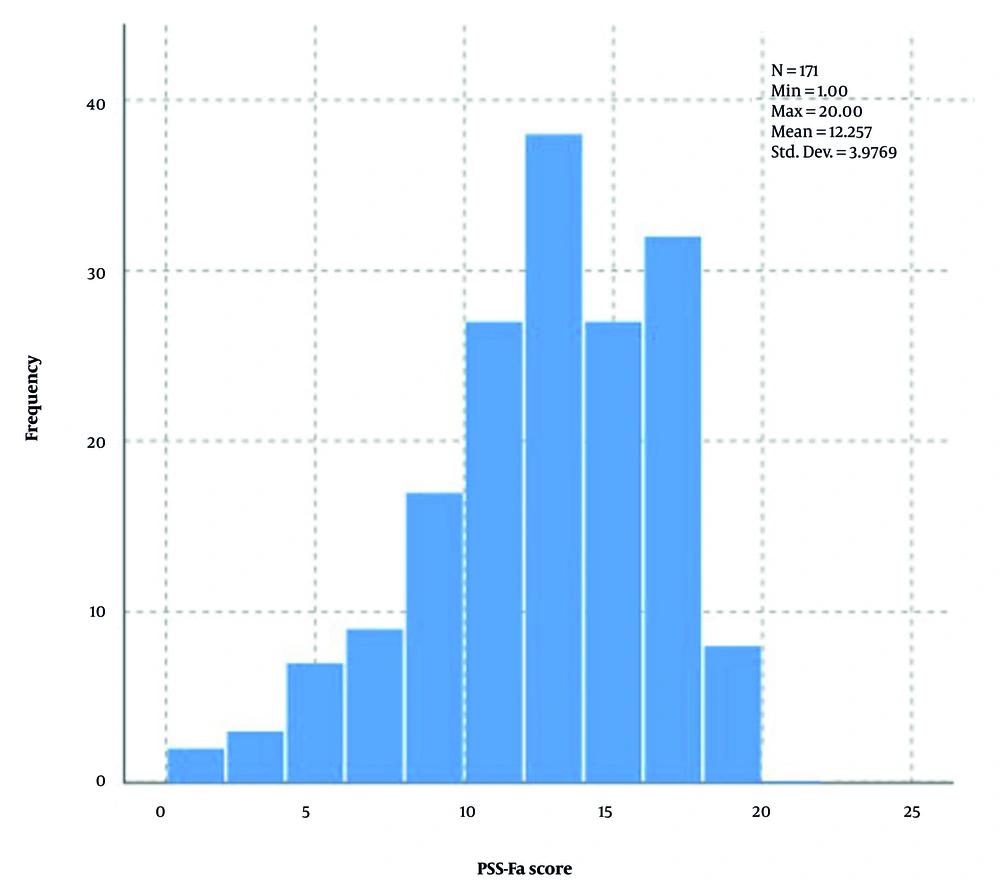
Figure 1.
The frequency histogram of the PSS-Fa scores
4.2. Hemoglobin A1C and Sleep Disorders
No associations were found between HbA1c values and various groups of sleep disorders on the basis of overall PSQI scores (P-value = 0.476) (Table 1) or self-reported levels of sleep quality (P-value = 0.453).
Table 1.Comparison of Digital Device Use, Family Support Score, and Hemoglobin A1C Level Between Various Groups of Sleep Disorders a
| Variables | No/Mild Sleep Disorder (n = 9) | Moderate Sleep Disorder (n = 75) | Severe Sleep Disorder (n = 87) | Total Population (n = 171) | P-Value |
|---|---|---|---|---|---|
| Watching TV (h) | 2.67 ± 2.12 (2; 3) | 2.74 ± 1.92 (2; 2.625) | 3.41 ± 1.94 (3; 2.75) | 3.08 ± 1.96 (2.5; 2.5) | 0.023 b |
| Video games (h) | 1.67 ± 0.82 (1.5; 1.375) | 2.53 ± 1.57 (2; 2.25) | 2.37 ± 1.62 (2; 2.25) | 2.39 ± 1.57 (2; 2.25) | 0.375 |
| Social media and the Internet (h) | 2.81 ± 1.51 (3.5; 2.125) | 4.24 ± 2.12 (4; 2.875) | 4.51 ± 2.54 (4; 3.5) | 4.29 ± 2.32 (4; 3.5) | 0.148 |
| PSS-Fa scores | 14.89 ± 2.36 (15; 3.5) | 13.01 ± 3.50 (14; 4.5) | 11.33 ± 4.26 (11; 5) | 12.26 ± 3.98 (12; 4.5) | 0.004 b |
| HbA1c (%) | 9.43 ± 2.24 (8.36; 3.23) | 9.10 ± 1.89 (8.21; 3.08) | 9.48 ± 2.02 (8.28; 2.55) | 9.32 ± 1.97 (8.34; 2.90) | 0.476 |
Abbreviations: PSS-Fa, Perceived Social Support from Family; HbA1c, hemoglobin A1C.
a Values are expressed as mean ± SD (Median; IQR).
b Statistically significant P-values.
4.3. Sedentary Behavior and Sleep Disorders
Table 1 compares the time spent on specific sedentary activities, family support scores, and HbA1c values between various groups of sleep disorders. The time spent on TV was significantly different across different groups of patients with sleep disorders (P-value = 0.023). Dunn’s test was applied to make pairwise comparisons, which showed a significant difference between the patients with no/mild and severe sleep disorders (P-value = 0.011). Nonetheless, no significant difference was found between the severe and moderate sleep disorder groups (P-value = 0.121) or between the moderate and no/mild sleep disorder groups (P-value = 0.731) regarding the hours spent watching TV (Table 2). The time spent on video games and the Internet was not related to the incidence of sleep problems (Table 1).
Table 2.Pairwise Comparison of Different Sleep Disorder Groups Regarding Quantitative Variables a
a Dunn’s test was performed for multiple comparisons.
b Statistically significant P-values.
4.3. Family Support and Sleep Disorders
The PSS-Fa scores differed significantly across the sleep disorder groups (P-value = 0.004). Applying Dunn’s correction for multiple comparisons revealed that patients with severe sleep disorders had significantly lower PSS-Fa scores compared with patients with moderate (P-value = 0.029) and no/mild (P-value = 0.026) sleep disorders (Table 2).
4.4. Family Support and Quantitative Variables
We found that the PSS-Fa score was significantly correlated with the HbA1c level (P-value < 0.001, ρ = -0.271), time since T1D diagnosis (P-value = 0.003, ρ = -0.229), and number of annual visits (P-value = 0.033, ρ = 0.164). However, there were no associations between family support and patient age (P-value = 0.169), FBS (P-value = 0.235), or random blood sugar (P-value = 0.315) (Table 3).
Table 3.Correlation of Perceived Social Support from Family Scores of Type 1 Diabetes Adolescents with Quantitative Variables
Abbreviation: HbA1c, hemoglobin A1C; T1D, type 1 diabetes.
a Statistically significant P-values.
5. Discussion
The findings of the current study suggested that both the family support scores and the amount of time spent watching TV are related to sleep disorders. However, sleep quality was not associated with the HbA1c level or the time spent on either video games or the Internet. Family support scores were negatively correlated with HbA1c levels and the time since T1D diagnosis. Patients with higher family support scores attended follow-up sessions more frequently.
The current body of evidence suggests that sleep and glycemic control have a bidirectional connection; poor glycemic control causes sleep problems and sleep problems interfere with glucose homeostasis (7, 9-11). According to two meta-analyses, the direct effect of sleep characteristics on glycemic management in T1D adolescents and children is not well established (9, 10). Ilter Bahadur et al. compared sleep and behavior problems between T1D children and non-diabetic controls. They reported that T1D children had a shorter sleep time and experienced more daytime sleepiness compared with their control group. However, this study found no association between sleep parameters and glycemic control (22). Alder et al. also discovered no significant association between HbA1c levels and sleep in T1D children and adolescents (23). Similarly, our results indicated that HbA1c values do not significantly vary between different sleep disorder groups.
On the other hand, numerous studies stated that poor sleep negatively affects glycemic control in T1D patients. A systematic review in 2021 demonstrated that poor sleep quality and irregular sleep patterns were related to higher HbA1c and suboptimal T1D self-care measurements (3). Moreover, both short and long sleep duration were linked to poor self-management behaviors (10), impaired adherence to glucose monitoring, and uncontrolled HbA1c levels (3). Berk and Celik followed 61 T1D patients in the 6 - 16 age group for one year. They reported higher HbA1c values in patients with higher sleep disorders (P-value = 0.02) (24). Frye et al. discovered that shorter sleep duration is linked with an elevated HbA1c level and poor diabetes self-care behaviors. However, additional analysis revealed that the relationship between HbA1c and sleep duration was mediated by self-measurement of blood glucose (25). These findings underline the mediating impact of self-management activities on the interaction between sleep and glycemic control of T1D youths. In fact, enhanced sleep could be accompanied by improved self-management behaviors, which subsequently contribute to better glycemic control (3, 10). However, our study did not identify any significant link between glycemic control and sleep.
Digital device use adversely affects sleep characteristics in children and adolescents (26). A study in 2010 found that the average overall time spent on screen devices was approximately 3.5 hours for male and 2.5 hours for female youths with T1D (27). The participants of our study spent approximately three times more hours a day on electronic devices. This may point out the increasing trend of electronic media use among children and adolescents. Huert-Uribe et al. performed a meta-analysis to evaluate physical activity and sedentary behavior in adolescents with T1D. This study discovered that T1D adolescents are more sedentary compared with healthy peers (4). This could be related to the fear of hypoglycemia and lack of both motivation and time in T1D patients (28). Sedentary behaviors, including screen use, have been linked to higher values of HbA1c (5). These findings highlight the concerning impact of sedentary activities on glycemic control in youth with T1D, which contributes to serious complications. Thus, it seems crucial to reverse sedentary behaviors and increase physical activity among adolescents with T1D to improve their cardiovascular profile and overall health (4). To address this issue, diabetes caregivers should focus on decreasing the duration of screen use as a leading contributor to a sedentary lifestyle. The American Diabetes Association emphasizes reducing sedentary activities, such as watching TV and using computers, to the greatest extent and taking breaks frequently by engaging in simple physical exercises (e.g., walking and standing). These feasible interventions may improve the glycemic status of diabetic patients (29). A randomized controlled trial study of T1D adults revealed that PSQI scores decreased significantly (21.4%; P-value < 0.001) after 6 weeks of increased physical activity (28). In a similar study on T1D children, sleep habits improved in patients with regular physical activity (30). A study of 45 T1D teenagers revealed a negative correlation between the time spent on sedentary activities and sleep duration (P-value < 0.01; ρ = -0.64) (31). Compared with these findings, the results of our study suggested that individuals who spent more time watching TV tended to experience more sleep disorders. Similarly, a published study illustrated that the duration of nocturnal sleep was notably shorter in teens who spent over 2 hours watching TV or had late bedtimes (32). Sleep disorders such as late bedtime could be associated with more sedentary behaviors in adolescents with T1D, which may lead to uncontrolled blood glucose levels (25). These findings highlight the impact of a sedentary lifestyle on T1D patients’ quality of life, particularly their sleep quality.
A meta-analysis revealed that greater sedentary behavior, with the exception of screen time spent completing homework, was associated with worse HbA1c levels in T1D youths. Personality traits related to engaging in schoolwork are accompanied by promoted self-care behaviors and better glycemic control, which could explain this finding (10). Calella et al. investigated the physical activity and lifestyle of T1D adolescents in Italy. They found a positive association between overall screen time (TV, the Internet, and video games) and HbA1c levels. This study also indicated that adolescents with T1D spent approximately eight hours on screen-based devices daily and that their level of physical activity was lower than the minimum standard recommendations (12). Similarly, the participants in our study had a mean overall screen time of approximately 9 hours daily. These findings highlight the necessity of improving healthcare measures for T1D adolescents to modify sedentary habits and enhance physical activity to achieve optimum glycemic control.
Family members of younger pediatric T1D patients are responsible for monitoring the blood glucose levels and supervising the insulin injection (6). Adolescents are more vulnerable to glycemic deterioration after the gradual transition to self-management, and parental involvement remains essential for desirable diabetes management (6). Perceived family social support enhances diabetes self-care measurements and self-efficacy in youths with T1D (33). A systematic review revealed that the involvement of parents in the management of diabetes enhances glycemic control in adolescents with T1D (6). Similarly, our results indicated that T1D adolescents with greater family support had lower HbA1c values and attended follow-up sessions at the diabetes clinic more frequently. This may highlight the significance of family support in promoting the adherence of T1D teens to their treatment.
A previous study in Iran reported that perceived family support was not associated with the age of T1D patients. However, both HbA1c levels and T1D duration were not related to family support, contrary to our study (20). A study of 150 T1D adolescents revealed that the involvement of parents in diabetes care declined significantly with increasing age (P-value < 0.01) (34). Hanna et al. reported that older adolescents with T1D perceived lower levels of parental autonomy support (P-value < 0.001) (35). AlHaidar et al. conducted a cross-sectional study to evaluate family support in T1D adolescents. They demonstrated that older adolescents perceived significantly lower levels of various family support elements. However, the time spent after the diagnosis of T1D and the HbA1c values were only correlated with family supervision (ρ = -0.647; P-value = 0.012) and critical situation support (ρ = 0.335; P-value = 0.017), respectively (36). These findings highlight the inconsistency of data on the link between family support and T1D adolescents’ characteristics and outcomes.
A longitudinal study on T1D adolescents and their parents indicated that parental adherence and involvement declined significantly over time (37). Family support was negatively associated with time since T1D diagnosis in our study but not with teen’s age. Parental burnout might explain this contradiction. Parents of diabetic children tend to experience burnout and characterize it as feeling grief for losing a normal life or feeling powerless to manage diabetes (38). Some background factors, such as socioeconomic status and limited leisure time, aggravate parental burnout (39). Hence, it could be practical for diabetes clinicians to support parents psychologically. This subsequently contributes to enhanced family support and improved attitudes towards diabetes management among T1D adolescents.
Although higher family support scores were associated with enhanced sleep quality in our results, the role of parental supervision in adolescents’ sleep health should be taken into consideration. According to Bergner et al., caregivers of T1D adolescents take some strategies to improve the quality of their teens’ sleep. This study mentioned setting sleep curfews (e.g., early bedtime) and eliminating digital devices from teenagers’ bedrooms as the most common strategies (40). However, parental interventions should not lead to prebedtime arguments, since such conflicts deteriorate sleep quality in children and adolescents (41).
5.1. Limitations
This study examined the relationship between family support, screen-based device use, sleep quality, and glycemic control in a large population of T1D adolescents in Iran. However, the cross-sectional design of this study is a potential limitation.
5.2. Conclusions
Sleep plays a prominent role in adolescents’ health. Sleep disorders and their contributors, including screen device use and family support, are still under discussion in the diabetic youth population. Family support and involvement in diabetes management should be promoted in adolescents, and the transition of diabetes-care responsibilities needs to be more cautious and organized. Moreover, parental supervision and timing seem crucial to monitor digital media use and sleep schedules in T1D adolescents given their unique supportive care needs. However, the interactions among sleep, digital device use, family support, and glycemic control in such patients need further investigation to be thoroughly understood.


