1. Background
Microbial keratitis is a vision-threatening disease in children, which can cause visual loss and amblyopia. Keratitis caused by ocular trauma has been reported to lead to blindness in almost 1.9 million cases in developing countries each year (1-3) and was recognized as a silent epidemic (2).
Predisposing factors associated with microbial keratitis vary with geographical location. Trauma to the eye has been reported to account for 48% to 65% of all corneal ulcers in developing countries (4); however, the major risk factor in western countries seems to be use of contact lenses (5).
To the best of the author’s knowledge, there is no published data on the epidemiological features of pediatric microbial keratitis in Iran. Study of adults showed that trauma was the major cause in adults at the region of this study (3).
In this study, epidemiological features of microbial keratitis in children was reviewed in order to investigate the most common predisposing factors, causative agents, surgical interventions, and drug therapy in children diagnosed with microbial keratitis at a tertiary care center in Southern Iran.
2. Methods
Medical records of a total of 63 corneal ulcer patients aged less than 15 years, who were diagnosed during five years and admitted to the ophthalmology department of Khalili Hospital, the largest tertiary ophthalmology care center in Southern Iran, were retrieved from archive of the hospital.
The researchers were adherent to the guidelines of the declaration of Helsinki and this research was approved by the Ethics Committee of Research Bureau, Shiraz University of Medical Sciences.
Corneal ulcer was defined as loss of corneal epithelium with underlying stromal infiltration and suppuration associated with signs of inflammation, with or without hypopyon. All patients were examined using slit-lamp bio-microscope by ophthalmology residents and recorded data were approved by a cornea specialist. Corneal scraping was determined using a sterile knife blade or a blunt Kimura spatula from the leading edge and bed of ulcer after applying a topical anesthetic drop (tetracaine). Children younger than five years old with any size of ulcer as well as any child with ulcer size of more than 5 mm, those, who had hypopyon on presentation and those, who needed a surgical intervention due to impending perforation or need for IV treatment were hospitalized. Also, patients, who had fungi or gram negative organisms in their prepared smears were hospitalized. Younger children received light general anesthesia during the procedure. Ulcer size was recorded based on the measurements under the slit lamp or surgical microscope. Corneal scrapings were spread on the labeled slides for gram staining. They were also inoculated in blood, chocolate, and modified sabouraud agar plates. Lowenstein-Jensen agar was used for some cases. Identification of different strains and colonies of bacteria was based on observation of the gram-stained slides and biochemical properties of cultured samples, using standard laboratory criteria (6). The inoculated media was incubated at 37°C and examined for growth on a daily basis by a microbiologist for up to three weeks. Cultures were considered positive when growth of the same organism was demonstrated on more than one solid medium and consistency of growth on one medium was determined along the microscopic findings of gram stained specimens. In addition, growth of the same organism from repeated scraping materials was reported as positive (7).
Patient’s age, gender, residential area (rural versus urban), duration of symptoms, such as redness, pain, photophobia and lacrimation before referral, along with ulcer size, results of smear and cultures as well as medical or surgical interventions were retrieved from admission and progress notes and drawings on file. Ulcer size, results of smear, and cultures as well as medical or surgical interventions were retrieved from the records on file. Recovery was defined as significant decrease in ulcer size during the hospital course or complete healing at early follow ups at the clinic.
Chi-square test was used for statistical analysis by the SPSS software. P values of less than 0.05 was considered statistically significant.
3. Results
The characteristics of children with microbial keratitis are shown in Table 1. Mean age at diagnosis was 5.2 years ± 4.8 (range: nine months to 15 years). Among admitted patients, males were more involved than females (61.9% versus 38.1%, P = 0.003) and children under the age of five years old (68.2%) were more involved than older cases (P = < 0.0001). Ulcer developed in the right eye in 52.3% and in the left side in 47.7%. Mean duration of symptoms before admission was 10.12 ± 19.7 days and mean duration of hospital stay was 6.9 ± 3.7 days. Hospitalized children mostly had an ulcer size larger than 5 mm (76.4%).
Table 1.
Characteristics of Children with Microbial Keratitisa
| Characteristics | Children | P Value | Recovered | P Value |
|---|---|---|---|---|
| Gender | 0.003 | 0.07 | ||
| Male (n = 39) | 61.9 | 30.8 | ||
| Female (n = 24) | 38.1 | 20.9 | ||
| Age | < 0.0001 | 0.07 | ||
| < 5 (n = 43) | 68.2 | 74.4 | ||
| > 5 (n = 20) | 31.8 | 70.0 | ||
| Residential area | 0.06 | 0.08 | ||
| Urban (n = 27) | 42.8 | 81.1 | ||
| Rural (n = 36) | 57.2 | 69.4 | ||
| Eye side | 0.887 | 0.527 | ||
| Right (n = 33) | 52.3 | 75.7 | ||
| Left (n = 30) | 47.7 | 70.0 | ||
| Ulcer size | < 0.0001 | 0.08 | ||
| > 5 mm (n = 38) | 60.0 | 78.9 | ||
| < 5mm (n = 18) | 28.6 | 66.6 |
aValues are presented as %.
Risk factors associated with microbial keratitis are shown in Figure 1. In this retrospective cohort, the most common risk factor associated with microbial keratitis was trauma. Trauma by wood sticks was a predisposing factor in both cases of proved fungal keratitis. In Table 2, the most common microorganisms found in corneal scraping samples are illustrated. Culture results were found on 36 patient’s files and was positive in 21 cases (58.4%) while in 15 cases (41.6%), no growth was reported. Gram staining and culture of corneal scrapings revealed that the most common microorganism was coagulase positive (five cases) and negative (four cases) Staphylococcus, followed by Pseudomonas aeruginosa (six cases). Most cases of coagulase positive Staphylococcus were resistant to tetracycline, Penicillin and clindamycin. Other causative organisms were Streptococcus pneumonia, Escherichia coli, and Candida albicans.
Table 2.
Gram Staining and Culture Results of Corneal Scraping in Children with Microbial Keratitisa
| Microbiological Investigation | Prevalence |
|---|---|
| Gram staining of corneal scraping (n = 36) | |
| Gram positive cocci (n = 25) | 69.4 |
| Gram negative cocci (n = 2) | 5.6 |
| Gram negative bacillus (n = 1) | 2.8 |
| No organism (n = 8) | 22.2 |
| Culture of Corneal Scraping (n = 36) | |
| Culture negative (n = 15) | 41.6 |
| Culture positive (n = 21) | 58.4 |
| Species in the Culture (n = 21) | |
| Pseudomonas aeruginosa (n = 6) | 28.6 |
| Staphylococcus coagulase positive (n = 5) | 23.8 |
| Staphylococcus coagulase negative (n = 4) | 19.1 |
| Streptococcus pneumonia (n = 2) | 9.5 |
| Escherichia coli (n = 2) | 9.5 |
| Candida albicans (n = 2) | 9.5 |
aValues are presented as %.
Table 3 indicates the number of children managed with medical treatment (combination of topical/systemic antibiotics and also topical steroids). Among all medications, children were commonly treated with combination of cefazolin/gentamycin. Acyclovir was added based on polymerase chain reaction (PCR) results in suspicious cases or empirically when Gram stain and cultures were negative, and very slow recovery was detected after two or three days of antibiotic therapy. Intravenous antibiotic was started based on initial size, depth and location, presence of hypopyon, gram stain results, response to topical medication, and adherence to topical treatment.
Table 3.
Medical Treatment Regimens of Children with Microbial Keratitisa
| Drug Therapy | Children |
|---|---|
| Cefazolin/gentamycin (topical) | 63.4 |
| Cefazolin/gentamycin (IV) | 55.6 |
| Ceftazidime/vancomycin (topical) | 33.3 |
| Ceftazidime/vancomycin (IV) | 21.7 |
| Oral acyclovir | 21.7 |
| Topical steroid * | 41.7 |
| Anti fungal (natamycin ) | 03.1 |
aValues are presented as %.
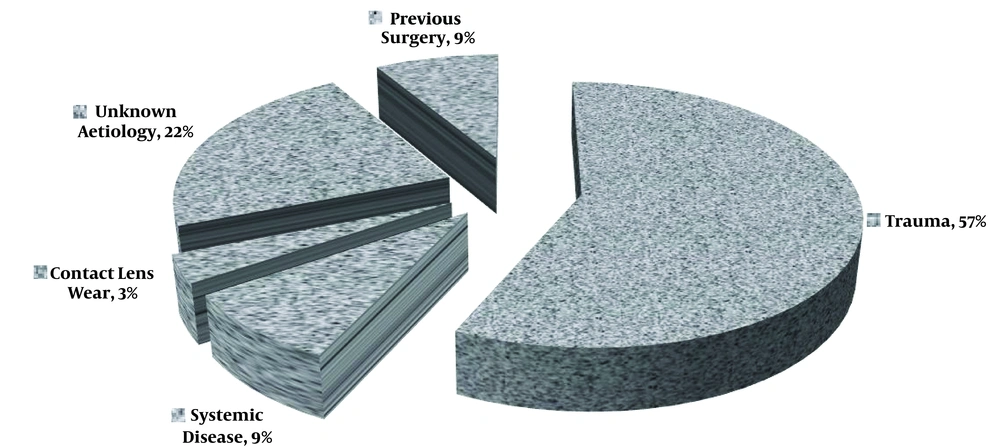
Figure 1.
Predisposing factors associated with microbial keratitis
Topical steroid was added during the hospital course for selected cases, in whom fungus or gram negative organisms were not the causative agent, and initial response to treatment was observed.
In Table 4, the percentage of children treated by surgical intervention are shown. Among all the procedures, penetrating keratoplasty was the most common surgery and used alone or in combination with other procedures, such as vitrectomy. Conjunctival flap was done on selected cases, where peripheral non-fungal ulcers remained stationary after few days of antibiotic treatment.
Table 4.
Type and Percentage of Surgical Interventions in Children with Microbial Keratitisa
| Surgical Intervention | Percentage of Children |
|---|---|
| Conjunctival flap | 14.7 |
| Penetrating keratoplasty alone | 16.9 |
| Amniotic membrane transplant | 6.4 |
| PK + Lensectomy + deep vitrectomy | 4.8 |
| PK + Lensectomy+ anterior vitrectomy | 3.2 |
aValues are presented as %.
Medical treatment failure was mostly seen in children, who were female, older than five years old, came from rural areas, had ulcer of the right eye, and ulcer size larger than 5 mm on the day of admission; however, these findings were not statistically significant. Endophthalmitis was diagnosed in three cases. Penetrating keratoplasty (alone or in combination with other procedures) was needed in almost 25% of cases. Early final outcome could be followed in almost a third of cases, mostly the ones, who had surgical intervention and consisted mainly of slit lamp appearance of the cornea, not visual outcome. Data was not sufficient for statistical analysis.
4. Discussion
Identification of common microorganisms in microbial keratitis and treatment outcomes could contribute to more efficient strategies for treatment of microbial keratitis. The prevalence of isolated microorganisms is different based on the area under study, therefore, having data from each geographic region will allow better understanding of the etiology and planning of treatment, especially in that particular area. The most common isolated microorganism from corneal ulcer belonged to Staphylococcus species in India (70%) (8), which is in accordance with the current study, whereas in Taiwan the most frequently found microorganism seemed to be Pseudomonas aeruginosa (45%) (9).
Generally speaking, another important factor in evaluation of infectious diseases is age and gender. There is a limited number of studies describing the epidemiological features of pediatric microbial keratitis (10) and to the best of the author’s knowledge, there is no reported study in Iran. Results of this study showed that pediatric microbial keratitis was more common in males than females in this region. This gender difference could be due to more outdoor activities or committing more dangerous games by males. In this study, it was shown that microbial keratitis is age dependent and its prevalence was significantly higher in children under five years old.
Consistent with the current study, microbial keratitis is more common in younger children in most countries (5, 7, 11) whereas older children were reported to be more involved in Taiwan. This finding may be due to popularity of the Orthokeratology Procedure (OK) or contact lens wear among treatment strategies for youth in Taiwan (9, 12). Moreover, the authors found that the mean age of affected children in Iran (5.2 years) is the youngest compared to other populations (range from six to ten years old) (12, 13).
The most common risk factor associated with pediatric microbial keratitis in this cohort was trauma (57.0%), consistent with other studies from Mexico, India, and Saudi Arabia (4, 10, 11) whereas in Taiwan (9), the major risk factor was reported to be the contact lens wear (40.7%); this is in accordance with the above speculation for higher mean age of patients in this country. Trauma was mostly caused by organic materials (14, 15) yet there were also cases caused by intimate objects, such as rocks, sand, soil, and fingernail, especially in younger children.
These results highlight the need for strict safety rules, especially in outdoor and indoor playgrounds as well as toys safety issues. In this study, systemic and periocular diseases like abnormalities of lids and exposure to keratopathy were the second most common risk factors for pediatric microbial keratitis, consistent with reported studies in some other populations (10).
Since overnight OK is not popular in Iran, the researchers did not observe any OK associated keratitis. For the same reason, Acanthamoeba keratitis, which has been shown to be a significant cause in OK cases (16) was not common in the patients.
Staphylococcus and Pseudomonas are two main microorganisms that were reported as the most common causes of microbial keratitis in children worldwide (12, 15, 17). In this study, the finding of Staphylococcus (coagulase positive and negative) as the main cause of keratitis, was consistent with studies in most other parts of the world (5, 10, 11).
In this study, only two out of 21 culture-positive cases were proved to be Candida albicans (9.5%), consistent with results from Taiwan (12). However, Candida albicans seems to be more prevalent in pediatric keratitis in some other parts of the world (10, 13, 15). The prevalence of fungal keratitis has been reported to be region and climate specific (18). The low incidence of fungal keratitis in the region of the current study could be due to the dry climate. Even though the laboratory of this study was using standard methods for culture, 41% of cases were culture negative and therefore had no defined microbiological cause. This may be caused by previous use of antibiotics or difficulty in specimen collection in the pediatric age group as well as presence of usual microorganisms or viruses as the cause of keratitis.
Usually, antibiotics are prescribed based on sensitivity of the organisms to antibiotics; however, the majority of community-acquired cases of bacterial keratitis, especially in children, can be treated with empirical antimicrobial therapy, without the need for obtaining smears or cultures (6). At the center of the current study, when the results of smears were not diagnostic, empirical topical antibiotic therapy was administered and then changes were made based on the results of culture and sensitivity. Based on previous reports, most ulcers can be treated successfully with topical antibiotics alone (19); however, in the current series, the percentage of children that had undergone surgical intervention (49.2%) was much higher than those reported by most other researchers (6% to 28%) (12, 15, 20). This study speculated that this may be due to later referral of patients to the clinic or resistance of causative organisms to the administered topical antibiotics. The need for penetrating a keratoplasty procedure in one fourth of reviewed cases can be considered as a flag to highlight poor visual outcome in children, considering high rejection rate, chance of induced astigmatism and amblyopia as well as other complications in the pediatric age group.
In addition, protein-calories malnutrition has been shown to be associated with poor response to medical treatment (21); this fact needs more detailed study in the study region. Fortified antibiotic solutions of cefazolin or vancomycin for gram-positive organisms and tobramycin or ceftazidime for gram-negative organisms were routinely used in advanced cases. The disadvantages of prolonged and non-selective use of these fortified antibiotics are bacterial resistance, ocular discomfort, and epithelial toxicity (10).
In this study, the addition of acyclovir to the treatment regimen of recalcitrant cases yielded recovery, even though typical features of herpetic keratitis was not evident at the time of presentation to the hospital. In 25 cases (40%), corticosteroids were also added to the regimen. Although the use of topical corticosteroids is controversial, it seems to be beneficial in treating cases of bacterial keratitis by reduction of tissue destruction and prevention of subsequent corneal scarring. Disadvantage of topical corticosteroids therapy include recrudescence of infection, local immunosuppression, intraocular pressure rise, cataract formation and inhibition of collagen synthesis as well as predisposition to corneal melting (10).
In this study, among patients with advanced microbial keratitis, who did not respond to medical treatment, partial conjunctival flap advancement (without obstruction of visual axis) yielded the highest recovery. Surgical interventions, such as conjunctival flap advancement, penetrating keratoplasty, and amniotic membrane transplantation were advocated in severe and intractable corneal ulcers. In very advanced cases with serious complications like endophthalmitis, other interventions, such as anterior or deep vitrectomy and lensectomy were performed to eradicate the infection.
This study was conducted at a tertiary care center, to which more complicated and recalcitrant cases were referred; therefore, it did not include all cases of keratitis in children, who were treated by general ophthalmologists at primary care centers; however, to the best of the authors’ knowledge, this is the first reported hospital based study of pediatric microbial keratitis in the Iranian population.
Microbial keratitis in children is different from adults in many aspects, including predisposing factors, poor compliance for examination, and receiving treatment as well as risk of developing amblyopia. The results of this study suggest that parental awareness of the risks associated with this condition, early diagnosis and referral, and adequate and proper provision for laboratory investigations are needed to reduce the incidence of microbial keratitis and improve the outcome of children with microbial keratitis. Since follow up exams were mostly not recorded in files after discharge of patients from the hospital, better outpatient follow up records is needed.
In conclusion, the results of this study highlight the prevalence of various causative organisms and predisposing factors for pediatric microbial keratitis in the region of the current study, which may help prevent an important potential cause of amblyopia and blindness in children.