1. Background
Soil pollution is a common byproduct of various industries in developing countries. The petroleum industry is particularly responsible for soil contamination as a result of activities related to crude oil extraction, refineries and transfer, underground crude oil storage tanks and the wastewaters. The degradation products of crude oil contaminants have raised major concerns for the human health and environment (1, 2). Countless studies have been performed on the methods of cleaning soil contaminants, recommending three major methods for polycyclic aromatic hydrocarbons (PAH) treatment: physical, chemical (thermochemical), and biological (microbial) (3, 4).
Biological methods have some advantages such as relative cost-effectiveness as well as the ability to be performed at the site of contamination and have been reported as the most environment-friendly methods (5). Biological methods of soil treatment with a recovery mechanism for the toxic petroleum derivatives such as PAHs (as the most important toxic contents of crude oil) have recently been more extensively studied (6). Characteristics of biological methods have been evaluated in several in-situ and ex-situ studies, including time consumption, cost-effectiveness, and efficacy for several soil textures (7).
In Iran, as a member of Organization of Petroleum Exporting Countries (OPEC), soil contamination is a serious concern, too. Tehran Refinery is one of the largest refineries in Iran and Middle East, with a nominal capacity of 225,000 barrels per day and an n operational capacity of 240,000 barrels per day (8). Tehran Refinery products are liquid gas, ordinary gasoline, light and heavy naphtha, kerosene, gas oil, furnace oil, mineral oil, and sulfur (9) and its wastewater has a high chemical organic demand (COD), close to 900 mg/L (10). The recent increases in the activities of Tehran Refinery, despite the old transmission lines and tanks, have resulted in the crude oil leakage and consequently, possibility of soil and following underground water contamination with crude oil compounds.
2. Objectives
In this study, we aimed to analyze the characteristics of contaminated soil samples of Tehran Refinery to suggest the best methods for treatment of this industrial site.
3. Materials and Methods
Soil samples were taken from five points of the west side of Tehran Refinery complex in Ray city, Tehran province, Iran (Figure 1), in June 2009. The modality of sampling was zigzag and soil samples of diamond shapes were taken at each point. The sampler was instructed to avoid sampling atypical areas such as eroded knolls, depressions, saline areas, fence lines, old road ways and yards, water channels, manure piles, and field edges. All samples were combined and a composite sample was taken for laboratory analysis. Each sample contained 1 kg of soil, taken from the depth of 50 cm and placed in plastic bags. The soil samples were transferred to the geology and biotechnology laboratories within one hour from the sampling.
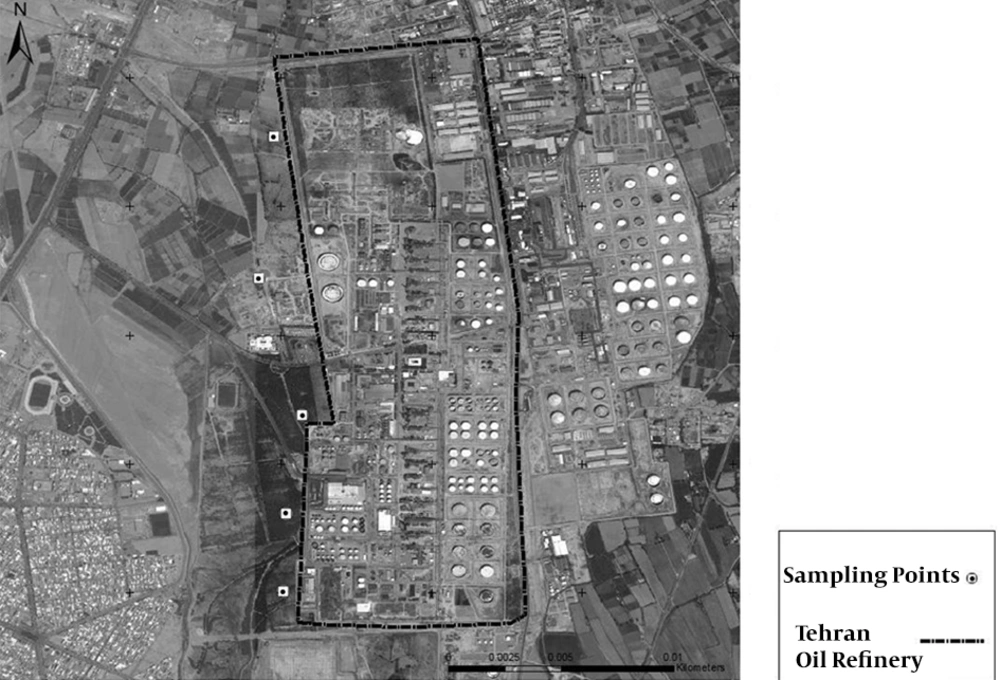
Figure 1.
Zigzag Soil Sampling Locations From Five Points of the of Tehran Refinery West Side Areas
3.1. Laboratory Assessment of the Soil Samples
The soil texture was characterized using the hydrometric method. The saturation percentage of the saturated paste was evaluated by the decoction method, using salinity and electrical conductivity (EC) of soil. The acidity (pH of paste) of the saturated extract was examined by pH meter, the amount of plaster gypsum by stone method, the percentage of organic carbon by Valkley-Black method, the total nitrogen percentage by Dal Kajal’s method, the available phosphor by Alsen method, and the adsorbent potassium by decoction method with ammonium acetate and it was read by flame photometer.
3.2. Biotechnology Laboratory Assessment
Soil samples were examined in the biotechnology laboratory to specify their extents of crude oil contamination. Primarily, five soil samples were mixed. For extraction of petroleum derivatives, 10 mL of dichloromethane solvent was added to 1 g soil. The mixture was shaken severely until the petroleum extraction was finished; afterwards, the mixture was centrifuged until the soil was separated from the solvent. The solvent phase was separated and passed to preweighed dishes. Then solvent was allowed to evaporate for 24 hours under the air stream. The dishes were weighed again and the weight differences were calculated to determine the amount of crude oils derivatives (11).
3.3. Soil Treatment Methods
The review and technical research articles discussing soil treatment methods were retrieved from Medline and Google Scholar, using the following keywords: crude oil, petroleum, remediation, soil and treatment. Soil treatment methods are summarized in Table 1. Advantages and disadvantages of available biological soil treatment methods were retrieved from the literature and compared with each other. The following criteria of biological methods were studied (Table 2): tissue of the soil (soil texture column), oil compounds which can be remediated (treatment column), the oil compounds which can be remediated more effectively (effective treatment column), cost (cost column) and timing (time column).
Table 1.
The Remediation Methods for Contaminated Soil
| Biological methods | Soil vapor extraction (SVE) |
| Landfarming | |
| Biopiles | |
| Phytoremediation | |
| Bioslurry systems (bioslurping) | |
| Bioventing | |
| Aeration (oxidation) | |
| Natural attenuation | |
| Physical methods | Soil washing |
| Soil flushing | |
| Encapsulation | |
| Solvent extraction | |
| Sorbents | |
| Thermochemical methods | Solidification/stabilization |
| Dehalogenation | |
| Thermal desorption | |
| Incineration | |
| Ozone | |
| Electro-bioreclamation |
| Soil Texture | Treatment | Effective Treatment | Cost, US$/t | Time | |
|---|---|---|---|---|---|
| Phytoremediation | No preference | Different contaminant | Heavy metal, radionuclides, chlorinated solvents, petroleum hydrocarbons, PCBs a, PAHs, organophosphate insecticides, explosives, surfactants | 10 - 50 | Often more than 2 y |
| Land farming | No preference | Petroleum hydrocarbon | Lighter petroleum hydrocarbones including gasoline derivatives | 30-60 | 6 mo - 2 y |
| Soil vapor extraction | Unsaturated soil, coarse-textured soil | VOCs a, SVOCs a | VOCs | 20-50 | a few mo - 2 y |
| Bioventing | Low-clay content, unsaturated soil | Petroleum products | Diesel-like mid-weight petroleum products | 10-75 | 6 mo - 2 y |
| Biopile b | high permeable | Halogenated VOCs + most petroleum products+ non halogenated VOCs + SVOCs+ pesticides | Mid-range products such as diesel or kerosene contain lower amounts of volatile components, and their biodegradations are more effective | 50 to more than 150 | A few weeks to a few months |
| Bioreactor c | Homogenous, non-clayey soils | Ordinance compounds, pesticides, PCBs, SVOCs, VOCs | Non-halogenated SVOCs, non-halogenated VOCs | 50 to more than 150 | 1 week to a few months |
| Natural attenuation d | No preference | Some chlorinated aromatic compounds, non-chlorinated solvents, diesel fuel, gasoline, some chlorinated aliphatic compounds | Gasoline+ BTEX a compounds | Less than 10 | Almost always more than 2 y |
a Abbreviations: VOC, volatile organic carbons; SVOC, semi-volatile organic carbons; PCB, Polychlorobiphenyls; BTEX, benzene, toluene, ethylbenzene, and xylenes.
b biocells or biomounds or compost cells or heap pile bioremediation or static-pile.
c bioslurry system.
d intrinsic remediation or intrinsic bioremediation.
4. Results
The soil texture was composed of 41 - 42% silt, 40 - 43% clay, and 15 - 18% sand. The averages are as follows: moisture content of the saturated soil (saturated paste): 12.96%; saline soil (electricity conductivity): 18.64 DS/m; pH of the paste: 8.36; amount of gypsum: 0.5%; organic carbon: 0.19%; total nitrogen: 0.026%; available phosphorus: 14.3 mg/kg; available potassium: 3.4 mg/kg-1. Physicochemical characteristics of soil samples are represented in Table 2.
The biotechnology laboratory reported that the average amount of crude oil derivatives in soil samples was less than 0.5% (0.5 g crude oil in 100 g soil).
All the retrieved common soil treatment methods are reported in Table 1. The common selected biological methods for soil contamination treatment, including phytoremediation, land farming, SVE, bioventing, natural attenuation, biopile, and bioreactor are compared in Table 3.
Table 3.
Physical and Chemical Characteristics of Soil Samples of Lands Around Tehran Refinery
| Samples | Sand, % | Clay, % | Silt, % | Saturated paste, % | EC × 103, DS/m | pH of paste | Gypsum, % | Carb, % | Total N, % | Available P, Mg/Kg | Available K, Mg/Kg |
|---|---|---|---|---|---|---|---|---|---|---|---|
| 1 | 15 | 43 | 42 | 12.6 | 20. 3 | 8.5 | 0.5 | 0.19 | 0.026 | 14.3 | 3.4 |
| 2 | 16 | 42 | 42 | 12. 5 | 24. 5 | 8.5 | 0.5 | 0.19 | 0.026 | 14.3 | 3.4 |
| 3 | 16 | 42 | 42 | 13. 1 | 19. 3 | 8.2 | 0.5 | 0.19 | 0.026 | 14.3 | 3.4 |
| 4 | 18 | 40 | 42 | 13. 3 | 16. 1 | 8.3 | 0.5 | 0.19 | 0.026 | 14.3 | 3.4 |
| 5 | 17 | 42 | 41 | 13.3 | 13 | 8.3 | 0.5 | 0.19 | 0.026 | 14.3 | 3.4 |
5. Discussion
The results of this study showed that the soil texture of lands around Tehran Refinery was silt and clay and the amount of crude oil derivatives was less than 0.5%. Considering the advantages and disadvantages of all soil treatment methods, the most efficient method for treatment of the current low level soil contamination is phytoremediation that is a cost effective solution for soil crude oil contamination in Iran as a developing country.
Soil treatment methods generally can be divided to three types: physical, chemical (thermochemical), and biological (microbial) (3, 4). Thorough biological methods treat soil contamination through bioremediation mechanism, which is a rapidly-developing way for restoration of natural processes in the environment (5). Common biological soil treatment methods are phytoremediation (12, 15), land farming (16, 17), SVE (18), bioventing (19), natural attenuation (20, 21), biopile (22), and bioreactor (13, 23). The cheapest method is natural attenuation, but mostly requires the longest time for the treatment process and is not effective on most of the PAHs. Nowadays, natural attenuation is used as the preferred method in majority of gasoline contaminated soils.
Phytoremediation is the second option for an affordable soil treatment, especially in the depths of less than 50 cm (7). Phytoremediation is time consuming, but effective on nearly all crude oil pollutants, especially toxic pollutants such as heavy metals, PAHs and Polychlorobiphenyls (PCBs) (24). In a developing country with a low budget for protection of the environment, decreasing the failure rate of environmental management centers is a strategic goal. Therefore, the crude oil-derived toxicity should be treated through a method which is effective on all sorts of existing as well as predicted contaminations. Phytoremediation is a good choice for treating the soil contamination of lands around Tehran Refinery, effective on low level soil contaminations in addition to wide spectrum of the current and predicted soil contaminations of lands soils around Tehran Refinery.
Plaza et al. declared that biopile was adequate for decontamination of soil from PAHs in the lands around Czechowice-Dziedzice Polish Oil Refinery (a refinery in Poland). Target points defined by Polish risk guidelines standards were achieved using the biopile method, by expending a large budget and only after 20 months (25). The level of PAHs is low in soils of lands around Tehran Refinery; thus, the biopile method is not optimal for its decontamination because of its high cost.
SVE is the second most time-consuming method after the biopile method. It is a low-cost soil treatment method; but still costly in comparison with phytoremediation. SVE is a more efficient method in cases of semi-volatile organic carbons (SVOCs) and volatile organic carbons (VOCs) soil contaminations. Therefore, considering the types of contaminants in the Tehran Refinery surrounding area, phytoremediation is more effective than SVE. On the other hand, Gitipour et al. demonstrated that SVE is an effective method for treatment of VOCs including benzene, toluene, ethylbenzene, and xylenes (BTEX) in the contaminated soil of southern area of Tehran Refinery. There was not any recommendation for phytoremediation of BTEX in Gitipour et al. study (26). The reason might be fact that SVE is more effective on BTEX detoxification in comparison with phytoremediation and also because of the soil type (low permeability) of lands around Tehran Refinery, SVE would be a better choice than phytoremediation in cases of BTEX contamination. However, in the conditions observed in our study, phytoremediation would be the preferred choice, because soil is contaminated with several kinds of toxic derivatives and not only PAHs.
Yong et al. performed a study on soil samples from the southern side of Tehran refinery. They suggested phytoremediation as the efficient soil treatment method and rejected SVE and soil washing due to the low vapor pressure and low permeability of the soils (27). We found the same type of soil around Tehran Refinery, but we also suggest phytoremediation as the preferred method because of its low cost and wide applications for a developing country.
There is no doubt that in future environmental incidents with high PAHs soil contaminations, SVE would be the preferred method.
Bioventing is nearly as time and budget consuming as SVE, but effective on different crude oil derivatives, such as medium-weight petroleum products including diesel, compared to SVE (19, 28). Therefore, for these kinds of pollutants, bioventing is the most applicable treatment method. Land farming is the most time-consuming and expensive method; therefore it is not suitable for soil decontamination of the lands around Tehran Refinery considering the low budget available for environmental affairs in Iran. Through biopile and bioreactore methods, the shortest time is consumed for soil treatment, but these methods are not cost-effective and only in emergency events can be applied as a supplementary to the physicochemical methods. The biopile method needs permeable soil texture, thus it is excluded from the list of appropriate methods of Tehran Refinery soil decontamination. The bioreactore method is effective on the homogenous soil and not applicable for the treatment of soil around Tehran Refinery.
Many novel soil treatment methods are suggested in the literature, such as soil washing (mechanical or ultrasonic) (29, 30) or earthworms (31, 32), which have not attracted enough attention from researchers because of their expensive or difficult management procedures.
Considering the budget restrictions of a developing country, it is better to use more experienced methods. In the case of soil pollutions of Tehran Refinery, based on the present study, the most efficient method would be phytoremediation which is inexpensive and also helps in creating a green area around the refinery, considered as an advantage of this method. Regarding the specific types of crude pollutants, SVE is the most applicable method, as it reduces the failure risk in management of the environment protection measures. In emergency-crude oil soil contaminations, soil washing seems to be the best method.