
1. Background
Klebsiella pneumoniae (K.pneumoniae) is a gram-negative bacillus of the Enterobacteriaceae family, which is a major cause of many infections, including urinary tract infection, sepsis, bacteremia, meningitis, and skin and soft tissue infections (1).
The bacterium is the most common cause of hospital-acquired infections and a primary etiology of community-acquired infections (CAIs) (1).
Unfortunately, in recent years, with the global emergence of antibiotic resistance among pathogens, the bacterium's susceptibility to current antibiotics decreased dramatically. Now the strain is the main cause of multi-drug resistance (MDR), extensive drug resistance (XDR), and even pan drug resistance (PDR) infections, particularly in hospital-acquired infections (2).
One of the most important mechanisms of resistance of the bacterium to antibiotics is the production of enzymes nominated as extended spectrum beta-lactamase (ESBL). These proteins hydrolyze and inactivate a wide range of antibiotics, including all penicillins and first, second, and third-generation cephalosporins (2).
During the past years, the last choice of antibiotic for treating ESBL-producing Enterobacteriaceae was carbapenems. Unfortunately, during recent years, the prevalence of carbapenemase-producing K. pneumonia (KP) increased dramatically, and the treatment of associated infections became challenging (1, 2).
Multi-drug resistance K. pneumonia strains have been reported from many regions globally, but their prevalence varies in different countries. The prevalence of ESBL-producing K. pneumonia strains was 46.7% in Asia-Pacific countries (3), 5.1% in Japan (4), 26.2% in Tunisia (5), 33.9% in Turkey (6), and 59.2% in Iran (7). In addition, the prevalence of carbapenem-resistant K. pneumonia strains in the United States, Italy, and China was 9.7%, 17.4%, and 7.1%, respectively (8-10).
To choose the best antibiotic for the empiric treatment of infections caused by this bacteria, it is necessary to know the antibiotic susceptibility of the bacterium in each geographic area (11).
Previous investigations into the antibiotic susceptibility of K. pneumonia in Iran have had some limitations, such as the inclusion of contaminant isolates in the analysis (12-16), small sample sizes (12-16), failure to differentiate nosocomial and community strains (12-15), and inclusion of only ESBL-producing isolates, limiting their utility in the empiric treatment of K. pneumonia infections in the region (12-16).
2. Objectives
Therefore, we decided to investigate and report the prevalence and antibiotic sensitivity pattern of K. pneumonia isolates according to the source of the infection (hospital versus community) and production of ESBL (producer versus non-producer) in inpatients from three referral hospitals in Isfahan, Central Iran.
3. Methods
3.1. Study Design
This study is part of a comprehensive project on antibacterial resistance in Isfahan, Iran, conducted from March 2016 to March 2018, named "Isfahan Antimicrobial Resistance Surveillance-1" (IAS-1). Isfahan antimicrobial resistance surveillance-1aimed to determine the antibiotic susceptibility patterns of common bacteria isolated from inpatients with established infections in three large medical centers in Isfahan, Iran: Alzahra, Dr. Shariati, and Dr. Gharazi Hospitals, which collectively have more than 1,300 beds. Their laboratories are approved for quality by the Iranian Ministry of Health for microbiological tests and collaborate with the World Health Organization in the Global Antimicrobial Resistance Surveillance System (17).
In addition to registering the antibiotic susceptibility of clinical isolates, this program aimed to determine contaminated samples and identify the source of infection, whether from the hospital or the community, through trained nurses and physicians. If the K. pneumonia species was isolated from a site with no clinical or para-clinical manifestations of infection, it was considered a contaminant and excluded from the study. Samples were collected after 48 hours of hospitalization, and all samples obtained from internal devices were categorized as nosocomial isolates, while others were classified as community-acquired organisms (17).
This study aimed to report the antibiotic resistance pattern of KP isolates in the IAS-1 program.
3.2. Identification of Organism
Identification of KP species and determination of the susceptibility pattern of the isolates were conducted using standard tests as guided by the Clinical Laboratory Standards Institute (18). The susceptibility of the samples was examined against the following classes of antibiotics: Aminoglycosides (Gentamicin or Amikacin), third-generation cephalosporins (cefotaxime or ceftriaxone), antipseudomonal third-generation cephalosporin (ceftazidime), fourth-generation cephalosporin (cefepime), fluoroquinolones (ciprofloxacin), folate inhibitors (trimethoprim-sulfamethoxazole), and carbapenems (imipenem or meropenem). Dehydrated discs from MAST, Merseyside, UK, and MIC strips from Liofilchem, Italy, were used in the study.
Isolates that were resistant to at least three classes of the examined antibiotics were classified as MDR. Those resistant to more than three tested antibiotic classes were considered possibly XDR, and those resistant to all examined antibiotic classes were deemed possibly PDR (19).
3.3. Statistical Analysis
The results of antibiotic susceptibility, ESBL production, and source of infection acquisition (hospital versus community) of KP, as well as the diagnosis and age group of the patients (< 20 years versus > 20 years), were recorded in WHONET software version 5.6 in each participating laboratory. Analysis was conducted using SPSS software version 18. To compare antibiotic susceptibility across different groups, chi-square or Fisher exact tests were employed. A P-value of less than 0.05 was considered statistically significant. The study was assessed and approved by the Institutional Review Board of Isfahan University of Medical Sciences (approval number: IR.MUI.MED.REC.1399.502).
4. Results
A total of 563 separate KP strains were isolated, of which 126 (22.4%) samples were considered contamination. Of the 437 patients with documented KP infection, 258 (59%) were male, 57 (13%) were under 20 years old, and 207 (47.4%) acquired the infection from the community.
Most strains were isolated from patients with bloodstream infections (143; 32.7%), followed by urinary tract infections (141; 32.3%), skin and soft tissue infections (78; 17.8%), and other infections (75; 17.2%). Extended spectrum beta-lactamase production was reported in 79 (18%) of the isolates, including 57 (27.5%) from CAIs and 22 (9.6%) from healthcare-associated infections (HAIs).
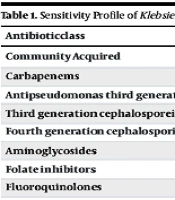
No antibiotic showed a high antibacterial effect on the isolated KP strains. The highest susceptibility of the isolates was to aminoglycosides (62.8%) and carbapenems (55%). Lower sensitivity was observed to third-generation cephalosporins (34.9%), folate inhibitors (33.7%), fluoroquinolones (30.3%), fourth-generation cephalosporins (28.8%), and antipseudomonal third-generation cephalosporins (26.9%). The sensitivity of the organism to all examined antibiotics, except folate inhibitors, was significantly higher in CAIs than in infections acquired from healthcare settings (Table 1).
Table 1.
Sensitivity Profile of Klebsiella pneumoniae in Accordance to Source of the Infection in Patients Admitted in Three Referral Hospitals in Isfahan, Iran
| Antibioticclass | Sensitivity of the Isolates: Number of Patients (Percent) | |||
|---|---|---|---|---|
| Community acquired | Healthcare associated | P-Value | Total an/N (%) | |
| Carbapenems | 200.252 (79.3) | 67.233 (28.7) | < 0.001 | 267.485 (55.0) |
| Antipseudomonas third generation cephalosporein | 81.195 (41.5) | 31.221 (14) | < 0.001 | 112.416 (26.9) |
| Third generation cephalosporeins | 52.126 (41.2) | 14.63 (22.2) | 0.010 | 66.189 (34.9) |
| Fourth generation cephalosporin | 89.192 (46.4) | 29.217 (13.4) | < 0.001 | 118.409 (28.8) |
| Aminoglycosides | 198.257 (77.0) | 119.247 (48.1) | < 0.001 | 317.50 (62.8) |
| Folate inhibitors | 47.129 (36.4) | 38.123 (30.9) | 0.352 | 85.252 (33.7) |
| Fluoroquinolones | 84.185 (45.4) | 21.161 (13) | < 0.001 | 105.346 (30.3) |
| Colistin | 9.9 (100) | 23.23 (100) | - | 32.32(100) |
| Multi-drug resistance (MDR) | 82.207 (39.6) | 172.230 (74.8) | < 0.001 | 254.437 (58.1) |
| Possible extensive drug resistance (XDR) | 76.207 (36.7) | 172.230 (74.8) | < 0.001 | 248.437 (56.8) |
| Possible pan drug resistance (PDR) | 3.20 (1.4) | 23.230 (10) | < 0.001 | 26.437 (5.5) |
a n/N. (%); number of sensitive isolates/ total number of examined isolates (percent).
Extended spectrum beta-lactamase-producing KP strains demonstrated high susceptibility to carbapenems (92.6%), intermediate sensitivity to aminoglycosides (63.1%), and low susceptibility to fluoroquinolones (28.7%), folate inhibitors (15.8%), and both fourth and third-generation cephalosporins (less than 12.9%) (Table 2). In contrast, while community-acquired strains showed higher susceptibility to aminoglycosides compared to nosocomial isolates among ESBL producers, the sensitivity of nosocomial strains to folate inhibitors was significantly higher than that of community-acquired isolates (Table 2).
Table 2.
Sensitivity Profile of Extended Spectrum Beta-Lactamase Producer Klebsiella pneumoniae Strains in Accordance to Source of the Infection in Patients Admitted in Three Referral Hospitals in Isfahan, Iran
| Antibiotic | Sensitivity of Extended Spectrum Beta-Lactamase Producer K. Pneumoniae Strains: Number of Patients (Percent) | |||
|---|---|---|---|---|
| Community Acquired a n/N (%) | Healthcare Associated *n/N (%) | P- Value | Total a n/N (%) | |
| Carbapenems | 66.72 (91.6) | 22.23 (95.6) | 1 | 88.95 (92.6) |
| Antipseudomonas third generation cephalosporeins | 1.57 (1.8) | 0.22 (0) | 1 | 1.79 (1.3) |
| Third generation cephalosporeins | 0.42 (0.0) | 0.9 (0.0) | - | 0.51 (0) |
| Fourth generation cephalosporins | 8.57 (14) | 2.20 (10) | 1 | 10.77 (12.9) |
| Aminoglycosides | 52.72 (72.2) | 8.23 (34.7) | 0.001 | 60.95 (63.1) |
| Folate inhibitors | 3.42 (7.1) | 7.21 (33.3) | 0.012 | 10.63 (15.8) |
| Fluoroquinolones | 16.55 (29.1) | 3.11 (27.3) | 1 | 19.66 (28.7) |
| Colistin | 4.4 (100) | 2.2 (100) | - | 6.6 (100) |
a n/N (%); number of sensitive isolates/ total number of examined isolates (percent).
5. Discussion
Klebsiella pneumoniae is one of the most common causes of infections among hospitalized patients, especially those with HAIs, and it exhibits a high level of resistance to various antibiotics in earlier studies (1, 2). Evaluating resistance to various antibiotics in different geographical areas is crucial for choosing the appropriate antibiotic for patients at high risk of KP-induced infection (13). Previous studies on the antibiotic susceptibility of this bacterium in Iran did not recognize and eliminate contaminant isolates from the final analysis (12-16). Moreover, antibiotic susceptibility of KP strains has not been reported separately for community-acquired and hospital-acquired isolates (12-15). Therefore, these studies do not provide complete information for determining the best antibiotics for treating KP-induced infections in different clinical settings.
The present study investigated the susceptibility of 437 true KP clinical isolates to eight classes of antibiotics and showed that a high percentage of the isolates are either PDR (5.5%) or XDR (56.8%). Similar to our investigation, previous studies in Ethiopia and Italy reported high rates of PDR and XDR isolates (20, 21), indicating that resistance of this bacterium to different classes of antibiotics is a global issue, necessitating worldwide efforts to combat it.
The present study revealed that colistin was the only antibiotic with high in vitro activity against KP isolates. Unfortunately, this drug does not exhibit much in vivo effectiveness for the treatment of bacterial infections. Therefore, combining colistin with other antibiotics could be more practical in the initial treatment of infections likely to be caused by this microorganism (22). Similar to our findings, studies conducted in France, England, and Italy reported high susceptibility of KP strains to colistin (23-25). On the other hand, investigations in Saudi Arabia and Tehran, Iran, showed low susceptibility of KP isolates to this drug (40.7% and 45.0% respectively) (14, 26). The explanation for this discrepancy could be related to the site of specimen selection and differences in antibiotic prescription practices across different geographical areas.
The antibiotic susceptibility of KP strains in the present study showed intermediate susceptibility to aminoglycosides (62.8%) and carbapenems (55%). Susceptibility to these classes of antibiotics was significantly higher in CAIs than in HAIs (77% in CAIs versus 48.1% in HAIs for aminoglycosides; and 79.3% in CAIs versus 28.7% in HAIs for carbapenems). This difference indicates the need for combining these antibiotics with colistin for treating severe nosocomial infections caused by this bacterium. A high level of resistance among nosocomial KP strains to aminoglycosides (51.9%) and carbapenems (71.3%) suggests a high rate of treatment failure in infected patients. This alarming finding underscores the urgent need for strategies to prevent resistance among nosocomial bacteria through rational antibiotic prescription in both hospital and community settings.
Similar susceptibility of KP isolates to aminoglycosides has been previously reported from Saudi Arabia (55.8%), India (58.5%), and Iran (60.4%) (13, 26, 27). Additionally, the susceptibility of KP strains to carbapenems in our study was similar to research conducted in Saudi Arabia in 2020 (57.75%) (26). Conversely, higher susceptibility to carbapenems has been reported from France (100%) (23), Kenya (77.7%) (28), India (68%) (29), and Iran (86.3%) (13). The higher resistance of KP strains in our study compared to other regions may be due to geographic variations in resistant KP strains.
The present study revealed that KP strains exhibited low susceptibility to third- and fourth-generation cephalosporins, indicating that this class of antibiotics is no longer suitable for empirical treatment of infections caused by this bacterium. The resistance rate of KP strains isolated from patients with HAIs was significantly higher than those isolated from individuals with CAIs. Similar low susceptibility to this class of antibiotics has been reported in previous studies around the world (12, 13, 23, 28).
The study also showed that KP strains had very low susceptibility to folate inhibitors (33.7%) and fluoroquinolones (30.3%). This finding aligns with previous studies in Saudi Arabia (26), India (27), and France (23), which demonstrate that these classes of antibacterials are not optimal choices for the initial treatment of KP infections in many parts of the world. Resistance to fluoroquinolones in isolates from patients with HAIs (87.0%) was significantly higher than those from patients with CAIs (54.6%).
In the present study, 18% of KP isolates were ESBL producers, which was lower than other reports from France (26.8%) and Algeria (88.6%) (23). The reason for this difference is unclear but may be related to different sampling sites or geographic variations in resistant strains. The rate of ESBL production in KP strains isolated from patients with HAIs and CAIs was 9.6% and 27.5%, respectively. Fortunately, ESBL-producing strains demonstrated high susceptibility to carbapenems (92.6%) and moderate sensitivity to aminoglycosides (63.1%), which aligns with findings from other investigations (12).
Overall, the present study showed that all KP strains in the study area were susceptible to colistin. Additionally, a significant percentage of strains were susceptible to aminoglycosides and carbapenems. For the initial treatment of severe infections potentially caused by KP, using colistin in combination with one or two antibiotics from the aminoglycoside or carbapenem classes appears to be a reasonable approach. We also found that KP isolates in the studied patients exhibited high resistance to third- and fourth-generation cephalosporins, folate inhibitors, and fluoroquinolones; therefore, these classes of antibiotics should be considered for use in the de-escalation phase of antibiotic therapy only.