
1. Background
For centuries, plants have been valued as sources of natural products. Plant compounds have been used as alternative medicines to treat various diseases. Herbs and spices are valuable resources that are used in everyday life as additives, flavors, fragrances, medicines, dyes, or directly in medicine. Black pepper, cultivated in southern India and other tropical regions, is a medicinal plant that contains compounds including alpha and beta pinenes, linalool, and terpineol, which have antiseptic, antibacterial, and antipyretic properties and are used in the treatment of heart disease and chest congestion (1, 2). Piperine is an alkaloid of black pepper. Of the more than 2500 Salmonella serovars reported worldwide, 1500 have been associated with human and animal disease (3). It is also a major cause of food poisoning in humans. Moreover, antibiotic resistance of Salmonella to common antibiotics is increasing. Poultry products, including meat and eggs, have been the main sources of human salmonellosis, acting as a vector for the pathogen in the human food chain (4). Salmonella Typhimurium causes typhoid fever in humans, which results in significant mortality worldwide (5). An estimated 11 to 21 million people worldwide are infected with typhoid fever annually (6). Factors such as unsafe water, unwashed food, and raw animal products are the most common causes of typhoid fever (7, 8). The prevalence of typhoid fever varies worldwide depending on the laboratory and sampling methods (9). Therefore, the impact of Salmonella Typhi is not limited to typhoid fever, but also extends to the increasing emergence of antimicrobial resistance (AMR), including multidrug resistance (MDR) to commonly prescribed antibiotics (10, 11).
2. Methods
2.1. Preparation of Piperine
Piperine was purchased commercially (Figure 1).
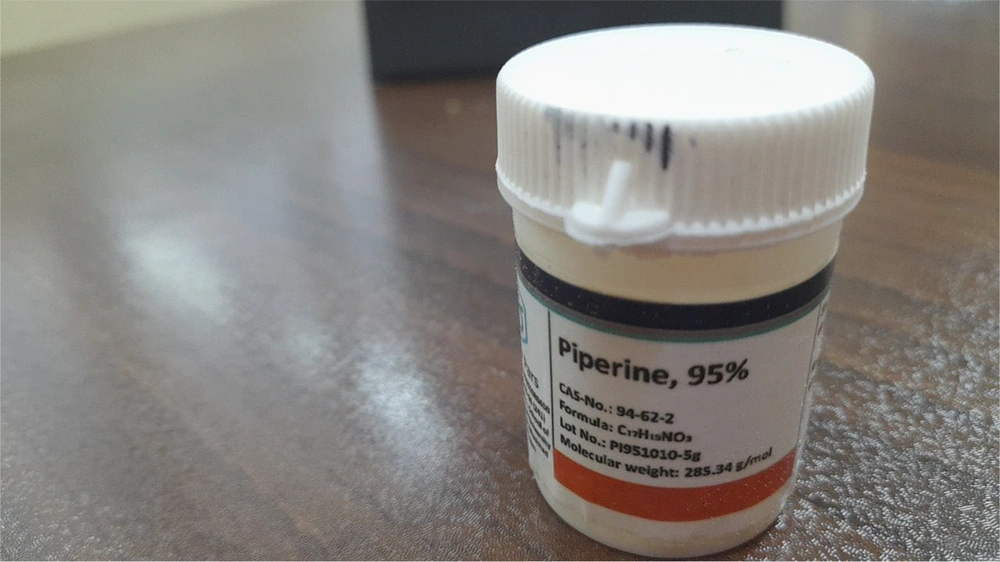
Figure 1.
Piperine, the active ingredient in black pepper
2.2. Isolation of Salmonella Typhimurium
Fresh poultry feces samples were collected from Zabol city. The samples were cultured on dedicated environments.
2.3. Agar Well Test
In the agar well method, after creating wells on the surface of Mueller Hinton agar culture medium and culturing bacterial suspension on the culture medium, 20 microliters of each of the prepared concentrations were poured into the wells and incubated for 24 hours at 37°C.
2.4. Determination of Minimum Inhibitory Concentration and Minimum Bactericidal Concentration for Piperine
The minimum inhibitory concentration (MIC) and minimum bactericidal concentration (MBC) values were determined for piperine, which had antibacterial effects. The determination of MIC and MBC was performed using sterile 96-well plates and the broth microdilution method according to CLSI guidelines (12).
2.5. Statistical Analysis
SPSS version 20 software was used for statistical analysis of data. Descriptive statistics such as mean and standard deviation were also used to describe the research variables.
3. Results
The diameter of the inhibition zone of piperine against 3 strains was 18 mm, one strain was 28 mm, three strains were 15 mm, one strain was 8 mm, one strain was 14 mm, one strain was 16 - 19 mm, and 13 mm (Table 1). The results of the minimum bactericidal concentration and minimum inhibitory concentration showed that the lowest inhibitory concentration was at 12.5 µg/µL, with one strain being inhibited at this concentration, and most strains being inhibited at 50 µg/µL (Table 1). The results of the lethality also showed that the highest lethality was at a concentration of 200 µg/µL.
Table 1.
Piperine Inhibition Against Salmonella
| Strain | Zone (mm) | MIC (µg/µL) | MBC (µg/µL) |
|---|---|---|---|
| 1 | 15 | 50 | 100 |
| 2 | 8 | 100 | 200 |
| 3 | 28 | 12.5 | 25 |
| 4 | 18 | 25 | 50 |
| 5 | 18 | 25 | 50 |
| 6 | 14 | 50 | 100 |
| 7 | 15 | 50 | 100 |
| 8 | 16 | 25 | 50 |
| 9 | 15 | 50 | 100 |
| 10 | 18 | 25 | 50 |
| 11 | 19 | 25 | 50 |
| 12 | 13 | 50 | 100 |
z Abbreviations: MIC, minimum inhibitory concentration; MBC, minimum bactericidal concentration.
4. Discussion
The results of the minimum bactericidal concentration and minimum inhibitory concentration showed that the lowest inhibitory concentration was at 12.5 µg/µL, with one strain being inhibited at this concentration, and most strains being inhibited at 50 µg/µL. The results of the lethality also showed that the highest lethality was at a concentration of 200 µg/µL. Masoumipour et al. investigated the antimicrobial properties of black pepper; the ethanolic compound had the greatest inhibitory effect on biofilm formation (13). Dorman and his colleagues in 2000 showed that the extract of a number of medicinal plants, including black pepper, has an inhibitory effect on Pseudomonas aeruginosa and Staphylococcus aureus (14). In another study that investigated the antimicrobial effects of black pepper using the well method, the results showed that the diameter of the inhibitory zone on Staphylococcus bacteria was 18 mm and the smallest diameter of the zone against Escherichia coli was 8 mm (15). Analysis of black pepper showed that it contains abundant tannins and alkaloids and is an inhibitor of Gram-negative and Gram-positive bacteria, including E. coli, Salmonella Typhimurium, Proteus, and S. aureus (16). Black pepper chloroform extract causes bacterial cell membrane permeability, thereby causing metabolic disorders and ultimately cell death (17). In a study by Vukovic et al., it was shown that black pepper essential oil showed good antimicrobial activity against L. monocytogenes, S. aureus, and Haemophilus influenzae (18). Piperine showed a very good inhibitory coefficient against most microorganisms and was inactive only against Pseudomunas aeruginosa (19). In another study, piperine and black pepper essential oil showed inhibition against Gram-positive bacteria, with piperine alone providing higher inhibition (20). In a study by Sultana et al., essential oil extracted from black pepper plant has shown higher antimicrobial properties than the antibiotic ceftriaxone (21). Zahin reported that black pepper extract, the diameter of the zone of inhibition against different multidrug-resistant isolates ranged from 10 to 14 mm (22). In another study, the effect of various medicinal plants on Salmonella Typhimurium was investigated. The result of the most effective plant extracts in inhibiting bacterial growth in the agar well diffusion method were Psidium guajava, Hibiscus sabdariffa, and Achillea setosa (23). In another study that investigated the effect of Mentha longifolia on Salmonella Typhimurium, the results showed that the lowest inhibitory concentration was 5 mg/mL (2). In another study that investigated the effect of synthetic nanoparticles on medicinal plants, researchers showed that synthetic nanoparticles from medicinal plants enhanced antimicrobial properties (24). Other studies have also been consistent with our study (25).
4.1. Conclusions
The results of this study indicate that piperine has a chemical formula with suitable antimicrobial properties that can be used as a pharmaceutical base or a suitable herbal medicine to combat microorganisms, including Salmonella Typhimurium.