
1. Background
Marriage remains a cornerstone of social stability; however, contemporary societies are experiencing notable shifts in marital dynamics (1). In recent decades, married women have encountered multifaceted psychological and interpersonal challenges that jeopardize relationship sustainability (2). In transitional societies such as Iran, women frequently navigate conflicts between entrenched traditional family roles and emerging modern identities. This cultural tension often generates heightened psychological strain, contributing to heightened marital instability and distress (3). In urban settings, married women increasingly report communication breakdowns and diminished fulfillment, which gradually undermine the marital bond (4). These difficulties extend beyond individual experience, profoundly affecting family psychological health and underscoring the need to investigate factors that precipitate marital dissolution in family psychology.
Fear of intimacy is a core psychological barrier that impedes the development and maintenance of deep, authentic connections. Conceptualized as an inhibited ability to share significant thoughts and feelings with a partner, this construct frequently originates from early attachment insecurities or prior relational trauma (5). In marital contexts, fear of intimacy functions as a covert disruptor, fostering emotional withdrawal and aversion to vulnerability. Individuals with elevated fear of intimacy often view closeness as a threat to autonomy, perpetuating cycles of avoidance and dissatisfaction (6). Ultimately, this impaired capacity for genuine intimacy creates psychological distance, rendering marriage more susceptible to stressors and increasing vulnerability to separation (7).
Divorce proneness, a multidimensional construct encompassing cognitive and behavioral inclinations toward marital termination, has emerged as a key focus in contemporary clinical research. Distinct from the act of divorce, divorce proneness reflects an ongoing internal appraisal of the costs and benefits of remaining in the union (8). Among married women, this tendency is frequently precipitated by accumulated feelings of neglect and the perception that core psychological needs remain unmet (9). Evidence suggests that divorce proneness unfolds gradually, progressing from fleeting thoughts of separation to concrete planning for legal dissolution (10). Identifying its antecedents is essential because it creates opportunities for early therapeutic intervention before relationships become irreparable.
Sexual satisfaction is a foundational element of marital well-being, extending beyond physical gratification to include psychological fulfillment and reciprocal responsiveness between partners (11). It serves as a critical marker of relationship quality and a protective factor against conflict. When sexual needs are met and affirmed, couples exhibit greater resilience and cohesion. In contrast, deficits in sexual satisfaction commonly evoke feelings of inadequacy, resentment, and profound isolation (12). Such dissatisfaction often signals underlying relational deficits, such as eroded trust or fear of vulnerability, that accelerate pathways to marital instability (13).
Emotional satisfaction also plays a pivotal role in marital longevity, denoting the extent to which partners feel understood, valued, and emotionally supported (14). For many women, emotional intimacy represents the primary foundation of a fulfilling relationship; its absence can render the marriage emotionally vacant. Emotional satisfaction provides a secure base for confronting life's demands with confidence. When it is lacking, the resulting emotional loneliness frequently motivates individuals to envision alternatives beyond the marriage (15). Thus, the interplay between emotional and sexual satisfaction may function as a mediating mechanism that can either reinforce or erode marital structure (16).
Although the literature extensively addresses marital stability, a notable gap remains in elucidating how intrapersonal psychological barriers, such as fear of intimacy, culminate in divorce proneness through the mediating pathways of sexual and emotional satisfaction. Prior research has predominantly examined direct associations, with limited attention to these complex mechanisms within specific cultural contexts. Amid escalating marital dissolution rates in Iran, there is a pressing need to delineate actionable underlying processes for clinical counseling aimed at safeguarding family cohesion. By integrating these variables, the present study offers a more comprehensive framework for culturally sensitive interventions tailored to married women.
2. Objectives
The present study used structural equation modeling to test a hypothesized mediation model in a sample of married women in Hamadan, Iran. This approach enabled the simultaneous assessment of direct and indirect effects and provided greater insight into the mechanisms linking fear of intimacy to divorce proneness through relational satisfaction domains. Accordingly, this study examined the structural association between fear of intimacy and divorce proneness, with particular emphasis on the mediating roles of sexual satisfaction and emotional satisfaction.
3. Methods
3.1. Design and Participants
This study adopted a descriptive-correlational design and used structural equation modeling as the primary analytical approach. The target population comprised all married women residing in Hamadan, Iran, in 2024. A total of 359 participants were recruited through convenience sampling. Eligibility criteria included being married for at least one year, having at least a secondary school education to ensure adequate comprehension of the questionnaires, and providing voluntary consent. Participants were excluded if they reported a recent history of severe psychiatric disorders or were currently involved in formal divorce proceedings. Ethical standards were strictly observed throughout the research process. Participants received complete information about the purpose of the study, were assured of the confidentiality of their responses, and provided informed consent before participation.
3.2. Procedure
Following approval of the research protocol, data were collected via online platforms and through in-person distribution at public community centers across Hamadan. Participants received either a digital or a printed packet containing the four standardized questionnaires. Brief instructions were provided at the beginning of each section to clarify the scoring method. Data collection spanned approximately three months. To minimize bias, participants were encouraged to respond honestly and were informed that there were no right or wrong answers. After completion, the questionnaires were screened for missing data, and incomplete responses were excluded from the final analysis.
3.3. Instruments
The Divorce Proneness Scale (17) was administered to assess participants’ inclination to end their marriage. This 14-item instrument uses a 7-point Likert response format ranging from 1 = not at all to 7 = extremely. Total scores range from 14 to 98, with higher scores indicating greater divorce proneness. Previous studies in Iran reported a Cronbach’s alpha of 0.85 for this scale (18); in the present study, internal consistency was 0.89.
The Fear of Intimacy Scale (19) was used to assess participants’ anxiety about forming close personal relationships. The instrument includes 35 items rated on a 5-point Likert scale ranging from 1 = not at all characteristic of me to 5 = extremely characteristic of me. Total scores range from 35 to 175, with higher scores indicating greater fear of intimacy. The Persian adaptation of this scale has previously demonstrated strong reliability in Iranian samples (α = 0.92) (20). In this study, Cronbach’s alpha was 0.90.
The Sexual Satisfaction Questionnaire (21) was used to evaluate participants’ satisfaction with their sexual relationship. It consists of 25 items rated on a 5-point Likert scale ranging from 1 = never to 5 = always. Total scores range from 25 to 125. Scores below 50 indicate dissatisfaction, scores of 51 - 75 indicate average satisfaction, and scores above 75 indicate high satisfaction. Previous Iranian research reported a reliability coefficient of 0.86 (22), whereas the present study yielded α = 0.88.
The Emotional Satisfaction Scale (23) assessed the degree of emotional fulfillment experienced within marriage. This brief 3-item measure evaluates the extent to which individuals feel understood and valued by their partner. Items are rated on a Likert-type scale, with higher total scores indicating greater emotional contentment. Internal consistency in the current sample was acceptable (Cronbach’s α = 0.87).
3.4. Data Analysis
Data analysis was performed using SPSS version 24 and AMOS version 26. First, descriptive statistics, including means and standard deviations, were calculated. Pearson correlation coefficients were then computed to examine bivariate relationships. Finally, the hypothesized model was evaluated using structural equation modeling to assess direct and indirect effects among the study variables. The model specified fear of intimacy as the exogenous variable, with sexual satisfaction and emotional satisfaction as parallel mediators, and divorce proneness as the primary endogenous outcome variable. Mediation was tested via indirect paths from fear of intimacy through each satisfaction variable to divorce proneness. The model was estimated using maximum likelihood estimation. Multivariate normality was assessed using Mardia's coefficient; although slight multivariate non-normality was observed, maximum likelihood estimation was retained because of its robustness for moderate sample sizes (N = 359). No missing data were present in the final dataset, as incomplete responses were excluded during screening. Outliers were examined using Mahalanobis distance (P < 0.001); no extreme multivariate outliers were identified.
4. Results
4.1. Sample Characteristics and Correlations
The sample comprised 359 married women recruited from Hamadan, Iran. Participants’ ages ranged from 22 to 58 years, with a mean age of 38.4 years (SD = 8.7). Regarding education, 98 women (27.3%) had completed high school or an equivalent qualification, whereas 261 women (72.7%) held a university degree at the bachelor’s level or higher. In terms of employment status, 142 participants (39.6%) were homemakers, and 217 (60.4%) were employed outside the home. Marriage duration varied, with 79 participants (22.0%) reporting less than 5 years of marriage and 280 (78.0%) reporting more than 5 years.
Table 1 presents the means, standard deviations, skewness, kurtosis, and Pearson correlation coefficients for the main study variables. Fear of intimacy had a mean of 98.07 (SD = 16.69). Compared with normative data from the original Fear of Intimacy Scale validation in nonclinical college samples (mean = 78.75, SD = 21.82), this sample showed moderately elevated levels. Sexual satisfaction averaged 43.12 (SD = 10.99), which falls in the low range based on the instrument’s scoring interpretation, in which scores below 50 indicate dissatisfaction; this finding is consistent with Persian adaptations reporting similarly low-to-moderate means in Iranian married samples. Emotional satisfaction was 9.87 (SD = 2.90) on its brief scale, reflecting moderate fulfillment. Divorce proneness averaged 54.08 (SD = 12.17), indicating a moderate inclination toward marital dissolution on the 14 - 98 scale and comparable to means reported in other Iranian studies of married or at-risk women. Skewness and kurtosis values were within acceptable ranges, supporting the use of parametric analyses. Bivariate correlations indicated significant associations among the variables. Fear of intimacy was negatively associated with sexual satisfaction (r = -0.17, P < 0.05) and emotional satisfaction (r = -0.21, P < 0.01) and positively correlated with divorce proneness (r = 0.28, P < 0.01). In addition, sexual satisfaction (r = -0.41, P < 0.01) and emotional satisfaction (r = -0.51, P < 0.01) showed strong negative associations with divorce proneness.
Table 1.
Descriptive Statistics, Skewness, Kurtosis, and Intercorrelations Among Study Variables
| Variables | Mean (SD) | Skewness | Kurtosis | 1 | 2 | 3 | 4 |
|---|---|---|---|---|---|---|---|
| 1. Fear of intimacy | 98.07 (16.69) | -0.95 | 0.52 | 1 | |||
| 2. Sexual satisfaction | 43.12 (10.99) | -0.28 | -0.34 | -0.17 a | 1 | ||
| 3. Emotional satisfaction | 9.87 (2.90) | -0.53 | -0.28 | -0.21 b | 0.28 b | 1 | |
| 4. Divorce proneness | 54.08 (12.17) | 0.11 | -0.93 | 0.28 b | -0.41 b | -0.51 b | 1 |
a P < 0.05.
b P < 0.01.
4.2. Structural Model Fit and Path Analysis
Table 2 presents the goodness-of-fit indices for the proposed structural equation model. The chi-square statistic was χ2 = 196.00 (P < 0.001), with a chi-square-to-degrees-of-freedom ratio of 2.00, which was acceptable (≤ 3). The goodness-of-fit index (GFI) was 0.97 (≥ 0.90), the adjusted GFI (AGFI) was 0.94 (≥ 0.90), the comparative fit index (CFI) was 0.98 (≥ 0.95), and the root mean square error of approximation (RMSEA) was 0.053 (90% CI, 0.042 - 0.064; ≤ 0.08). The standardized root mean square residual (SRMR) was 0.041 (≤ 0.08). Collectively, these indices indicate excellent to very good model fit, suggesting that the hypothesized model adequately fits the observed data.
Table 2.
Goodness-of-Fit Indices for the Final Structural Model
| Fit Index | Value | Acceptable Value |
|---|---|---|
| χ2 | 196 | - |
| df | 98 | - |
| χ2/df | 2.00 | ≤ 3 |
| GFI | 0.97 | ≥ 0.90 |
| AGFI | 0.94 | ≥ 0.90 |
| CFI | 0.98 | ≥ 0.90 |
| RMSEA | 0.053 | ≤ 0.08 |
Table 3 reports the standardized beta coefficients (β), standard errors (SEs), and P values for direct and mediated paths. Direct effects included a significant positive association between fear of intimacy and divorce proneness (β = 0.17, SE = 0.12, P = 0.024), along with strong negative effects of fear of intimacy on sexual satisfaction (β = -0.48, SE = 0.03, P < 0.001) and emotional satisfaction (β = -0.23, SE = 0.02, P < 0.001). Both mediators were negatively associated with divorce proneness: emotional satisfaction (β = -0.45, SE = 0.18, P < 0.001) and sexual satisfaction (β = -0.29, SE = 0.06, P < 0.001). Mediation analyses using bootstrapping with 5000 resamples and bias-corrected confidence intervals confirmed significant indirect effects: fear of intimacy → sexual satisfaction → divorce proneness (β = -0.10, SE = 0.03, P = 0.002; 95% CI, -0.16 to -0.05) and fear of intimacy → emotional satisfaction → divorce proneness (β = -0.14, SE = 0.02, P = 0.001; 95% CI, -0.19 to -0.09). These findings indicate partial mediation, with fear of intimacy exerting both direct and indirect effects on divorce proneness through reduced relational satisfaction. The model explained substantial variance in the endogenous variables (R2 for sexual satisfaction = 0.23; R2 for emotional satisfaction = 0.05; R2 for divorce proneness = 0.38). Figure 1 depicts the final tested structural model, illustrating the hypothesized pathways among the variables.
Table 3.
Standardized Path Coefficients for Direct and Mediated Relationships in the Final Model
| Path | β | SE | P-Value |
|---|---|---|---|
| Direct relationships | |||
| Fear of intimacy → Emotional satisfaction | -0.23 | 0.02 | 0.001 |
| Fear of intimacy → Sexual satisfaction | -0.48 | 0.03 | 0.001 |
| Fear of intimacy → Divorce proneness | 0.17 | 0.12 | 0.024 |
| Emotional satisfaction → Divorce proneness | -0.45 | 0.18 | 0.001 |
| Sexual satisfaction → Divorce proneness | -0.29 | 0.06 | 0.001 |
| Mediating relationships | |||
| Fear of intimacy → Sexual satisfaction → Divorce proneness | -0.10 | 0.03 | 0.002 |
| Fear of intimacy → Emotional satisfaction → Divorce proneness | -0.14 | 0.02 | 0.001 |
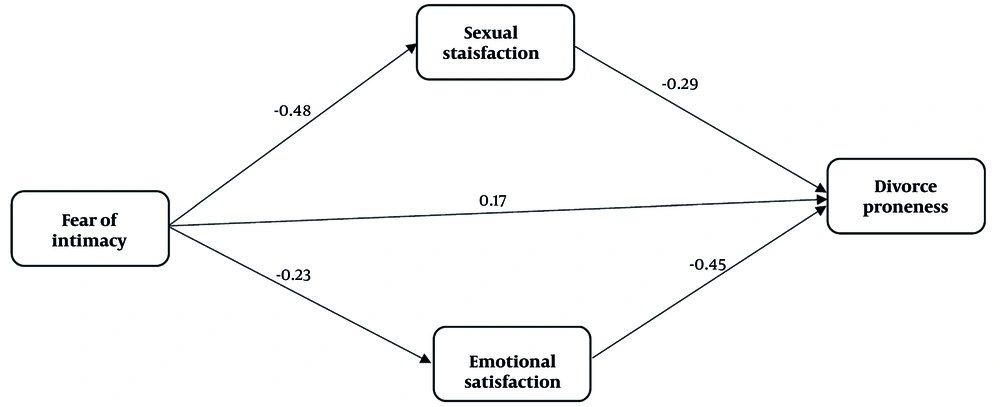
Figure 1.
Final structural model of the study
5. Discussion
The present study examined the structural pathways linking fear of intimacy to divorce proneness among married women in Hamadan, Iran, with particular attention to the mediating roles of sexual satisfaction and emotional satisfaction. A key finding was a statistically significant positive direct association between fear of intimacy and divorce proneness. This suggests that greater anxiety regarding emotional vulnerability and closeness increases cognitive and behavioral tendencies toward marital dissolution. Theoretically, fear of intimacy functions as a defensive mechanism that impedes the development of a secure relational foundation. By avoiding authentic self-disclosure to reduce the risk of rejection or loss of autonomy, individuals maintain superficial interactions, thereby increasing marital fragility in the face of stressors. These results are consistent with recent empirical evidence indicating that fear of intimacy, or related constructs such as intimacy avoidance, is a key predictor of relational difficulties, reduced marital satisfaction, and increased instability or dissolution risk. For example, Finzi-Dottan (24) used an actor-partner interdependence model to show that fear of intimacy mediates the association between self-differentiation and marital relationship satisfaction in both partners, with lower self-differentiation contributing to higher fear of intimacy and subsequently reduced satisfaction. Similarly, studies in Iranian contexts have linked fear of intimacy to adverse marital outcomes, including reduced adjustment, heightened emotional barriers, and increased vulnerability to relational breakdown in culturally evolving settings. Seyfizadeh et al. (25) reported a significant relationship between early maladaptive schemas and marital adjustment, with fear of intimacy acting as a mediator among married individuals.
Fear of intimacy also exerted a significant negative effect on sexual satisfaction. Sexual intimacy extends beyond physical acts to encompass deep emotional exposure and mutual attunement. Individuals with high fear of intimacy often exhibit performance-related anxiety or emotional disengagement during sexual interactions to maintain psychological distance, thereby hindering reciprocal responsiveness and reducing overall fulfillment (24). This pattern aligns with Dosch et al.'s (26) assertion that psychological impediments often outweigh physiological factors in shaping sexual satisfaction, as well as Amirahmadi et al.'s (18) observation that mindfulness and openness are foundational to adaptive sexual dynamics among married Iranian women.
A similar negative association was observed between fear of intimacy and emotional satisfaction. Emotional fulfillment requires transparency, trust, and responsiveness to a partner's relational bids, elements that may be perceived as threatening by individuals who fear intimacy. Suppression of emotional needs and limited reciprocity can create an emotional vacuum, culminating in loneliness and perceived neglect. This finding is consistent with Mirzazade et al.'s (27) emphasis on mutual vulnerability as essential for emotional contentment and with Dehghanidowlatabadi et al.'s (28) documentation of emotional disconnection as a primary contributor to declining marital quality in Iranian couples.
Sexual satisfaction emerged as a significant negative predictor of divorce proneness. Within the marital system, sexual fulfillment functions as a strong buffer against stressors, fostering a sense of exclusivity, belonging, and relational reward. Higher sexual satisfaction reinforces perceptions of the marriage as a worthwhile investment, thereby reducing thoughts of separation. Deficits, conversely, may foster resentment and perceptions of burden. These observations are consistent with Rusbult et al.'s (17) investment model, which positions satisfaction as a core determinant of commitment, and with broader evidence linking sexual health to marital longevity.
Emotional satisfaction similarly played a protective role against divorce proneness. It provides the psychological cohesion necessary to withstand relational challenges. For many women, feeling genuinely understood and valued is a paramount factor in sustaining commitment; its presence increases the perceived costs of dissolution. This accords with attachment theory perspectives, in which emotional security underpins relational endurance, and with family psychology research indicating that emotional neglect is a stronger precursor to divorce than socioeconomic stressors.
Importantly, mediation analyses showed that fear of intimacy influences divorce proneness indirectly by eroding sexual and emotional satisfaction, with significant indirect effects of medium magnitude confirmed through bootstrapping. Rather than inevitably precipitating divorce, fear undermines everyday relational rewards, progressively fostering dissatisfaction and desires for separation. This mechanism highlights the importance of targeting core intimacy deficits in therapeutic practice. Clinicians should address not only overt conflicts but also underlying barriers to vulnerability, thereby restoring sexual and emotional bonds and reducing dissolution risk.
5.1. Conclusions
In conclusion, this study demonstrates that fear of intimacy is a critical psychological precursor of divorce proneness among married women, influencing divorce proneness both directly and indirectly through the mediating pathways of sexual satisfaction and emotional satisfaction. The findings indicate that an internal resistance to vulnerability not only diminishes the quality of the marital bond but also significantly accelerates progression toward marital instability. By clarifying these mediating pathways and reporting effect sizes and confidence intervals, the study highlights the substantial variance explained in divorce proneness and underscores the need to address intimacy-related anxieties in clinical and therapeutic contexts. Accordingly, therapeutic interventions aimed at fostering emotional openness and sexual fulfillment may serve as effective buffers against the risk of separation, providing a strategic framework for enhancing marital longevity and preserving family cohesion.
5.2. Limitations and Future Directions
One major limitation of this study is its cross-sectional design, which precludes definitive causal inferences and prevents examination of how these relationships evolve over time. Moreover, the use of convenience sampling among married women in Hamadan limits the generalizability of the findings to other groups, such as men, individuals living in rural areas, or those from varied socioeconomic backgrounds.
Future research would benefit from longitudinal designs to better establish the directionality of effects, as well as from collecting dyadic data from both spouses to provide a more comprehensive picture of the marital dynamics involved. Including male participants and more diverse Iranian samples would further elucidate gender-specific and culturally nuanced mechanisms of intimacy and stability.