1. Introduction
The liver is one of the most important organs in the human body and serves several functions, including metabolism and the removal of xenobiotics from vital body systems. The liver encounters toxic substances and metabolites; therefore, it can be continuously exposed to numerous chemicals and microbial and viral agents (1). In many cases, metabolic activation occurs during hepatic detoxification pathways mediated by liver microsomal enzymes, including cytochrome P-450, and this process can ultimately generate toxic substances and reactive species that can cause severe damage to various tissues, including the liver (2). Adverse drug reactions (ADRs) represent one of the most complex issues in clinical medicine (3). Changes in biochemical parameters in the human body may be related to differences in the expression of metabolizing enzymes, the presence of different metabolic pathways, and the effects of immunological reactions (4).
Epilepsy is a neurological disorder characterized by loss of consciousness and conditions associated with convulsions. Currently, various drugs are used to treat epilepsy, such as phenytoin, carbamazepine, phenobarbital, and valproic acid (5).
In some cases, antiepileptic drugs can cause severe adverse effects, such as blood disorders, hirsutism, gingival hyperplasia, idiosyncratic liver toxicity, and weight gain (6). Among these drugs, carbamazepine (CBZ) is one of the best-known and oldest antiepileptic drugs and helps control seizures by blocking sodium-dependent channels (7). According to the literature, carbamazepine use in patients with epilepsy can be accompanied by serious adverse effects, such as aplastic anemia, jaundice, Stevens-Johnson syndrome, lupus erythematosus, and toxic epidermal necrolysis (8).
Recently, the use of plant-based drugs has increased in developed and developing countries because of their notable efficacy, acceptable safety, availability, and lower cost (9). Some crude plant extracts used in traditional medicine are considered rich sources of preventive and protective agents for humans and animals, particularly for the liver. These properties are attributed to plant-based antioxidant compounds, including vitamin C, carotenoids, lycopene, and flavonoids, which can inhibit free radicals and related damage (10, 11). In this regard, other plant extracts, such as those obtained from Silybum marianum and Cichorium intybus, have demonstrated antioxidant effects (12).
In Iran, liver diseases resulting from adverse drug effects and viral hepatitis are somewhat prevalent (13). Regarding the use of traditional medicine for the treatment of liver disorders, three plants, Silybum marianum (SM), Cichorium intybus (CI), and Ziziphus vulgaris (ZV), were selected to evaluate their therapeutic effects in a patient with liver disorders due to drug side effects. Another aim of this study was to attenuate CBZ-dependent side effects and the resulting liver damage in a patient with epilepsy.
2. Case Presentation
The patient was a 27-year-old man weighing 75 kg who had been under care for tonic-clonic seizures for approximately the previous 2 years. During this period, he had been receiving carbamazepine (CBZ) at 800 mg/day and phenobarbital (PHB) at 100 mg/day. The patient’s serum liver enzyme levels were elevated, including aspartate transaminase (AST) at 58.3 ± 6.37 U/L, alanine aminotransferase (ALT) at 91.8 ± 12.3 U/L, and alkaline phosphatase (ALP) at 546.3 ± 20.1 U/L. Other values obtained from biochemical and hematological tests were within the normal range (Table 1). The patient did not experience any epileptic seizures during these experiments or before the treatment protocol began. The patient complied with the medicinal plant prescription for his disease in this study, and written consent was obtained to continue the study.
Table 1.
| Chemical Parameters | Before Treatment | One-Month Treatment | Two-Month Treatment | Normal Range for Men |
|---|---|---|---|---|
| Fasting blood sugar (mg/dL) | 80.33 ± 5.51 | 78.33 ± 1.53 | 87 ± 3.60 | 70 - 110 |
| Urea (mg/dL) | 21.66 ± 1.53 | 25.32 ± 2.08 | 27 ± 1.73 | 19 - 44 |
| Creatinine (mg/dL) | 1.00 ± 0.10 | 0.93 ± 0.06 | 0.97 ± 0.05 | 0.7 - 1.4 |
| Uric acid (mg/dL) | 5.83 ± 0.15 | 5.73 ± 0.25 | 5.6 ± 0.17 | 3.6 - 8.20 |
| Cholesterol (mg/dL) | 157.0 ± 6.08 | 150.6 ± 4.04 | 158.0 ± 1.53 | > 200 |
| HDL-cholesterol (mg/dL) | 39.33 ± 1.53 | 42.00 ± 1.73 | 40.00 ± 1.00 | < 35 |
| LDL-cholesterol (mg/dL) | 80.66 ± 2.51 | 71.00 ± 1.00 | 77.00 ± 1.52 | > 130 |
| Triglycerides (mg/dL) | 85.00 ± 3.00 | 81.67 ± 3.21 | 88.33 ± 1.53 | > 200 |
| Calcium (mg/dL) | 9.53 ± 0.29 | 9.4 ± 0.17 | 9.40 ± 0.10 | 8.3 - 10.3 |
| Phosphorus (mg/dL) | 3.9 ± 0.26 | 3.83 ± 0.06 | 3.73 ± 0.23 | 2.5 - 4.5 |
| Na (mEq/L) | 138.0 ± 2.00 | 138.7 ± 1.52 | 138.00 ± 1.00 | 135 - 145 |
| K (mEq/L) | 4.63 ± 0.15 | 4.73 ± 0.05 | 4.57 ± 0.06 | 3.5 - 5 |
| AST (U/L) | 58.3 ± 6.37 | 37.5 ± 4.97 | 34.0 ± 3.16 | < 37 |
| ALT (U/L) | 91.8 ± 12.30 | 43.0 ± 3.00 | 40.5 ± 3.83 | < 41 |
| ALP (U/L) | 546.3 ± 20.10 | 370.0 ± 5.00 | 370.5 ± 4.76 | 64 - 306 |
| Total bilirubin (mg/dL) | 1.00 ± 0.10 | ND | 0.9 ± 0.1 | 0.2 - 1.4 |
| Direct bilirubin (mg/dL) | 0.20 ± 0.10 | ND | 0.2 ± 0.00 | ≤ 0.3 |
| Creatine phosphokinase (U/L) | 34.0 ± 1.00 | ND | 42 ± 2.00 | 24 - 195 |
| Lactate dehydrogenase (U/L) | 243 ± 2.00 | ND | 253 ± 2.00 | < 480 |
| White blood cell (× 103/µL) | 7.7 ± 0.91 | 7.4 ± 0.2 | 8.03 ± 0.06 | 4 - 10 |
| Red blood cell (× 106/µL) | 4.94 ± 0.06 | 4.83 ± 0.4 | 4.85 ± 0.05 | 3.9 - 5.8 |
| Hemoglobin (g/dL) | 14.6 ± 0.20 | 14.4 ± 0.17 | 14.2 ± 0.10 | 14 - 18 |
| Hematocrit (%) | 44.2 ± 0.26 | 43.9 ± 0.10 | 43.3 ± 0.17 | 40 - 54 |
| Platelet (×103/µL) | 304 ± 9.53 | 297 ± 1.00 | 284 ± 3.60 | 150 - 450 |
| Prothrombin time (s) | 12.8 ± 0.28 | 13 ± 0.00 | 13 ± 0.00 | 12 - 13.5 |
| Partial thromboplastin time (s) | 32 ± 2.00 | 34 ± 2.00 | 36 ± 1.00 | 24 - 36 |
| International normalized ratio | 1 | 1 | 1 | > 1 |
a Values are mean ± SD of different replicates (N = 3) from five measurements. Abbreviation: ND, not determined.
b Paired t-test was used to compare the means.
2.1. Treatment Protocols
Silybum marianum seeds were obtained from the Kelardasht district in Mazandaran province, northern Iran. The other two medicinal plants, ZV and CI, were collected from Kashan city in Isfahan province, Iran.
All stages of the selection and preparation procedures for the three medicinal plants were based on separate human and animal studies and standard methods adopted from previous studies (14-16). Because no human clinical study has been designed using the combination of these three medicinal plants to simultaneously control CBZ side effects in patients and prevent and/or attenuate CBZ-associated liver injury, the treatment protocol was based on extrapolated evidence from related human and animal studies.
The treatment protocol was performed in accordance with ethical principles under the framework of the Declaration of Helsinki for human experiments and animal studies conducted using the three medicinal plants mentioned above (17). The experiment was fully explained to the patient, and his compliance and fully informed consent were obtained through a written agreement signed by the patient. Written informed consent was also obtained from the patient for publication and presentation of this case.
Treatment was based on the combined use of CI extract at 88 mg/kg body weight/day, SM pulverized seeds at 6.6 mg/kg body weight/day, and ZV at 133 mg/kg body weight/day, and continued for 4 weeks.
Treatment evaluation was based on changes in the patient’s liver enzyme levels, with reversal of liver enzymes to normal levels considered a positive treatment response. Treatment comparisons were performed using SPSS software, version 20. A paired t-test was used to analyze the data. P < 0.05 was considered statistically significant.
3. Discussion
As shown in Table 1, the patient’s liver enzyme levels decreased and reached near-normal limits 1 month after the initial treatment. The measured AST, ALT, and ALP levels in this patient were 37.5 ± 4.97, 43.0 ± 3.00, and 370.0 ± 5.00 U/L, respectively. After 2 months of treatment, the AST and ALT levels were within normal limits, corresponding to 34.0 ± 3.16 and 40.5 ± 3.83 U/L, respectively. The ALP level approached the normal range and was measured at 370.5 ± 4.76 U/L.
The measured total phenol and flavonoid levels in the patient are shown in Table 2.
Table 2.
Flavonoid and Phenol Amounts Received by the Patient Per Day During the Study a
| Plants | Amount of Total Flavonoids b (mg/day) | Amount of Total Phenols c (mg/day) |
|---|---|---|
| SM | 69.50 | 62.30 |
| ZV | 5.56 | 4.81 |
| CI | 125.78 | 81.89 |
| Total | 200.84 | 149 |
a Silymarin was administered at a dose of 20.46 mg/day. Abbreviations: CI, cichorium intybus; SM, silybum marianum; ZV, Ziziphus vulgaris.
b Quercetin equivalent.
c Gallic acid equivalent.
AST, ALT, and ALP are among the most important liver enzymes routinely evaluated to detect liver diseases. Increased levels of these enzymes indicate hepatocellular damage because they are located in the cytoplasm and are released into the blood when cellular damage occurs (1, 18).
Studies of antiepileptic drugs, such as carbamazepine and valproate, have shown that these drugs can initiate oxygen-dependent tissue damage through several mechanisms and thereby affect antioxidant systems (19). Higher doses of carbamazepine may result in enzymatic activity with reduced antioxidant properties due to oxidative stress. Furthermore, chronic use of this drug can cause an imbalance between antioxidant and oxidant pools in the human body; accordingly, the production of reactive oxygen species (ROS) may exceed the antioxidant defense capacity (20).
The presence of important flavonoids, such as silybin (SBN), silydianin (SDN), and silychristin (SCN), in SM seeds was one of the main reasons for including SM seeds in this study. Silymarin is believed to exert hepatoprotective effects through different mechanisms, including cell membrane stabilization and free radical inhibition. By increasing cellular glutathione, silymarin can induce DNA polymerase gene expression, which consequently increases rRNA levels and supports liver cell regeneration (21).
Some pharmaceutical properties observed in ZV are related to the antioxidant properties of flavonoid compounds present in this plant. Studies on this plant have shown that, due to the presence of active compounds, it can inhibit histamine release and interfere with the activation of cholinesterase and cyclooxygenase (COX) I and II enzymes (22).
The medicinal plants used in this study contain notable antioxidant and flavonoid compounds (Table 2). In this respect, a previous study showed that flavonoids can increase the antioxidant capacities of glutathione, reduced glutathione (GSH), glutathione peroxidase (GPx), and catalase (CAT), thereby producing hepatoprotective effects by reducing tissue damage, particularly liver damage (23). The presumed mechanisms underlying the protective activities of these three medicinal plants briefly include activation of the defense system through both enzymatic and nonenzymatic pathways, followed by increases in GSH and other defense systems, such as CAT and GPx. Through the nonenzymatic pathway, major components present in the three medicinal plants, including ascorbic acid, carotenoids, flavonoids, anthraglycosides, and phenolic compounds, may act together with the enzymatic pathway to stimulate the immune system, inhibit free radicals, and stabilize cell membranes. As a result, liver function may normalize, and AST, ALT, and ALP levels may return to normal values (Figure 1).
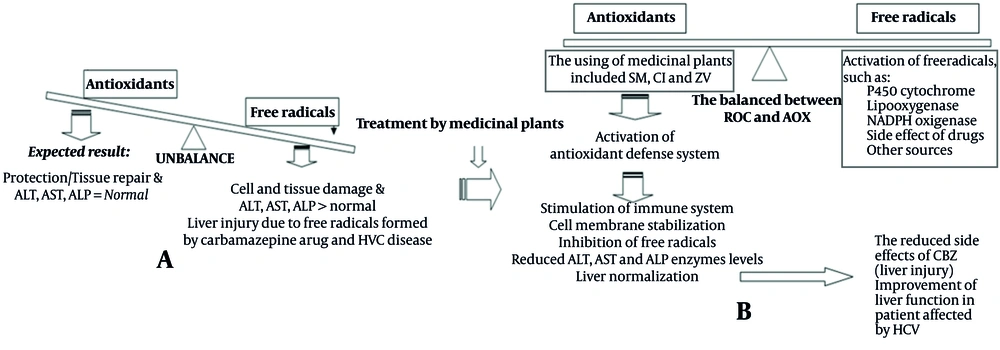
Figure 1.
Presumed mechanisms by which SM, CI, and ZV medicinal plants activate the antioxidant defense system through enzymatic or nonenzymatic pathways and inhibit free radicals due to specific constituents, including flavonoids, phenolic compounds, and carotenoids, thereby balancing free radicals and antioxidant systems. Abbreviations: CI, Cichorium intybus; SM, Silybum marianum; ZV, Ziziphus vulgaris.
Considering the data of this study, because the proposed mechanism of carbamazepine-induced liver toxicity is free radical production, concurrent use of the three medicinal plants Silybum marianum, Cichorium intybus, and Ziziphus vulgaris could inhibit free radical production.