
Introduction
Methimazole (MTZ) as an anti thyroid drug was used to treat hyperthyroidism [1]. MTZ inhibits iodine and peroxidase from their normal interactions with thyroglobulin [2] and it causes cellular protection or cellular damage [3, 4]. Moreover, there are extra thyroidal effects of anti thyroid drugs [5]. MTZ causes cellular damage in the liver, kidney, spleen and heart and these effects are not caused by hypothyroidism itself [6]. MTZ-induced hypothyroidism has tumorigenic effects and modifies pulmonary function [7, 8].
MTZ changes amount of opioid receptors, mu, delta, and kappa, in CNS. Bhargava et al. showed that the binding of 3H-DAGO (mu receptor) to various region of rats brain, amygdala, pons, medulla, striatum, midbrain and cortex membranes in MTZ-treated rats was more than control groups, while the binding of 3H-DSTLE (delta-receptors) in amygdala and hypothalamus membranes did not change. The binding of 3H-EKC (kappa-receptors) to membranes of pons and medulla was lower but in the striatum and cortex was more than the control groups. They suggested that brain mu, delta and kappa-opioid receptors are differentially altered in hypothyroidism [9].
Morphine is an agonist for the opiate μ-receptor [10] and causes tolerance-dependency through down-regulation of μ in CNS. Physical dependency could be shown with μ-opiate antagonist’s exposure that is named withdrawal syndrome [11].
There is no evidence that show the amount of morphine dependency in presence of anti thyroid hormone drugs in acute and chronic usage. Therefore, investigation of their effects on addicted human health is necessary. Thus in the study as a first investigation effects of MTZ in acute and chronic application on morphine dependency by evaluation of its withdrawal signs were investigated.
Materials and Methods
In this experimental study adult male NMRI mice at two months of age having weights of 30-40 g obtained from animal house of Jondi-Shapour University of Medical Sciences were used. Animals were housed in plastic cages (4 per cage) in an animal room maintained at 23±1ºC on a 12 h dark cycle (light period, 07:00- 19:00). Food and water were available at all times except during experiments. Each animal was used only once and then sacrificed. Seven animals were used in each group. Body weight was recorded at the starting and on experiment days. Health condition of all animals was noted during the investigation. The whole procedure was carried out in accordance with institutional guidelines for animal care and use. MTZ purchased from Iran Hormone Company (Co), Iran. Morphine sulphate powder purchased from Tolid daru Co, Iran and naloxone from Temad Co, Iran. Morphine dependency induced by 3 daily injections of increasing morphine dose (s.c.) for 3 days (20, 40 and 80 mg/kg). In four day or testing day mice received a final morphine (40 mg/kg) and after 3 hour received naloxone (5 mg/kg, i.p.) for induction the withdrawal syndrome. Numbers of withdrawal signs such as jumping, rearing and climbing were evaluated during 30 min after naloxone injection. MTZ were injected in two ways an acute and chronic administration as followed.
Experimental procedure: Different experimental protocols were employed as following in table 1.
Table 1.
Protocol of animal treatment and investigation
| Investigation | Treatment | Groups | |
|---|---|---|---|
| Morphine+saline (i.p.) + naloxone (5 mg/kg, i.p.), Morphine+MTZ | Control group Experimental group 1, 2, 3 | Acute application of MTZ | |
| Tap water (24 days) +morphine +naloxone (5 mg/kg, i.p.) MTZ (500 μg/L in 24 days) | Control (24 days) Experimental group (24 days) | Chronic application of MTZ | |
1Methimazole.
*Dose selected from previous study that was induced hypothyroid disease.
| Signs | Rearing | Climbing | Jumping |
|---|---|---|---|
| 27. 8±1.99 | 24.2± 3 | 65 ± 9.65 | |
| 25.3±2.6 | 26.1±2.6 | 76.2±8.2 | |
| 26.7±1.7 | 32.4±4.1 | 90.8±11.2 | |
| 22.2 ±4.97 | 43.57±3.85 | 135.14 ±28.08 | |
| 29±2.01 | 25±2.1 | 67.14±9.33 | |
| 32.57±5.6 | 40.29±6.49 | 180.14±18.62 |
Value are expressed as the mean±SEM, N=7,
* p<0.05,
** p<0.01,
*** p<0.05 in compared to the control groups,
≠ p<0.001 in compared to an acute methimazole group 40,
In acute application of MTZ, animals received this drug (10, 20, 40 mg/kg, i.p.) after morphine dependency just 30 min before the naloxone or testing day. Control group received saline instead of MTZ. In chronic application of MTZ (500 μg/L in 24 days), animals received MTZ three weeks before morphine dependency and were followed to testing day.
One full feeding bottle was consumed daily. Fresh solution of MTZ was prepared daily. Control group received tap water only.
Statistical analysis: Data analyzed by SPSS-16 and all results were expressed as the mean±SEM. Statistical evaluation of data was performed using Student's t-test and analysis of variance (ANOVA) with one factor followed by Duncan test. p<0.05 was considered significant.
In the present study, all experiments and methods were carried out in accordance with the Institutional Guidelines for Animal Care and Use of Laboratory Animals, and approved by the Department of Biology of the Shahid Chamran University (Ahvaz, Iran).
Results
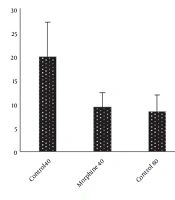
In acute application of MTZ only in doses of 20 and 40 mg/kg, i.p., statistically significant differences were observed between the mean number of climbing and jumping and control group with p<0.05 and p<0.01 respectively and did not change rearing behavior as it has been shown in (Table 2). Thus MTZ potentiated some of morphine withdrawal signs in dose dependent manner.
In chronic administration of MTZ, the mean number of climbing (p<0.05) and jumping (p<0.001) increased significantly compared to control group, but not rearing (Table 2). Therefore chronic application of MTZ like acute application shows potentiating effect on some of morphine withdrawal signs. Comparison between morphine withdrawal signs in acute and chronic application of MTZ showed significant difference in rearing and jumping signs (p<0.05).
Discussion
Our findings in this study as a first investigation showed that MTZ in both acute and chronic application potentiate some of the morphine withdrawal signs in addicted mice. On the other hand MTZ increases physical dependency of morphine. These results are in agreement with the idea that MTZ up regulates membranes μ-opiate receptors of amygdala, pons and medulla, striatum, midbrain and cortex [9]. It was shown that most of these regions involve in dependency of opioids [12]. Considering the similarity of MTZ effect in acute and chronic application, it seems this drug alters directly the central mechanisms of physical dependency phenomenon of morphine, because there was not enough time for thyroid hormone level changes. Although MTZ applied for hypothyroidism induction and almost total action related to hypothyroidism, some studies indicate that tissue damage found in hypothyroidism is caused by MTZ and these effects are not by hypothyroidism itself [6]. A limitation of this study is that we did not measure the thyroid hormone levels in acute and chronic application of MTZ so future studies can examine this factor separately in above mentioned phenomenon. But comparison between morphine withdrawal signs in acute and chronic application of MTZ showed a significant difference in rearing and jumping signs. It means that the chronic application of MTZ and/or MTZ-induced hypothyroidism causes more potentiating on the morphine withdrawal signs.
However according to the results of a study, hypothyroidism induces an up-regulation of endogenous opioids such as enkephalin and dynorphin mRNA in granule cells in dentate gyrus which supports our results [13].
Another study represented that hypothyroidism increases dopamine receptor sensitivity by increasing receptor concentration [14]. It has been indicated that neurotransmission of dopamine has important role in morphine withdrawal syndrome. A research team, who were studying on the condition of the morphine withdrawal syndrome, found that dopamine as a neurotransmitter plays an important role; and its agonists potentiate abstinence behaviour in rodents [15]. Based on above studies and our findings, we propose that the MTZ may affect mechanisms of morphine dependency, directly and/or indirectly, through dopamine and/or opioid receptors in addicted mice. Therefore it seems that the increasing effect of MTZ on signs of withdrawal syndrome is related to increasing of excitability or number of μ-opiate receptors.