1. Background
Newly - qualified junior doctors may be required to implement their resuscitation skills very early in their career and there is evidence to demonstrate an inadequacy in the ability to recall CPR fundamentals amongst students (1, 2). Importantly, the Royal College of Paediatrics and Child Health have called for medical professionals to be competent in performing a range of paediatric skills (3).
Novice doctors are often at the forefront of paediatric care and thus their ability to undertake basic but important skills is paramount (4). The introduction of a full time Resuscitation Training Officer in 1987 marked the formalisation of resuscitation teaching in the United Kingdom, to address these concerns (5). However, medical students are usually only trained in adult BLS, and consequently lack the confidence to manage paediatric - specific emergencies (6). This concern is evident in the poor outcomes demonstrated in delivering successful Paediatric Basic Life Support (7).
Numerous studies have highlighted the very little attention Basic Life Support receives in the undergraduate medical curriculum (8-12). Of greater concern is that medical students surprisingly over - estimate their poor ability to deliver such aid in a real - world setting on actual patients. This may be owing to the very poor confidence levels amongst undergraduates - however the literature remains sparse (2). We aimed to evaluate the baseline confidence levels of medical students in dealing with a paediatric cardiac arrest (PCA) and the improvement seen following a PBLS training course.
2. Methods
2.1. Study Design
A prospective before- and after - questionnaire study was conducted on 51 medical students, from a single UK medical school, who attended a recognised one - day Paediatric Basic Life Support training programme (based on Resuscitation Council UK guidelines). Demographic details, previous basic life support and first aid experiences were also recorded. The study was run in accordance with the principles of the Declaration of Helsinki.
2.2. Questionnaire
A 10 - point scale on candidate self - reported pre- and post - course confidence levels was distributed to the participants. Evaluation of student knowledge of the chest compression to ventilation ratio in both adult and paediatric patients was assessed amongst other factors in the pre - course questionnaire. Student opinion on the inclusion of further first aid training as part of their undergraduate course was also sought in the post - course questionnaire.
2.3. Statistical Analysis
Analysis was performed using the Statistical Package for Social Sciences (SPSS), Amonk IBM, New York. Version 20. A paired student t - test was used to assess differences in student confidence levels before and after the first aid course. A P value of 0.05 was used to identify a significant difference.
3. Results
3.1. Student Details
52 students completed the training and returned the questionnaire. Participant details are available in Table 1.
Table 1.
Details of Participating Students
| Parameter | Number (%) |
|---|---|
| Number of students | 52 (100%) |
| Number of students from each year of study (%) | |
| 1st | 6 (11.8%) |
| 2nd | 8 (15.7%) |
| 3rd | 10 (19.6%) |
| 4th | 19 (37.4%) |
| 5th | 8 (15.7%) |
| Number of students who had been involved in the resuscitation of a Cardiac Arrest Resuscitation (%) | 10 (19.2%) |
| Number of students who had administered First Aid (%) | 15 (28.9%) |
50 (96.2%) students reported that they had past adult/paediatric basic life support learning experience. Twenty - four (46.2%) had witnessed a cardiac arrest in the past and ten (19.2%) reported that they had been involved in a cardiac arrest resuscitation.
3.2. Paediatric Basic Life Support Self - Reported Confidence
The students reported a mean pre - training confidence in paediatric basic life support of 2.2 out of 10 (2.2/10). The lowest mean confidence was observed in the eight second - year students and was reported at 1/10 (Table 2). The highest mean rating was apparent in the eight final - year students at 4.6/10. Following the completion of the training, a significant increase (P < 0.05) was observed in the student cohort as the mean confidence rose to 7.5/10 - a change of 341% (Figure 1). The post - training questionnaire showed that 61.5% of the students were “not very surprised” by the profound changes between paediatric and adult BLS in their individual scores.
Table 2.
Student Mean Pre - Course Confidence Rating in Respect to Their Year of Study
| Student Year of Study | Mean Pre - Course Confidence (/10) |
|---|---|
| 1 | 1.8 |
| 2 | 1.0 |
| 3 | 2.6 |
| 4 | 1.8 |
| 5 | 4.6 |
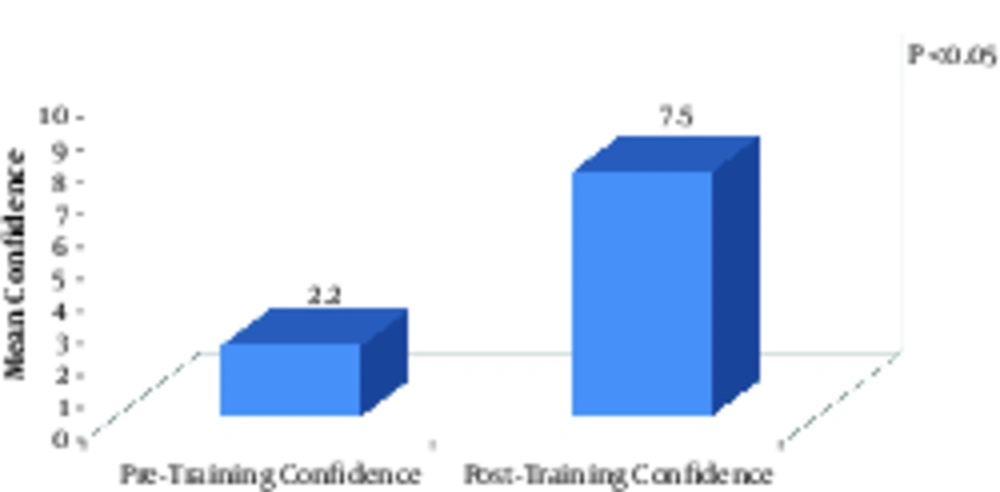
Figure 1.
Mean Confidences of Medical Students Prior to and After the Training
3.3. Assessment of Student Knowledge
The pre - course questionnaire found forty - nine students (96.1%) as having correctly identified the recommended adult chest compression to ventilation ratio as 30:2. However this was worryingly lower for the paediatric equivalent, only twelve participants (23.5%) correctly provided the ratio of 15:2 in response to the question.
3.4. Student Opinion
96.1% (Figure 2) of the student cohort said they would like for a paediatric basic life support component to be part of their undergraduate curriculum. 92.1% expressed that they would attend an adult equivalent refresher course mid - way through their degree
Student satisfaction with the training was high - usefulness was rated 7.3/10 and delivery 7.5/10. 62.7% of the students said they would prefer a whole - day paediatric basic life support training session.
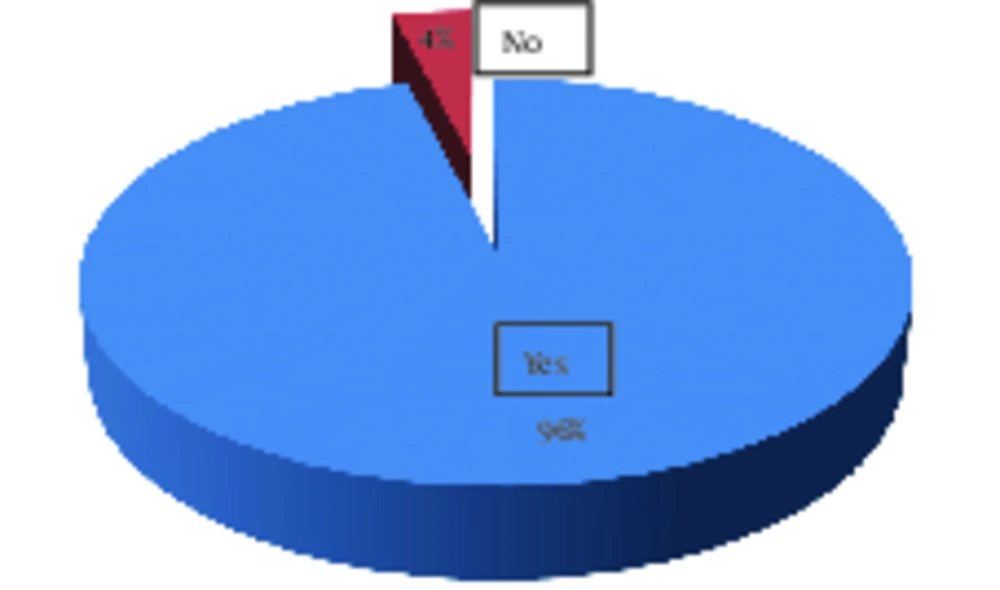
Figure 2.
Response to Whether the Students Would Like for a Paediatric Basic Life Support Component in Their Course Curriculum
4. Discussion
We demonstrated that medical students lack the confidence in managing paediatric cardiac arrests; however, a significant increase (P < 0.05) of 341% in mean confidence (from 2.2/10 to 7.5/10) was observed following the completion of a single - day training programme. This lack of confidence was reinforced when only 23.5% of the cohort correctly identified the chest compression to ventilation ratio in paediatric patients. Consequently, 96% of the students reported that they would wish for a PBLS component to be integrated into the undergraduate curriculum.
Our findings were corroborated by a similar study in South Wales, which found student confidence to have improved following a training programme (13). However, their observed increase of just 30% is clearly much smaller than our experiences and findings. The difference may be a limitation of their relatively smaller cohort of students. Moreover, their method of scoring is poorly outlined to allow for further comparison to our study.
Our findings of an improvement in knowledge levels are limited to the same day of the course. Durojaiye et al. demonstrated that in fact the improvement is sustained for as long as 2 months after the initial intervention (4). These findings were apparent in emergency and paediatric trainees who had undergone training on a host of incidences including the management of septic shock and anaphylaxis, adrenaline doses in asystole and cervical spine protection in trauma. This implies a promising long term benefit for such an interventional measure, during the training of undergraduate students.
Another five - hour BLS programme, delivered over a four - week period for dental students in Turkey, revealed that students were considerably better at opening the airway and performing chest compressions, after an eight - month period post - training (14). This offers an insight into the long term benefit of even a shorter interventional measure. This comparison is limited by the study partaking in a BLS course rather than a PBLS programme; however, the study reinforces the usefulness of resuscitation in improving knowledge.
Online resources have also been found to be helpful in improving confidence and knowledge. At the Sydney Medical School, 26 students were provided with an e - learning package and their ability to resuscitate was assessed through means of a multiple-choice test and on a manikin (15). Post e - learning scores showed an improvement of 57.7% in performing resuscitation and 27.8% on the multiple - choice assessment.
These studies demonstrate that resuscitation courses can facilitate the development of both knowledge and confidence in performing both adult and paediatric resuscitation. Amongst the various methods of teaching resuscitation and first aid, peer - to - peer teaching of CPR is also noted to be effective (8).
Our limitations include that the cohort studied originated from a small target population from a single medical school, which brings with it an inherent selection bias. There may be variations in exposures/confidence between the various year groups of the students, however this is minimised by them being from the same medical school and having similar proportions in our cohort. A self - reported confidence level following an educational intervention would result in an element of measurement bias. Another limitation includes basing confidence levels on a single subjective question. The scope of the study did not extend to include the long-term follow - up impact of the course, beyond the day of training. In turn, our study may only provide a reflection of the cohort’s immediate memory and confidence.
4.1. Conclusion
Our findings clearly demonstrate very poor confidence among medical students with PCA at all stages of their training. We would strongly advocate the inclusion of a PBLS component in all Medical School Curriculums, so that future doctors are adequately prepared to deliver PBLS with confidence.