
1. Background
Playing soccer requires players to cope with varying degrees of asymmetrical kinetic patterns (1) and mechanical workloads imposed on the musculoskeletal structures, consequently, leading to anincreased risk of injury (1). It is shown that playing soccer presents a higher risk of injuries in the lower extremities (ranging from 2.3 to 6.4 injuries per 1000 athlete-exposure hours) compared with other team sports (2). Children and adolescent players seem to be more likely to be injured than other age groups (3), which is probably due to less skill (4), lower muscle strength (5), less endurance and coordination (6).
Risk factors are traditionally divided into internal (or intrinsic) athlete-related risk factors and external (or extrinsic) environmental risk factors (3). In case of sport injury prevention and management, risk factors are divided into modifiable and non-modifiable factors. To prevent or decrease the sport injuries, it is necessary to manipulate modifiable factors in order to eventually come up with a lower risk of injuries. Physical fitness is one of the internal and modifiable risk factors. The important components of fitness are physical strength, muscular endurance, cardiorespiratory endurance, coordination, balance, flexibility, and body composition (7). Studies have clearly shown that individuals with lower levels of fitness are more likely to be injured (7) and that improving fitness lowers risk of injury (3). Those who are more fit perform the activity at a lower percentage of their maximal capability and so can perform the task for a longer period of time, fatigue less rapidly, recover faster, and have greater reserve capacity for subsequent tasks. Such athletes maintain high levels of physical fitness, not only for optimal performance in tasks but also to reduce injury risk (7).
In the recent years, some prevention programs have been designed and carried out to prevent soccer injuries (8-12). Soligard et al. (2008) stated that the 11+ program can prevent injuries in the young female soccer players and it can generally reduce one third of the injuries while reducing half of the severe injuries (11). Beside the relative success of these programs in preventing the incidence of sport injuries, they would be more accepted and employed by coaches and players, if in addition to preventing injuries, they were effective in improving performance and physical fitness in soccer players (12). It has been reported that the 11+ program has significant effects on speed (13), dribbling speed, shooting accuracy (13), players’ agility and vertical jump in soccer players (14). Zareei et al. (2016) reported significant improvements in the Sargent vertical jump, Bosko repetitive jump and dynamic balance tests following one season of 11+ exercises in Iranian adolescent male soccer players. However, no significant improvements were observed in the Illinois agility, 40-yard speed, 20-yard speed and Yo-Yo intermittent recovery test level 1, flexibility and dribbling tests (15).
FIFA’s 11+ injury prevention program has been structured for the above 14 players (10, 16). Recently the experts at FIFA Medical assessment and research center (F-MARC) have designed “FIFA 11+ Kids” while keeping the features of puberty and the more common child injuries in mind (17). This exercise program has been designed to enhance the spatial orientation, prediction, and attention, increase the body stability and movement coordination, and finally teach the appropriate landing techniques (17). The main goal of this program is to manipulate the internal risk factors such as muscle strength and balance in order to reduce the risk of injury. It is thought that weakness of both power and strength in muscles are important risk factors for injuries among child players. Therefore, two distinct parts of the 11+ Kids program are allocated to plyometric and jumping exercises. Rossler et al. (2015) investigated the effects of this program on the kids’ neuromuscular performance compared to a regular warm-up program and showed the effectiveness of this program in enhancing the kids’ motor performance (18). FIFA intends to expand and develop the FIFA 11+ Kids comprehensive warm-up program. Since the number of studies to confirm the effect of this program on performance and physical fitness is too limited and to date, no research has been carried out to examine its effects on performance and physical fitness in Asia, the purpose of this study was to investigate the effect of FIFA 11+ kids’ comprehensive warm-up program on performance and some physical fitness elements of Iranian adolescent soccer players.
2. Methods
56 adolescent soccer players participated in this study. The participants were recruited from three football schools of Tehran province, Iran, and were divided into intervention (24 players) and control groups (32 players) based on block randomization method. Written informed consent was obtained prior to the commencement of the study from coaches or parents as caretakers, on behalf of the minors involved. The research was approved by the ethical committee of Shahid Beheshti University. To be included in the research, the players were to be between 9 to 14 years old and healthy at the time of entry. The absence in the pre-test, post-test or in three introductory sessions would exclude the participants. The players were reqired to take three sessions of 90 minutes exercise each week, including two training sessions and at least one match. Five players of the intervention group and nine of the control group withdrew due to not completing the pre-test or post-test. The final analysis included the data of 42 players (19 players in the intervention group and 23 players in the control group).
The intervention group took the 11+ kids’ exercises for 10 weeks. While the control group was asked to follow the routine warm-up during the season. Before starting the research, all the managers and players of the intervention group were trained by the authors. A poster was provided illustrating the certain exercises for the 11+ Kids warm-up program and the guidebook for 11+ Kids program rendered by the authors.
The 11+ Kids has been expanded and improved by F-MARC. It focuses on three key quantities such as enhancing the coordination and balance, strengthening the leg and core muscles, and improving the landing techniques. The 11+ consists of seven types of exercises that should be done at the start of each training or competition session. Each exercise includes five difficulty levels. The program starts from level one and progresses to level five gradually (18).
The intervention group took the 20-minute-long exercises instead of the routine warm-up. The noteworthy point in this program is the emphasis on performing the exercises with appropriate technique. The program requires players to maintain correct posture and body control while performing the movements.
All players took part in the pre and post-tests of performance and the physical fitness one week before and after the intervention. To measure the performance and the physical fitness, we used dribbling, Illinois agility, flexibility, standing high jump, triple hop, Y balance, 20 and 40-yard speed, plank, and side plank tests. All Measurements were taken in one session with the same protocol including the start time, the order of tests, and the rest periods for all players in the pre-test and the post-test. All tests were conducted under the supervision of researchers and by the same raters.
For the speed dribbling test, the player dribbles 6 cones placed in straight line with 1.5 meters distance in zigzag, after making a U-turn at the last one, back to the start line (15, 19).
In the Illinois agility test (20, 21), four cones are located in a 3.05-meter distance. The player runs 10 meters straight forward, turns back toward the first cone, zigzags between the cones, turns back in the same manner, and runs 10 meters. Finally, the player turns back the distance directly and passes the finish line (15, 20).
The forward-bending test was used to measure the flexibility (22). The jumping distance was measured by a meter settled on the floor. The triple-hop test was applied to measure the lower limb performance. In this test, the participant stands behind the start line with the target foot in front and makes three consecutive hops (23).
In order to measure the isokinetic strength of the lower limb muscles of the subjects, a Biodex system 4 isokinetic dynamometer (20 Ramsay Rode, Shirley, New York, USA) was used. To calculate the maximum torque of quadriceps and hamstrings, angular velocity was considered 60 and 90 degrees per second (15).
For the Y balance test, the participant stands on her/his dominant foot and reaches as far as possible in each direction with the other foot. The reaching distance is counted and divided by foot length in centimeter and multiplied by 100 to be normalized (24).
The total time for the 40 yard and 20-yard distances were recorded (25). The time to keep plank and side plank were recorded to evaluate the trunk muscular endurance (12, 20, 26).
The independent t-test was used to show differences between the groups for general characteristics. The covariance analysis was used to determine the pretest, posttest and intergroup test differences. The intergroup variable consisted of the group (two levels: control, exercise) and covariate variable of pretest (27).
3. Results
Anthropometric data are presented in Table 2. Groups did not differ in age, body height, body mass, and BMI (P > 0.45).
The normality of data, the homogeneity of gradient regression lines, and the linear relation between the covariate and dependent variables were analyzed and approved. Therefore, the covariance analysis was used to test the hypotheses. Based on Table 1, the results of covariance analysis showed a significant difference between the groups for the 40-yard speed test (P = 0.002), the Y balance test at posterior (P = 0.001), medial (P = 0.001) and lateral (P = 0.001) directions and also the triple hop test (P = 0.002). No significant difference was observed between the groups for the 20-yard speed, Illinois, dribbling, plank, side plank, long jump and flexibility tests (P > 0.05).
Table 1.
FIFA 11+ Warm-Up Program for Kids
| Exercise | Repetition and Set |
|---|---|
| 1- Smooth running and paying attention to the instructor | |
| Stop by the instructor signal | 5*3 |
| Stop by observing the instructor signal | 5*3 |
| Keeping ball on hand with hearing instructor order | 5*3 |
| Ball keeping on hand by observing instructor sign | 5*3 |
| Playing ball on feet by hearing the instructor order | 5*3 |
| 2- Hopping | |
| Landing on one foot | 10 jumps*2 (5 jumps on each foot) |
| Holding ball on hands | 10 jumps*2 (5 jumps on each foot) |
| Ball balance on one hand | 10 jumps*2 (5 jumps on each foot) |
| Keeping the ball on the ground | 10 jumps*2 (5 jumps on each foot) |
| Keeping balance and stretching forward with ball | 10 jumps*2 (5 jumps on each foot) |
| 3- Single leg standing | |
| Ball throwing | 1*left and right |
| Passing ball through feet and throwing it | 1*left and right |
| Passing ball | 1*left and right |
| Throwing ball and playing with partner | 1*left and right |
| Challenging balance | 1* left and right (20 seconds) |
| 4- Plank position | |
| Rolling ball under the body | 2*1 rolling |
| Plank position and rolling the ball with the foot | 3*15 second |
| Plank position and rolling the ball with hand | 3*15 second |
| Plank position with rolling the ball between the feet and the hands | 3*15 second |
| Hands-on ball and challenging position | 3*15 second |
| 5- Single leg jumping | |
| Forward jumping | 2*5 jumps on left and right foot |
| Forward and backward jumping | 2*5 jumps on left and right foot |
| Side jumping | 2*5 jumps on left and right foot |
| Jumping with instructor side order | 2*5 jumps on left and right foot |
| Jumping with instructor side order with ball in hand | 2*5 jumps on left and right foot |
| 6- Spiderman move | |
| Touching ball with replacing feet | 3*15 seconds |
| Stretching in this position | 3*15 seconds |
| Crawling | 3*5 - 10 meter |
| Crawling and moving ball between feet | 3*5 - 10 meter |
| Crawling with hands and moving ball with feet | 3*5 - 7 meter |
| 7- Rolling | |
| Bending and rolling | Each direction * 5 - 7 |
| Rolling smoothly from standing position | Each direction * 5 - 7 |
| Rolling fast from standing position | Each direction * 5 - 7 |
| Walking Slowly and Rolling | Each direction * 5 - 7 |
| Running Smoothly and Rolling | Each direction * 5 - 7 |
| Variable | Control Group | 11+ for Kids Group | ||
|---|---|---|---|---|
| Pre-Test | Post-Test | Pre-Test | Post-Test | |
| Age, y | 12.16 ± 1.13 | 12.32 ± 1.09 | 11.93 ± 1.91 | 12.13 ± 1.75 |
| Height, cm | 153.12 ± 10.92 | 154.3 ± 11.01 | 147.36 ± 7.50 | 149.02 ± 8.15 |
| Weight, kg | 43.02 ± 4.30 | 43.72 ± 4.98 | 40.09 ± 4.03 | 40.90 ± 4.34 |
| Body mass index | 19.03 ± 0.64 | 19.60 ± 0.65 | 18.03 ± 0.99 | 18.34 ± 0.72 |
| Fat, % | 6.45 ± 1.38 | 6.50 ± 1.23 | 5.58 ± 1.3 | 5.51 ± 1.12 |
aValues are expressed means ± SD.
bNo differences between groups in pre-tests values were found.
Table 3.
Results of Covariance Analysis Test for Variables
| Test | SS | df | MS | F | Sig. |
|---|---|---|---|---|---|
| Illinois, s | |||||
| Pretest | 12.601 | 1 | 12.601 | 7.046 | 0.11 |
| Training | 0.165 | 1 | 0.165 | 0.92 | 0.763 |
| Error | 69.749 | 39 | 1.788 | ||
| 40 yard speed, s | |||||
| Pretest | 1.409 | 1 | 1.419 | 6.630 | 0.14 |
| Training | 2.251 | 1 | 2.251 | 10.521 | 0.002* |
| Error | 8.346 | 39 | 0.214 | ||
| 20 yard speed, s | |||||
| Pretest | 0.397 | 1 | 0.397 | 5.890 | 0.20 |
| Training | 0.23 | 1 | 0.23 | 3.54 | 0.06 |
| Error | 2.63 | 39 | 0.67 | ||
| Dribbling, s | |||||
| Pretest | 28.27 | 1 | 28.27 | 0.43 | 0.51 |
| Training | 19.73 | 1 | 19.73 | 0.30 | 0.58 |
| Error | 2515.12 | 39 | 64.49 | ||
| Flexibility, cm | |||||
| Pretest | 161.24 | 1 | 161.24 | 6.08 | 0.18 |
| Training | 59.82 | 1 | 59.82 | 2.25 | 0.14 |
| Error | 980.37 | 37 | 26.49 | ||
| Plank, s | |||||
| Pretest | 72.36 | 1 | 72.36 | 2.28 | 0.13 |
| Training | 20.82 | 1 | 20.82 | 0.65 | 0.42 |
| Error | 1140.44 | 36 | 31.67 | ||
| Side plank, s | |||||
| Pretest | 2.76 | 1 | 2.76 | 7.40 | 0.10 |
| Training | 0.44 | 1 | 0.44 | 1.17 | 0.28 |
| Error | 13.07 | 35 | 0.37 | ||
| Posterior Y, cm | |||||
| Pretest | 0.14 | 1 | 0.14 | 0.00 | 0.09 |
| Training | 1355.36 | 1 | 1355.36 | 12.21 | 0.001* |
| Error | 4328.66 | 39 | 110.99 | ||
| Medial Y, cm | |||||
| Pretest | 92.72 | 1 | 92.72 | 0.96 | 0.32 |
| Training | 1219.66 | 1 | 1219.33 | 12.71 | 0.01* |
| Error | 3742.33 | 39 | 95.95 | ||
| Lateral Y, cm | |||||
| Pretest | 11.47 | 1 | 11.47 | 0.14 | 0.70* |
| Training | 1123.77 | 1 | 1123.77 | 13.87 | 0.01* |
| Error | 3159.68 | 39 | 81.01 | ||
| Triple hop, cm | |||||
| Pretest | 0.43 | 1 | 0.43 | 0.98 | 0.32 |
| Training | 5.14 | 1 | 5.14 | 11.62 | 0.02* |
| Error | 17.27 | 39 | 0.44 | ||
| Long jump, cm | |||||
| Pretest | 6641.74 | 1 | 6641.74 | 12.75 | 0.10 |
| Training | 630.67 | 1 | 63.67 | 1.21 | 0.27 |
| Error | 20310.18 | 39 | 520.77 |
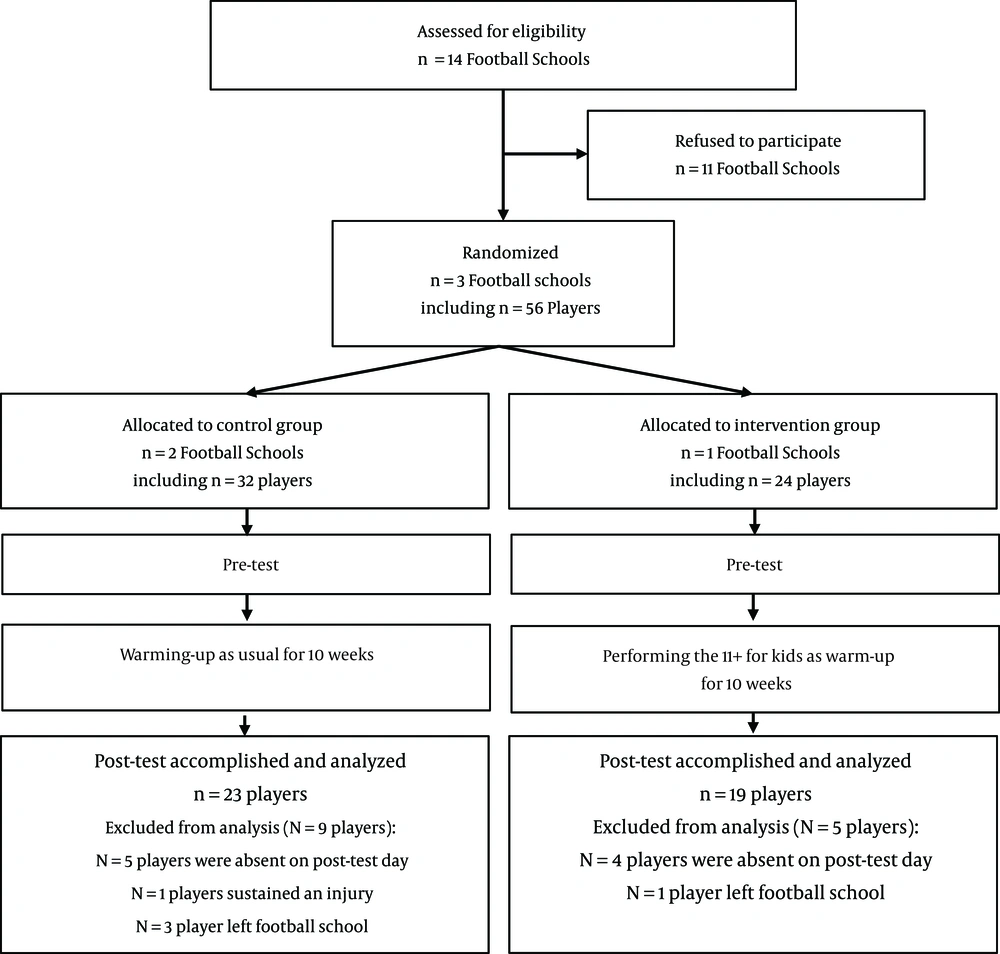
Figure 1.
Flow of study participants
4. Discussion
FIFA 11+ injury prevention program for kids mainly focuses on improving the coordination and balance, strengthening the leg muscles, the core and optimizing the landing techniques, so it was presumably expected to have positive effects on the quantities which it emphasizes. As observed in this study, our results revealed that the intervention group performed significantly better than the control group on the Y balance, the triple hop, and the 40-yard speed tests.
Regarding the positive effect of the FIFA 11+ injury prevention program for kids on Y balance test, Padua et al. (2009) (28), DiStefano et al. (2010) (29), Bizzini et al. (2013) (13) got similar results on the dynamic balance of soccer players. The existence of balance drills, especially on one foot, such as number 2 and 3 exercises is the most probable reason for the success of “the 11+ kids” exercises in enhancing the dynamic balance of the adolescent players (29). Balance exercises lead to the enhancement of the neurological adaptation and inhibitory irritability of spinal reflexes such as stretching reflex and enhancement of co-contraction pattern in the agonist and antagonist muscles (30) which in turn end up with improved balance.
The FIFA 11+ Injury Prevention Program for Kids also made a significant improvement in the triple hop test. Kilding et al. (2008) also showed that 6 weeks of 11+ exercises for the above 14 years players can improve the performance of the triple hop test (31). These results could be ascribed to the hop drills in “the 11+ Kids” program (exercise 1, 2, and 3) and also the correct maintaining of knee and ankle positions; but Steffen et al. (2013) could not show the same outcome in triple hop test in 13 - 18 female players (12) which could be due to the differences in age, gender and time in contrast to the present study.
For the positive influence of the 11+ Kids on the 40-yard speed running, Kilding et al. (2008) also have indicated the significant effect of 11+ exercises on the speed of soccer players. Bizzini et al. (2013) and Impellizzeri et al. (2013) have shown the significant influence of the FIFA 11+ program; but Daneshjoo et al. (2013), Zareei et al. (2016) (15), Steffen et al. (2008) (12), Lindblom et al. (2011) (32) have reported contrary results. This disagreement might be owing to the difference in the skill level of the players, in which, Daneshjoo et al. (2013), Zareei et al. (2016) and Lindblom et al. (2011) tested the professional soccer players while the other two studies tested the amateur soccer players. In this respect, it can be declared that since the professional soccer players have highly developed physical characteristics and limited capacity left to improve, they accomplished little changes. On the other hand, the physical characteristics of the amateur players have not grown enough so that the appropriate exercise programs can develop those characteristics (14). Contrary to professional soccer players, kids have larger potential for progress; as a result, they could have benefited from the protocol in this study as shown.
According to the results, no significant difference was seen between the groups for the Illinois agility, 20 yard speed time, dribbling time, flexibility, plank, side plank and long jump tests.
In line with the results of this study, Daneshjoo et al. (2013) (14) and Zareei et al. (2016) also stated that “the 11+” exercises could not significantly affect players’ dribbling speed (15). Steffen et al. (2013) also showed that “the 11+” exercises were not able to improve dribbling (12). Since “the 11+ Kids” do not concentrate on the enhancement of required soccer skills, therefore it is not expected to influence the players’ dribbling skill.
Also, concerning emerged results for Illinois agility test, Zareei et al. (2016) and Impellizzeri et al. (2013) reported the same. Agility is a complex ability and depends on neuromuscular coordination, the articulation system, dynamic balance, power, stability and the speed (17); therefore, improving agility is complex and requires specific practices. Since the exercises of “11+ Kids” are carried out with slow speed and a few changes in directions, thus it is not anticipated that the components of “11+ Kids” could significantly improve the agility.
Flexibility could not take advantage of “11+ Kids” in our study. Zareei et al. (2016) got the same outcomes by the 11+ program for the flexibility of adolescent players (15). The lack of stretching exercises in this program is the most liable reason for the ineffectiveness of “the 11+ Kids” in flexibility. Whereas the researchers have shown that the stretching exercises cannot be effective in preventing the incidence of injuries in soccer players (33, 34), the programmers of “the 11+ Kids” have not placed any stretching exercise in this warm-up program (15).
The results showed that using the “11+ Kids” exercises could not improve the explosive power. Steffen et al. (2008) did not report a significant difference in relation to the vertical jump among the female soccer players as well (12). In addition, Impellizzeri et al. (2013) did not observe a significant difference between the two control groups and the FIFA 11+ in relation to the vertical jump (17). But Zareei et al. (2016) reported a significant enhancement in the tests of Sargent vertical jump following one season of 11+ exercises. In the mentioned studies, the anaerobic power of the lower extremities has been measured by Sargent jump test. However, in the present study, the long jump test was used which has differences with the Sargent jump that might possibly alter the results.
The plank and side plank tests were used to measure the core stability, but no significant difference was observed between the two groups. Kilding et al. (2008) also did not show an influence on the resistance values of upper-body muscles through doing the 11+ exercises on 24 young soccer players (31); but Impellizzeri et al. (2013) stated that the 11+ exercises have a significant impact on the resistance of upper-body muscles of soccer players (17). These differences may depend on the factors such as the number of exercise sessions, gender, age and the skill level of players studied; thus, it is recommended that more studies be carried out due to the mentioned intervening factors.
4.1. Conclusion
The results of this study showed that performing 10 weeks of 11+ exercises for kids could improve the dynamic balance, triple hop distance and speed in under 14 year old soccer players, although it is not successful in enhancing the outcomes of other tests. It can be concluded that the FIFA 11+ injury prevention program for kids has components that can improve some of the physical fitness elements which are specifically covered by the content. Since the content of this protocol has been intentionally focused on related physical fitness factors to prevent sport injuries, therefore, it cannot be expected to improve all aspects of physical fitness or players’ performance; unless the content is modified accordingly. According to the findings of this study, the FIFA 11+ injury prevention program for kids can potentially influence some of the factors related to sport injuries, which can benefit players by positively manipulating documented internal risk factors in favor of preventing sport injuries.