
1. Background
Coronavirus disease 2019 (COVID-19) was first introduced in December 2019 in Wuhan, China, and rapidly spread worldwide (1). Now, the disease is in the pandemic stage based on the World Health Organization (WHO) declaration on March 11, 2020 (2). The basic reproduction number (R0) of COVID-19 has been reported to be between 2 and 3.6 during peaks (3, 4). Inhalation of droplets and touching infected surfaces are the most common COVID-19 transmission routes (5). COVID-19 prevention strategies, such as following quarantine rules and social distancing, using face masks, and washing hands regularly, are recommended (6).
The disease has also spread rapidly in Iran with an incidence rate of 4.6 per 1,000,000 (7), and all provinces are affected in this pandemic. People’s knowledge and attitude help them develop preventive behaviors.
Multiple sclerosis (MS) is a chronic autoimmune disease of the central nervous system. It commonly affects young adults and may result in severe disability over time. Patients with MS may use immunosuppressive or immunomodulatory medication that make them more prone to different infections (8).
People’s knowledge and behavior regarding COVID-19 are crucial to determine how they follow quarantine rules and obey safety behaviors and prevention strategies.
2. Objectives
We designed this study to evaluate the attitude and knowledge of Iranian patients with MS about COVID-19, as provided by physicians.
3. Methods
The Ethics Committee of the Tehran University of Medical Sciences approved this cross-sectional study in March 2020.
The inclusion criteria were confirmed MS diagnosis based on the McDonald 2017 criteria and age above 18 years.
A google form was created as a survey tool. The patients were asked to fill out the survey after obtaining their consent.
The form included questions on basic characteristics, including age, sex, MS type, and disease duration, as well as questions on COVID-19 transmission routes and prevention strategies, COVID-19 symptoms, concerns about MS-related checkups during the COVID-19 pandemic, COVID-19 infection test, and how well physicians help patients in case of COVID-19 infection.
The form was posted on Telegram and Instagram channels of the Iranian MS Society (IMSS). During the study, 4272 MS patients were the IMMS members and had access to the form.
Data was collected and analyzed using SPSS software version 22 (SPSS Inc., Chicago, IL, USA) and was presented as mean ± SD for continuous variables and as frequencies for categorical variables. The chi-square test was used for comparison between the categorical variables. A P-value of less than 0.05 was considered significant.
4. Results
Four hundred and ten filled out forms were collected. The mean age of the patients and the mean duration of their disease were 34.5 ± 8 and 7.2 ± 5.7 years, respectively. The F/M ratio was 4.06, and the most used medications were Interferons (INFs) and Rituximab (Table 1).
Table 1.
Basic Characteristics of the Patientsa
| Variables | Findings |
|---|---|
| Sex | |
| Male | 81 (19.8) |
| Female | 329 (80.2) |
| Age, y | 34.5 ± 8 |
| Disease duration, y | 7.2 ± 5.7 |
| MS type | |
| Relapsing remitting | 303 (73.9) |
| Progressive (SP, PP) | 107 (26.1) |
| Occupation | |
| Employed | 179 (43.6) |
| Unemployed | 231 (56.3) |
| Medication type | |
| Ocrelizumab | 14 (3.4) |
| Interferons (INFs) | 108 (26.3) |
| Teriflunomide | 6 (1.5) |
| Dimethyl fumarate | 32 (7.8) |
| Rituximab | 107 (26.1) |
| Fingolimod | 81 (19.8) |
| Glatiramer acetate | 21 (5.1) |
| Tysabri | 5 (1.2) |
| No current medication | 36 (8.8) |
aValues are expressed as mean ± SD or No. (%).
Only 114 (63.6%) out of the 179 employed cases were asked to work from home, while the others had to work at the office.
Nearly 80% of the participants believed that patients with MS were at a higher risk of COVID-19 infection, and 75% of them thought that wearing a face mask could prevent the infection transmission (Table 2).
Table 2
. Knowledge About COVID-19 Transmission Routes
| Yes | No | I Have No Idea | |
|---|---|---|---|
| Do you think COVID-19 can be transmitted through airborne particles? | 152 (37.1) | 160 (39) | 98 (23.9) |
| Can COVID-19 be transmitted via devices and objects? | 390 (95.1) | 8 (2) | 12 (2.9) |
| Is there a high risk of person-to-person transmission? | 403 (98.3) | 2 (0.5) | 5 (1.2) |
| Do you think patients consuming immunosuppressive or immunomodulatory drugs (such as MS patients) are at a higher risk of COVID-19 infection? | 332 (81) | 44 (10.7) | 34 (8.3) |
| Does traveling increase the risk of becoming infected with COVID-19? | 397 (96.8) | 6 (1.5) | 7 (1.7) |
| Is it enough to wash hands with soap and water to prevent the infection? (or it is necessary to use disinfectants?) | 375 (91.5) | 20 (4.9) | 15 (3.7) |
| Can wearing a face mask prevent the infection transmission? | 311 (75.9) | 65 (15.9) | 34 (8.3) |
| Do you think avoiding crowded places including public transportation can prevent COVID-19 infection? | 407 (99.3) | 2 (0.5) | 1 (0.2) |
| Is it helpful to keep suspected cases of COVID-19 in quarantine to prevent the virus spread? | 406 (99) | 1 (0.2) | 3 (0.7) |
Most of the participants were concerned about having an MRI examination or blood test during the COVID-19 pandemic, and only 19% of the patients received enough information about COVID-19 from their physicians (Table 3).
Table 3.
Concerns About MS Related Checkups During the COVID-19 Pandemic
| Not at All | A Lot | A Little | |
|---|---|---|---|
| Have you been worried about having an MS attack during this period? | 126 (30.7) | 127 (31) | 157 (38.3) |
| Have you received enough information about COVID-19 from physicians? | 78 (19) | 201 (49) | 131 (32) |
| Do you worry about having an MRI scan during the outbreak? | 76 (18.5) | 219 (53.4) | 115 (28) |
| Have you been worried about giving blood tests during the outbreak? | 85 (20.7) | 207 (50.5) | 118 (28.8) |
| Have you been worried about needing hospitalization due to MS attacks during the outbreak? | 86 (21) | 205 (50) | 119 (29) |
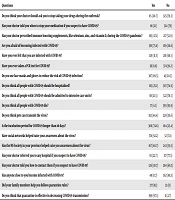
Ninety-seven percent of the patients believed that quarantine rules were beneficial, and 92% of family members helped the patients follow the rules. Nearly half of physicians prescribed immune-boosting supplements, like selenium, zinc, and vitamin D, and 73% of the patients were afraid of becoming infected with COVID-19 (Table 4).
Table 4.
Attitudes About COVID-19 Infection and Physicians’ Roles
| Questions | Yes | No |
|---|---|---|
| Do you think your doctor should ask you to stop taking your drugs during the outbreak? | 85 (20.7) | 325 (79.3) |
| Has your doctor told you when to stop your medication if you suspect to have COVID-19? | 86 (21) | 324 (79) |
| Has your doctor prescribed immune boosting supplements, like selenium, zinc, and vitamin D, during the COVID-19 pandemic? | 193 (47.1) | 217 (52.9) |
| Are you afraid of becoming infected with COVID-19? | 301 (73.4) | 109 (26.6) |
| Have you ever felt that you are infected with COVID-19? | 129 (31.5) | 281 (68.5) |
| Have you ever taken a PCR test for COVID-19? | 36 (8.8) | 374 (91.2) |
| Do you use face masks and gloves to reduce the risk of COVID-19 infection? | 367 (89.5) | 43 (10.5) |
| Do you think all people with COVID-19 should be hospitalized? | 103 (25.1) | 307 (74.9) |
| Do you think all people with COVID-19 should be admitted to intensive care units? | 88 (21.5) | 322 (78.5) |
| Do you think all people with COVID-19 die? | 17 (4.1) | 393 (95.9) |
| Do you think pets can transmit the virus? | 182 (44.4) | 228 (55.6) |
| Is the incubation period for COVID-19 longer than 10 days? | 306 (74.6) | 104 (25.4) |
| Have social networks helped raise your awareness about the virus? | 378 (92.2) | 32 (7.8) |
| Has the MS Society in your province helped raise you awareness about the virus? | 167 (40.7) | 243 (59.3) |
| Has your doctor referred you to any hospital if you suspect to have COVID-19? | 93 (22.7) | 317 (77.3) |
| Has your doctor told you how to contact them if you suspect to have COVID-19? | 126 (30.7) | 284 (69.3) |
| Has anyone close to you become infected with COVID-19? | 48 (11.7) | 362 (88.3) |
| Did your family members help you follow quarantine rules? | 377 (92) | 33 (8) |
| Do you think that quarantine is effective in decreasing COVID-19 transmission? | 399 (97.3) | 11 (2.7) |
Of the total patients, 24 (5.9%) followed quarantine rules around 10% - 30%, 84 (20.5%) around 40% - 60%, and 302 (73.7%) around 70% - 100%.
Women followed quarantine rules more than men (P < 0.001), while there was no significant difference between them regarding disease type (P = 0.2).
Most of the patients regarded fever following shortness of breath as COVID-19 symptoms and believed that they had to discontinue their medication with these symptoms (Table 5).
Table 5.
Patients’ Beliefs Regarding Symptoms Indicating the Need for Medication Discontinuation
| Values | |
|---|---|
| Fever | 204 (49.8) |
| Shortness of breath | 170 (41.5) |
| Nausea/vomiting | 14 (3.4) |
| Cough | 15 (3.7) |
| Fatigue | 1 (0.2) |
| Headache | 1 (0.2) |
| Sneezing | 5 (1.2) |
5. Discussion
In this study, we first evaluated patients’ knowledge about COVID-19 transmission routes and prevention strategies. We then examined the amount of information they received from their healthcare providers regarding the time they need to stop their medication, hospitals they can refer in case of COVID-19 infection, and support they receive from physicians in case of the infection. We also asked about their concerns regarding their disease course relapses and para-clinical evaluations during the COVID-19 pandemic.
According to the results, the enrolled patients had an acceptable level of knowledge regarding the COVID-19 transmission routes (particles, devices, and person-to-person). However, only 75% of the patients believed that wearing face masks and gloves could prevent COVID-19 infection, and 89% of them claimed that they used face masks and gloves. These findings are in accordance with Shaygannejad et al.’s findings (9). In their study, 96% of the participants believed that face masks were effective in COVID-19 prevention and 82% of them believed that social distancing was necessary. Moreover, near 40% of them told that the disease could be transmitted by animals.
In the current study, 44% of the patients believed that pets could transfer the disease, although there is no evidence for it (10). Moreover, 97% of the patients claimed that quarantine helped prevent the infection, although only 73% of them followed quarantine rules completely or almost completely. These findings showed that Iranian MS patients were aware of COVID-19 transmission routes, although some of them did not believe in preventive methods.
Only 80% of our patients believed that they had a higher risk of infection than others, showing that they did not have enough information regarding their disease nature and the effects of medications treatments on the immune system. Ignoring preventive rules may expose people to a higher risk of infection. The results also showed that our participants had good knowledge about the outcome of infected cases and COVID-19 symptoms.
These findings show that social networks play a major role in increasing general knowledge about COVID-19 infection, and patients are rely on information they receive from these media.
In the second part of our evaluation, we found that only one-fifth of physicians gave their patients enough information about COVID-19 infection, and near one-third of physicians informed their patients of how to contact them if they suspected to have the disease. Twenty percent of physicians recommended their patients to stop taking medication if they were suspected to have the infection, and nearly half of physicians prescribed immune-boosting supplements. Accordingly, physicians responsible for treating MS patients should give them more information about MS, COVID-19 infection, and how to manage their medication in different stages. Physicians’ lack of communication could be due to overcrowded offices during the COVID-19 epidemic in Iran at the time of writing the manuscript. Furthermore, the Iranian new year holiday caused physicians to have less time to talk with their patients.
As patients with MS receive immunotherapies, they require careful surveillance and should be consulted remotely to obtain comprehensive information without the need for a face-to-face visit. Bonavita et al. (11) suggested a triage tool, including 10 questions to screen patients with MS, which can be sent using google forms to decrease unnecessary referrals to hospitals.
Physicians could provide online face-to-face visits or consultation sessions to screen suspected cases. In this way, they can keep MS patients away from medical centers during the COVID-19 pandemic and decrease the risk of infection (11). Physicians could also monitor their patients to ensure that patients use their medication regularly and see if patients need to discontinue their medication or refer to medical centers.
We also found that more than half of the patients were worried about MS-related attacks during the COVID-19 pandemic and that near 80% of them were worried about undergoing MRI evaluation or blood tests or the need for hospitalization. Their concerns regarding these issues appear to be sensible as hospitalization or referral to a laboratory or imaging center predisposes them to a higher risk of infection. As MS patients receive immunosuppressive medication, they become prone to infections and may develop severe symptoms. If patients use digital monitoring, they can tell their physicians whether they had an any attack. Digital monitoring can also help patients decide if hospitalization is needed or they can postpone para-clinical evaluations to prevent patients’ unnecessary referrals to medical centers and reduce the burden for healthcare providers during the COVID-19 pandemic.
The results also revealed that women followed quarantine rules significantly better than men, showing that women care more about their health, although men need to spend more time outside because of their jobs.
Strict preventive methods, including quarantine, are recommended for COVID-19 prevention. During the spread of communicable diseases, quarantine should be considered, as it was used to control SARS in 2003 and influenza (12). Individuals receiving immunosuppressive medications, such as MS patients, should follow the rules more closely, and family members must provide these patients’ needs to prevent them from leaving the house.
During the current COVID-19 pandemic, all individuals should follow quarantine rules to avoid imposing costs to both patients and the health system. Thus, informing special cases such as MS patients about COVID-19 is crucial, and physicians play a major role in this regard.
This study had some strengths. First, it was the first study on MS patients. Second, the sample size was acceptable. Third, patients from all provinces of Iran were enrolled. Limitations include responder bias, the lack of a comparator group (either healthy individuals or individuals with other chronic autoimmune diseases), and the study’s cross-sectional nature.
5.1. Conclusions
The results showed that Iranian MS patients had good knowledge regarding COVID-19 prevention strategies and transmission routes, while they received less information from their physicians regarding medication termination, referral centers, and physician support in case of COVID-19 suspicion.