


1. Background
The desert and semi-desert climates of Iran are very suitable for various animals, including snakes, scorpions, and other venomous arthropods (1). Among the venomous animals in Iran, scorpions are more significant in terms of spread and frequency of stings. Many people are affected in Iran every year, and in some cases, this leads to death. Scorpion stings cause various blood and nerve complications in the victims.
Wasps and bees are venomous insects in Iran, belonging to the order Hymenoptera (2, 3). They are more prevalent in the warm and temperate regions of the world. Their stings can lead to local to systemic problems, such as swelling, respiratory and renal conditions, low blood pressure, and occasionally death. They cause more severe complications in susceptible individuals (4-7). The death rate in some countries, such as the United States, was 28.2% of all deaths from insect stings from 1802 to 1997 (8).
Four families of Hymenoptera, including Vespidae, Apidae, Mutillidae, and Formicidae, are capable of stinging and defending their habitat. Stings are followed by two types of symptoms: Local and systemic (9, 10). The venomous members of the Mutillidae family are not invasive, and stinging is their form of defense. Velvet ants play a vital role in the ecosystem as parasites, primarily targeting the larvae and pupae of wasps and other terrestrial insects. This parasitic behavior helps regulate the populations of these insects and contributes to the overall health and balance of the ecosystem. Male velvet ants, which are capable of flight, can feed on the nectar of flowers and play a role in pollination.
Stings from these arthropods are painful, but death from a sting has not yet been reported. These parasitoid ants target the immature stages of insects, such as other Hymenoptera (11, 12). Sensitive individuals may show allergic reactions to the sting. Velvet ants can cause very painful stings. There is more than just severe pain and the possibility of allergic reactions for sensitive people. Their sting is strong and can cause a significant reaction. Those who are allergic to insect stings should take extra precautions. Velvet ant stings can be more dangerous for children under school age. The sting may also have more complications for older people or those with underlying medical conditions. Velvet ant stings cause severe, immediate pain, followed by redness, swelling, and prolonged intense itching at the site of the sting. Although there are no reports of deaths from velvet ant stings, the sting can cause a local reaction or, in some cases, a systemic reaction that may last for several days, and some people experience long-term sensitivity. Some people might also experience a hot feeling around the sting. Treatment of the sting is similar to other insect stings. Stinging is generally done only for defense (13, 14).
Mutillids are not a real threat to humans, animals, or domestic animals. The LD50 venom of velvet ants in mice is 71 mg/kg body weight, which is relatively non-toxic compared to the Pogonomyrmex ant, which is equivalent to 0.12 mg/kg, and for some honey bees, 2.8 mg/kg (15, 16).
The Mutillidae family consists of 230 genera and an estimated 8,000 species with worldwide distribution (17-19). Some references show evidence of an estimated 6,000 species (20). It is known that 67 species of velvet ants in 21 genera have been identified from different provinces of Iran (21, 22). More recent studies have confirmed the existence of 92 species in 25 genera in Iran (19). Fear of animals, including insects and arthropods, due to their venom is always significant (1). Although the exoskeleton of velvet ants is hard, some predators, such as toads, lizards, and birds, are considered predators of these insects.
2. Objectives
Velvet ants have recently garnered attention due to reports of their stings from health authorities in Kashan city, Iran. Considering the importance of the issue, identifying the sting agent and their habitat was our objective.
3. Methods
The study is descriptive and cross-sectional, exploratory, and conducted in both the field and laboratory. This research was conducted based on complaints of stings from certain parts of Kashan city to identify stings in infected areas. The visits started in the spring and summer of 2010, and in the following years, complaints from people about stings increased. Sampling of velvet ants was done at sunset and in the early hours of the night. In total, sampling from 28 locations, including contaminated residential houses in Kashan city, was carried out.
Velvet ants were caught by turning on lights in the courtyards of houses, on the walls of residential buildings, inside rooms, in the seams of mosaics, and under carpets. Samples were collected into containers, which were labeled with a basic number and information, including the date and place of collection. The samples were stored in 70% ethanol and sent abroad, and then mounted for morphological diagnosis. The diagnostic parameters for velvet ants of the genus Dentilla involve a combination of morphological and color characteristics.
Key features include body length, color patterns, and specific structural details of the head, mesosoma (thorax), and metasoma (abdomen). The lower subbasal lobe of the mandible is scarcely invaginated below, with the height of the subbasal tooth being less than the smallest distance between the notch and the upper carina of the mandible. The size of males varies from 7.2 to 9.9 mm. The mesosoma is dorsally covered with reticulate punctures; the Scutellar Scale is smaller (less visible), without distinct tubercles around the Scutellar Scale. The size of females varies from 6.4 to 7.2 mm.
Velvet ants, despite their name, are not true ants. They are a type of solitary wasp that is easily distinguished from ants by their lack of geniculate antennae and the absence of the petiole node between the thorax and abdomen that all ants have. The mesothorax segments are fused together. They exhibit sexual dimorphism. A major diagnostic feature is the extreme sexual dimorphism. Females are wingless and resemble large, hairy ants, while males have wings and are more bee-like in appearance.
Samples transported to the entomology laboratory of Kashan University of Medical Sciences were identified by considering the morphological parameters and using a stereomicroscope after confirming the original identity as a velvet ant and belonging to the Mutillidae family. To identify the genus and its species, the samples were sent to the laboratory of the Department of Plant Protection of Qazvin Agricultural Research and Education Center. At that center, a photo of the valuable specimen was used in the identification of the species and sent to Russia for Professor Arkady Lelej. Additionally, the number of velvet ants in their area of sexual dimorphism was presented with descriptive photographs and tables.
4. Results
The results of the study showed that the sting agent in the region was the velvet ant of the Dentilla genus, reported for the first time as a new species in Iran. Professor Arkady Lelej of Russia's Federative State confirmed the specimens as a new species of Dentilla velvet ants in Iran. Finally, in 2025, this velvet ant causing stings in Kashan was identified as Dentilla dehghanii sp. nov. (23). Figure 1 shows the study area and the identification of the new species D. dehghanii sp. nov. in Iran. In 2025, Professor Lelej revised other species of the velvet ant genus Dentilla, which included changes such as moving the species D. weidneri to the genus Smicromyrme. Based on this study, the number of species in the genus Dentilla increased to 7, which have been reported mostly in the southern half and with a higher species density in southeastern Iran (Figure 2).
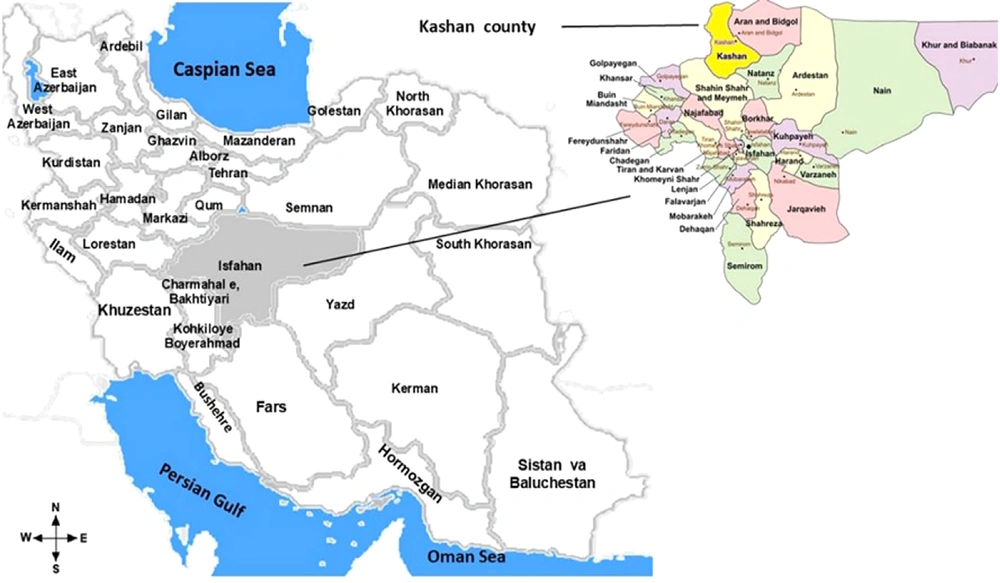
Figure 1.
Study area and identification of a new species of Dentilla dehghanii sp. nov., in Iran (photo prepared by Dehghani and Kassiri)
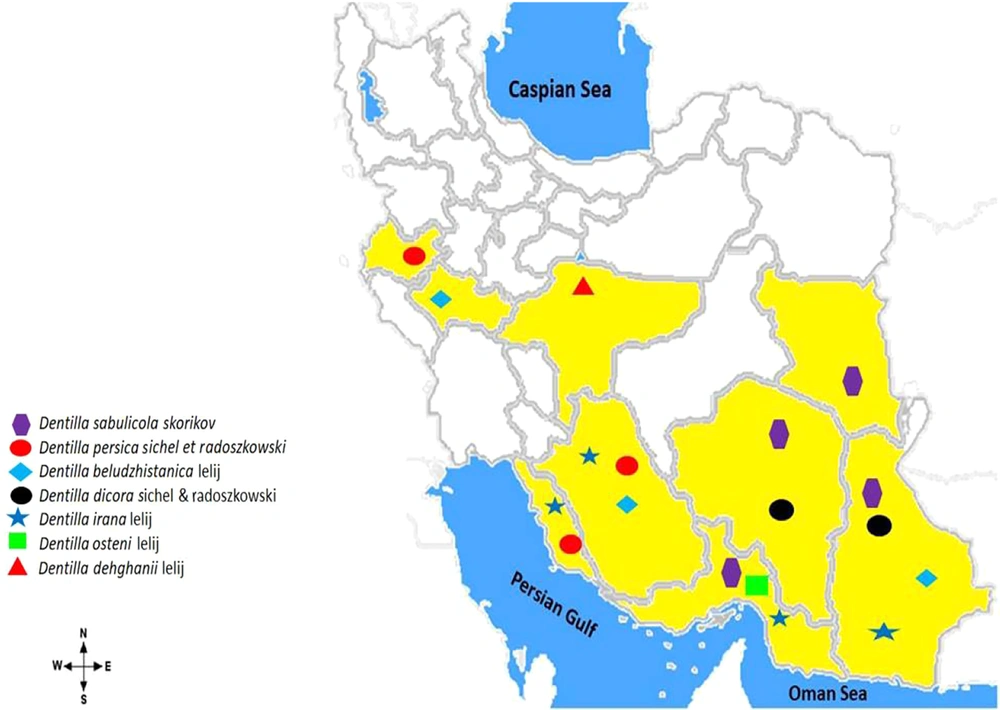
Figure 2.
Provincial distribution of species of the genus Dentilla in Iran (photo prepared by Dehghani and Kassiri)
From the total number of 248 collected samples, 84% were detected as female. These ants are active in the spring and summer seasons and disappear during the cold months of autumn and winter. The results of the study showed that from 2011 to 2014, each year, the number of residential areas contaminated with this species increased, as given in Table 1. The morphological features of the specimen included a large stinger and abdomen, and yellowish hair, which gave a beautiful appearance to the velvet ant (Figure 3). Females are 6.4 to 7.2 mm long. The head is pale red, round, and equal in width to the pronotum. Males are 7.2 to 9.9 mm long, with head width equal to mesosoma width (Figure 4).
Table 1.Distribution of Infected Living Houses, Number of Stingy People, Number of Male and Female Velvet Ants, and the Appearance and Disappearance Months in Kashan
| Year | Infected Houses | Stung People | Total Collected Velvet Ant | Wingless | Winged | Month of Appearance | Month of Disappearance |
|---|---|---|---|---|---|---|---|
| 2011 | 2 | 5 | 10 | 10 | - | June | September |
| 2012 | 6 | 12 | 15 | 15 | - | May | October |
| 2013 | 8 | 13 | 40 | 34 | 6 | June | September |
| 2014 | 12 | 19 | 183 | 150 | 33 | May | September |
| Total | 28 | 49 | 248 | 209 | 39 | - | - |
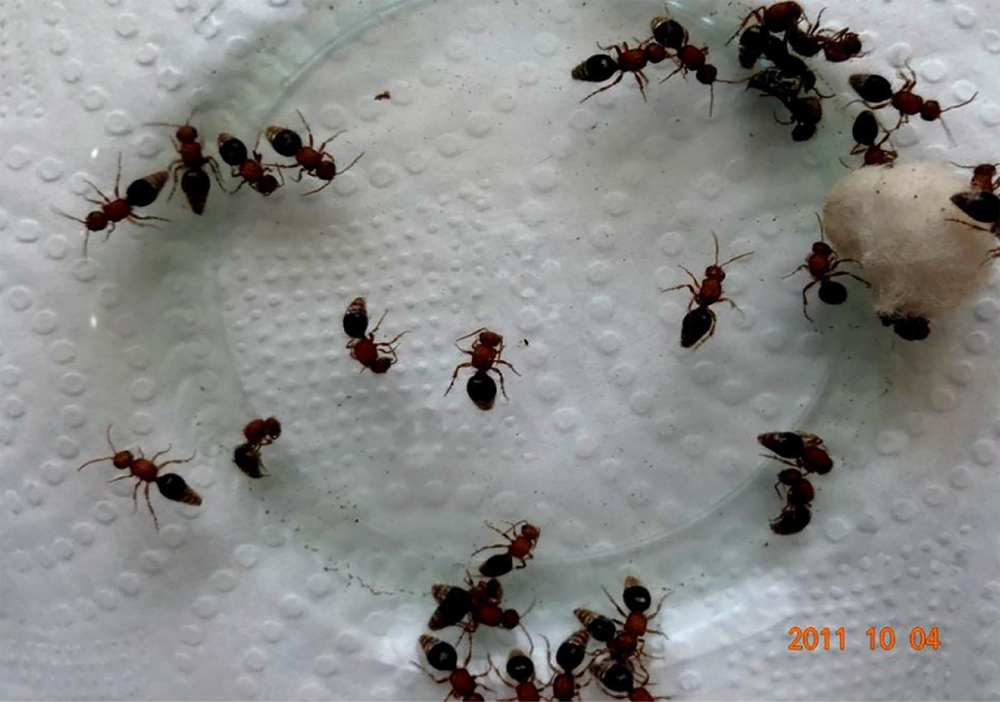
Figure 3.
It shows 30 live females of Dentilla dehghanii sp. nov., (photo prepared by Dehghani and Kassiri).
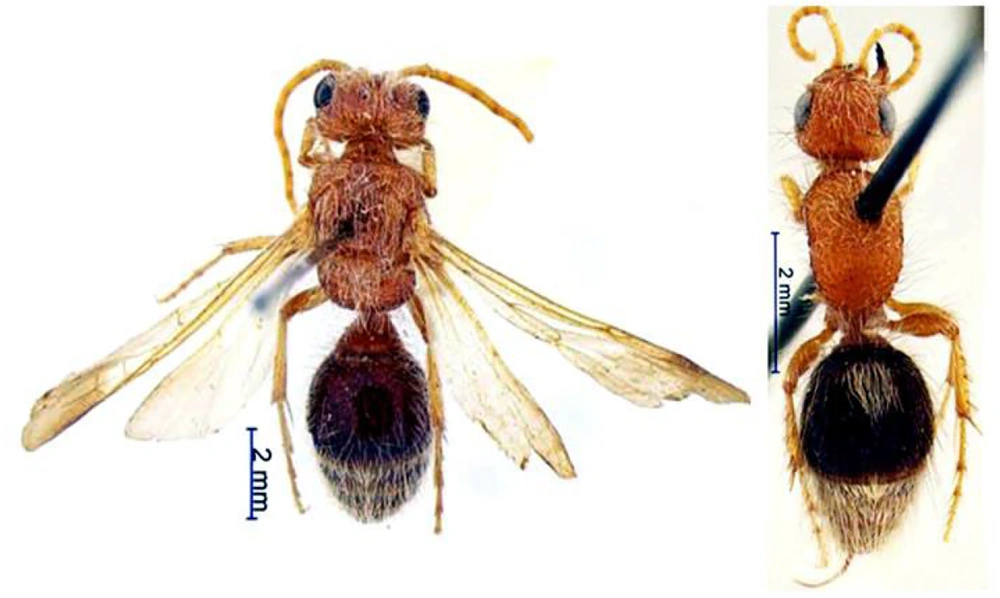
Figure 4.
Female (right) and male (left) of Dentilla dehghanii sp. nov., (photos prepared by Lelej 2025)
This sting caused severe pain, itching, and redness of the skin that persisted for about a week in the victims. The stung individuals complained of severe pain, especially in the first 8 hours at the sting site. Pain and itching in the stomach were sometimes mild, lasting for 3 - 4 months. Occasionally, stings have occurred from under the bed sheet or on trousers. The bedrooms were sprayed with pesticide due to the frequency of velvet ants (Figure 5).
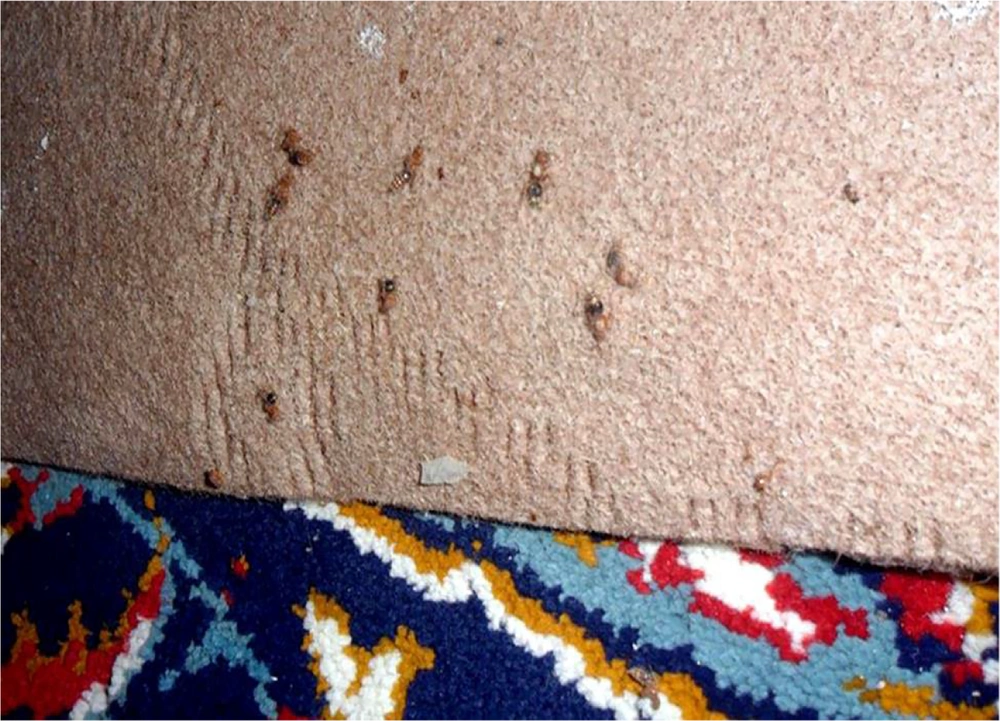
Figure 5.
Dead velvet ants of the new species of Dentilla dehghanii sp. nov., after the use of pesticides in the reception and sleeping rooms in Kashan-Iran
5. Discussion
It was found that the sting agent in Kashan County is a new species of velvet ant in the genus Dentilla, reported for the first time as a new species in Iran. Up to now, only 6 species of Dentilla have been reported in Iran. With this addition, the number will reach 7. Based on reports, 92 species of velvet ants in 25 genera have been identified from different provinces of Iran (19). Therefore, in total, taking into account this new species, the number of velvet ant species in Iran is 93.
Velvet ants, like many insects, are ectothermic, or cold-blooded, meaning they rely on external sources of heat to regulate their body temperature. The higher temperatures in the summer months provide optimal conditions for their activity and reproduction. They are seen in Kashan from mid-spring to late summer. The summer months, especially summer, coincide with the velvet ant mating season. Velvet ants are parasitic, meaning they lay their eggs on other insects that nest in the ground. The abundance of these hosts during the summer months likely contributes to the higher velvet ant population.
People who work or live in areas frequented by velvet ants, those who live in old houses made of mud and bricks, and people who work in gardening or carpet weaving are more likely to encounter these insects. Children are also more vulnerable to stings due to their curiosity and desire to explore (3).
The D. dehghanii sp. nov., a velvet ant, was active in residential areas of Kashan city during the spring and summer seasons but disappeared during the cold months of autumn and winter. It seems that the warm weather of the spring and summer seasons causes them to enter any crack or hole throughout the day to ensure survival in this dry climate and provide suitable shelter. This behavior is similar to that of other arthropods, including scorpions, and even reptiles. The old structures of Kashan and parts of Ravand are built with local building materials such as clay and mud. Due to the use of raw materials like clay, these houses are resistant to the extreme heat and cold of the desert and provide pleasant and cool spaces in the heart of Kashan's hot summers (1, 3).
The sting caused severe pain, itching, and skin redness that persisted for up to a week in victims. Velvet ants have large stingers, so the victim suffers severe and continuous pain. They are known as cow killers. The affected individuals complained of extreme pain, especially during the first 8 hours after the sting. Mild pain and itching sometimes persisted for 3 - 4 months. It seems that the ant venom remains in the body for a long time and is especially problematic in sensitive individuals (11, 12, 24).
Velvet ant venom consists of enzymes, small peptides, and amines. Allergens include phospholipases, hyaluronidases, and cholinesterases. Some peptides cause the release of histamine through the degranulation of mast cells. Histamine, serotonin, and acetylcholine are involved in the pain of velvet ant stings (25). Therefore, toxicological studies are recommended for this species.
Occasionally, stings occur in underwear or on trousers and at home. Due to the frequency and stings of velvet ants, sanitation with pesticides was conducted inside the bedrooms. According to local people, sanitation was done at different times with various pesticides, but after a while, stings increased, indicating resistance. The sting of these arthropods can incapacitate the injured, preventing them from performing ordinary and everyday activities. The presence of these insects among military forces is also significant (26, 27).
People are more likely to be stung by velvet ants when walking barefoot in infested areas or when they are careless. The severity of the pain and reaction to the sting will vary depending on the sensitivity of the person being stung; however, the sting is usually much more painful than a wasp sting. Velvet ant stings should be cleaned and disinfected like a wasp sting. An ice pack and painkillers should be used if necessary. Since velvet ants are usually solitary and not social, it is unlikely that a person will be stung multiple times. As with any stinging insect, if a victim develops a generalized rash, difficulty breathing, or signs of an allergic reaction, they should seek medical attention immediately.
5.1. Conclusions
Velvet ants are one of the causes of stings in human habitats. Houses made of traditional and old materials provide the conditions for their habitat and reproduction. Therefore, to prevent stings and possible risks, it is recommended to: Accurately identify velvet ants' habitats, observe workplace and living hygiene, improve and renovate the workplace and living environment, fill and cover cracks, openings, and holes in these places, install fine-mesh screens for windows, inspect shoes and clothes before wearing, and avoid walking barefoot. In view of the further spread of these arthropods in residential areas, training in personal and home protection, knowledge of the life cycle of these insects, proper sting prevention, and the improvement of residential environments are recommended.
5.2. Limitations
One of the limitations of this study was the slow speed of sending samples to reference laboratories. Therefore, it took a very long time from observation to diagnosis and identification. The strong points of our study were that, for the first time, a new species of venomous arthropod with a sting and its complications was introduced and reported in Iran. The highlights of our study were that, for the first time, workplaces and residential areas in central Iran have been identified as suitable habitats for velvet ants. A rare regional outbreak of velvet ants was reported. The author of the species is Professor Arkady Lelej, and D. dehghanii belongs to the Mutillidae family and was identified in early 2025.




