
1. Background
Participating in regular physical activity is an important component of a healthy lifestyle and improving quality of life. Physical activity has been shown to not only prevent the onset of cardiovascular disease (CVD) but to also effectively reduce the risk and burden of CVD (1, 2). It has also been well-established that aerobic training is an important component of a comprehensive training program aimed at reducing body weight (3).
Research regarding physical activity levels among college students has generally indicated low levels of physical activity (1). This is disconcerting since there appears to be a trend that this sedentary behavior might be carried forward into adulthood (4).
Living a physically inactive lifestyle has certain health consequences such as an increased risk of obesity. Obesity is closely associated with a number of diseases such as type 2 diabetes, CVD, and cancer (5, 6). Statements have been made identifying a problematic increase in overweightness/obesity within South Africa (7). South Africa is characterized by a predominantly black population, and obesity is more prevalent in black South African women than men (8), while obese black South African females also tend to underestimate their body size (9). Further, individuals following a sedentary lifestyle are at increased risk of being affected by diseases that are related to a high body fat percentage (10, 11). College students who are physically inactive may be prone to the accumulation of unwanted body fat (1). This is exacerbated by the transition from high school to college since this is a critical period related to the development of inactivity and obesity (12, 13). Rural South African students have previously expressed that participation in physical activity is made more difficult due to safety issues and lack of infrastructure (14). Further, when South African female students attempt weight loss, they generally prefer the use of unhealthy nutritional supplements and not physical activity (15).
Over the years, exercise programs used for reducing the risk factors associated with obesity and CVD have focused on aerobic types of exercise, complemented by resistance training, while high intensity interval training has gained popularity (16, 17). The American Council of Sports Medicine (ACSM) supports moderate intensity physical activity of between 150 and 250 minutes per week to prevent weight gain and > 250 minutes per week for clinically significant weight loss (18). Further, there is a dose-response relationship between physical activity and the prevention of weight gain, which is most apparent when moderate-to-vigorous intensity physical activity (≥ 3 METs) is above 150 minutes per week (19). In light of these recommendations, there is currently no research literature that compares the attitudes and adherence to low, moderate, or high-intensity exercise programs in sedentary black African females. Thus it is challenging to determine which would be the most suitable way to structure an exercise program for sedentary black females who want to start exercising. Some results propose that although high-intensity interval training protocols are time efficient, they are not more effective than aerobic exercise training in improving the aerobic and anaerobic performance of sedentary young adults over an eight-week period (20). It might be more safe and enjoyable for sedentary females to use aerobic means of exercise to start a new exercise routine, however comparing enjoyment between high-intensity interval training and conventional aerobic training is problematic due to various deviations from original protocols and performing acute measurements only (20, 21).
In this regard, it is evident that increased body fat and decreased physical activity might be present in rural college students, which could predispose them to CVD. Exercise could prevent and reduce this burden of disease by focusing on improving body composition (especially waist circumference and body fat percentage), and cardiorespiratory fitness since these are recommended as the main targets of physical activity programs aimed at preventing cardiometabolic diseases in college students (22). However, it is essential to first establish the most appropriate and feasible mode, exercise duration, intensity, and frequency to elicit these changes in rural black South African students.
2. Objectives
This study sought to compare the differences in body fat percentage, waist-to-hip ratio (WHR), and cardiorespiratory endurance following six weeks of combined resistance and aerobic training when compared to a non-exercising control group of sedentary rural black college women. Thus, the primary aim of the study was to examine if a concurrent resistance and aerobic training program could elicit body composition and cardiorespiratory changes in rural black college women.
3. Methods
3.1. Participants
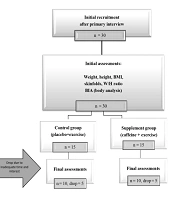
The present study employed a small scale proof-of-concept investigation pretest-posttest design with an experimental group and one control group using an intention-to-treat (ITT) analysis. Participants were black female students residing at the University of Zululand, South Africa. Participants were recruited by placing posters in areas where they reside, stating the inclusion criteria. The university is classified as a rural university by the South African Council of Higher Education (23, 24). Ethical clearance was obtained from the University of Zululand (UZREC 171110-030 PGH 2017/34) before the commencement of the research. Data gathering and obtaining of consent strictly adhered to the Declaration of Helsinki and followed ethical principles for medical research involving human subjects to prevent harm to participants. All data was stored in accordance with South Africa’s Protection of Personal Information (PoPI) act, and participants remained anonymous. Participants were not motivated to participate by financial or other incentives, apart from being informed on the outcomes and results of the study after data gathering was completed. Those participants who met the inclusion criteria; black females, 18 - 25 years of age, sedentary for a period of at least three months before the start of the intervention, and residing at the rural university, were enlisted as possible participants and were screened for contra-indications to exercise or exercise testing (25). Participants were randomly assigned to a combined resistance and aerobic training group (COM) (n = 20) or control group (n = 20). Of the original 28 participants, four participants in the experimental group did not adhere to the exercise program, and four participants from the control group did not complete their post-test evaluations. This study was a single-blind study with experimental and control groups being blinded and not aware of each other’s participation.
3.2. Procedures
Baseline testing was done after receiving informed consent. The following measurements were performed: Resting heart rate (25), resting blood pressure (25), waist circumference (25), hip circumference (25), body fat percentage (26), and a six-minute walk test (27).
Resting heart rate and blood pressure were measured seated after a five-minute rest with the ausculatory method, using a Welch Allen blood pressure cuff and stethoscope (Hillrom, United States of America).
Waist-to-hip ratio (WHR) as a ratio measurement of the circumference of the waist to that of the hip was calculated using a Mabis retractable tape measure (DMI Healthcare, Santa Clara, CA, United States of America): WHR = waist circumference ÷ hip circumference. Body fat percentage was taken according to the International Society for the Advancement of Kinanthropometry (ISAK) standards using a Harpenden skinfold caliper (Baty International, United Kingdom). Body fat percentage was calculated using the equation of Jackson, Pollock, and Ward (26, 28).
The six-minute walk test was performed according to the American Thoracic Society’s standardized method (27). Participants were required to walk freely on an outdoor athletics track with a grass surface for six minutes, and the total distance was measured in meters. All other measurements were taken in the indoor laboratory. The six-minute walk test was utilized due to its inexpensiveness, ease of use by participants, and its low risk of knee injury.
3.3. Intervention
The COM participants were required to train four times weekly for six weeks. Each session commenced and concluded with a five-minute cycle at 30% of heart rate reserve (HRR) (25, 29). The warm-up was followed by both aerobic and resistance training. Aerobic training consisted of 30 minutes a session (week 1 - 3: cycling for 3 minutes at 60% heart rate reserve (HRR), followed by 2 minutes at 50% HRR; week 4 - 6: 3 minutes at 70% HRR, followed by 2 minutes at 60% HRR). Resistance training consisted of participants training at 50% of their one-repetition maximum (1-RM) for week 1 - 3, doing 3 sets of 15 repetitions; for week 4 - 6 at 60% 1-RM, completing three sets of 15 repetitions with 1-RM being estimated from a 10-RM test (30). Resistance exercises included upper-body resistance exercises (barbell upright row, latissimus dorsi pulldown, seated cable row, and dumbbell bench press), abdominal exercises (side plank with leg abduction using ankle weights and sit-ups holding a dumbbell under the chin), and lower-body resistance exercises (barbell squats, dumbbell static lunges, dumbbell lateral bench step-ups, and barbell bent knee deadlifts). Recovery between sets were set at 20 seconds, and recovery between exercises at one minute. All exercise sessions were supervised by the same qualified sport scientist.
3.4. Statistical Analysis
The Statistical Package for the Social Science (SPSS) 23.0 was used for statistical analysis. Dependant and independent t-tests were used to compare changes within and between groups, and the effect size was used to determine practical significance. Statistical significance was set at P ≤ 0.05. Practical significance/d-values were set at 0.2 for a small effect, 0.5 for a medium effect, and 0.8 for a large effect (31).
4. Results
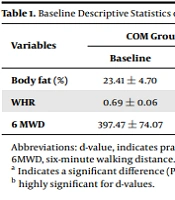
No significant (P > 0.05) differences were found between the COM and control group at baseline. After the intervention, a significant (P = 0.006) difference and large effect size (d = 0.9) was found in body fat percentage. The WHR and six-minute walking distance did not significantly change in either group. Within the experimental group, there was a significant improvement (P = 0.004) in the body fat percentage. However, no significant improvements were found in WHR and six-minute walking distance of the COM or control group (Table 1).
Table 1.
Baseline Descriptive Statistics of the Combined Resistance and Aerobic Training Group and Control Group
| Variables | COM Group (N = 20) | Control Group (N = 20) | Intergroup Findings | Intragroup Findings | ||||
|---|---|---|---|---|---|---|---|---|
| Baseline | Post-test | Baseline | Post-test | P-Value | D-Value | P-Value | D-Value | |
| Body fat (%) | 23.41 ± 4.70 | 21.73 ± 4.59 | 25.55 ± 5.76 | 26.18 ± 5.04 | 0.006a | 0.9b | 0.004a | 0.4 |
| WHR | 0.69 ± 0.06 | 0.69 ± 0.04 | 0.70 ± 0.05 | 0.71 ± 0.06 | 0.223 | 0.4 | 0.38 | 0.0 |
| 6 MWD | 397.47 ± 74.07 | 418.87 ± 102.13 | 378.95 ± 85.78 | 385.40 ± 82.12 | 0.260 | 0.36 | 0.10 | 0.2 |
Abbreviations: d-value, indicates practical significance; COM, combined resistance and aerobic training; SD, standard deviation; %, percentage; WHR, waist-to-hip ratio; 6MWD, six-minute walking distance.
a Indicates a significant difference (P ≤ 0.05) between pre- and post-test.
b highly significant for d-values.
5. Discussion
The novel finding of the present study of a decreased body fat percentage in rural black college women is critical in the development of public health programs. This is because overweightness/obesity have significant influences on the development and progression of CVD, particularly among women (32). While this finding may have been expected since research is unequivocal regarding resistance training’s unique ability to positively alter body composition in health promotion (16), this evidence is based on research focused mainly on male-only or mixed populations. This is problematic in that there is substantial heterogeneity in an individual's ability to improve body composition in response to exercise, with responses varied depending on sex, genetics, and the environment (32); hence the need for studies such as the present study, which focus not only on women but also the environment in which they exist. Comparisons between different national and international black minorities and populations are scarce. Therefore collaboration to find commonalities in environments experienced by various groups could help build successful health education and health improvement strategies, much needed on the African continent.
Further, while the body fat percentage of the control group remained above the norm for this population, the body fat percentage of the COM group decreased to within the normal range following the six-week concurrent training (33, 34). The fat loss experienced following the concurrent training is also noteworthy since it is contrary to the findings of small weight losses following exercise when they are not combined with dietary restrictions (35, 36).
The present study’s six-week concurrent training failed to elicit changes in WHR in this population of rural black college women and is contrary to the findings of Woodson et al. (37), who found a reduced WHR following their 12-week physical activity lifestyle modification. While it may seem problematic that the present study’s concurrent training failed to improve WHR in this sample of rural black college women, it must be noted that at both the baseline and final testing occasions, their WHR were already below 0.8. This finding possibly indicates a gynoid fat distribution, which is similar to other research on black South African women (33, 34).
Although the six-minute walking distances found in the present study are well-below findings in foreign populations (36), the prescribed six-week concurrent training was unable to improve this health and fitness parameter in the sampled rural black college women. Evidence suggests that females appear to gain greater benefit from low to moderate aerobic training, as utilized in this study (32). The lack of change may be related to an inadequate duration of aerobic exercise for this population. Although the observed decrease in adiposity in this study has a stronger association than fitness with certain CVD risk, such as c-reactive protein (CRP) and interleukin (IL)-6, higher levels of fitness are still essential for lowering CVD risk, especially in the presence of high levels of central adiposity as observed in this study (38).
5.1. Limitations
Since the study utilized a small scale proof-of-concept investigation pretest-posttest design using an ITT analysis, the small sample may reduce ecological validity. This study did not monitor the female participants’ menstrual cycles that could have potentially influenced variables related to body composition and cardiorespiratory endurance performance (39, 40). Further, the dietary intake of the participants was not investigated which could influence body composition variables. Adding cultural eating habits as a control variable to future exercise interventions and to research related to adherence to weight loss interventions might deepen insights. Although the data gives us an indication of the current situation within a specific population in the district of Zululand, more longitudinal research on rural groups within South Africa is needed.
5.2. Conclusions
Although body composition (especially waist circumference and body fat percentage) and cardiorespiratory fitness are recommended as the main targets of physical activity programs aimed at preventing CVD in college students (22), this study demonstrated that a six-week combined resistance and aerobic training program only improved body fat percentage, and not WHR and cardiorespiratory fitness, in sedentary rural college-aged females. As such, this program may only have a limited ability in curbing the growing obesity problem in rural-based college-aged females. Further, these findings suggest that one method of program design does not fit all populations and that exercise prescription should be targeted and not generalized.