
1. Context
Autism spectrum disorder (ASD) is a worldwide neurodevelopmental condition characterized by difficulties in social interaction and communication, as well as repetitive behaviors and limited interests (1-3). Although it does not fully align with the criteria specified in the Diagnostic and Statistical Manual of Mental Disorders, Fifth Edition (DSM-5), ASD is frequently associated with notable motor problems (4). Motor dysfunction is increasingly acknowledged as a significant aspect of ASD, occurring alongside the more commonly recognized social and communication hurdles (5). The study regarding the prevalence of motor impairments within the ASD population indicated that 51% of the participants exhibited low muscle tone (hypotonia), 34% displayed difficulties with motor planning (apraxia), 19% walked on their tiptoes, and 9% showed indications of delays in gross motor skills (6, 7).
Motor planning, commonly known as praxis, involves the capacity to envision, organize, and carry out the physical actions needed for everyday tasks (8). This skill is essential for developing motor abilities, especially in children diagnosed (9). Children with ASD frequently demonstrate challenges in motor planning, displaying more inconsistency in choosing hand movements and a reduced ability to mimic physical actions when compared to their typically developing counterparts (9, 10). These motor problems in children with ASD can emerge early in their growth, possibly even before signs of social and language challenges arise, indicating that they might serve as useful early indicators for diagnosis (11-13).
Motor skills development can be hindered by various obstacles, often involving repetitive and rigid movements, along with numerous perceptual and physical issues that impact balance, walking, and coordination (14). Studies show that children with ASD often face difficulties with motor planning, resulting in delays in both large and small muscle skills (15). These challenges may present themselves as awkwardness, a slower pace in learning new abilities, and trouble with coordination and balance, which can ultimately influence their social interactions and success in school (12). The correlation between motor planning difficulties and developmental areas is increasingly recognized (16). Recent systematic reviews also highlight a strong association between behavioral symptoms and motor development impairments in ASD (17).
Recent studies have concentrated on grasping the characteristics and degrees of movement difficulties associated with neurodevelopmental disorders, investigating their potential as early indicators and contributing factors to functioning in various areas (18). Even though there is increasing evidence of movement issues in ASD, a deeper comprehension of motor skills and effective movement-based therapies is still necessary (10) Occupational therapy has proven to be essential in improving motor planning abilities through specific activities that enhance both fine and gross muscle coordination (19). By combining playful methods with organized interventions, caregivers and therapists can establish nurturing settings that encourage the growth of crucial motor skills (20).
2. Objectives
This review aims to bring together existing research on motor planning in autism, examining its significance for diagnosis and therapy while emphasizing the necessity for a more detailed understanding of these movement abilities. By tackling the intricacies of motor planning within the framework of ASD, we can more effectively assist children in navigating these obstacles and enhancing their overall well-being.
3. Methods
3.1. Study Design
This narrative review examined the literature on motor planning, motor skills, and motor abnormalities in children with ASD. Motor challenges have consistently been recognized as a notable characteristic of ASD, occurring alongside communication difficulties, and various movement irregularities have been reported. The researchers discuss the possible consequences of these motor issues on cognitive and social development. Still, the focus on motor development within autism research has been limited, as early interventions usually prioritize core symptoms.
3.2. Search Strategy and Study Selection
This review systematically assesses the effectiveness of motor skills and abnormalities, examining recent studies on motor difficulties and skills in children with ASD. The methodology includes an extensive search of multiple databases such as PubMed, Scopus, Science Direct, and Google Scholar, utilizing keywords such as "autism", "autism spectrum disorder", "motor", "movement", "planning", "intervention", "therapy", "assessment", "evaluation", "diagnosis", and "skills". Specific inclusion criteria are set to concentrate on peer-reviewed studies published from 2000 to 2024 that focus on motor planning and skills in children with ASD. The review also organizes the selected studies by the types of interventions that were related to improvements in motor skills. Additionally, the analysis observes changes in social and communicative abilities following enhancements in motor planning and skills, revealing promising yet inconsistent outcomes across the different studies, as shown in Figure 1. PRISMA-based flowchart summarizing the number of records identified, screened, and included. These additions aim to ensure the reproducibility and transparency of our review process.
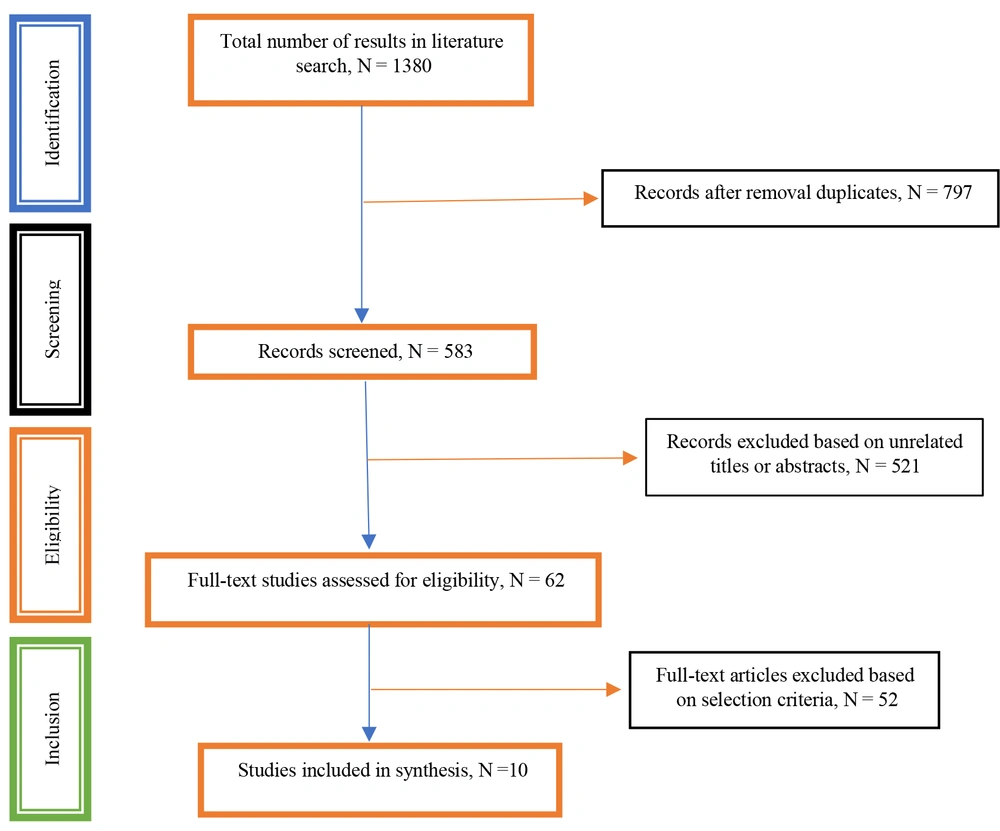
Figure 1.
The steps of the study at a glance
The authors also emphasize the importance of including motor skills training in rehabilitation programs for children with autism and encourage future research to focus on improving motor skills to enhance motor planning abilities and thereby decrease activity limitations and participation barriers. By thoroughly reviewing the existing literature and pinpointing research gaps, this review aspires to establish a framework for understanding the basic motor skills, motor planning, and motor deficits of children with ASD.
4. Results
The current study showed that motor planning in individuals with ASD is marked by distinct patterns where motor difficulties are apparent. These challenges can notably hinder their capacity to learn and perform motor skills efficiently (16). The summary of the motor planning process impacted by autism is presented in Figure 2.
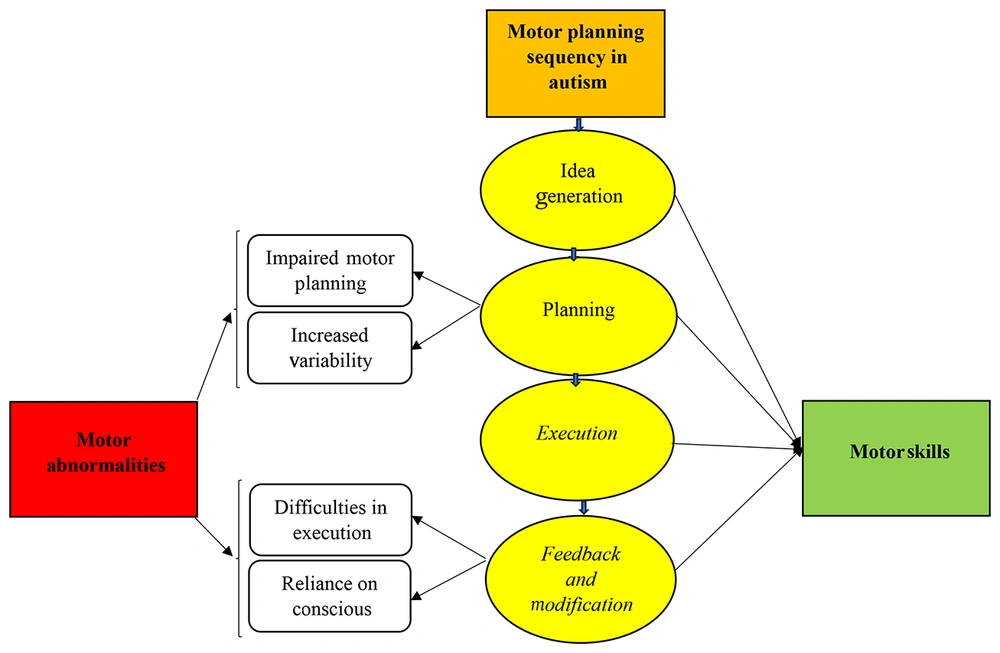
Figure 2.
Motor planning sequence in autism, motor abnormalities, and motor skills
4.1. Prevalence and Characteristics of Motor Impairments in Autism Spectrum Disorder
The current literature consistently shows that motor impairments are highly prevalent and multifaceted in children diagnosed with ASD. Prevalence estimates vary somewhat, but motor difficulties affect between 60% and 87% of individuals across diverse samples, representing a significant comorbidity often underrecognized clinically (1, 21). These impairments encompass both gross motor domains, such as walking, postural control, balance, coordination of bilateral movements, and fine motor domains, including hand dexterity, handwriting, visual-motor integration, and skilled manual tasks (21).
Gross motor deficits typically manifest as atypical gait patterns characterized by reduced speed and irregular cadence, poor postural stability, diminished balance control, and hypotonia (22). These deficits often result in delayed attainment of motor milestones, such as independent sitting, crawling, and walking, which may be further complicated by challenges in motor sequencing and planning 1. Fine motor challenges frequently involve difficulties in activities requiring precision and coordination, including catching, manipulating small objects, and tasks demanding bilateral hand coordination (17).
4.2. Early Developmental Course of Motor Dysfunction
Longitudinal and prospective studies highlight that motor dysfunction often emerges in the first year of life, preceding an ASD diagnosis (23). Infants later diagnosed demonstrate decreased spontaneous hand movements, poorer head and neck control, and delayed gross motor milestones compared to typically developing peers. By 12 to 14 months, significant delays in standing, walking, and balance are commonly reported (17). These early motor disturbances, which may be subtle at first, are potentially critical early markers for later social and communicative development (22).
4.3. Neurological and Sensory-Motor Underpinnings
Accumulating neurobiological evidence implicates altered functional and structural connectivity within cerebral networks responsible for motor control and integration (24, 25). For example, disrupted interactions between the cerebellum and parietal cortex may underlie praxis deficits, affecting the ability to plan, initiate, and regulate skilled movements such as gestures and tool use 25. Furthermore, atypical sensory processing patterns, particularly an overreliance on proprioceptive cues at the expense of visual-motor integration, have been documented, correlating with greater social impairments and modality-specific sensory atypicalities observed in ASD populations (26). Such findings suggest that motor and sensory processing anomalies contribute jointly to the atypical sensorimotor experience characteristic of ASD (27).
4.4. Correlations Between Motor and Communication Domains
Robust and statistically meaningful correlations have been established linking motor function and communication abilities:
Gross motor skills and expressive language: Moderate correlations (usually ranging from r = 0.40 to 0.60) indicate that more proficient gross motor abilities, particularly postural control and balance, are strongly associated with improved expressive language capacity (27-30). This suggests a shared or interactive developmental pathway, potentially mediated by overlapping neural substrates such as the cerebellum and basal ganglia (1, 31).
Fine motor skills and receptive language: Moderate correlations (r = 0.35 to 0.56) between fine motor coordination and receptive language skills have been reported, reflecting the role of motor precision and visual-motor integration in supporting language comprehension processes (17).
Motor planning and pragmatic/social communication: Difficulties in praxis are closely tied to pragmatic language deficits and social communicative challenges, emphasizing the possibility of shared motor-linguistic neural networks impacting social use of language (1, 17).
Predictive value of early motor milestones: Prospective studies consistently show that early motor development before (24) months predicts later language outcomes, independent of cognitive abilities (1). These findings underscore the critical need for early motor screening in developmental monitoring protocols (31).
4.5. Intervention Outcomes and Moderators of Effectiveness
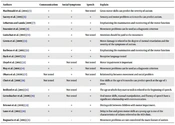
Clinical and research evidence indicates that motor-based interventions can beneficially influence both motor proficiency and communication outcomes in ASD, though effects vary based on multiple factors, including intervention type, duration, and intensity (17). Programs that target sensorimotor integration, motor planning, and praxis tend to yield more robust improvements in language and social communication than nonspecific physical activity or gross motor training alone (17, 31). Interventions of longer duration (≥ 12 weeks) and higher intensity (multiple sessions per week) correlate with significantly larger gains in both motor and communicative domains, highlighting the importance of sufficient dosage (17, 30). The studies summarized are presented in Table 1.
Table 1.
Summary of Studies on Motor-Communication Associations and Intervention Outcomes in Children with Autism Spectrum Disorder
| Study (Author, y) | Population, (n, y) | Motor Domain (s) | Communication Subdomain (s) | Association (Effect Size) a | Intervention (if any) |
|---|---|---|---|---|---|
| Bhat, 2021 (25) | 83, 4 - 8, ASD | Praxis, Postural control, Balance | Expressive, Receptive | r = 0.47 (expressive), r = 0.38 (receptive) | None |
| Simarro Gonzalez et al., 2024 (26) | 97, 3 - 12, ASD | Fine motor, Pencil, Visual-motor | Expressive, Receptive | r = 0.42 - 0.56 | None |
| Rosales et al., 2025 (27) | 636, 4 - 12, ASD (meta - analysis) | Multiple (gross, fine, balance) | Social, Language composite | g = 0.47 (combined effect, P < 0.01) | Motor interventions |
| Hwang and Lee, 2024 (28) | 120, 2 - 7, ASD | Early motor skills (6 - 24 mo) | Language development | r = 0.39 - 0.58 | None |
| Hashemi et al., 2024 (29) | 58, 6 - 10, ASD | Balance, Coordination | Pragmatic social skills | r = 0.31 | Balance exercise program |
| Wilson et al., 2018 (30) | 102, 5 - 9, ASD | Postural control, Fine motor | Receptive, Expressive | r = 0.44 (receptive), r = 0.50 (expressive) | Motor play activities |
| Fears et al., 2024 (31) | 354 (multi - study) | Combined (gross, fine, praxis) | Overall language and social | 12+ weeks: g = 0.58, < 12 weeks: g = 0.32 | Varied intervention |
| Shiri et al., 2024 (17) | 112 (systematic review) | General motor function, Coordination, Fine motor | Behavioral symptoms (repetitive, social) | Qualitative synthesis: Strong link between motor and behavioral severity | Systematic review (no intervention) |
| Kardaani and Ebrahimpur, 2024 (32) | 60, 5 - 8, ASD | Visual-motor coordination, Imitation | Visual-spatial and perceptual processing | η² = 0.41 (motion imagery vs. control) | Motion imagery intervention |
| Zamani et al., 2025 (33) | 46, 6 - 9, ASD | Motor sequence learning, Fine motor | Task retention, Learning rate | d = 0.54 (internal focus advantage) | Attentional focus-based motor training |
Abbreviation: ASD, autism spectrum disorder.
a Effect sizes (r, g, η², d) indicate the strength of association or intervention impact.
5. Discussion
Recent findings from this review highlight that motor impairments in ASD are not merely peripheral symptoms but are deeply integrated into the neurodevelopmental trajectory of the disorder. The reviewed literature consistently demonstrates that difficulties in motor planning and execution, particularly in sequencing, timing, balance, and coordination, emerge early and may precede the onset of social and communication difficulties (5). These findings strengthen the conceptualization of motor dysfunction as a core and early-developing component of ASD rather than a secondary manifestation. Such evidence reinforces the idea that motor abnormalities can act as reliable early biomarkers for ASD detection and intervention, providing a potential pathway for preclinical screening and preventive therapeutic approaches (23).
Moreover, increasing research attention has been devoted to the objective quantification of these motor characteristics using advanced technological methods (32). Several studies included in this review have employed systems such as three-dimensional motion capture, inertial measurement units (IMUs), and wearable accelerometer-based sensors to examine micro-level kinematic patterns (32, 33). These tools have enabled precise detection of gait asymmetry, postural instability, atypical hand trajectories, and increased variability in joint movement among children with ASD (34). Importantly, such technologies overcome the limitations of subjective observation by providing continuous, high-resolution data that reveal subtle motor irregularities not visible to the naked eye (1, 34). Complementing these biomechanical methods, EEG-based motor decoding and computational modeling have shed light on atypical neural activity associated with motor preparation, sensory feedback integration, and movement execution (1, 34). Together, these approaches bridge behavioral and neurophysiological evidence, demonstrating that motor planning deficits in ASD reflect both functional network disorganization and sensorimotor integration anomalies (17).
Parallel to technological advancements, longitudinal and long-term monitoring studies have provided valuable insight into the predictive value of early motor behavior for later developmental outcomes (17). For example, the SPARK cohort study revealed that approximately 88% of children with ASD exhibit measurable motor dysfunction, underscoring the necessity of including motor evaluation in early diagnostic assessments (33). Likewise, comprehensive reviews of early behavioral markers 5 indicate that deviations in gross and fine motor milestones, often observable within the first 12 to 18 months, are significant predictors of subsequent ASD diagnosis (17). These longitudinal observations demonstrate that the developmental cascade from motor deficits to communication and social difficulties may begin much earlier than previously assumed (1). Therefore, continuous digital monitoring, using wearable motion sensors or home-based camera tracking systems, represents a promising avenue for early detection and risk stratification of ASD in infants (34).
By integrating findings from both technological and longitudinal research, the present review identifies a critical gap in the literature: While the qualitative descriptions of motor difficulties in ASD are well-established, the systematic integration of technology-based assessment with developmental follow-up remains scarce (17, 33). Future research should thus adopt multimodal frameworks that combine kinematic, electrophysiological, and behavioral data across different developmental stages (32). Such approaches will enable researchers to capture the dynamic evolution of motor skills over time, establish normative growth trajectories, and detect atypical motor signatures predictive of social and cognitive outcomes (33). Additionally, machine learning and artificial intelligence (AI)-assisted analytics can play a transformative role in identifying latent motor patterns and predicting response to interventions based on individualized motor profiles (5, 33).
Motion imagery training has also been shown to enhance visual-motor perception in children with ASD, supporting the integration of cognitive-motor approaches in therapy (35). Beyond assessment, evidence from intervention studies reviewed here indicates that motor-based rehabilitation programs, including occupational therapy, sensorimotor training, and structured physical activity, can significantly enhance both fine and gross motor skills in children with ASD (30, 35). Improvements in postural control, bilateral coordination, and praxis have been observed following consistent motor training (36). However, the impact of these interventions on social communication outcomes remains variable, suggesting that future trials should integrate technological feedback systems to personalize motor learning strategies and optimize transfer effects across domains (36). For instance, wearable biofeedback devices and virtual reality-assisted motor training can provide real-time sensory reinforcement, improving motor learning efficiency and engagement in children with ASD (32). The role of internal attentional focus in facilitating motor learning may partly explain the differential outcomes observed across intervention programs (17).
5.1. Conclusions
This review demonstrates that motor impairments in ASD are fundamental components of the condition’s neurodevelopmental profile rather than secondary effects. Difficulties in motor sequencing, timing, and coordination emerge early, often before social and communication deficits, highlighting their potential as early diagnostic markers. The evidence reviewed shows that disruptions in motor planning and execution are consistently linked to atypical neural activation and sensory-motor integration deficits, emphasizing the central role of motor function in ASD development.
Informed by recent technological and longitudinal studies, this review supports the integration of advanced technologies and long-term monitoring in future research. Motion capture, wearable sensors, EEG decoding, and AI-based motion analysis offer precise, objective methods for identifying early motor irregularities, while extended developmental tracking can clarify how these deficits evolve and respond to intervention. Combining these approaches within personalized motor training and rehabilitation programs could improve both motor and functional outcomes, paving the way for earlier, data-driven, and more effective therapeutic strategies for individuals with ASD.