
1. Background
Traumatic brain injury (TBI) is associated not only with brain damage but also with effects on distant organs and endocrine glands (1). Endocrine abnormalities are among the secondary injuries of TBI, and pituitary, adrenal, and thyroid dysfunction are among the endocrine disorders that occur after TBI. For example, the prevalence of hypopituitarism and growth hormone deficiency (GHD) after TBI has been estimated at 27.5 - 32% (2), and older age, injury severity, and skull fractures are considered important risk factors for this disorder (3). In addition, decreased levels of adrenocorticotropic hormone have been observed after TBI, indicating adrenal insufficiency and adrenal gland damage; moreover, young age and high injury severity have been associated with the development of adrenal dysfunction after TBI (4). Interestingly, serum levels of the thyroid function marker free triiodothyronine were significantly positively correlated with seizure risk after TBI, suggesting an association with neurological outcomes after TBI (5). Thus, TBI may be associated with negative consequences, including post-traumatic endocrine disruption.
Epidemiological studies of endocrine disorders following TBI are rare. However, one epidemiological study reported an approximately 3-fold increased risk of developing endocrine disorders, particularly hypopituitarism, after TBI in children, with a higher prevalence in female patients than in male patients (6).
In Iran, TBI is a common cause of death and severe disability (incidence rate: 15.3/105 and mortality rate: 10.4%), and epidemiological studies have indicated a high prevalence at young ages (7). In addition, approximately two-thirds of these patients were male, and road accidents (60%) are the most important cause of TBI (7). Nevertheless, endocrine disorders after TBI have not been studied from an epidemiological perspective in Iran.
2. Objectives
This study was conducted to estimate the prevalence of endocrine disorders after TBI in Hamadan, Iran.
3. Methods
3.1. Study Design
The prevalence of endocrine disorders after TBI was assessed retrospectively by reviewing hospital databases in Hamadan city, Iran. TBI patient records and endocrine disorder diagnoses were collected through chart review. TBI diagnoses were based on International Classification of Diseases, Ninth Revision (ICD-9) codes (850.x-854.x for concussion, 430.x-432.x for cerebral hemorrhage, and 800.x-804.x for skull fracture). Endocrine outcomes included the following diagnoses: hypopituitarism (ICD-9: 253.7), hypogonadism (ICD-9: 257.2), central hypothyroidism (ICD-9: 244.8), secondary adrenal insufficiency (ICD-9: 255.4), growth hormone deficiency (ICD-9: 253.3), diabetes insipidus (ICD-9: 253.5), and hyperprolactinemia (ICD-9: 253.1). Each diagnosis was confirmed by review of endocrinology consultation notes and corroborated using the following laboratory criteria: central hypothyroidism, low free T4 with inappropriately normal/low thyroid-stimulating hormone (TSH); secondary adrenal insufficiency, morning cortisol < 3 µg/dL or peak cortisol < 18 µg/dL after cosyntropin stimulation; hypogonadism, low testosterone with inappropriately low/normal luteinizing hormone (LH) and follicle-stimulating hormone (FSH); GHD, peak GH < 3 ng/mL on stimulation testing; diabetes insipidus, serum sodium > 145 mEq/L with inappropriately dilute urine (urine osmolality < 300 mOsm/kg); and hyperprolactinemia, prolactin > 25 ng/mL in males and > 25 ng/mL in non-lactating females. The inclusion criteria were: 1) diagnosis of TBI, as defined above, and 2) a new diagnosis of any of the listed endocrine disorders documented after the date of TBI, with no prior endocrine diagnosis in the medical record. The exclusion criteria included patients with cerebrovascular disease (ICD-9: 430.x-438.x) and patients with documented endocrine disorders or use of hormone replacement therapy before the TBI date. To distinguish pre-existing endocrine disorders from post-TBI endocrine disorders, we required that: a) the first endocrine diagnosis date occur after the TBI admission date; b) no mention of the same endocrine condition be present in any pre-TBI outpatient or inpatient records during the 2 years preceding the TBI; and c) there be no history of pituitary surgery, radiation, or medications known to cause endocrine abnormalities (eg, glucocorticoids, antipsychotics, or opioids) before TBI.
3.2. Data Analysis
Data were extracted from hospital databases and included demographics, the TBI diagnosis date, and the endocrine disorder diagnosis date. Patients were categorized into four groups:
1) Group A (TBI+, H+): TBI with subsequent endocrine disorder
2) Group B (TBI+, H-): TBI without subsequent endocrine disorder
3) Group C (TBI-, H+): Endocrine disorder without prior TBI
4) Group D (TBI-, H-): Neither TBI nor endocrine disorder
In addition, the prevalence and incidence of endocrine disorders after TBI were calculated according to gender and age. Data analysis was performed using SPSS version 26 software. Prevalence was calculated as shown in Equation 1 (6):
where A is the number of TBI patients who developed an endocrine disorder and B is the number of TBI patients who did not. Prevalence was reported as a percentage with 95% confidence intervals (CIs), stratified by sex and age group.
Cumulative incidence of endocrine disorders after TBI over the study period 2020 - 2024 was calculated as shown in Equation 2:
The denominator was the total number of TBI patients without pre-existing endocrine disorders at the time of TBI diagnosis (ie, the population at risk). Because the exact date of endocrine onset could not always be determined from retrospective records, person-time incidence rates were not calculable; therefore, cumulative incidence over the fixed 5-year study window is reported. In addition, we analyzed the time gap between TBI onset and endocrine disorder diagnosis by subtracting the year of TBI injury from the year of endocrine disorder diagnosis, using an unpaired t-test. The prevalence of endocrine disorders after TBI was also compared by age using analysis of variance followed by the Tukey post hoc test. All analyses were performed using SPSS version 26.
4. Results
During the 5-year period from 2020 to 2024, 39,709 patients experienced TBI in Hamadan city; among them, 1.5% (n = 619) were affected by endocrine disturbance Table 1. As shown in Table 2, the number of TBI patients increased continuously during this period, from 6532 in 2020 to 8894 in 2024. Similarly, the prevalence of endocrine disorders after TBI increased from 0.011 in 2020 to 0.020 in 2024, indicating that TBI can be associated with endocrine disorders in subsequent years. The mean prevalence during the 5 years was 0.015 ± 0.0035 (95% CI, 0.0107 to 0.0193).
Table 1.
Diagnostic Criteria for TBI-Related Endocrine Outcomes
| Endocrine Outcome | ICD-9 Code | Diagnostic Clinical/Laboratory Criteria |
|---|---|---|
| Hypopituitarism (unspecified) | 253.7 | Documented deficiency in ≥ 2 anterior pituitary axes on endocrine consultation |
| Hypogonadism | 257.2 | Low total testosterone (< 250 ng/dL in males) with inappropriately low/normal LH and FSH |
| Central hypothyroidism | 244.8 | Low free T4 (< 0.8 ng/dL) with inappropriately normal/low TSH (< 2.5 mIU/L) |
| Secondary adrenal insufficiency | 255.4 | Morning cortisol < 3 µg/dL or peak cortisol < 18 µg/dL 30 - 60 minutes after cosyntropin (250 µg) stimulation |
| Growth hormone deficiency | 253.3 | Peak GH < 3 ng/mL on glucagon or insulin tolerance stimulation testing |
| Diabetes insipidus | 253.5 | Serum Na > 145 mEq/L with urine osmolality < 300 mOsm/kg or abnormal water deprivation test |
| Hyperprolactinemia | 253.1 | Prolactin > 25 ng/mL in males or > 25 ng/mL in non-lactating females, confirmed on repeat testing |
Table 2.
Contingency Table of TBI and Non-TBI Patients with and Without Endocrine Disorders a
| Years | TBI | Prevalence | Non-TBI | ||
|---|---|---|---|---|---|
| H+ | H- | H+ | H- | ||
| 2020 | 78 | 6532 | 0.011 | 932 | 68975 |
| 2021 | 101 | 7325 | 0.013 | 996 | 71869 |
| 2022 | 119 | 7983 | 0.014 | 1055 | 72567 |
| 2023 | 143 | 8456 | 0.017 | 1432 | 75421 |
| 2024 | 178 | 8894 | 0.020 | 1479 | 76351 |
| Total | 619 | 39190 | 0.0155 | 5894 | 365183 |
a H+: affected by endocrine disorders; H-: not affected.
There were differences in the prevalence of endocrine disorders after TBI between women and men. Of the total 619 TBI+/H+ patients, 60.42% were women and 39.58% were men. The prevalence of endocrine disorders was higher in women (prevalence: 0.035) than in men (prevalence: 0.008), indicating that women are more prone to developing endocrine disorders after TBI (Table 3).
Table 3.
Prevalence of Endocrine Disorders After Traumatic Brain Injury (TBI+/H+) by Gender a
| Variables | TBI+/H+ | |
|---|---|---|
| No. (%) | Prevalence | |
| Total | 619 (100) | 0.016 |
| Female | 374 (60.42) | 0.035 |
| Male | 245 (39.58) | 0.008 |
a TBI+/H+: Endocrine disorders after traumatic brain injury.
In addition, we assessed endocrine disorders after TBI by age, and the results indicated a higher prevalence in younger age groups (age range 18 - 30 years: 0.034; age range 30 - 40 years: 0.028) than in older age groups (age range 40 - 60 years: 0.021; age > 60 years: 0.008). Analysis of variance and the Tukey post hoc test indicated significant differences in the prevalence of endocrine disorders after TBI among age groups, such that the prevalence of this type of endocrine disorder was significantly higher in the 18 - 30-year age group than in the 30 - 40-year (P = 0.022), 40 - 60-year (P < 0.001), and > 60-year (P < 0.0001) age groups. Overall, the prevalence of endocrine disorders was higher in younger age groups than in middle-aged and older age groups (Figure 1).
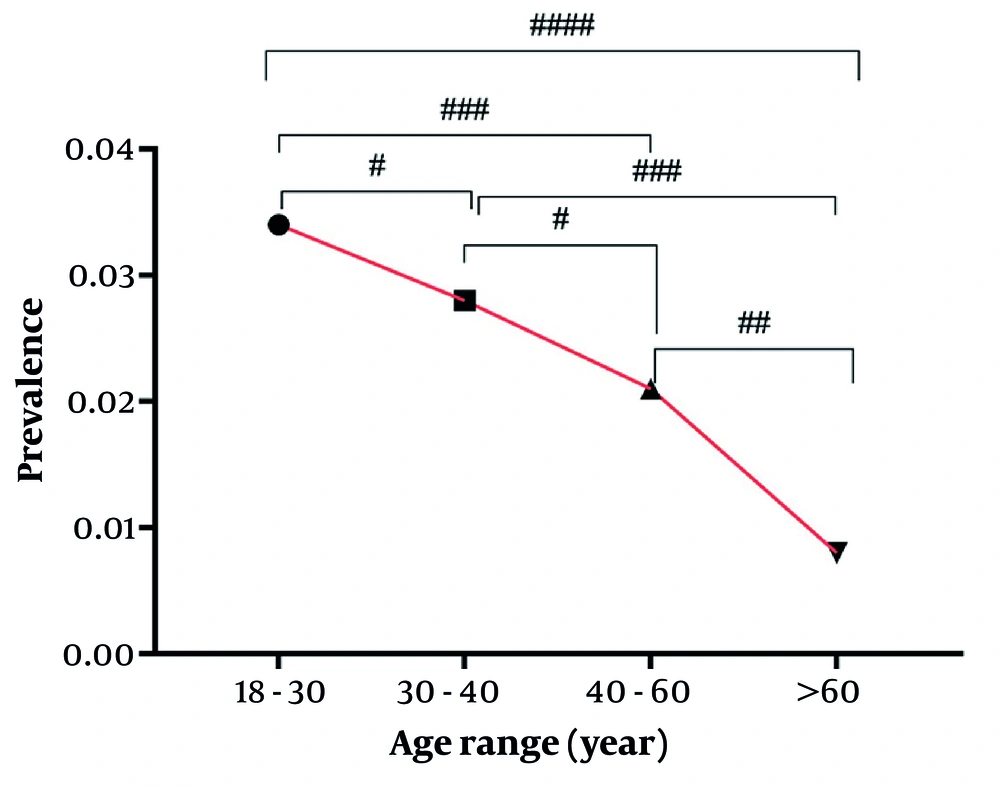
Figure 1.
Prevalence of endocrine disorders after traumatic brain injury based on age. #P < 0.05, ##P < 0.01, ###P < 0.001, ####P < 0.0001.
The incidence index was measured to determine the probability of developing endocrine disorders after TBI in male and female patients during the study years, and the results are shown in Figure 2. As shown, incidence was higher in female patients than in male patients in all study years, indicating that women are more likely to be affected by endocrine disorders after TBI than men. Notably, incidence was highest in 2024 for all patients (incidence: 0.0044), indicating that endocrine disorders after TBI should be considered by specialist physicians.
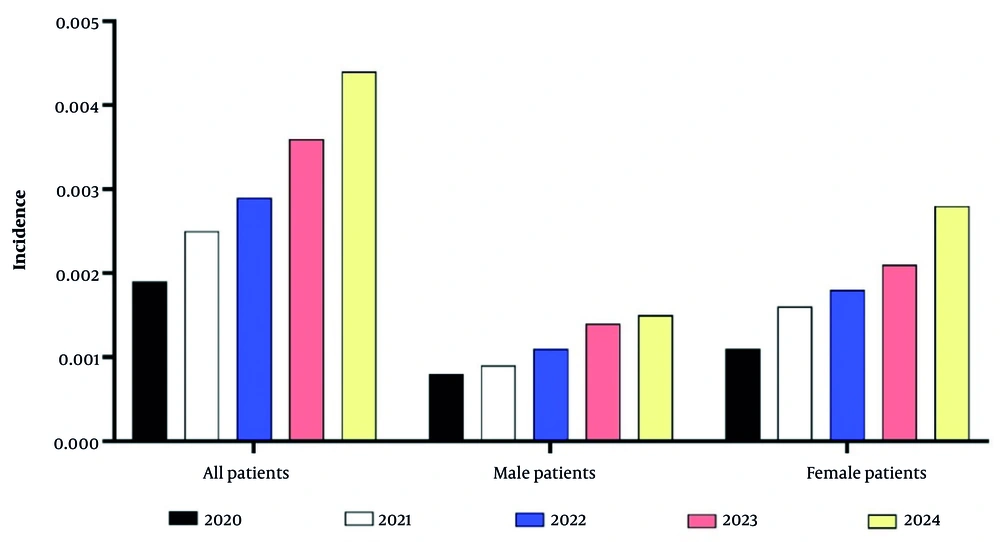
Figure 2.
Incidence rate of endocrine disorders after traumatic brain injury between male and female patients, as well as all patients, during the study years (2020 - 2024) in Hamadan city, Iran.
The mean time gap, defined as the time interval between the recorded diagnosis of TBI and the diagnosis of endocrine disorders, was measured by gender. The results indicated that the time gap in women (3.28 ± 1.98 years) was significantly shorter than in men (4.36 ± 2.28 years; 95% CI, 0.237 to 2.363 years; P = 0.0183) (Figure 3). Therefore, the time to the recorded diagnosis of endocrine disorders after TBI was earlier in women than in men.
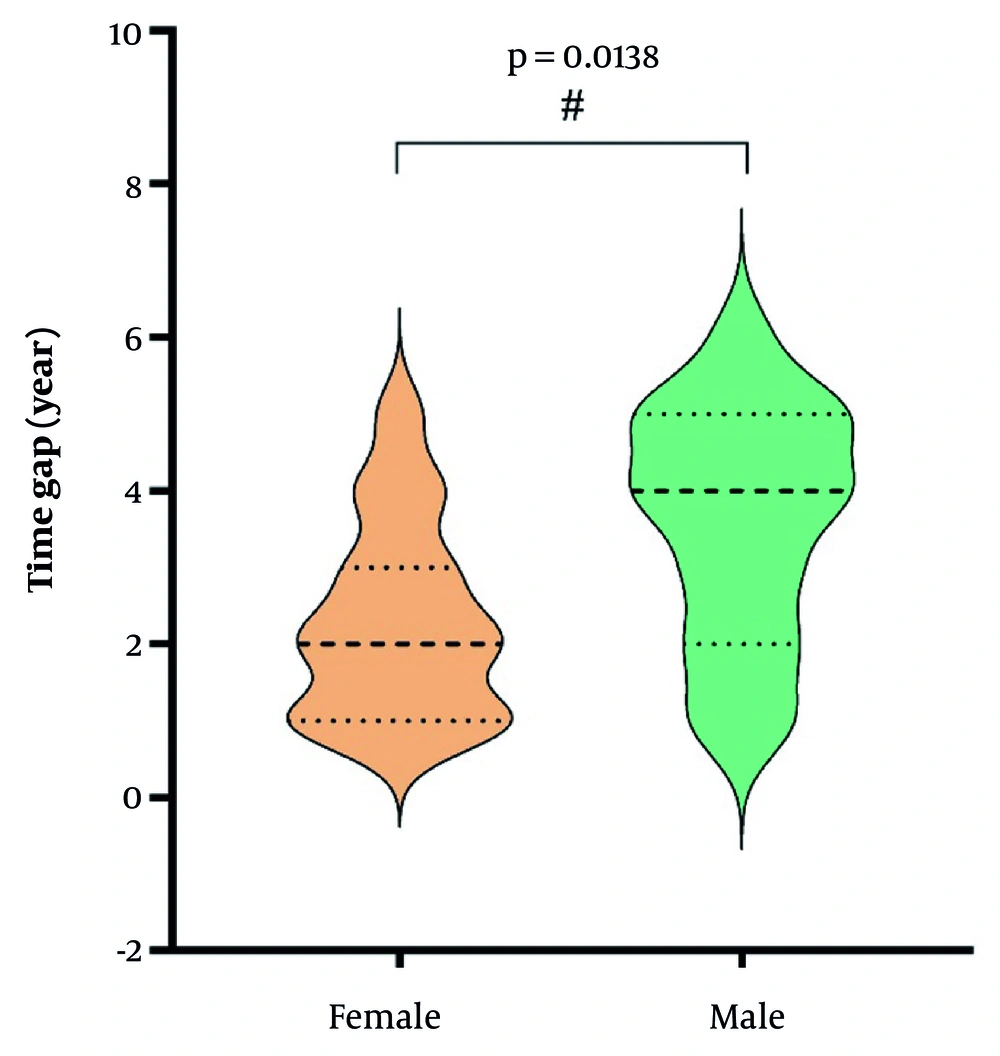
Figure 3.
Time gap between the onset of TBI and the recorded diagnosis of endocrine disorders based on gender in Hamadan city, Iran (female: n = 374; male: n = 245). #Shows significant difference.
5. Discussion
The findings of this study indicated an increasing trend in the prevalence of both TBI and post-TBI endocrine disorders in Hamadan, Iran, from 2020 to 2024, and women (prevalence: 0.035) were more likely than men (prevalence: 0.008) to develop endocrine disorders after TBI. In addition, younger patients with TBI showed a higher prevalence of endocrine disorders after TBI (age range 18 - 30 years: 0.034; age range 30 - 40 years: 0.028) than older patients. The incidence of endocrine disorders after TBI was estimated to be higher in women than in men, indicating that women are more susceptible to developing endocrine disorders. Finally, the time to a recorded diagnosis of endocrine disorders after TBI was shorter in women than in men.
One adverse consequence of TBI is endocrine disorders, which may manifest years after TBI (8). The mechanism underlying the development of these disorders is not fully understood. However, damage to the hypothalamic-pituitary axis is associated with disruption of endocrine and neural function (9). In particular, the pituitary gland plays an important role in regulating the function of other endocrine glands by secreting hormones such as thyroid-stimulating hormone, growth hormone, and luteinizing hormone (10), and any damage to it can strongly affect the function of other glands in the body. Given that this vital gland is located at the base of the skull, it is highly sensitive to mechanical damage, and necrosis of this gland occurs in deceased patients with TBI (11). In addition, a high prevalence of pituitary dysfunction has been observed in patients with TBI and skull fractures (12), indicating damage to the hypothalamic-pituitary axis. Therefore, TBI can be associated with subsequent endocrine disorders that should be considered by specialists.
In this study, female and younger patients with TBI had a higher prevalence of endocrine disorders after TBI. Although the severity of TBI is lower in women than in men because of the effects of gonadal steroid hormones (13), some studies have reported greater damage in women after TBI (14). Similarly, in this study, the development of endocrine disorders after TBI was calculated to be more common in women than in men. This finding could be attributed to the important role of sex hormones in the brains of patients with TBI (15). For example, men show decreases in progesterone, testosterone, and prolactin after TBI, whereas women show greater decreases in estradiol, indicating sex-dependent endocrine changes after TBI (16). As noted, the prevalence of endocrine disorders in young patients with TBI in this study was higher than in other age groups, indicating greater susceptibility to developing these disorders. In addition, one of the most common endocrine disorders after TBI is GHD, which is caused by damage to the pituitary gland (17). Young patients with TBI have been shown to have a sharp decrease in growth hormone and gonadotropin levels even 5 years after TBI (18).
Given that endocrine disorders, especially hypopituitarism after TBI, can be associated with adverse outcomes such as endocrine and metabolic disorders, screening and annual follow-up should be considered in the treatment plan for these patients. Hormone replacement therapy can also be considered. It is worth noting that most patients with TBI in Hamadan were young and in their active years, which can have negative consequences for the community's economy. Therefore, it is strongly recommended that TBI injury prevention programs be implemented in Hamadan city, Iran.
5.1. Conclusions
Post-TBI endocrine disorders were common among patients with TBI in Hamadan city, Iran, and women were more susceptible to developing endocrine disorders after TBI. In addition, a higher prevalence of endocrine disorders after TBI was observed in younger patients with TBI, and the incidence of endocrine disorders after TBI was estimated to be higher in women than in men.
5.2. Limitations
This study has several limitations that should be considered when interpreting the findings. First, identification of endocrine disorders depended on the availability of endocrinology consultation documentation and laboratory data; cases that were not investigated or documented by clinicians would have been missed, potentially leading to underestimation of the true prevalence and incidence. Second, although we applied specific laboratory thresholds and ICD-9 codes to define endocrine outcomes, variations in diagnostic practices and assay methods over the study period 2020 - 2024 may have affected case ascertainment. Third, the retrospective nature of the study precluded systematic screening of all patients with TBI for endocrine disorders; therefore, the reported rates likely reflect clinically detected cases rather than the true population-level burden. Fourth, we could not fully control for potential confounders such as TBI severity, mechanism of injury, medication use, and pre-existing comorbidities, which may influence the observed association between TBI and endocrine disorders. Fifth, the exclusion of patients with cerebrovascular diseases and pre-existing endocrine disorders, while necessary to ensure specificity, may have introduced selection bias. Finally, the relatively short follow-up period may be insufficient to capture late-onset endocrine complications, particularly GHD, which can manifest years after the initial injury. Future prospective, multicenter studies with systematic endocrine screening and longer follow-up are needed to confirm these findings and better characterize the epidemiology of post-TBI endocrine disorders in Iran.