
1. Background
Learning is the process of active engagement with experiences, and effective learning leads to personal and professional development, as well as a desire to learn more. As adult learners, medical students are responsible for their learning not only for the sake of human health, but also to further enhance human life (1).
It is widely believed that human genetics is central to the bodies of medical knowledge in modern medical schools (2). Personalized medicine refers to the medical practice in which each patient receives the most proper treatments and adaptable dosages and mergers of drugs based on their genome. This field of medicine has become more pragmatic over time. In the coming decade and with the rapid growth of new medical information and knowledge, new educational methods will be required to address the changes in the world’s population, disease nature, and management strategies. Although genetics has become more integrated into all areas of medicine, the number of the physicians opting for the specialty of medical genetics is not increasing noticeably (3).
The medical genetics curricula in the medical schools of the universities in Iran include basic and clinical materials; the basic materials cover the theoretical foundation of medical genetics, which should be imagined by students. In the case of these materials, teachers must use educational aids (e.g., pictures, movies, animations, and models) for the better understanding of basic information. On the other hand, the clinical materials primarily address the processes of molecular and cellular genetic diagnostics, which are taught theoretically. The backbones of these tests are explained by teachers although they may not be comprehended by everyone until they are put into practice. Among the other elements of clinical materials are the manifestation and management of genetic diseases and genetic counseling skills, which are also taught theoretically in medical universities.
Medical genetics education in medical schools is often restricted to two theoretical units (34 hours) in the basic sciences period during the first five semesters of medical courses. In the recently revised medical curriculum, these two unites have been defined as an afloat lesson, which could be taught in the basic or pathophysiology courses of medical education.
The medical school of Ahvaz Jundishapur University of Medical Sciences is an important medical school in the south of Iran, ranked as the first-class medical school by the Iranian Ministry of Health and Medical Education (4). Considering the wide variety of the educational methods used in various medical schools to improve students’ imagination skills and enhance their practical skills in genetics, further analysis is required regarding their exact effects.
2. Objectives
The practice-based class of medical genetics in laboratory is offered by the author during the teaching of genetics to the medical students of Ahvaz Jundishapur University of Medical Sciences, which will be presented in this article, followed by the analysis of the questionnaires completed by the students about the efficacy of the class in medical genetics education.
3. Methods
The medical students of Ahvaz Jundishapour University of Medical Sciences attend genetics classes based on the curriculum in the third semester of the basic sciences period. The curriculum is approved by the Iranian Ministry of Health and Medical Education and consists of two theory-based units (34 hours). In this experience, all the students (n = 72) required to take the theory-based genetics class in the first semester of the academic year 2014 were selected as the sample population and divided into three groups. After making the necessary arrangements with the educational department of the medical school, the course was presented in the laboratory of the Department of Medical Genetics as a practice-based class.
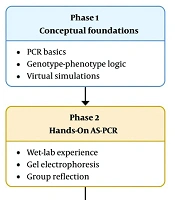
In this class, the students learned basic practical backgrounds, methods, instruments, chemicals, and results of genetic tests carried out in human medical laboratories. In addition, they observed and manually carried out common procedures such as molecular genetics methods (e.g., polymerase chain reaction) and cytogenetic techniques (e.g., karyotyping).
In the last session of the practice class, the attending students were asked to complete a questionnaire. Similar to all the students of the author, they were surveyed about the quality of the course to increase the clinical ability of the students in the diagnosis and referral of genetic disorders. Furthermore, the students were particularly enquired about the advantages and impact of the practice class. All the students (n = 72) completed the questionnaire in the last session (100% response rate). The items in the questionnaire had four options of highly, average, slightly, and not at all. The frequency of the answers was obtained by direct counting, and statistical analysis was performed in SPSS version 19.0.
The questionnaire contained six items regarding the quality and quantity of the genetics course, the applied teaching methods, and the presented practice classes. Moreover, the students were enquired about the practicality of the class and its effects on increasing their interest in genetic diseases. Finally, they were asked to comment on the teaching of medical genetics. The questionnaires were completed anonymously to avoid ethical conflicts. The validity of the questionnaire was confirmed by research and education experts, and its reliability was determined at the Cronbach’s alpha of 0.523.
4. Results
The questionnaires were completed by 72 medical students of Ahvaz Jundishapour University of Medical Sciences who attended the genetics practice class. Out of 72 students, 39 were female and 33 were male (54% and 46%, respectively). In the questionnaire, the students initially responded to the questions regarding the quality and quantity of the genetics course and the applied teaching methods (results not inserted), followed by the items regarding the practice genetics class.
In response to the question “How useful was the practice genetics class to you?”, 15 students (20.8%) believed it to be highly useful, 38.9% considered average usefulness, 26.4% chose the option “slightly”, and 13.9% believed that the course was not useful at all. In response to the question “How could the practice class help medical students in the better understanding of genetics?”, 37 students (51.4%) chose the option ‘highly’, 29.2% considered it average, 11.1% chose the item ‘slightly’, and 8.3% stated that the course was not helpful at all.
Table 1 shows the details of the responses to the mentioned questions. In response to the question regarding genetics teaching (How does the teaching of medical genetics affect your interest in genetic diseases?), 41 students (57%) stated that the teaching increased their interest, while seven students (9.7%) believed that the teaching decreased their interest, nine students (12.5%) believed the teaching made them hate the field, and 15 students (20.8%) reported no effects on their interest. In response to the final open question, 23 students (32%) emphasized on the teaching of medical genetics by presenting more clinical examples by the teachers and performing more laboratory tests by the students.
Table 1.
Responses of Medical Students (n=72) Regarding Practice Genetics Class
| Question | Not at All, No. (%) | Slightly, No. (%) | Moderately, No. (%) | Highly, No. (%) | Total, No. (%) |
|---|---|---|---|---|---|
| Useful for medical students | 10 (13.9) | 19 (26.4) | 28 (38.9) | 15 (20.8) | 72 (100) |
| Helping with better understanding of genetics items | 6 (8.3) | 8 (11.1) | 21 (29.2) | 37 (51.4) | 72 (100) |
5. Discussion
Unfortunately, the current curriculum of genetics for medical students in the universities of medical sciences in Iran is purely theory-based. After the analysis of medical genetics teaching in 30 medical universities of Iran in 2014, the author observed that about two-thirds of the medical schools dedicated 20 - 40 hours to medical genetics in the third and fourth semesters of basic sciences, which was largely concerned with general concepts (86%) rather than practical applications (11%). Only in two medical schools, the students passed four practical units in the pediatric, gynecology, and neurology wards of hospitals, visited the admitted patients for genetic disorders, and passed one optional practical unit in hospitals or genetic laboratories to learn common cytogenetic and molecular genetic methods (4).
After the evaluation of medical genetics teaching in the United States and Canadian medical schools, Thurston reported that only 11% of the centers offered practical training in the curriculum of medical genetics, and at least 50% of these schools integrated genetics into clinical education. In the schools where medical genetics was taught after the basic sciences period, education mostly occurred in pediatric wards (2). Teaching in this regard does not encourage medical student to face the challenges associated with the genetic problem of patients and select medical genetics as their specific field of study. In contrast, using practical education and the integration of clinical items not only challenges students by genetic diagnosis and management, but it also increases their preoccupation to study and search in the medical genetics field. In the present study, 57% of the students stated that the genetics practice class increased their interest in genetics subjects.
In another research, Cooksey et al. (5) analyzed all the medical geneticists certified by the American Board of Medical Genetics (ABMG), concluding that young physicians did not enter the specialty of clinical genetics. Although no similar studies could be found regarding the teaching of genetics in the medical schools of Iran, the current research on the viewpoints of the medical students of Ahvaz Jundishapur University of Medical Sciences on the teaching clinical manifestations of genetic disorders revealed that the teaching of the clinical aspects and manifestation of genetic disorders played a key role in improving the learning of genetics by medical students (6).
In the current research, the majority of the medical students believed that the practice genetics class was useful and helped with the better understanding of genetics principles. Therefore, it could be inferred that the medical students distinguished their operative educational items and were interested in further enhancing their medical skills.
In 1994, the American Institute of Medicine declared that in the field of education, insignificant progress has been made to prepare physicians for the increasing requirements for genetic testing, education, and counseling projected for the future. Following this claim, a study of American medical schools was conducted in 1998 by the Association of the Professors of Human or Medical Genetics, indicating that medical students were averagely exposed to only 29 hours of academic tuition in medical genetics (7).
In another research, Korf (8) evaluated the integration of genetics into the preclinical and clinical curricula at Harvard Medical School, concluding that genetics arrested the attention of the public, and there were high expectations regarding the fusion of the human genome knowledge into medicine. This requires the awareness of the genetics principles and recovery of specific skills for physicians. The transition of genetics from the study of imaging items to its proper place is occurring rapidly and is faster than the pace that the medical education system could adapt to. Furthermore, Korf believed that the examination of various models of genetics education in the curriculum of medical schools will gain importance in the near future, and the efficacy issues in this regard must be adjusted (8).
One of the limitations of the present study was the small sample size although we selected all the medical students of the same educational semester. Another limitation was the small number of the questions for the evaluation of the usefulness and helpfulness of the teaching methods; we performed an evaluation of the students’ attitude, and the issues should be addressed by several different questions. Considering the limited number of the questions, the Cronbach’s alpha level was also relatively low, and the revision of the questionnaire is recommended in the further investigations in this regard.
Our findings indicated the general interest of the medical students of Ahvaz Jundishapour University of Medical Sciences to learn the practical items of medical genetics. If a revolution occurs in genetics practice educational methods by using imagery, animations, films, models, apprenticeship model, ambulatory teaching, problem-based learning, small and large group discussions, role models, role-play, computer-assisted learning, video presentation, task-based teaching, workshops, and demonstration, future young physicians will approach, diagnose, and manage genetic disorders more accurately than the physicians today (4, 9, 10).
5.1. Conclusions
The exploration of medical and human genetics information has been rapid in recent years, and genetics educational methods in medical schools have failed to keep up with the pace. In many medical schools, medical genetics teaching is restricted to several non-practical subjects. In this study, the medical students of Ahvaz Jundishapour University of Medical Sciences confirmed the impact of practical teaching on their clinical abilities. Each item in the medical genetic education should be accompanied with students’ practical experiences and advanced teaching methods, meeting practice genetic classes, visiting the genetic patients admitted to hospitals, analysis of laboratory genetic tests, and counseling sessions.