
1. Context
Universities are the most well-known educational centers worldwide, which are essential with different roles, including education, research, services, entrepreneurship, and value-creation. Medical universities are critical due to their therapeutic role. The key role of universities, however, is education, which has received much attention since these centers were established. When universities, especially medical universities, pay proper attention to their most important role, namely education, they can maintain and enhance their position in society (1). Iran has strong religious values, which make education essential (2). Therefore, addressing education in universities, especially medical universities, is very important. Medical universities are centers of guidance and treatment for humans, and the slightest mistake, especially in educational matters can be harmful (3). The crucial instrument by which medical universities can achieve their goals and ideals, especially in education, is educational commitment. Thus, analyzing the educational commitment and quality of medical universities is considered an important step here. Educational commitment is the essential part of an ethical commitment in university ethical documents, which focuses on education. Educational commitment is important to achieve lofty educational goals (2, 4). Most universities, especially in Iran, lack such a commitment or have an incomplete educational commitment as a part of a university’s ethical documents (5). Educational commitment in universities includes value components resulted from duties and understanding of higher education experts in different roles, as well as that of students and graduates (3). Medical universities need educational commitment due to the changes in higher education over recent years. In recent years, many people were interested in receiving higher education (branches of medical science), which led to a challenge in the quality of education. Quality of education is one the critical concerns of medical universities, and the influx of students seeking degrees has changed the focus of attention from quality to quantity. The educational commitment in this context is of utmost importance. The right of medical universities to students and other stakeholders in education is based on educational commitment, resulting in improved quality of education. In teaching, students and other stakeholders need to be committed to teaching and their duties at the university (3, 6). For example, students need to know the purpose of education and their duties during university education. However, educational commitment consists of the students' commitment to getting a university education and includes faculty, staff, and managers. Most universities' ethical documentation, including medical universities, have focused more on the ethical charter, i.e., the university commitment to others (2, 7), but this research studied the educational commitment, which is not considered enough in ethical documents of universities.
All involved people should be included in educational commitment so that the medical university can properly fulfill education. Educational commitment plays a key role in developing medical universities and students. There is little research on educational commitment, especially in Iran. However, many faculty and university managers have realized the importance and significance of this commitment.
The University of Amsterdam and Wake Forest University provided employee and student codes of conduct, behavioral and social policies and regulations, personal behaviors, offenses and their principles, academic misconduct, and medical forgiveness in a resource (8, 9). The University of the Witwatersrand has developed an ethical document consisted of 4 parts, which mainly focuses on research ethics (4). Abdollahi and Taghizade investigated the ethics of education in engineering universities and showed that engineering universities in Iran are far from the top global universities regarding educational ethics (5). Nemati and Taghizade examined the educational ethics in medical universities. According to this study, there was a large gap between educational ethics and the desired level (2). Zarafshani et al. studied the effect of communication between students and professors based on ethical principles on improving educational efficiency, students' motivation and self-confidence and increased effective quality of education. The results of this study indicated that the communication between students and professors and observing the ethical principles in this regard need to be considered more in medical universities of Iran (10). Barnhoorn et al. studied the ethical issues of students of medicine and showed that gender and nationality affect non-professional behaviors (11). Howard university provided an ethical document in which the ethical codes are described for students, faculty, managers, and staff (12). Garmann Johnsen et al. studied professional ethics and indicated the importance of it, the effect of ethics on work and social life, and its key role in life (13). Al-Zahra University provided a comprehensive ethical document for the university in four parts, including preface, basic principles, the organization's commitment to individuals and environment, and people's commitment to the organization (14). Mesbahi and Abbaszadeh studied the professional ethics system in higher education, especially in medical universities and mentioned that ethics in higher education is multidimensional and results in university efficiency (15). Pourzanjani et al. studied ethical codes for nursing students and found that topics in the nursing professional ethics codes are care or, in other words, ethics in clinical care, while the topic in nursing students' ethics codes is education. Therefore, nursing students' ethical codes or regulations should be formulated with the theme of ethics in academic and educational settings, similarly to other nursing colleges (16). Alvani and Rahmati reviewed the efforts made to direct the university toward spirituality and establishing ethics, some concepts, definitions, techniques, and ethical management tools in the organization. This research mainly focused on the practical process of ethical charter compilation in the university (17). Schwartz investigated the relationship between the common aspects of ethical and behavioral codes regarding the executive dimension of ethical and behavioral codes. The findings showed that ethical codes are essential elements affecting people's behavior (18). Adams investigated codes of ethics as components of ethical behavior and indicated that universities with ethical codes have better behavior in their staff, managers, and other members (19).
The literature review showed that the research absence on educational commitment is evident in the universities of Iran and other countries. The studies concentrated on limited ethical components in universities and ethical charters. Educational commitment was addressed in these studies as a part of ethical documents, which has been neglected. Consequently, a comprehensive study of educational commitment in Iranian universities (medical sciences and engineering) is needed to compare with the top global universities and improve educational commitment.
2. Methods
A comparative study (1) method was used by the George Brady model to conduct this qualitative study. The study was performed based on a four-stage comparison process into four stages of describing, interpreting, neighborhood and comparison. In the stage of describing the research components, note-taking and sufficient preparations were prepared for review and criticism in the next stages based on the evidence and information. In the interpretation stage, the information collected in the first stage were analyzed. In the next step, the prepared information was classified and put together to create a framework for comparison and differences. Finally, the details were considered in the field of similarities and differences and giving answers to the research questions based on the comparison in the step of comparing the research. The results of these four stages are presented (Tables 1-4).
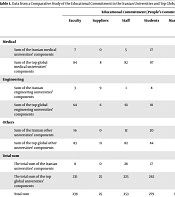
Table 1.
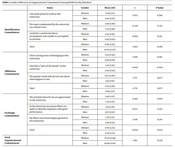
Data from a Comparative Study of the Educational Commitment in the Iranian Universities and Top Global Universities a
| Educational Commitment (People's Commitment to University Education) | ||||||||
|---|---|---|---|---|---|---|---|---|
| Faculty | Suppliers | Staff | Students | Managers | Board of Trustees and Stakeholders | Audit Board | Educational Departments | |
| Medical | ||||||||
| Sum of the Iranian medical universities' components | 7 | 0 | 5 | 17 | 3 | 0 | 0 | 0 |
| Sum of the top global medical universities' components | 84 | 8 | 82 | 97 | 44 | 43 | 45 | 19 |
| Engineering | ||||||||
| Sum of the Iranian engineering universities' components | 3 | 9 | 1 | 8 | 1 | 0 | 0 | 0 |
| Sum of the top global engineering universities' components | 64 | 6 | 61 | 81 | 15 | 16 | 26 | 5 |
| Others | ||||||||
| Sum of the Iranian other universities' components | 16 | 0 | 12 | 20 | 3 | 0 | 0 | 0 |
| Sum of the top global other universities' components | 83 | 11 | 82 | 84 | 34 | 15 | 40 | 14 |
| Total sum | ||||||||
| The total sum of the Iranian universities' components | 8 | 0 | 28 | 17 | 7 | 0 | 0 | 0 |
| The total sum of the top global universities' components | 231 | 25 | 225 | 262 | 93 | 74 | 75 | 38 |
| Total sum | 239 | 25 | 253 | 279 | 100 | 74 | 75 | 38 |
Table 2.
The Comparative Study Data of Educational Commitment in the Iranian Universities as a Percentage
| Components | Name of Universities (Number of Components) | Number of Universities | Percentage (%) | |
|---|---|---|---|---|
| Medical universities | Educational commitment (staff, students, and managers) | Zanjan University of Medical Sciences (in progress) (2), Shahid Beheshti University of Medical Sciences (1), Kurdistan University of Medical Sciences (1), Golestan University of Medical Sciences (1), Arak University of Medical Sciences (1), Kermanshah University of Medical Sciences (1), Tabriz University of Medical Sciences (1), Urmia University of Medical Sciences (1), Isfahan University of Medical Sciences (1), Iran University of Medical Sciences (1), Baqiyatallah University of Medical Sciences (1), Bushehr University of Medical Sciences (1), Shahid Sadoughi University of Medical Sciences (1), Yazd University of Medical Sciences (1), Shiraz University of Medical Sciences (1), Shahrekord University of Medical Sciences (1), Qom University of Medical Sciences (1), Kashan University of Medical Sciences (1), Gilan University of Medical Sciences (1), Lorestan University of Medical Sciences (1), Mashhad University of Medical Sciences (1), Hamedan University of Medical Sciences (1), Hakim Sabzevari University of Medical Sciences (1), Kovar University of Medical Sciences (1), Tehran University of Social Welfare and Rehabilitation Sciences (1), Army University of Medical Sciences (1), Ahvaz University of Medical Sciences (1), Tehran University of Medical Sciences (1), Rafsanjan University of Medical Sciences (1), Zahedan University of Medical Sciences (1), Qazvin University of Medical Sciences (1), Ardabil University of Medical Sciences and Health Services (1), and Semnan University of Medical Sciences and Health Services (1) | 32 of 65 | 49.23 |
| Other universities | Educational commitment (staff, students, and managers) | Al-Zahra University of Tehran (4), Islamic Azad University (3), Farhangian University (7), University of Tehran (in progress) (2), Ferdowsi University of Mashhad (2), Payame Noor University (2), University of Applied Science & Technology (2), Shahid Abbaspour University of Tehran (2), Lorestan University (2), Imam Sadegh University (2), Shahreza Higher Education Center (2), Research Institute of Iranian Universities (2), Arak University (1), Urmia University (1), Ilam University (1), Kharazmi University (in progress) (1), Semnan University (1), Shahid Beheshti University of Tehran (1), Shahid Rajaee University of Tehran (1), Allameh Tabataba'i University of Tehran (in progress) (1), Gorgan University of Agricultural Sciences and Natural Resources (1), University of Gilan (1), University of Isfahan (1), University of Tabriz (1), Tarbiat Modares University (1), Shahrekord University (1), Shahid Chamran University of Ahvaz (1), Shahid Madani University of Azerbaijan Iran (1), Shiraz University (1), Qom University (1), Kashan University (1) and Yazd University (1) | 33 of 347 | 9.51 |
| Engineering universities | Educational commitment (staff, students, and managers) | Abadan Oil Industry University (2), Isfahan University of Technology (2), Amir Kabir University of Technology (2), Sahand Iran University of Technology (1), Iran University of Science and Technology (1), Sharif University of Technology (under development) (1), Khaje Nasir Toosi University of Technology (1), Shiraz University of Technology (1), Malek Ashtar University of Technology (1), and Vocational & Technical University (1) | 10 of 127 | 7.87 |
| All Iranian universities | Educational commitment (staff, students, and managers) | - | 72 of 539 | 13.35 |
Table 3.
The Comparative Study Data Regarding the Educational Commitment of the Top Global Universities as a Percentage a
| Components | Number of Universities | Percentage (%) | |
|---|---|---|---|
| Universities (medical, engineering, and others) | Educational commitment (Faculty, Suppliers, Staff, Students, Managers, Board of Trustees and Stakeholders, Audit board, and Educational Departments) | 100 of 100 | 100 |
a The names of the top global universities have not been mentioned due to lack of space. More information about the present study can be found in other articles by the author (Saeedeh Taghizadeh) (2).
Table 4.
Priorities in the Educational Commitment of the Iranian Universities and the Top Global Universities a
| Components | Medical Universities of Iran | Engineering Universities of Iran | Other Universities in Iran | World's Top Medical Universities | World's Top Engineering Universities | World's Top Other Universities | All Top Global Universities | All Universities in Iran | All Universities |
|---|---|---|---|---|---|---|---|---|---|
| The educational commitment of the student | 1 | 1 | 1 | 1 | 1 | 1 | 1 | 1 | 1 |
| The educational commitment of faculty | 2 | 2 | 2 | 2 | 2 | 2 | 2 | 2 | 2 |
| The educational commitment of staff | 3 | 3 | 3 | 3 | 3 | 3 | 3 | 3 | 3 |
| The educational commitment of the manager | 4 | 4 | 4 | 5 | 6 | 5 | 4 | 4 | 4 |
| The educational commitment of audit board | 0 | 0 | 0 | 4 | 4 | 4 | 5 | 0 | 5 |
| The educational commitment of the board of trustees and stakeholders | 0 | 0 | 0 | 6 | 5 | 6 | 6 | 0 | 6 |
| The educational commitment of educational departments | 0 | 0 | 0 | 7 | 8 | 7 | 7 | 0 | 7 |
| The educational commitment of suppliers | 0 | 0 | 0 | 8 | 7 | 8 | 8 | 0 | 8 |
a Numbering based on the priority of universities.
The sampling method was complete enumeration. The population consisted of the top 100 global universities in medicine, engineering, and other universities (2) based on Shanghai Ranking (20), and 539 universities in Iran (65 medical sciences, 127 engineering, and 347 other universities) based on National Organization for Educational Testing of Iran (21), of which 81 universities in Iran (3) (33 medical universities, ten engineering universities, and 32 other universities) and 100 universities abroad in medicine, engineering and other had an educational commitment. These documents of universities (medical, engineering and other universities) were analyzed in terms of their main headings (Table 1) to compare their strategies to promote and compile an educational commitment in medical universities. The data were qualitatively analyzed using descriptive statistical methods.
Educational commitment in universities refers to documents in the mentioned universities, with contents related to the people’s commitment to academic education. In addition, the components of educational commitment refer to components of the mentioned documents (Table 1).
3. Results
Based on research findings, there are only four components of the eight components in the educational commitment of Iranian universities, including faculty, staff, students, and managers. While, all components are included in the educational commitment of top global universities, indicating enough attention to educational commitment. The educational commitment of students is the priority of all universities. The educational commitment of faculty is the second priority of all universities, and the educational commitment of staff is the third priority of all universities. Other components are prioritized differently. For example, the fourth priority of the educational commitment of the top global universities are the educational commitment of the audit board, which is the educational commitment of managers in the universities of Iran (Tables 1 and 4). The universities of Iran and top global universities focus respectively on students, faculty, staff, and managers considering the priorities in the educational commitment of universities. In terms of educational commitment, the faculty should play a greater role; then the students will have a significant role. Therefore, it seems that the faculty, and then students, managers, and staff should be considered in educational commitment (Table 4) and should be individually committed to education in universities.
On the other hand, the educational commitments of universities of medical sciences, engineering, and other universities in Iran and abroad are not very different (Table 4). Al-Zahra, Islamic Azad, and Farhangian Universities have a complete educational commitment in Iran. The medical universities in Iran, including Zanjan University of Medical Sciences, Shahid Beheshti University of Medical Sciences, Kordestan University of Medical Sciences, and Golestan University of Medical Sciences, and the universities of engineering, including Abadan Oil Industry University, Isfahan Industrial University, Amir Kabir University of Technology, Sahand Iran Industrial University, Iran University of Science and Industry, and Sharif Industrial University have a complete educational commitment. The universities of Stanford, Harvard, California (San Fransisco) and Washington have a complete educational commitment to the top universities of the world ( Tables 2and 3).
According to the findings, state universities pay more attention to educational commitment than all other universities in Iran and around the world. Non-state universities have become more concerned with attracting capital (especially students) than with considering their educational commitments and this issue is due to their financial need. Most universities in Tehran have an educational commitment, revealing the concentration of material and intellectual capital in Tehran (Tables 2 and 3). These materials and intellectual capital, represented by the educational commitment, should be distributed equally in all cities of Iran to result in comprehensible development of the country, especially in medical education.
There were 49.23% of medical universities that paid more attention to educational commitment, followed by 9.51% of other universities and 7.87% of engineering universities (Table 2). Consequently, greater attention to educational commitment can result in greater Iranian universities of medical sciences development in education, research, and services. However, educational commitment is considered a partial component of the university ethical documents as an important principle in the educational guidance of the involved people in universities, which has not received enough attention. The Iranian universities do not have an acceptable level of education on educational commitment. Despite enough attention to ethical documents by the top global universities (Table 3), the educational commitment and its integration have not been considered well.
4. Discussion
A medical university can only be efficient and effective when all stakeholders are committed, including students, faculty, staff, and managers. However, the educational commitment components need to be provided for involved people individually in terms of their duties, responsibilities, and other influential conditions. An educational commitment can cause unity in implementing an effective and efficient education in medical universities. According to the investigations conducted in this study and based on the research findings, an educational commitment of medical universities should include eight main parts:
(I) The educational commitment of students: This part of the commitment includes the students' commitment to the university. For example, the students should spend all their time to learn, enter the class with full energy and preparedness, be interested in their field of study, participate and demand in teaching, make optimum use of educational opportunities and facilities, have self-belief and self-esteem, have a respectful interaction with each other and professors, have an appropriate dress in the educational settings, abide by the educational rules and regulations and be diligent in keeping the privacy, confidentiality, and ethics of education.
(II) The educational commitment of faculty: This part is generally related to the faculty commitment to the university. For example, the faculties should be experts, know teaching methods, be aware of students, be knowledgeable about the up-to-date teaching resources and teaching techniques, motivate students to learn, support the students in teaching, avoid discrimination among students, be committed to class time and students' trust, transmit a sense of worth to students, abide by the law, regulations, rules, and duties with flexibility, justice and fairness, devote time to academic responsibilities, be available for the students, guide the students, care about students' privacy, personal independence, and creativity, be a role model in all issues, be self-assessing and teach it to the students, and encourage students to ask questions.
(III) The educational commitment of staff: This part includes the commitment of staff, especially those working in the educational departments of the medical university. For example, university staff should have knowledge about the educational issues in the university, facilitate university educational issues, be responsible for university education, see students as divine mercy, work diligently to help the students to meet their needs and avoid harassment and slacking, be accountable, transparent and respectful, respect to privacy, protect students' dignity, physical and mental health, and gender security, have accuracy, quality, and speed in performing their professional duties, observe honesty, intimacy, respect, forgiveness, and benevolence, be interested in learning and be empowered, attempt to be innovative and make changes, make optimum use of time and facilities and prefer the interests of the university to their interests.
(IV) The educational commitment of managers: This part generally includes the commitment of managers, especially those working in the education departments of the university. For instance, managers should pave the way for effective education through proper policymaking, be knowledgeable about various issues of education such as teaching methods, techniques, and patterns, control the professional ethics regarding education, provide adequate conditions and facilities for better education in the university, and be a role model in all areas, especially in education.
(V) The educational commitment of the audit board: This part expressed the commitment of the audit board to education in the university. For example, the audit board members should be knowledgeable about modern educational issues, be active in creating development and growth opportunities of education in the university, be aware of applied education research, respect students', faculty's, and staff's freedom of expression, prevent educational immorality, protect the rights of faculty and students, be transparent and uniform, have a respectful interaction, be an optimist and accountable, respect information confidentiality and privacy, have ethical audits to improve regulations and rules to make the processes optimum and obey the rules, and avoid tastes.
(VI) The educational commitment of the board of trustees and stakeholders: This part is generally concerned about the commitment of the board of trustees and stakeholders to education in the university. For example, the board of trustees and stakeholders should be aware of university education and its different components, provide the needed funding to provide modern facilities and conditions, be responsible for university education, try to attract the best faculty and staff and act consciously in keeping the educational interests of the university.
(VII) The educational commitment of educational departments: This part is focused on the commitment of educational departments to education in the university. For example, the educational departments should facilitate the collaboration and empathy among faculties for developing education, facilitate the education process and related administrative matters, attract empowered and good-tempered faculties, tend to spirituality and science, be transparent, ordered, and predictable, realize the students' rights to select their educational matters, increase the members' cooperation rather than competition, evaluate the department activities continually through internal and external evaluation, inform the members about the results, promote fair judgment, and consider students' issues in planning.
(VIII) The educational commitment of suppliers: This part of the commitment is generally focused on the suppliers’ commitments to university education. For example, suppliers should attempt to provide the best and most practical opportunities for effective education, adhere to the professional ethics to provide the best things for the university, be aware of the university and especially education, and have appropriate and ethical communications with universities, be transparent in their performance, and abide by the rules and regulations of the university.
4.1. Conclusions
This study aimed to evaluate the educational commitment of Iranian and top global universities to promote the educational commitment in universities with an emphasis on medical universities. About 100% of the top universities worldwide and 13.35% of Iranian universities had the educational commitment. Therefore, the results indicated a lack of enough attention to the educational commitment in Iranian universities. However, Iranian medical universities were in better condition. The first priority of the educational commitment of Iranian and global universities was the educational commitment of students. The second and third priorities were the educational commitment of faculty and staff, respectively. Moreover, most of the state universities in Iran and the world had an educational commitment. Documents of professional ethics of Al-Zahra University in Tehran, Stanford University, Harvard University, and California (San Francisco) University had the most comprehensible educational commitment and comply with each other.
According to the results, comprehensible studies are needed to provide a unified educational commitment to significantly support education in medical universities. All the involved people in university education need to be aware of their duties and responsibilities to education in university. Based on the findings of the present study, an educational commitment can compose of eight parts, which are the educational commitment of students, faculty, staff, managers, audit board, board of trustees and stakeholders, educational departments, and suppliers, each of which contains subparts.