
1. Background
Human resources play a crucial role in the success of any organization, and their significance is particularly evident in educational institutions (1). The successful implementation of the educational system depends on several factors, including faculty members' participation and efforts, and the university's excellence depends on its employees' performance (2). In this context, Organizational Commitment (OC) is a crucial factor that directly impacts the success of an organization (3). The concept of commitment was first introduced to the literature in 1960 by Becker and explained as "one mechanism producing consistent human behavior" (4). Luthans defines OC as (1) strong desire to remain a group member; (2) willingness to work hard as an organizational goal; and (3) willingness to accept the organization's values and goals (5). In addition, Balfour and Whechler classified OC into three categories: Identification Commitment (commitment based on membership in the organization), Affiliation Commitment (a sense of commitment based on connection and relationship for rational and emotional reasons), and Exchange Commitment (emotional bond and emotional attachment of employees to organization) (6).
The consequences of OC are mainly an increase in employee performance, more motivation, and fewer turnover intentions, which have a significant relationship with the organization's overall performance (7, 8). Employee behavior has become a central concept in organizational research since the 1970s (9). OC is vital for retaining and attracting talent in any organization and plays a fundamental role in achieving the goal, innovation, and stability of an organization because improving trust between employees, managers, and other related parties of any organization and stronger commitment could enhance organizational development, growth, and survival (10). OC is a continuous process that results from employee participation in organizational decisions, attention to the organization's employees, and the success and well-being of the organization (11). In addition, OC is an attitude or orientation towards the organization that connects the individual's identity to the organization (12). Researchers believe that organizations with engaged employees are more effective, and employees who show high levels of OC are more productive and less likely to quit (13). In addition, OC is one of the main motivational aspects that form the identity of the organization's people and makes them participate, integrate with the organization, or enjoy being a member (14).
The critical thing about OC is that it is not a stable or fixed trait throughout a person's life. Thus, OC results from critical organizational factors that are beneficial to pay attention to and are a function of personal characteristics and situational factors related to the work environment (15). In this regard, Schroder indicated that organizational policy, nature of work, salary, working conditions, and promotion are the essential predictors of OC (16). OC is critical in educational organizations, and the teacher's OC level has been introduced as a determining factor for achieving quality education (17). Since teachers with lower OC are likely to make less effort in the classroom, this adversely affects students' learning and progress (18). Given the significant impact of OC on an organization's effectiveness and the lack of information in the Western region of Iran, it is crucial to conduct studies to identify the factors influencing OC among faculty members.
2. Objectives
The present study was conducted to determine the OC status among faculty members of Kermanshah University of Medical Sciences (KUMS).
3. Methods
3.1. Participants and Procedure
This cross-sectional study was conducted on 177 faculty members at KUMS in the west of Iran. The sample size was determined as much as 209 based on a pilot study conducted at a 95% confidence level. This calculation considered the OC variance and an error rate of 0.1 units. The subjects were enrolled, and data was collected in the following stages. First, different faculties at KUMS were considered as clusters. Then, faculty members in each faculty voluntarily enrolled in the study. Finally, 177 (84.6%) faculty members out of 209 agreed to participate in the study. Inclusion criteria required being a faculty member at KUMS with at least one year of job history. Unwillingness to cooperate or incomplete questionnaire item answers were considered exclusion criteria.
3.2. Measure
The data were collected by a self-report written questionnaire consisting of two parts. The first part measures age (years), job history (years), and gender (female, male). The second part of the organizational commitment standard questionnaire.
3.2.1. Organizational Commitment Questionnaire
OC was measured by a 9-item standard questionnaire (6). Each item was evaluated on a five-point Likert-type scaling (1 = strongly disagree, 5 = strongly agree). One item in each dimension is reverse-scored (5 = strongly disagree, 1 = strongly agree). OC Questionnaire included three dimensions: Identification Commitment (IC), Affiliation Commitment (AC), and Exchange Commitment (EC). IC was measured using three items: “I am quite proud to work at this university.” Cronbach’s alpha indicated that the IC sub-scale possessed good internal reliability (0.78). AC was measured using three items: “I feel like a "part of the family" at this university.” Cronbach’s alpha indicated that the IC sub-scale possessed good internal reliability (0.81). EC was measured using three items: “In the university, necessary efforts are made to identify employees with good performance.” Cronbach’s alpha indicated that the IC sub-scale possessed good internal reliability (0.71). Furthermore, our study's total reliability coefficient for the OC questionnaire was 0.72.
3.3. Data Analysis
The data were analyzed by SPSS version 16 using appropriate statistical tests including bivariate correlation, and independent samples t-test at 95% significant level.
4. Results
The mean age of academic members was 40.43 (95% CI: 39.42 - 41.62) years. Further, the mean job history was 11.96 (95 % CI: 10.53 - 13.39) years. About 38.4 and 61.6% of participants were women and men, respectively. The mean score of OC was 28.12 (SD: 4.82), ranging from 9 - 45, which indicated that the participants obtained 62% of the maximum obtainable score for OC.
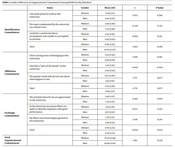
The gender difference in OC among KUMS faculty members is shown in Table 1. As the findings show, there was no significant difference between gender and different areas of OC.
Table 1.
Gender Difference in Organizational Commitment Among KUMS Faculty Members
| Items | Gender | Mean (SD) | t | P-Value | |
|---|---|---|---|---|---|
| Identification commitment | I am quite proud to work at this university. | Women | 3.29 (1.02) | -1.075 | 0.284 |
| Men | 3.44 (0.87) | ||||
| The topics emphasized by the university are critical to me. | Women | 3.48 (0.90) | -0.339 | 0.735 | |
| Men | 3.53 (0.88) | ||||
| I work for a university that is incompetent and unable to accomplish its mission. | Women | 2.91 (0.89) | -0.930 | 0.353 | |
| Men | 3.04 (0.95) | ||||
| Total | Women | 9.69 (2.03) | -1.063 | 0.289 | |
| Men | 10.02 (2.05) | ||||
| Affiliation commitment | I feel a strong sense of belonging to this university. | Women | 3.34 (0.96) | -1.309 | 0.192 |
| Men | 3.60 (0.95) | ||||
| I feel like a "part of the family" at this university. | Women | 3.44 (1.02) | -0.844 | 0.400 | |
| Men | 3.56 (0.94) | ||||
| The people I work with do not care about what happens to me. | Women | 2.57 (0.90) | -1.777 | 0.077 | |
| Men | 2.81 (0.87) | ||||
| Total | Women | 9.42 (1.96) | -1.776 | 0.077 | |
| Men | 9.99 (2.11) | ||||
| Exchange commitment | The activities done by me are appreciated in the university. | Women | 2.86 (1.07) | 0.483 | 0.629 |
| Men | 2.78 (1.03) | ||||
| In the university, necessary efforts are made to identify employees with good performance. | Women | 2.83 (1.16) | 0.972 | 0.332 | |
| Men | 2.67 (0.97) | ||||
| My efforts have been largely ignored in this university. | Women | 2.76 (1.15) | -1.246 | 0.214 | |
| Men | 2.98 (1.03) | ||||
| Total | Women | 8.47 (2.50) | 0.059 | 0.953 | |
| Men | 8.44 (2.14) | ||||
| Total organizational commitment | - | Women | 27.58 (5.08) | -1.182 | 0.239 |
| Men | 28.46 (4.64) |
The correlation between the components of OC with age and job history is shown in Table 2.
Table 2.
Correlation Between the Components of OC with Age and Job History
| Mean (SD) | IC | AC | EC | OC | Age | |
|---|---|---|---|---|---|---|
| IC | 9.89 (2.04) | 1 | ||||
| AC | 9.77 (2.06) | 0.487 a | 1 | |||
| EC | 8.45 (2.31) | 0.314a | 0.244a | 1 | ||
| OC | 28.12 (4.82) | 0.788a | 0.784a | 0.753a | 1 | |
| Age | 40.43 (7.99) | 0.183b | 0.321a | -0.053 | 0.192b | 1 |
| Job History | 11.96 (9.40) | 0.149 | 0.287a | -0.081 | 0.147 | 0.883a |
a Correlation is significant at the 0.01 level.
b Correlation is significant at the 0.05 level.
5. Discussion
The faculty members at KUMS scored 62% out of the maximum possible score for OC, indicating that they missed around 40% of the score that could have been achieved. These findings should serve as a wake-up call for educational planners and university administrators. Identifying the factors that impact OC is crucial to successfully implementing interventions that promote OC.
There are various and conflicting findings regarding the impact of gender on OC. For instance, Gumbang et al. in Labuan, Malaysia, among 112 employees, revealed that males exhibited higher levels of OC than females (10). Jena's research in India also suggested a higher occurrence of OC among men (19). However, in their meta-analysis study, Dalgic reviewed 33 studies with a sample size of 11,690 and found that the impact of gender on teachers' Organizational Commitment (OC) was in favor of women, but it was not significant (20). In return, Aydin et al. showed that men's OC was stronger than women's regarding organizational values and norms, while women's OC was stronger in belonging and loyalty (21). In addition, regarding Early Career Engineers in Canada, Osten also reported no gender differences in OC (22). Moreover, the results of the present study are consistent with Rabindarang et al.'s study among teachers in Malaysia (23). Chukwusa also discussed the role of gender in OC among library staff in Nigeria and reported no significant relationship between gender and OC (24). This study did not show any gender differences regarding OC. However, the average score of OC among men was slightly higher than that of women. More extensive research should consider other mediating factors (such as job involvement, job satisfaction, organizational climate, career growth, etc.) as a better judgment.
Another finding of the present study was the positive and significant correlation between age and OC. Although the relationship between job history and OC was positive, it was insignificant. In this regard, Allen and Meyer also indicated that the increase in continuous commitment has a closer relationship with the increase in organizational and positional tenure. However, emotional and normative commitment increases significantly with the rise in the age of employees (25). However, the significant point in the present study was the negative correlation (although not statistically significant) between age and job history in the domain of EC. This finding needs the special attention of KUMS University managers because the EC among faculty members has decreased with increasing age and job history. In the first stage, it seems important to pay attention to and appreciate faculty members' activities and identify good performers to help improve the OC. Faculty members should receive feedback and support as needed. In addition, creating a warm and cooperative atmosphere while reducing conflict could improve the work environment. Employees' understanding of equality and fairness in reward distribution is also essential. In addition, one of the factors affecting OC is career growth, and if people feel no such opportunities in their work, OC becomes less essential for them (26). Organizations strive to avoid losing valuable talent by cultivating a dedicated workforce because the loss of such talent can have negative consequences for organizations. Based on the present results, KUMS decision-makers should pay more attention to exchange commitment and seek to improve it by identifying influential factors. Providing fair conditions for career growth, especially at the beginning of employment, can lead to useful findings.
Although the current research has some strengths, such as using a standard and short nine-item questionnaire, it also has some limitations. For instance, essential determinants influencing OC, such as leadership style, income satisfaction, job satisfaction, interest in teaching, organizational climate, and workplace well-being, were not examined. Moreover, the present research was conducted only among faculty members at KUMS and may not be generalizable to other universities. Furthermore, the current study was cross-sectional and does not establish causality. Lastly, the collected data were based on self-reports, which may have some error percentage.
5.1. Conclusions
The results of this study have provided valuable insights into the state of OC at KUMS. Faculty members scored 62% of the maximum possible score for OC, which can be utilized in management training programs that enhance OC. Educational organization managers should consider factors that influence OC, particularly EC. Emphasizing the subjects and areas of OC can effectively increase faculty members' dedication to the university.