
1. Background
One of the main goals of all medical sciences and health services universities in the country is to train specialized and committed human resources to provide quality services. In this regard, one of the essential skills needed among medical team members is to enhance the spirit of cooperation and collaborative work with other health team members, which also affects the patient care process (1). Various definitions of inter-professional collaboration attempt to depict the multiple dimensions of these professional interactions. Generally, inter-professional collaborations refer to the diverse ways through which professionals work together to enhance favorable outcomes for patients and efficiency in service delivery (2).
Studies have shown that various supportive and inhibitive factors affect inter-professional collaboration in clinical and educational environments. For instance, the study by Zielinska-Tamczak et al. indicated that subjective norms (e.g., lack of appropriate legal regulations) and interpersonal skills might disrupt the inter-professional collaboration process (3). The study by Benjamin also showed that remote education, online interactions, and inter-professional training enhanced by simulation are options to overcome these barriers (4).
Inter-professional collaboration and its related challenges are not limited to the clinical environment and its personnel but also apply to the student population, even in non-clinical settings, because implementing inter-professional collaboration training is an organizational challenge; students often have limited opportunities to experience inter-professional collaboration in real life (5).
However, the importance of inter-professional collaboration in the medical field, which deals with patients, is more significant than in other professions. According to available resources, inadequate collaboration between care team members (such as doctors and nurses) impacts clinical outcomes, job satisfaction among health team members, and hospital costs. Teamwork can lead to favorable outcomes, such as improved health-related outcomes for patients, reduced hospital costs, increased job satisfaction, and enhanced patient safety. Conversely, poor or inappropriate communication between care team members can lead to conflict and chronic challenges among them, resulting in increased medical errors and poor patient outcomes (6-9).
Today, various strategies such as training and education are used to enhance inter-professional collaboration, and their effectiveness has been confirmed through various studies. For example, studies have shown that professional stereotypes affect the effectiveness of teamwork relationships between nursing and medical students, and inter-professional education reduces negative attitudes between these two professions (10). In addition to education, the attitudes of health team members (nurses, doctors, students, etc.) are another influential factor in this process. Therefore, measuring, evaluating, and intervening to enhance these attitudes is important. In fact, the initial step in assessing the effectiveness of collaboration requires exploring the attitudes and experiences of health team members and healthcare professionals toward inter-professional collaboration (4), and published studies in this area highlight the importance of this issue.
For instance, Rezai's study on nurses' attitudes toward inter-professional collaboration and the factors influencing it showed that attitudes toward teamwork significantly predict nurses' attitudes toward inter-professional collaboration (P < 0.001 and B = 0.350) (11). Schot et al. also demonstrated that developing inter-professional collaborations is not solely the responsibility of managers and policymakers but requires the active participation of professionals and their experiential understanding and attitudes toward inter-professional collaboration (12). Therefore, due to the challenges in measuring the complexity of professional interactions and their quality through objective indicators, inter-professional collaborations have increasingly been studied through the subjective perceptions of involved professionals regarding their collaborations with other specialists (2).
Given the above considerations, it is necessary to examine the inter-professional attitudes of medical students and take necessary actions to enhance their collaboration. The student population in the medical field represents future health team colleagues, and assessing their inter-professional attitudes while they are still students — when there are more opportunities for educational interventions to improve their inter-professional attitudes — is always significant. Therefore, the main research question was: Is there a significant difference between the inter-professional attitudes of medical and nursing students at Islamic Azad University?
2. Objectives
Despite this importance, according to the current study's search, no research has specifically examined the inter-professional attitudes of medical and nursing students at Islamic Azad University. Since Islamic Azad University is one of the higher education institutions responsible for training a large group of future workforce members, particularly in the medical field, the aim of this study is to fill this research gap and examine the inter-professional attitudes of medical and nursing students at Islamic Azad University.
3. Methods
The current research was a cross-sectional study conducted among students at the Faculty of Medical Sciences, Islamic Azad University, in the year 2024. The study participants consisted of medical interns and eighth-semester nursing students who were selected through a convenience sampling, as these samples had the most experience regarding inter-professional communications and clinical work among medical and nursing students. To conduct the study, after obtaining permission from the Research Ethics Committee of Islamic Azad University-Sari Branch (designated ethics code IR.IAU.SARI.REC.1402.016), the target group was identified. Then, by visiting the educational treatment centers of the university and explaining the study's purpose to the target group, data were collected. The current study used the STROBE cross-sectional reporting guidelines (13).
3.1. Instruments
The research tool was the Questionnaire for Assessing Health Team Members' Attitudes Toward Inter-Professional Skills (AHPQ). This questionnaire was developed for the first time by Lindqvist et al. in 2005. To use the questionnaire in the current study, permission was obtained via email from them. The questionnaire includes two components: Caring (13 items) and subservient (5 items), along with two additional items (poorly paid/well paid, not confrontational/confrontational), forming a total of twenty questions. Each individual must express their attitude regarding their profession and other healthcare professions. The scoring method for the questions is based on the Visual Analogue Scale (VAS). In this scale, a five-point range is used to score each item of the questionnaire, where respondents must mark the required amount regarding that characteristic on this range (ruler) (10, 14).
In Lindqvist et al.'s study, the Cronbach's alpha of the questionnaire was reported as 0.87 (10). This questionnaire was translated into Persian in Iran during Najafi et al.'s study, and its validity and reliability were assessed and confirmed for medical and nursing students. According to their study results, CVR = 0.62, CVI = 0.79, and the Cronbach's alpha in this study was approximately 0.94 (1). For the current study, the questionnaire was piloted with 30 students, and based on the pilot results, the Cronbach's alpha of the questionnaire was found to be 0.8. To examine the validity, the Persian version of the questionnaire (translated version) was provided to 5 experts (3 medical education experts and 2 nursing education experts) before implementation. Based on their comments, two items were edited in terms of wording, and its validity was confirmed by the experts.
3.2. Data Analysis
The data of the study were analyzed using SPSS16 software with descriptive statistics, including mean, median, and standard deviation. Additionally, due to the non-normality of the data based on the results of the Kolmogorov-Smirnov test (P < 0.05), the Mann-Whitney non-parametric statistical test was used for data analysis.
4. Results
A total of 145 questionnaires were completed (n: One hundred percent). The mean age of the participants in the study was 24 ± 3.08 years. Most participants were from the medical field (96 individuals), female (74 individuals), and local (111 individuals). Table 1 presents the demographic characteristics of the participants in the study.
Table 1.
Demographic Characteristics of Participants a
| Characteristics | Values |
|---|---|
| Gender | |
| Male | 71 (49) |
| Female | 74 (51) |
| Academic discipline | |
| Medical | 96 (66) |
| Nurse | 49 (34) |
| Residence status | |
| Dormitory | 111 (77) |
| Non-dormitory | 34 (23) |
a Values are expressed as No. (%).
Data analysis showed that the highest and lowest mean scores among medical students were related to the item of technically focused (4.45 ± 0.67) and poorly paid (3.12 ± 1.42), respectively. Similarly, the highest and lowest mean scores among nursing students were related to the item of caring (4.30 ± 0.82) and approachable (3.67 ± 0.98), respectively (Table 2).
Table 2.
Average Score of Inter-professional Attitude Items Based on Academic Discipline a
| Item | Medical | Nurse |
|---|---|---|
| Non-caring/caring | 4.27 ± 0.71 | 30 ± 0.82/4 |
| Non-empathetic/empathetic | 4.06 ± 0.90 | 22 ± 0.82/4 |
| Non-approachable/approachable | 3.68 ± 1.00 | 67 ± 0.98/3 |
| Does not value team work/values teamwork | 4.21 ± 0.84 | 24 ± 0.82/4 |
| Non-sympathetic/sympathetic | 3.96 ± 0.87 | 97 ± 0.90/3 |
| Not thoughtful/thoughtful | 4.26 ± 0.71 | 12 ± 0.83/4 |
| Flexible/not flexible | 3.97 ± 0.91 | 89 ± 0.87/3 |
| Not patient-centred/patient-centred | 4.26 ± 0.72 | 14 ± 0.76/4 |
| Self-centred/not self-centred | 3.72 ± 0.78 | 89 ± 0.87/3 |
| Rough/gentle | 4.14 ± 0.73 | 24 ± 0.72/4 |
| Arrogant/not arrogant | 4.08 ± 0.92 | 24 ± 0.75/4 |
| Theoretical/practical | 4.04 ± 0.93 | 08 ± 1.03/4 |
| Not conciliatory/conciliatory | 4.07 ± 0.93 | 16 ± 0.89/4 |
| Confident/vulnerable | 4.30 ± 0.85 | 77 ± 1.08/3 |
| Assertive/non-assertive | 4.25 ± 0.85 | 02 ± 0.92/4 |
| Values autonomy/does not value autonomy | 4.11 ± 0.88 | 12 ± 0.80/4 |
| Technically focused/not technically focused | 4.45 ± 0.67 | 06 ± 0.96/4 |
| Independent/not independent | 4.42 ± 0.80 | 83 ± 0.98/3 |
| Well paid/poorly paid | 3.12 ± 1.42 | 75 ± 1.21/3 |
| Confrontational/not confrontational | 4.14 ± 0.89 | 18 ± 0.78/4 |
a Values are expressed as mean ± SD.
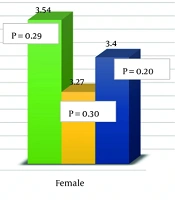
The results of the Kolmogorov-Smirnov test indicated that the data distribution was not normal (P < 0.05), thus the Mann-Whitney test was used for data analysis. The results of the Mann-Whitney test showed a statistically significant difference in the subservient component between medical and nursing students (P < 0.05). However, no statistically significant difference was found in the caring component between the two groups (P > 0.05). According to the results, there was no statistically significant difference in the caring and subservient components based on gender (Table 3).
Table 3.
The Results of the Mann-Whitney Test in the Component of Care and Citizenship Between Two Groups
| Groups | Median | Mann-Whitney U | Z | P |
|---|---|---|---|---|
| Subservient | 4/20 | 1629/5 | -3/041 | 0.002 |
| Nurse students | ||||
| Medical students | ||||
| Caring | 4/07 | 2202/0 | -0/628 | 0.53 |
| Nurse students | ||||
| Medical students |
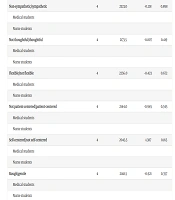
Additionally, the results of the Mann-Whitney test indicated a statistically significant difference between medical and nursing students in the items of confident/vulnerable (P = 0.02), technically focused/not technically focused (P = 0.015), independent/not independent (P = 0.0001), and well paid/poorly paid (P = 0.01), while no significant difference was observed in other items (P > 0.05) (Table 4).
Table 4.
The Results of the Mann-Whitney Test in the Items of the Questionnaire Between the Two Groups
| Items | Median | Mann-Whitney U | Z | P |
|---|---|---|---|---|
| Non-caring/caring | 4 | 2224.5 | -0.580 | 0.562 |
| Medical students | ||||
| Nurse students | ||||
| Non-empathetic/empathetic | 4 | 2134.5 | -0.968 | 0.333 |
| Medical students | ||||
| Nurse students | ||||
| Non-approachable/approachable | 4 | 2338.5 | -0.059 | 0.953 |
| Medical students | ||||
| Nurse students | ||||
| Does not value team work/values teamwork | 4 | 2311.5 | -0.134 | 0.894 |
| Medical students | ||||
| Nurse students | ||||
| Non-sympathetic/sympathetic | 4 | 2323.0 | -0.128 | 0.898 |
| Medical students | ||||
| Nurse students | ||||
| Not thoughtful/thoughtful | 4 | 2173.5 | -0.807 | 0.419 |
| Medical students | ||||
| Nurse students | ||||
| Flexible/not flexible | 4 | 2256.0 | -0.423 | 0.672 |
| Medical students | ||||
| Nurse students | ||||
| Not patient-centered/patient-centered | 4 | 2144.0 | -0.945 | 0.345 |
| Medical students | ||||
| Nurse students | ||||
| Self-centered/not self-centered | 4 | 2043.5 | -1.387 | 0.165 |
| Medical students | ||||
| Nurse students | ||||
| Rough/gentle | 4 | 2148.5 | -0.921 | 0.357 |
| Medical students | ||||
| Nurse students | ||||
| Arrogant/not arrogant | 4 | 2176.0 | -0.786 | 0.432 |
| Medical students | ||||
| Nurse students | ||||
| Theoretical/practical | 4 | 2226.5 | -0.557 | 0.578 |
| Medical students | ||||
| Nurse students | ||||
| Not conciliatory/conciliatory | 4 | 2219.0 | -0.596 | 0.551 |
| Medical students | ||||
| Nurse students | ||||
| Confident/vulnerable | 4 | 1666.0 | -3.071 | 0.002 |
| Medical students | ||||
| Nurse students | ||||
| Assertive/non-assertive | 4 | 2017.0 | -1.504 | 0.132 |
| Medical students | ||||
| Nurse students | ||||
| Values autonomy/does not value autonomy | 4 | 2326.0 | -0.119 | 0.905 |
| Medical students | ||||
| Nurse students | ||||
| Technically focused/not technically focused | 4 | 1824.0 | -2.424 | 0.015 |
| Medical students | ||||
| Nurse students | ||||
| Independent/not independent | 4 | 1497.5 | -3.870 | 0.0001 |
| Medical students | ||||
| Nurse students | ||||
| Well paid/poorly paid | 4 | 1756.0 | -2.560 | 0.01 |
| Medical students | ||||
| Nurse students | ||||
| Confrontational/not confrontational | 4 | 2344.0 | 0.034 | 0.973 |
| Medical students | ||||
| Nurse students |
5. Discussion
The current study aimed to examine the inter-professional attitudes of medical and nursing students. The results showed a statistically significant difference in the subservient component between the attitudes of medical and nursing students (P < 0.05), but no significant difference was found in the caring component. There was also a statistically significant difference between the attitudes of medical and nursing students in the items of confident/vulnerable (P = 0.02), technically focused/not technically focused (P = 0.015), independent/not independent (P = 0.0001), and well paid/poorly paid (P = 0.01). Specifically, the median attitude scores of medical students in the items of technically focused and independence capability were higher than those of nursing students, while in the payment (well paid/poorly paid) item, the attitude score of nursing students was higher. No significant difference was observed between the two groups in other items.
A review of studies related to the attitudes of nurses and doctors towards collaboration showed that there were differences in their results (6). For instance, the findings of the study by Agha Mohammadi et al. indicated that the comparison of scores between doctors and nurses in the four domains showed a significant difference in the areas of care versus treatment and nurses' independence (P < 0.05) (6), which contrasts with the current study's results indicating no difference between the two groups in the care component. However, it aligns with the finding of a significant difference in independence capability. One reason for this discrepancy may stem from the study population. In the current study, our population consisted of students, specifically service learners, whereas in the aforementioned study, the population comprised staff members with different levels of experience and conditions, such as employment status or being on a project. According to studies, the score of attitudes towards inter-professional collaboration has a significant relationship with the employment status of nurses (15).
The study by Kempner et al. showed that medical students’ attitudes towards inter-professional collaboration between doctors and nurses, especially in the areas of "authority" and "responsibility", were significantly more favorable than those of residents. Procedural specialty residents had a lower attitude towards doctor-nurse collaboration compared to non-procedural specialty residents. The findings regarding the attitudes of medical students in that study contrast with the findings of this study, which indicated a significant difference between medical and nursing students in the item of techniques and professional rules, while the difference in attitudes between procedural and non-procedural residents aligns with this study's findings (16). This may be due to prioritizing and seeking opportunities for learning procedures among students.
Groessl and Vandenhouten examined inter-professional attitudes in three groups: Internal medicine residents, nursing students, and master's level social work students. The results showed a significant difference among them, with social work learners having a more favorable attitude towards teamwork, roles, responsibilities, and community orientation compared to their medical and nursing counterparts. This finding contradicts the current study's results, which indicated no difference in the teamwork item (17).
Ulrich et al. also examined inter-professional attitudes among nurses (nursing and pediatric nursing), therapists (physical therapy, speech therapy), and diagnostic specialists (biomedical sciences and radiography). Their study's results indicated that all health professional groups had a positive attitude towards communication, teamwork, and inter-professional relationships. Therefore, there was no significant difference in overall attitude scores among the health specialist groups (18). These findings are consistent with the current study's results indicating no significant difference in the teamwork item score. This shows that nursing and medical students also recognize the value of teamwork in care and treatment.
Inter-professional collaboration facilitates efficient patient care, enhances the ability to solve patient problems, and leads to better clinical outcomes for patients. They emphasized that although the attitude towards inter-professional collaboration among healthcare professionals is highly positive, many healthcare professionals face challenges in inter-professional collaboration. Therefore, it is necessary to develop organizational policies that facilitate learning and interactions among this group of healthcare professionals (4).
However, the tools and criteria used in studies to examine inter-professional attitudes have varied. For example, Norris et al. developed and introduced the "Inter-professional Attitudes Scale" (19). Additionally, several studies have focused on education and intervention to enhance inter-professional attitudes, using attitude assessment tools to evaluate the impact of these interventions (14). For instance, the study by Gregory et al. showed that participation in an inter-professional virtual educational program was associated with improved inter-professional attitudes (20). Research by Algahtani et al. indicated that students and healthcare professionals had positive perceptions and readiness for inter-professional education, recommending the implementation of shared learning through an integrated curriculum (21).
In this study, an attempt was made to use a census method and standard data collection tools to increase the generalizability of the findings. However, given that the study was limited to Islamic Azad University, Sari Branch, further study is needed to generalize the results to other student groups and medical universities.
5.1. Conclusions
Based on the current study, it can be concluded that recent emphases on inter-professional collaboration and the experience of the COVID-19 pandemic among the studied students, as well as the inter-professional collaboration arising from those conditions, have influenced their inter-professional attitudes. There were no significant differences between the two groups in items such as teamwork, patient care, practical ability, patient-centeredness, and empathy. However, areas such as independence, payment, technical focus, and vulnerability require more detailed examination. Furthermore, these topics need to be addressed in educational programs. Therefore, conducting qualitative studies in this area would be beneficial. It is suggested that future studies utilize a longitudinal approach employing a mixed-methods design to explore this topic.
5.2. Limitations
One of the limitations of the current study was that it was conducted at Islamic Azad University and that other universities were not examined and compared. Also, only two groups, medicine and nursing, were examined in this study, so it is suggested that other groups, such as paramedical fields, be included in future studies.