1. Background
Universities are one of the most important and constructive social institutions which must help promote creativity, empowerment and comprehensive development in any society. Universities are the source of acquisition and application of up-to-date world knowledge in various fields (1). As specialized institutions, universities cover courses in various areas such as research, education, consultations, evaluation and supervision. Comprehensive growth and promotion of universities require a strategic orientation and adoption of policies based on growth and development consistent with current environmental changes (2).
One of the most fundamental components of medical education system is curriculum which includes learning opportunities and experiences as the most obvious aspect of the mission and the most practical policy of educational system for management of students’ learning (3). Curricula are designed and implemented under the supervision and responsibility of the educational system in order to create positive changes in knowledge, skills and attitudes of students and to evaluate their performance. Such curricula must be designed to create a dynamic learning environment, facilitate growth of students, and form their true identity. Therefore, realization of human dignity and actualization of students’ potential occurs through education, textbooks, proper teaching and learning conditions and presence of individuals capable of and specialized in implementing the curricula (4).
On the other hand, little comprehensive research has been conducted on medical education environment and its aspects and elements (5) while most studies have focused on a particular aspect of this issue. Accordingly, one of the particular areas in regard to medical education and curricula is spiritual health. In addition to professional training of individuals, medical education as a social institution is required to facilitate spiritual growth as an element influencing other aspects of life including moral obligations, self-esteem and commitment. Studies suggest that spirituality is one of the most important components of students’ lives during their course of studies (6). In fact, spirituality and spiritual growth have a positive impact on the quality of life, individual growth, better understanding of personal and professional goals and meaning of life (7).
Spiritual health is the newest aspect of health besides physical, mental and social health (8). Spiritual health is very difficult to define. Undoubtedly, the comprehensive definition of spiritual health is not limited to the effect of prayers and spiritual states in curing diseases and using them instead of conventional medical treatments or complementary medicine (9). Spiritual health can be defined as having a sense of acceptance, positive emotions, ethics and a sense of positive interaction with a dominant divine power, others and oneself, achieved through a dynamic and harmonious personal cognitive, emotional, functional and consequential process (10). Mozafarinia et al. (11) believe that spiritual health consists of three aspects of cognition, emotion and interaction. The cognitive aspect refers to having a special understanding of God, human and creation, and acceptance of God and divine law as the first step towards God. Knowing oneself is the most important step towards obtaining a knowledge of God. The next step is emotions, sense of peace, joy, hope and love of God and divine prophets. One of the most important indicators of spiritual health and states of a spiritual individual is positive emotions (love of God and divine prophets and spiritual experiences). The aspect of interaction refers to the way an individual expresses their inner spiritual beliefs in the outside world.
Self-esteem is considered part of personality health of individuals because self-affirmation and self-acceptance and a sense of self-worth are characteristics of a healthy and normal personality (12). In other words, self-esteem refers to how individuals think of themselves, how much they love themselves and how they are satisfied with their own performance, especially their feeling about their social and educational performance (13) as well as the harmony and proximity between their ideal and actual self-image. In other words, self-esteem refers to the degree of approval of individuals’ self-worth or their judgment about their own worth (14). As a matter of fact, it is the basic human need for a stable and consistent self-evaluation. It is one of the concepts researchers and thinkers have focused on over the last decades. According to Harter’s (15) hierarchical model, self-esteem is influenced by three major areas: educational, physical and social areas. Development and actualization of students’ self-esteem in these three aspects depends on creating the necessary conditions.
Accordingly, medical education must pay more attention to students’ spiritual growth in its curricular and extracurricular programs, bridge the gap between students’ scientific and spiritual progress (16), and facilitate the development of their self-esteem. Therefore, it is important to identify the factors affecting students’ self-esteem in medical education environments and adopt appropriate measures to implement medical education curricula so that by offering proper strategies, steps may be taken in order to solve the problems in this area.
Many researchers have studied the main variables of the research but no research was found that examined all three variables in students in a single study. Furthermore, the present research adopts a comprehensive approach to study the effect of the mediating variable of spiritual health in the university environment on students’ self-esteem, an issue which has not been considered in previous studies. Previous studies have merely emphasized one of these aspects. For example, Cox (17), Fukofuka (18), Hodge (19), and Williams et al. (20) found that spirituality has a positive effect on students’ academic achievement as well as their ability to overcome problems and stress and build self-esteem. Asplund (21) showed that faith and spirituality have a significant role in students’ decision to stay in university. Forward et al. (22) found a significant relationship between students’ spiritual beliefs and organizational support of universities and students’ commitment. A study by Constantine et al. (23) also confirms that spirituality in students acts as a coping mechanism against educational and professional problems. Bigham (24) found that universities can help students to make a career choice in accordance with their values and beliefs and have a successful performance in their careers by offering programs in the field of spiritual growth. Duffy (25) concluded that religion and spirituality have a significant effect on observing occupational values among university graduates. Duffy and Lent (26) showed that those with a higher level of spirituality acted more maturely in making professional decisions. Considering the above issues, it could be stated that spirituality can affect all aspects of an individual’s life and be associated with scientific and professional values (6, 16).
In this sense, researchers have explained various factors that play a role in the quality of university environment in different educational and research aspects from different perspectives. Achieving these factors facilitates improvement of universities in various areas. Universities are then compelled to design and implement effective educational courses for students and reflect their findings about effective curricula.
Therefore, curricula play a significant role in the educational-research environment of university, students’ spiritual health and its consequent effect on students’ self-esteem. The present paper examined the relationship between educational-research environment of university, spiritual health and students’ self-esteem in higher education curricula in the form of a causal model and a case study. Thus, the research questions include: does the educational-research environment of university significantly predict students’ self-esteem?, does the educational-research environment of university significantly predict students’ spiritual health?, does spiritual health, by controlling the educational-research environment of university, significantly predict students’ self-esteem?, and does spiritual health play a mediating role in the relationship between the educational-research environment of university and students’ self-esteem (Figure 1)?
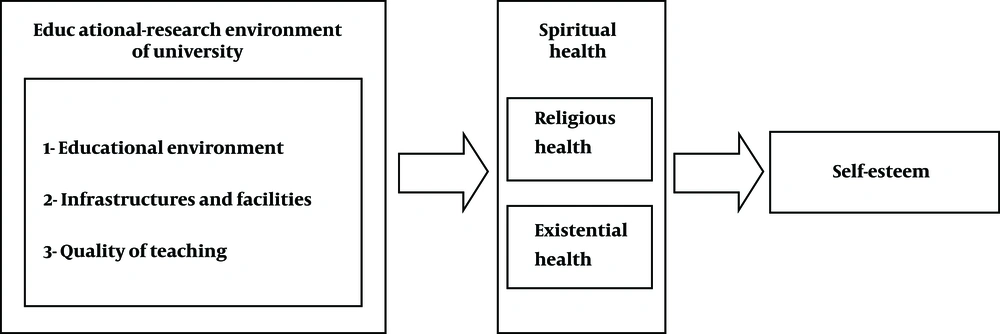
Figure 1.
The conceptual model of the research
2. Objectives
The main aim of this research is to provide the causal model of the educational-research environment of university, spiritual health and students’ self-esteem in higher education curricula of Shiraz University of Medical Sciences (SUMS) in 2018 - 2019.
3. Methods
The present research is a correlational-descriptive study. The statistical population consists of all students of SUMS in the 2018 - 2019 educational year. A sample of 211 students was selected by stratified random sampling. Due to the significance of the subject of spiritual health among students, the sample consisted of students from the third, fifth and seventh semesters selected proportional to the number of students in each semester by using stratified random sampling method. Freshmen were not included in this study.
The following tools were used to study the research variables:
A) Educational-Research Environment of University Questionnaire (27): This questionnaire included 24 items and was constructed using three subcomponents of educational environment (8 items), infrastructure and facilities (8 items) and quality of teaching (8 items). This tool uses five-point Likert scale from never (score 1) to very often (score 5). The minimum and maximum scores obtained in this questionnaire are 1 and 96. Content validity (assessed by experts), construct validity (using principal component analysis and confirmatory factor analysis) and internal consistency (Cronbach’s alpha) of this scale have been confirmed by Ghadampour et al. (27). Kaiser-Meyer-Olkin (KMO) measure of sampling adequacy is 0.90 for this scale and level of significance of Bartlett test is reported to be less than 0.0001. The tool developer reported Cronbach’s alpha coefficient 0.92 for the overall questionnaire and 0.84, 0.81, and 0.92 respectively for the components of educational environment, facilities and infrastructures, and quality of teaching. In the present research, content validity of the questionnaire was confirmed by experts and reliability was 0.90 for the overall questionnaire and 0.76, 0.87, and 0.80 respectively for components of educational environment, facilities and infrastructures, and quality of teaching.
B) Spiritual Health Questionnaire: This questionnaire consists of 20 items, of which 10 measure religious health and 10 measure existential health of a person. Items are scored on a six-point Likert scale from completely disagree (score 1) to completely agree (score 6). Spiritual health score is the sum of these two subscales and ranges between 20 and 120. Using Cronbach’s alpha, Paloutzian and Ellison (28) calculated its reliability as 0.82. Its overall internal consistency has been confirmed in an experimental study by Asghari et al. (29) on 35 students with Cronbach’s alpha of 0.87 and on 343 students of Kharazmi University with Cronbach’s alpha of 0.83. We calculated reliability as 0.79 for the whole scale and 0.65 and 0.68 respectively for religious health and existential health subscales in the present research.
C) Self-Esteem Questionnaire: It includes 10 items with the options of ‘I agree’ and ‘I disagree’. This scale is scored as follows: ‘I agree’ response to each of the items 1 to 5 is +1; ‘I disagree’ response to each of the items 1 to 5 is -1; ‘I agree’ response to each of the items 6 to 10 is -1 and ‘I disagree’ response to each of the items 6 to 10 is +1. Scores above zero show high self-esteem and scores below zero show low self-esteem. Score of +10 shows very high self-esteem and score of -10 shows very low self-esteem. Therefore, the higher the score, the higher the self-esteem. Variation range is between -10 and +10. Alizadeh et al. (30) reported Cronbach’s alpha coefficient of the questionnaire as 0.73. In the present research, reliability was obtained 0.83. Pearson’s correlation coefficient was also used to measure the relationship between the variables. According to Baron and Kenny’s (31) model, sequential simultaneous multiple regression was used to study the relationships in the proposed research model.
4. Results
The correlation coefficients of research variables are shown. There is a positive and significant relationship between the variables of educational-research environment of university and students’ self-esteem, between the variables of educational-research environment of university and spiritual health and also between the variables of spiritual health and students’ self-esteem (Table 1).
Table 1.
Correlation Coefficients of Variables of Educational-Research Environment of University, Spiritual Health and Students’ Self-Esteem
| 1 | 2 | 3 | 4 | 5 | |
|---|---|---|---|---|---|
| Educational-research environment of university | |||||
| 1. Educational environment | 1 | ||||
| 2. Quality of teaching | 0.54b | 1 | |||
| 3. Infrastructures and facilities | 0.51a | 0.66b | 1 | ||
| Spiritual health | |||||
| 4. Religious health | 0.51b | 0.45b | 0.46b | 1 | |
| 5. Existential health | 0.43b | 0.33b | 0.27b | 0.69b | 1 |
| Self-esteem | |||||
| 6. Self-esteem | 0.18b | 0.05 | 0.16a | 0.27b | 0.18b |
aP < 0.05.
bP < 0.01.
The coefficients presented in Table 1 indicate that there is a relationship between the exogenous, mediating and endogenous variables of the model, which provides the prerequisite for path analysis.
Predicting Students’ Self-Esteem Based on the Variable of Educational-Research Environment of University: the effect of educational-research environment of university on students’ self-esteem was studied. Given the results of regression analysis, it can be stated that the components of educational-research environment of university have a significant effect on students’ self-esteem (F = 3.81, P < 0.01). Also, the results of regression analysis indicated that educational environment (β = 0.16, P < 0.05) and infrastructures and facilities (β = 0.21, P < 0.05) predicted students’ self-esteem positively and significantly. But changes in the quality of teaching did not predict students’ self-esteem. Furthermore, educational-research environment of university predicted 5% of total variance of students’ self-esteem. Regression coefficients are presented (Figure 2).
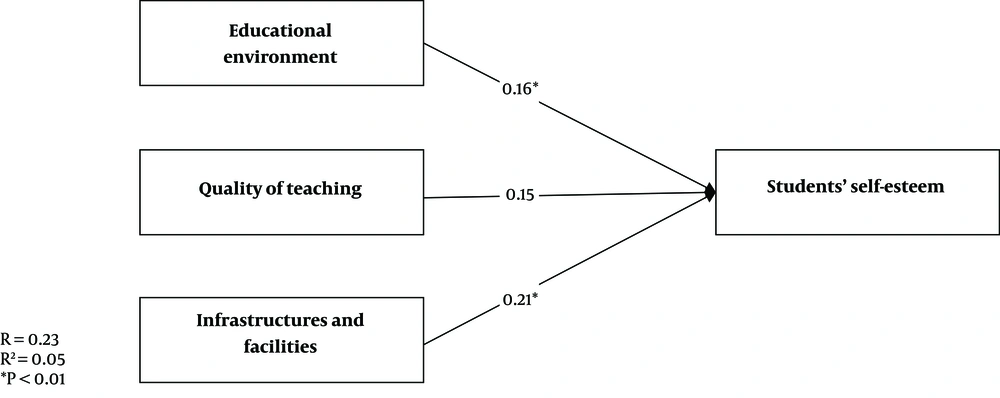
Figure 2.
Predicting students’ self-esteem based on the variable of educational-research environment of university
Predicting Spiritual Health Based on the Changes in Educational-Research Environment of University: Educational-research environment of university was considered as a predictor variable and components of spiritual health as the criterion variable. Thus, two simultaneous multiple regression analyses were conducted. The results of regression analyses for each aspect of spiritual health are as follows:
A) Spiritual Health: According to the results of regression analysis, the components of educational-research environment of university have a significant effect on religious health (F = 33.62, P < 0.001). Also, the results of regression analysis indicated that educational environment of university (β = 0.33, P < 0.0001) and infrastructures and facilities (β = 0.19, P < 0.01) predicted students’ religious health positively and significantly. But the variable of quality of teaching did not predict students’ religious health. In addition, educational-research environment of university predicted 33% of the total variance of students’ religious health. Regression coefficients are shown (Figure 3).
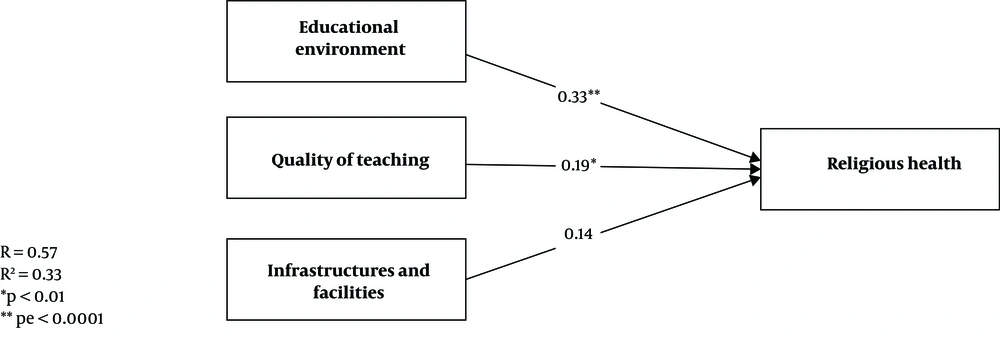
Figure 3.
Predicting students’ spiritual health based on the components of educational-research environment of university
B) Existential Health: Considering the results of regression analysis, the components of educational-research environment of university have a significant effect on students’ existential health (F = 16.96, P < 0.0001). The results of regression analysis also indicated that educational environment (β = 0.35, P < 0.0001) predicted students’ existential health positively and significantly. Based on the results of the present research, the components of quality of teaching and infrastructures and facilities did not predict students’ existential health. In addition, educational-research environment of university predicted 20% of the total variance of students’ existential health. Regression coefficients are shown (Figure 4).
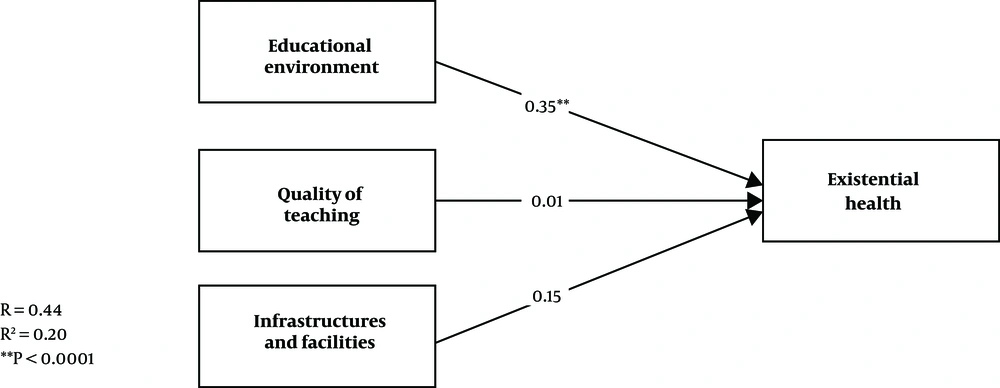
Figure 4.
Predicting students’ existential health based on the components of educational-research environment of university
Predicting students’ self-esteem based on the two variables of educational-research environment of university and spiritual health: The components of educational-research environment of university and spiritual health have a significant effect on students’ self-esteem (F = 4.40, P < 0.001). The results of regression analysis also indicated that infrastructures and facilities (β = 0.20, P < 0.05) predicted students’ self-esteem positively and significantly, but educational environment and quality of teaching did not predict students’ self-esteem. Also, religious health predicted students’ self-esteem (β = 0.25, P < 0.001) positively and significantly. In addition, educational-research environment of university and spiritual health predicted 59% of the total variance of students’ self-esteem. Regression coefficients are shown (Figure 5).
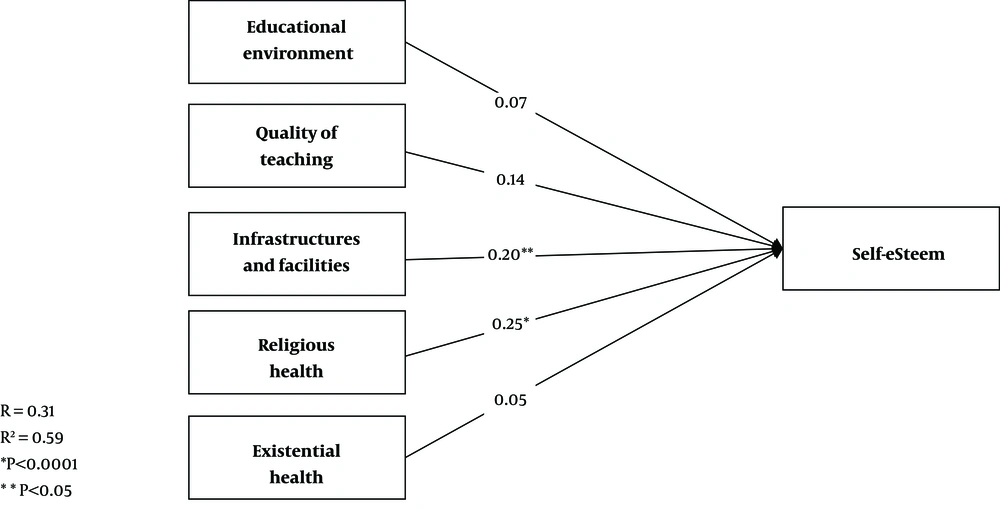
Figure 5.
Predicting students’ self-esteem based on spiritual health while controlling educational-research environment of university
Studying the Mediating Role of Spiritual Health in the Relationship Between the Components of Educational-Research Environment of University and Students’ Self-Esteem: By studying and comparing the regression coefficients of components of educational-research environment of university in the first and third phase, it was found that the regression coefficient of educational environment decreased from 0.16 to 0.07, quality of teaching from 0.15 to 0.14 and infrastructures and facilities from 0.21 to 0.20. In this case, religious health has a full mediating role between the variables of educational environment and students’ self-esteem. By eliminating the insignificant paths, the final model was obtained (Figure 6).
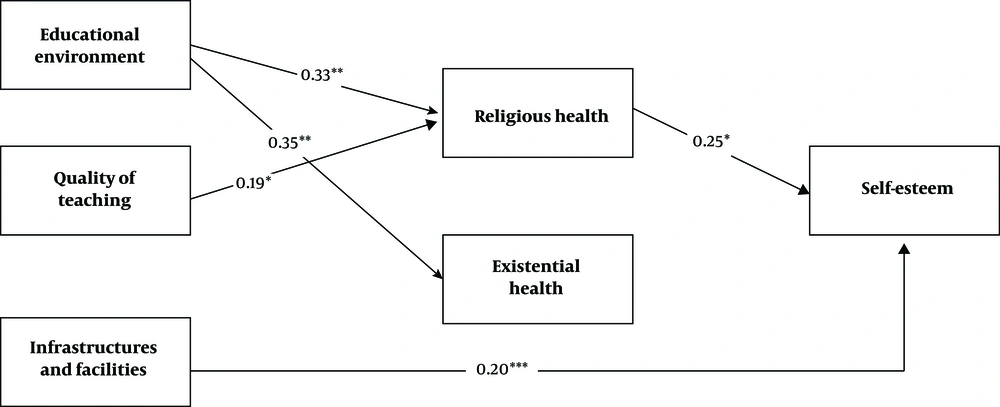
Figure 6.
Final model of students’ self-esteem
5. Discussion
Studying the relationship between the exogenous variable of educational-research environment of university and the endogenous variable of students’ self-esteem showed that educational environment, the curricula and infrastructures and facilities are positive and significant predictors of students’ self-esteem. These findings are consistent with the results of other studies (2, 15, 27, 28). In fact, the university environment, as an intellectual and ethical environment, must create and circulate knowledge and provide suitable curriculum content and thus enhance students’ motivation and constructive interactions. Undoubtedly, such an environment provides the context and conditions for acquisition of competencies, successes, virtues, acceptance, attention and compassion of others as well as students’ success and building self-esteem as a belief. Therefore, the university curricula, due to their important role in the areas of education, research and providing scientific and social services, facilitate such a success and serve as effective steps in fulfilling the ideals of society. Higher education means investment in human resources and students make up a large portion of society. This young population plays a major role in building a healthy society in the future. Blossoming of the talents and development of proper performance distinguishes students as key players in society with high self-esteem.
The results of another part of the research showed that the components of the educational-research environment of university significantly predicted students’ spiritual health. This finding is consistent with the results of other studies (10, 11, 16). Research shows spiritual growth is one of the most important components of students’ lives during their course of studies (6). In fact, on the one hand, spiritual health is associated with human’s spiritual experience, which refers to an individual’s perception of health in their spiritual lives when they interact with a higher power. On the other hand, it refers to individuals’ compatibility with themselves, society and environment. In fact, a curriculum must be considered as the architecture of knowledge which must be continuously revised and modified to play an important role in the growth and evolution of learners. In this regard, due to their familiarity with the factors affecting the curricula, faculty members are important participants in designing the curricula. They play a major role in students’ tendency toward finding meaning and purpose in life, deep understanding of the value of life, altruism and having a sense of social justice and, in general, a propensity toward spiritual matters. Accordingly, in spite of considering various aspects and elements of the curriculum including goals, contents, materials, sources, time and place, teacher and student; spiritual orientations in different religious and existential aspects should be taken into consideration, so that students may develop spiritual tendencies and build self-esteem.
5.1. Conclusions
Considering the relationship between research variables, the quality of university educational and research environments should be improved through educational and non-educational activities. In this way the basis for the improvement of students' spiritual health and as a result their self-esteem is provided. This issue highlights the necessity of proper planning by university officials.