
1. Background
Genomics in sports is one of the relatively new scientific insights focusing on the organization and performance of genomes in elite athletes (1). Scientific data have supported the influence of several genes on the physical performance of elite athletes. In fact, genes determine about 50% of the variability in physical performance (2). One of the major factors required for the physical performance of body is the availability of energy for muscle activity. In muscle tissues, muscle-specific creatine kinase (CKMM) is an important energy-supplying enzyme (3). It has been suggested that the CKMM gene A/G polymorphism is associated with physical performance among karate athletes (4). Similarly, Fedotovskaya et al. demonstrated that the frequency of the CKMM G allele was significantly higher in a group of Polish and Russian athletes than in non-athletes (5). Furthermore, the AG genotype of creatine kinase was significantly associated with the responses of maximal oxygen consumption (6) and running economy (7) to endurance training.
It is also well documented that the peroxisome proliferator-activated receptor gamma co-activator 1-alpha gene (PGC-1α, encoded by the PPARGC1A gene in humans) is an important component of exercise-induced muscle adaptation because it is one of the activators of transcription factors controlling gene expression in response to exercise. Researchers have pointed out the role of the PGC-1α genotype in predicting endurance capacity (8). In this regard, Jin et al. found that the Gly/Gly genotype of the PPARGC1A gene could have a beneficial effect on endurance status in elite athletes (9). It is also suggested that the PGC-1α gene polymorphism in non-athlete adolescents is a determinant of their endurance performance, but not of their speed and power performance (10).
Although an appropriate genetic predisposition is not simply enough for successful sport performance, the effect of genes should not be overlooked in many sport activities because it can help increase adaptive capacity or response to exercise in different sports. Hockey is categorized as a high-intensity intermittent exercise (11), which requires high levels of physiological demands. Since they perform most of the game with an intensity of greater than 85% of the maximum heart rate, the improvement in aerobic capacity is followed, thus leading to an enhanced profile of physical activity during the game (12). As aforementioned, the PGC-1α and CKMM genes are considered muscle-specific determinants of physical performance through supplying energy and regulating gene expression (7, 10). Thus, it is important to understand the role of CKMM and PGC1-α genes polymorphisms in elite hockey players, which could help identify and select the most talented athletes at a young age more accurately with the lowest error rate; this may lead to the successful performance of Iranian athletes at the international level. Furthermore, adopting such an approach could reduce the misuse of financial resources and manpower considerably. Therefore, given the importance of aerobic capacity in hockey athletes, as well as the lack of research in this area, the aim of this study was to evaluate the CKMM and PPARGC1A genes polymorphisms in elite hockey players.
2. Methods
2.1. Participants
The study was descriptive developmental in design. The participants included 50 hockey athletes and 100 non-athletes. The athletes were members of the national hockey team of the Islamic Republic of Iran chosen through a selective sampling procedure based on their sports background and the definition of elite athlete. Research sampling and the assessment of participants’ health and medical records were conducted following necessary arrangements with the hockey federation and administration of consent questionnaires. The control group involved healthy individuals while presuming the random distribution of different Iranian ethnicities and races. This study was approved by the Ethics Committee of Sports Sciences Research Institute of Iran (SSRII) (reference No. IR.SSRI.REC.1400.1003).
2.2. DNA Extraction from Saliva
From each participant, 2 mL of saliva was sampled, and the respective DNA was extracted using Gene Varz Company kits following laboratory instructions.
2.3. Primer Design
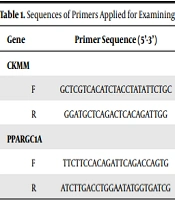
The primers were designed using the Oligo7 software. To ensure their specificity, the Primer-BLAST software available in the National Center for Biotechnology Information (NCBI) database was used. After the specificity of the performance of the primers was ensured, they were sent to the Sinaclon Company for synthesis. The names of all of the primers, along with their sequences and expected base pairs are listed in Table 1.
Table 1.
Sequences of Primers Applied for Examining Polymorphisms
| Gene | Primer Sequence (5’-3’) | PCR Product Base Pair |
|---|---|---|
| CKMM | 311 | |
| F | GCTCGTCACATCTACCTATATTCTGC | |
| R | GGATGCTCAGACTCACAGATTGG | |
| PPARGC1A | 491 | |
| F | TTCTTCCACAGATTCAGACCAGTG | |
| R | ATCTTGACCTGGAATATGGTGATCG |
2.4. Genotyping
For determining the genotypes in the current study, the PCR-RFLP method was employed.
2.5. Genotyping PGC1-α and CKMM Gene Polymorphisms
To determine the genotypes of the CKMM gene, the restriction fragment length polymorphism (RFLP) method was utilized. The restriction enzymes and the characteristics of base pairs related to the CKMM gene are displayed in Table 2. Enzymatic digestion was conducted overnight at temperature 37ºC involving 1 μL (microliter) of the enzyme (Thermo Scientific, Eco130I, #ER0411, Germany), 3 μL of the PCR product, 2 μL of special buffer, and 15 μL of deionized water.
Table 2.
Restriction Enzymes Used for Genotyping the CKMM and PPARGC1A Genes Polymorphisms
| Gene | Enzyme | PCR Product Base Pair | Enzymatic Digestion Product Base Pair |
|---|---|---|---|
| CKMM | Eco130I | 311 | |
| AA | 108-203 | ||
| GA | 108-203-311 | ||
| GG | 311 | ||
| PPARGC1A | MspI | 491 | |
| GG | 172-319 | ||
| GA | 172-319-491 | ||
| AA | 491 |
Following enzymatic digestion, the product of enzymatic digestion was electrophoresed on a 12% polyacrylamide gel to observe the pair bases. Then, three samples with different genotypes were sent to the CodonCode Company for sequencing. The sequencing data were analyzed by SnapGene Viewer, version 5.3.2.
To determine the genotype of the PPARGC1A gene, the RFLP method was applied. Table 3 presents the restriction enzymes and the characteristics of base pairs related to the PPARGC1A gene. Enzymatic digestion was carried out overnight at temperature 37ºC involving 1 μL of the enzyme (Thermo Scientific, Mspl, #ER0541, Germany), 3 μL of PCR product, 2 μL of a special buffer, and 15 μL of deionized water. After enzymatic digestion, the product was electrophoresed on a 12% polyacrylamide gel to observe the pair bases. Finally, three samples with different genotypes were sent to the CodonCode Company for sequencing.
Table 3.
PPARGC1A Genotype and Allele Frequencies and Percentages Across Groups a
| Genotype | PPARGC1A | ||||
|---|---|---|---|---|---|
| Control | Hockey | Allele | Control | Hockey | |
| AA | 12 (12) | 6 (12) | A | 64 (32) | 29 (29) |
| GG | 48 (48) | 27 (54) | G | 136 (68) | 71 (71) |
| AG | 40 (40) | 17 (34) | |||
| Total | 100 (100) | 50 (100) | |||
aValues are expressed as No. (%).
2.6. Data Analysis
After examining the variants of the two groups (viz., hockey athletes and controls) in terms of the Hardy-Weinberg equilibrium, the allele and genotype frequencies of the groups were prepared and compared through the chi-square test using SPSS software (version 25). The significance level was set at P < 0.05.
3. Results
3.1. PPARGC1A Gene Polymorphism
The descriptive data related to the AA, GG, and AG genotypes of the PPARGC1A gene are presented in Table 3. Based on the descriptive statistics, the frequency of the AA genotype was similar in both hockey athletes and control groups (12%). The frequency of the GG genotype was 6% higher in the hockey athletes group than in the control group (54% vs. 48%). Moreover, the frequency of the AG genotype was 40% in the control group and 34% in the hockey athletes group. The results of the chi-square test revealed no significant differences between the two groups in terms of AA, GG, and AG genotypes (P = 1.000, P = 0.603, and P = 0.593, respectively).
3.2. CKMM Gene Polymorphism
The descriptive data related to the CKMM gene polymorphism are shown in Table 4. According to the table, the frequency of the AA genotype was 5% higher in the hockey athletes group than in the control group (33% vs. 38%). Similarly, the frequency of the GG genotype was 2% higher in the hockey athletes group (12% vs. 10%). As for the frequency of the AG genotype, it was 7% lower in the hockey athletes group than in the control group (50% vs. 57%).
Table 4.
CKMM Genotype and Allele Frequencies and Percentages Across Groups a
| Genotype | CKMM | ||||
|---|---|---|---|---|---|
| Control | Hockey | Allele | Control | Hockey | |
| AA | 33 (33) | 19 (38) | A | 123 (61.5) | 63 (63) |
| GG | 10 (10) | 6 (12) | G | 77 (38.5) | 37 (37) |
| AG | 5 7 (5 7) | 25 (50) | |||
| Total | 100 (100) | 50 (100) | |||
aValues are expressed as No. (%).
According to the results of the chi-square test, despite the greater frequency of the AA genotype in the hockey athletes group, no significant difference in this regard was detected between the groups (P = 0.671). In the same vein, there were no significant differences between the groups in terms of the frequency of either GG (P = 0.926) or AG genotype (P = 0.524).
4. Discussion
The primary aim of this study was to determine the polymorphisms of CKMM and PPARGC1A genes in Iranian elite hockey players. The results of the current study showed no significant differences between hockey players and non-athletes in terms of AA, AG, and GG genotypes of PPARGC1A gene polymorphism.
The PPARGC1A gene, as a transcription factor, controls the mitochondrial biogenesis and oxidative phosphorylation in skeletal muscles (13). On the other hand, aerobic capacity depends on the mitochondrial function of skeletal muscles (14). In line with this study, Eynon et al. showed that a small number of the A allele and a high level of the GG genotype were associated with an increase in endurance performance ability (15). The amount of the G allele in the hockey athletes group was about 71%, which was about 3% more than that in the control group. Scholars have reported that the GG genotype is more common among endurance athletes (16). A study also showed that the GG genotype was 18% in speed athletes such as skaters while the AG and AA genotypes were 32% and 2%, respectively (17). Additionally, in endurance athletes such as cross-country skiers, the frequency of each of the aforementioned genotypes was 28%, 32%, and 4%, respectively (17). These findings suggest that the A allele could hamper aerobic capacity; however, the G allele might be regarded as an influential factor in endurance performance (2), as it is mostly present among endurance athletes (18). Contrary to this study, it has been suggested that the frequency of the G allele is not greater in athletes than in non-athletes (8). Therefore, the high levels of the GG genotype in the current study could be apparently one of the genetic characteristics associated with the high levels of muscular and aerobic endurance among hockey athletes.
The results related to the AA genotype of PPARGC1A are generally different across races. Researchers have demonstrated that when compared to the GG genotype, people with greater levels of the AA genotype tend to have less maximal oxygen consumption (19). It has also been shown that the AA genotype differs across endurance and speed athletes; this genotype is not usually observed in endurance athletes, but it is at a rate of about 13% for speed athletes (15).
It has been revealed that the AG genotype of the PPARGC1A gene is present in both elite athletes and non-athletes, although it is significantly higher in the former (2). It has been also shown that this genotype is strongly associated with speed, time, and maximal oxygen consumption (2). In another study, Russian researchers found that the AG genotype in endurance athletes was significantly related to a high proportion of slow-twitch fibers and maximal oxygen consumption (20). In addition, Lucia et al. indicated the role of the AG genotype in predicting aerobic fitness among male Spanish endurance athletes (8).
Another major finding was that the genotypes of the CKMM gene for the athletes were not significantly different from those of their non-athlete counterparts in the control group although the frequency of the genotypes differed between groups (i.e., the AA and GG genotypes were about 5% and 2% higher in the athletes than in the control group, respectively, while the AG genotype was 7% greater in the latter group).
Given that there seems to be no research attempt for the evaluation of CKMM gene polymorphism among hockey athletes and that the results of the current study indicated no overall differences between the two groups under investigation, the AA genotype of the CKMM gene has been reportedly associated with a high level of maximal oxygen consumption among sailing athletes (21). In this study, the AA and GG genotypes were higher in the elite athletes than in the non-athletes even though they did not reach the significance level. However, the AG genotype was lower in the elite athletes. Contrary to this study, Batavani et al. showed that the AG genotype of CKMM gene polymorphism was significantly higher in professional and semi-professional athletes than in the control group. Specifically, the results indicated that in professional athletes, the AA, AG, and GG genotypes were 31.3%, 56.9%, and 11.6%, respectively. In non-professional athletes, however, the rates were 32.5%, 43%, and 24.4%, respectively (4). In another study among non-athlete individuals, those with the AA genotype ran a higher risk of increased creatine kinase in response to exercise when compared to individuals with the GG and AG genotypes; the G allele may, thus, be associated with a protective mechanism against muscle breakdown due to pressure. Unfortunately, such studies have not investigated athletes (5). Furthermore, the AA genotype and A allele were 59.7% and 78.7% in endurance athletes, respectively, while the respective frequencies for the control group were 44.2% and 65.4%. The G allele was 45.9% among strength athletes and 34.6% in the control group, a difference that did not reach the significance level. Nevertheless, the difference between the two groups in terms of the GG genotype was statistically significant (31.1% for strength athletes vs. 13.4% for the control group) (21). In the present study, the A allele was 1.5% higher in hockey players than in non-athletes.
The AG genotype of the CKMM gene is related to skeletal muscle functions in humans; it is also associated with the physical performance and maximal oxygen consumption during endurance and power exercises (22). In a study, a significant difference was found between power athletes and the control group in terms of the AG genotype. In this regard, higher levels of the G and GG genotypes of creatine kinase were observed in strength athletes than in the control group (23). The A allele and AA genotype were significantly greater among Russian endurance athletes than in the control group (21). The A allele is likely to affect gene expression, reduce creatine kinase in heart muscles, stimulate greater oxidative phosphorylation, and, thus, help build up endurance (5). On the other hand, the GG genotype was significantly higher among Russian weightlifting athletes than in the control group (21). It seems that the AA genotype and A allele could play a greater role in building up endurance while the G allele, which was higher in weightlifting athletes, may have an important role in the quality of power and strength (21). However, it appears that more research in this area is needed before we could clarify and confirm the findings reported here.
There are also some recommendations to be considered in future studies. For instance, the sample size should be bigger to ensure the validity of the findings. Moreover, the likely effect of multiple genes on the phenotype or expected performance in athletes should be taken into account; in other words, the reason why the results obtained in some studies were not significant could not be unrelated to the probable overlapping effect of other genes.
Among the limitations of the present study, the small number of very professional hockey athletes available is worthy of note. In addition, due to the conditions caused by the COVID-19 pandemic, it was not possible for the research team to conduct performance evaluations; this should be considered in future research.
4.1. Conclusions
In sum, by examining the frequency of the PGC1-α and CKMM genes polymorphisms, no significant differences were noticed between the Iranian elite inline hockey athletes and non-athletes, which may be due to the overlapping effect of other genes and/or the small size of the sample under study.