
1. Background
The performance and physical activity of each individual depends on the nature of the assignment, which is affected by several causes e.g. psychology, environment and genetic background. However, favorable genetic background is not enough for optimal sport performances, which are yielded by intensive training. Nevertheless, the influence of genes across a range of athletic activities should not be ignored to be effective in raising the capacity to respond/adapt to training (1).
The energy supply for muscle activity is a key factor required for physical performance. Especially, efficiency of the adenosine triphosphate (ATP) synthesizing resources seems to be important. In muscle tissues, the muscle isoform of creatine kinase (CKM) is a key enzyme of energy supply (2-5). CK-MM is located at the surface of myosin filaments near actomyosin ATPase and is involved in the provision of the energy for the working myosin heads, supplying them with newly synthesized ATP in the course of muscle contraction (6). Also, this protein is sited at the surface of the endoplasmic reticulum and influences muscle contraction by regulating the calcium ion flux during the tension and relaxation phases (7). In addition, CK-MM along with the mitochondrial creatine phosphokinase isoform is involved in the transport of energy to muscular contraction proteins (8, 9).
Previous studies have demonstrated that the inhibition of the CK-MM activity causes a reduction in the intensity and strength of muscle contractions resulting in an enhanced oxygen uptake by contracting muscles (10, 11). The CK-MM is encoded by the CK-MM gene (19q13.2 - 13.3). Interestingly, there was enhanced aerobic performance and lower fatigability after long-term physical activity in CK-MM knockout mice. Therefore, it may be supposed that CK-MM activity plays a key role in limitation of the possibility of performing long-term physical exercise.
The A/G variant is (rs8111989) situated in the 3’-untranslated area of CKM gene (OMIM: 123310), which seems to be relevant in terms of genetic testing in sportsmen (3). This SNP may have an influence on the mRNA stability and may change the gene expression (12). It is believed that the A/G polymorphism is also associated with different CK-MM activities in myocytes (13). The frequency of the minor G allele in this type of polymorphism varies in the range from 15% in the Chinese population to 29% - 35% in Caucasians and 32% in white Americans (14-16). Recently interdependence between the CK-MM A/G polymorphism and individual differences in the expression of the physical qualities of a person has been shown in several studies (17, 18). Association of the CK-MM A/G polymorphism with the increment in aerobic power after aerobic physical training of subjects not engaged in sports has been demonstrated (13, 16, 19).
Martial arts are considered as having a high static (> 50% MVC) and low dynamic (< 40% VO2 max) component. The increasing static component for martial arts is likely due to the percentage of maximal voluntary contraction (MVC). Therefore, in martial arts, a moderate total of cardiovascular demand and continuous tension and relaxation phases is seen (7, 20). On the other hand, CK-MM is a key enzyme of energy supply which demonstrates aerobic performance capability. So it may be supposed that CK-MM activity plays a key role in limitation of the long-term martial arts performance. As, Karate is one of the most popular martial arts, hence this study was performed on karate competitors.
2. Objectives
In a deep view of the physiological role of CK-MM, it would be particularly interesting to reveal the inter relation between the CK-MM gene A/G polymorphism and the levels of physical performance among karatekas.
3. Methods
This investigation was carried out on 275 subjects (mean age 27.2 ± 7.4 years) residing in the state of Isfahan in Iran with participation of 172 karatekas (male; n = 93; female, n = 79) (included kata = 17.3%; kumite = 76.8% and both kata/kumite = 5.9% competitors)(divided in two groups of professional (86 professional (male: n=43 and female: n=43); + 86 amateur athletes (male: n = 50 and female: n = 36) compared with 103 non-athletes (male; n = 50; female, n = 53).
All subjects in professional group were members of Iranian national teams (Junior and senior/ male and female in last decade) who had earned a medal or good score in world, Asian, international or national championships. Among them, 5 athletes had honorary worldwide and Asian places. Also, 50 athletes had honorary international places and 117 athletes had honorary country places as the highest rank in their experience.
All members in amateur group succeeded to take the black belt in karate (at least four years experience in karate), but they didn’t succeeded to get any score or medal in the aforementioned championships. The control group consisted of 103 subjects (male; n = 50; female, n = 53). The main condition for including subjects in the control group was the absence of previous experience in any sport on a regular basis.
The subjects were familiarized with the experimental conditions and gave their written consent to participate in the experiment. Also, there were no familial inter- and intra-group relation of subjects; also bioethics aspects were considered based on the criteria described by advisory board of the faculty of physical education and sport sciences. Blood samples were taken from all subjects and genome was isolated according to the alkali treatment protocol as already described (21).
3.1. DNA Isolation
In this process, 2 mL blood samples were taken from each individual, after completing a consent form. Genomic DNA was extracted from peripheral blood samples using standard salting out procedure. To evaluate quantity and quality of extracted DNA, absorbance at 260/280 nm, was measured by a NanoDrop spectrometer (Nanodrop 1000; Thermo Scientific, Wilmington, NC, USA), and by electrophoresis on 1% agarose gel. Extracted DNAs were stored at -20°C until further usage for genotyping analysis.
3.2. DNA Amplification and Restriction Fragment Length Polymorphism (RFLP) Analysis
The CK-MM gene A/G polymorphism was determined by PCR using a specific primer pair (the forward primer, 5’-GGG ATG CTC AGA CTC ACA GA-3’; the overturn primer, 5’-AAC TTG AAT TTA GCC CAA CG-3’). The PCR reaction was in a volume of 25 μL containing 1 μL extracted genome (approximately 100 ng) as template and 0.2 μM of each primer, 0.2 mM each of deoxynucleotidetriphosphate (CinnaGen Co.), 1.25 U Smar taq DNA polymerase (CinnaGen Co.), and 4mM Mg2+ (Cinnagen Co.). PCR conditions were set as one cycle for 5 min at 94°C as the preliminary denaturation step, 35 repetitive amplification cycles including 30 Sec at 94°C, 45 Sec at 57°C and 45 Second at 72°C, followed by a final cycle for 7 minutes at 72°C. Amplicons, 359 bp in length were treated with the restriction endonuclease Bsp/9I (SibEnzyme). A 359 bp fragment corresponding to the allele was cut producing202- and 157-bp fragments. If the length of fragment was 359 it demonstrated the G/G genotype and whether the length of fragments were 202 and 157 it demonstrated the A/A genotype, and if the length of fragments were 157, 202 and 358 it demonstrated the A/G genotype. The restriction fragment lengths of the products were analyzed by electrophoretic separation in 2% agarose gel followed by staining with ethidium bromide and visualization in transmitted ultraviolet light.
3.3. Statistical Analyses
The graph was prepared with the Graph Pad in Stat software. The differences were considered statistically significant at P < 0.05. Differences in the all frequency were assessed by SPSS software and non-parametric chi-Square test. Calculation of odds ratio (OR) with 95%, confidence intervals (95% CI) was used to assess correlations between SNPs and professional, amateur athletes possibility.
4. Results
The electrophoresis of the PCR products were led to diagnosis of the types of the allele (A/G: in length of 157 bp and 202 bp respectively) and genotype of all subjects (Figure 1).
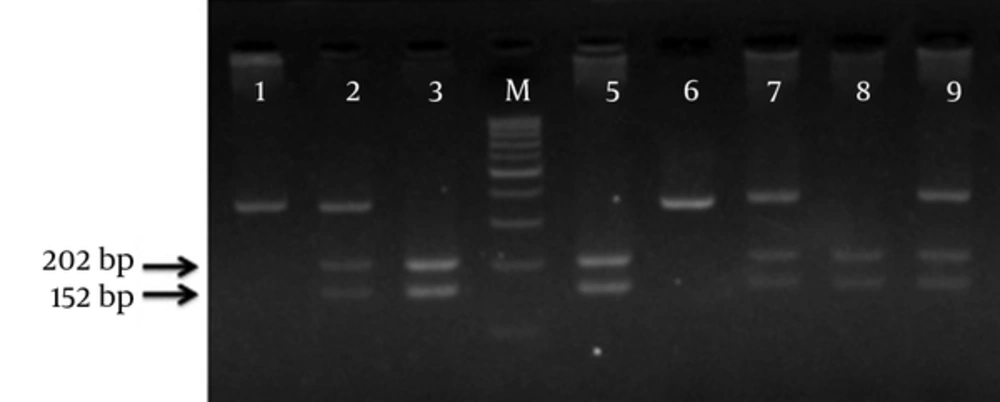
Figure 1.
Representative of An Agaros Gel Electrophoresis of PCR Partial Products of CK-MM Gene. Lane 3, 5, 8; AA Genotype (157 bp), Lanes 2, 7, 9; AG Genotype (157, 202 bp) and Lanes 1, 6; GG Genotype (202 bp). M (Lane 4) is DNA 100 bp Ladder (Fermentas)
The distribution analyses of genotype and allele frequencies by the CK-MM gene (A/G polymorphism) in athletes and control subjects have shown the subsequent findings. Chi-Square tests revealed that there was a significant difference in distribution of CK-MM gene, totally (P = 0.0003). The AG genotype (52.4%) was the most common prevalence and the GG genotype (14.1%) was the least of them (χ2 = 16.79, P = 0.0001).
Table 1.
Distribution of the CK-MM Genotype in Subjectsa
| Groups | CK-MM Genotype (Number and Percentage) | ||
|---|---|---|---|
| GG | AG | AA | |
| Professional | 10 (11.6) | 49 (56.9) | 27 (31.3) |
| Amateur | 21 (24.4) | 37 (43.0) | 28 (32.5) |
| Non-athlete | 8 (7.7) | 58 (56.3) | 37 (36) |
| Total (Professional, Amateur and Non-Athletes) | 39 (14.1) | 144 (52.4) | 92 (33.4) |
aValues are expressed as number percent.
Multinomial logistic regression analysis used for differentiating three groups to estimate odd ratio (OR) of each genotype (Table 2). As shown in Table 2, Frequency of T/T and C/T in comparison to C/C genotype significantly decreases in amateurs versus control group (OR = 0.278, 0.137 < CI < 0.565 P value < 0.001; OR = 0.238, 0.133 < CI < 0.425 P value < 0.001, respectively). But there is no statistically significant difference between elite and control.
Table 2.
The Comparison of the CK-MM Genotype Distribution in Groups
| Conditiona | Parameter Estimates | ||||
|---|---|---|---|---|---|
| Sig. | Odd ratio | 95% confidence interval for Exp (B) | |||
| Lower bound | Upper bound | ||||
| Elite | CKMM gene = T / T | 0.218 | 0.583 | 0.247 | 1.375 |
| CKMM gene = T / C | 0.248 | 0.660 | 0.326 | 1.336 | |
| CKMM gene = C / C | 0 | 1.000 | . | ||
| Amateur | CKMM gene = T / T | < 0.001 | 0.278 | 0.137 | 0.565 |
| CKMM gene = T / C | < 0.001 | 0.238 | 0.133 | 0.425 | |
| CKMM gene = C / C | 0 | 1.000 | . | . | |
aThe reference category is: Control.
5. Discussion
The present survey, analyzed the CK-MM gene A/G polymorphism in two populations of athletes in contrast not athletic healthy group. The genotyping of CK-MM showed differences in all subjects. Estimation of the genotype frequency distribution showed that the CK-MM AG genotype frequencies in Iranian population (professional, amateur karate athletes and control subjects) were significantly higher than AA and GG genotypes, significantly; while the frequency of AA genotype was more than GG genotype, too.
In a study by Khaledi et al. on 100 Iranian elite athletes (who participated in Olympic and world championships in different sports) and 100 non-athletes as control group, similar results were obtained (22). The CKMM AA genotype was associated with high values of VO2 max and this result showed that Iranian athletes and non-athletes had more endurance potential (4). As the G allele is the rare allele for the CKM-NcoI polymorphism, researchers have speculated that this allele is associated with a protective mechanism against muscle breakdown (15).
Results showed that the CK-MM gene AG genotype occurrence in professional group (AA: 31.3%, AG: 56.9%, GG: 11.6%) was significantly different with those observed for amateur karatekas (AA: 32.5%, AG: 43.0%, GG: 24.4%) and furthermore, CK-MM genotype in amateur group was also significantly different with non-athletes (AA: 36%, AG: 56.3%, GG: 7.7%).
Results of a case control study of 384 Russian athletes and 1116 nonathletic controls showed that CK-MM A allele and AA genotype carriers were more frequent among endurance athletes than in controls, while GG genotype was more prevalent in weightlifters compared to control subjects (31.1% vs. 13.4%) (4). Fedotovskaia et al. have also reported that the incidence the CK-MM G allele in Polish and Russian combat athletes (among primarily power component of athletic performance) was more than control, significantly (41.2% vs. 35.6%) (4).
On the other hand, Eider et al., showed no statistical differences between CK-MM genotypes obtained for Polish or Russian rowers compare to the control group. Hence, they concluded that the CK-MM A/G polymorphism was not the main determinant factor for endurance performance in those athlets (3). Another study by Martinez et al. examined the frequency of CK-MM SNP rs8111989 in Hispanic marathon runners compared to the control and they reported no significant differences in allele rates of these SNPs (21).
Although there is no significant differences between the frequency of CK-MM genotypes in professional karatekas and non-athletes, we have found association between this SNP of the CK-MM gene and athletic status among karatekas (elite and amateur). Therefore, it can be speculated that SNP rs8111989 in CK-MM is an important determinant of karatekas’ performance level. Similar to professional karatekas, there are several individuals with the same CK-MM genotyping in non-athlete group whose ability for karate training has not been identified yet. However, significant difference in CK-MM genotyping between elite and amateur karatekas reflects a relation between the CK-MM gene A/G genotype and elite karateka performance. It should be emphasized that on the basis of relative aerobic/anaerobic energy system contribution (mixed anaerobic/aerobic energy production), time of competitive exercise performance, and intensity of exertion, karate cannot be categorized as a pure endurance sport. The mixed strength/endurance character of karate falls between both endpoints (power versus endurance) of the athlete phenotype variety. The aerobic role to overall energy production among exercise and the ability of muscles to produce high power at high velocities is important, too.
Karate is a high static and low dynamic sport. The increasing static component in this classification for martial arts is due to the likely percentage of maximal voluntary contraction (MVC) as martial arts need moderate total cardiovascular demands (20).
Finally, our results of this survey showed the relationship between A/G polymorphism and Iranian karate elite and amateur performance. Prevalence of the CK-MM gene AG genotype among the elite and amateur karatekas improved the chance of its responsibility in brilliant karatekas performance.
In conclusion, to clarify the role of CK-MM gene polymorphism in athletic status, an intensive study at large scale is needed which should be performed in future studies.