
Peer review is a judgement on another researcher’s work, and it can shape a career. Brieflands treats it as the central responsibility of running a journal. This page sets out how review works across all Brieflands journals: who reviews, what is masked from whom, what reviewers commit to, and what authors can expect.
Scope
All submitted manuscripts, external review and editorial approval
Reviewers per manuscript
At least three independent reviewers
Masking
Reviewers do not see author identities; associate editors do
Typical decision time
Usually 2–3 months from submission
How review works
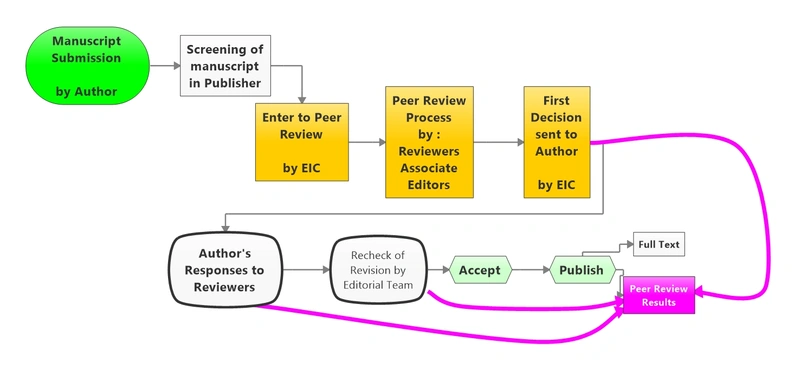
Every submission follows the same route. The diagram further down shows the same process visually.
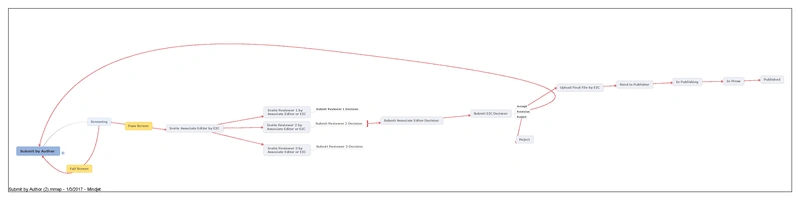
Double-anonymised review, then open reports
Both apply in every Brieflands journal, one after the other. They are two stages of the same process, not alternatives to choose between.
During review: double-anonymised (double-blind)
Neither the reviewer nor the author knows the other. The reviewer receives a blinded PDF and sees only the text of the manuscript, without names or affiliations. This applies to every submission, in every journal.
After the decision: open peer review
Once review has finished, Brieflands publishes the reports of those reviewers who agreed to open peer review, so that readers and authors can read the comments behind the decision. Reviewers who do not agree remain anonymous and their reports are not published.
Open peer review in detail
Open peer review makes the details of the whole review process public — reviewer, associate editor and editor-in-chief comments — where the editor-in-chief, the authors and the reviewers all agree to it.
Signed reviewers
These reviewers agree to have their names and affiliations shown on the public journal website alongside their comments.
Anonymous reviewers
These reviewers stay anonymous to the public and are known only to the editor-in-chief. Only their comments appear publicly.
Brieflands gives the following reasons for opening the process:
- Greater transparency, and more constructive, more tactful comments — which raises the quality of reviews
- Stronger motivation for everyone involved in the process
- Greater author satisfaction, and more honesty between authors and reviewers
- Educational value for authors and for students new to the field
- It discourages reviewers from pursuing their own agendas, and makes reviewer conflicts of interest easier to detect


What reviewers commit to
Every Brieflands reviewer agrees to these terms. A reviewer is answerable both to the author, whose work is being judged, and to the editor who invited the review.
- Keep all information about a manuscript confidential and treat it as privileged.
- Review objectively, with no personal criticism of the author. Any personal knowledge of the authors must not affect comments or decisions.
- Express views clearly, with supporting argument, in roughly 500 to 1,000 words.
- Identify relevant published work the authors have not cited.
- Draw the editor-in-chief’s attention to any substantial similarity or overlap with other published articles.
- Decline to review where a conflict of interest exists — competitive, collaborative or any other relationship with the authors, companies or institutions connected to the work.
- Give written feedback on the scholarly merit and scientific value of the work, and return it within the time agreed.
- Keep comments relevant to the subject and factually accurate, and frame judgements constructively so the author can see how the work could be improved.
- Do not retain the manuscript, or any copy of it, once the review is complete.
Working with the editor
- Tell the editor at once if you cannot review within the time agreed, and suggest other suitable reviewers where you can.
- Follow the editor’s written instructions on what the journal expects of the submitted work.
- Assess scientific merit, originality and scope, say how the work could be improved, and give a recommendation consistent with your rating.
- Give a clear, level-headed reason for that recommendation, grounded in accepted research ethics.
- Do not contact the author directly without the editor’s permission.
Competence and impartiality
- Accept only those reviews you have the subject expertise to complete, and decline where that expertise is not adequate.
- Base the recommendation on scientific merit, relevance to the subject and the scope of the journal — never on the financial standing, race or ethnic origin of the authors.
- Stay responsive to the editorial office throughout the review, and take the steps needed to meet the journal’s deadlines.
Becoming a reviewer
To review for a Brieflands journal, send a request with your CV through the support portal. The journal’s editorial board will review it and be in contact. Reviewers can obtain an online validated certificate for completed work.