
1. Background
Recently, the interest in physical beauty is becoming more prevalent. Therefore, it is not surprising that each year, the demand for cosmetic surgery increases (1). According to the report of the American Society of Plastic Surgeons, breast cosmetic surgery has continued to be the most frequent cosmetic surgical procedure since 2006 (2). Additionally, these surgeries have dramatically increased in the recent years in Iran (3). Due to the fact that breasts have an important role in feminine identity, femininity, sexual desire, physical, and sexual attractiveness (4), their deformity or loss in numerous cases is interpreted as the loss of female identity (5). Women with breast deformities reported a lack of self-esteem, sexual health, and social adjustment (6). This issue shows the importance of mammaplasty or cosmetic surgery.
Women with breast cancer are among those who face threats to body image following surgery. Mastectomy can affect changes in body image (7) and sexual life (8). Body exposure during sexual activity and sexual assertiveness are other factors that could be influenced by mastectomy. Body image is the picture of the body formed in our mind, and its related features contain the expression of emotions, imitation, identification, beauty, and social dimensions (9). For those who suffer from breast cancer, such a construct is multidimensional (10). Suffering from cancer has a psychological dimension, which depends on the clinical aspect of the disease, particularly its stage and its effects on functioning and quality of life (11).
Body exposure during sexual activities is a self-body image experience in the context of sexual relations. Body exposure indicates a sense of self-consciousness or extreme anxiety about the body’s appearance that results in avoidance of revealing some aspects of the body to the sexual partner during sexual intercourse (12). Sexual assertiveness has a major contribution to satisfaction with sexual and marital relations (13). It is a complicated skill that includes three dimensions, namely the ability to initiate and inform the partner about desired sexual intercourse position, the ability to refuse unwanted sexual intercourse, and the ability to communicate about sexual history (14). Research on the self-esteem and sexual satisfaction of breast cancer survivors show a pattern of dissatisfaction in most of them (15).
Reconstruction or mammaplasty, which is a part of breast cancer treatment, intends to address anxieties regarding the body image following mastectomy (16). Body image dissatisfaction and sexual dissatisfaction are major factors that motivate patients to undergo plastic surgery (17). Lotfi Kashani et al. mentioned that no significant effect was observed in terms of patients’ body image by sexual skills training (18); however, Teo et al. revealed that body image and quality of life are influenced by breast reconstruction (16). Fang et al. also proved that women with breast reconstruction had a better body image score than women with mastectomy (19). Kelsall et al. reported that patients undergoing oncoplastic breast-conserving surgery had better psychosocial and self-rated satisfaction with breast appearance (20).
2. Objectives
Due to the destructive effect of mastectomy on body image and the importance of the decision on mammaplasty based on a realistic expectation of its results in sexual life, this study tried to answer the question of whether the body image, body exposure, and sexual assertiveness of mastectomized women were different from those of women volunteering for mammaplasty and women undergoing mammaplasty after mastectomy.
3. Methods
This research was an introspective cohort study. In this study, three groups were identified and prospectively compared.
3.1. Statistical Population and Sample
The statistical population of the study included mastectomized women with/without mammaplasty and patients with cancer who volunteered for mammoplasty within the age range of 25 - 55 years in Tehran, Iran, 2018. According to Cohen’s table, with an alpha level of 0.05, and effect a size of a medium to high (21), the sample included 37 women with mastectomy, 28 mastectomized women who volunteered for mammoplasty, and 31 women who underwent mammaplasty after mastectomy. The participants were selected through convenience sampling from patients who had been referred to specialized breast surgery centers, namely Shohadaye Tajrish Hospital, Imam Hospital, Hazrat Rasoul Hospital, and two cosmetic surgery centers in Tehran. The inclusion criteria were literacy at the level of reading and writing, nonparticipation in educational and counseling programs, the age range of 25 - 55 years, at least one year after the completion of medical treatment related to cancer for mastectomized patients and at least one year after mammoplasty. The exclusion criteria were the recurrence of the disease in patients with mastectomy, diagnosis of neuropsychiatric disorders or use of psychiatric drugs, and unwillingness to continue participation in the study. After explaining the research, declaring information confidentiality, and obtaining written consent, the subjects were evaluated using several questionnaires.
3.2. Research Tools
The tool used in the study included the Assessment of Body-Image Cognitive Distortions (ABCD) Questionnaire, the Body Exposure during Sexual Activities Questionnaire (BESAQ), and the Hurlbert Index of Sexual Assertiveness (HISA).
3.2.1. Assessment of Body-Image Cognitive Distortions Questionnaire
This is an 18-item scale that was adapted and validated by Cash (22) to assess cognitive distortions when interpreting or processing information related to appearance. The scoring system of items follows a 5-point Likert scale [never (0) to always (4)]. The minimum and maximum test scores are 0 and 72, respectively. Two 18-item parallel forms of the ABCD were validated using a sample of 263 female college students. Apart from being unidimensional, both forms not only had high internal consistency (Cronbach’s alpha = 0.93 and 0.94) but also were strongly intercorrelated (r = 0.93). In addition, both forms were relatively free from socially desirable responses (r = -0.14, ns). Engle (23) examined the relationship between body image cognitive distortions and various dysfunctional body image behaviors. In both bivariate and multivariate analyses, the ABCD scores were moderate to strongly associated with both avoidant and compulsive body image behaviors (24). The English version of this questionnaire (form A) was translated into Persian by the researcher and administered to 96 Iranian students to assess its psychometric properties. The test-retest reliability of the questionnaire with an interval of 2 months was obtained to be 0.72. The construct validity of the questionnaire was 0.86 through the agreement coefficient of 20 psychologists. In the current study, the alpha coefficient was 0.69.
3.2.2. Body Exposure during Sexual Activities Questionnaire
This 28-item scale was developed by Hangen and Cash (25) to measure anxious attentional focus on and body exposure avoidance during sexual intercourse. The scoring system follows a 5-point Likert scale, ranging from never (a score of 0) to always (a score of 4). The minimum and maximum test scores are 0 and 112, respectively. Findings supported the BESAQ’s reliability and validity. The BESAQ’s internal consistency (Cronbach’s alpha) was 0.95 for male and 0.96 for female subjects (12). After translating the English version of the questionnaire into Persian by the researcher, its test-retest reliability on 96 Iranian students with an interval of 2 months was obtained to be 0.83. The construct validity of the questionnaire was 0.89 through the agreement coefficient of 20 psychologists. In the current study, the alpha coefficient was 0.75.
3.2.3. Hurlbert Index of Sexual Assertiveness
This 25-item scale was provided by Hurlbert to measure women’s sexual assertiveness in interaction with others (26). This questionnaire contains 25 items scored on a 5-point Likert scale, ranging from never (a score of 0) to always (a score of 4). The minimum and maximum test scores are 0 and 100, respectively. Hulbert reported a Cronbach’s alpha of 0.86; however, to evaluate the construct validity, a correlation of 0.82 is reported, which is obtained using the Gambrell-Richey Assertion Inventory (26). Pierce and Hurlbert (27) reported test-retest reliability of 0.85 during 28 days (24). In a study conducted in Iran, Bay (28) reported its content validity and internal consistency (α = 0.91). Sanai et al. reported the content validity index to be 0.91 in Iran (29). In the current study, the alpha coefficient was 0.81.
Due to the measurement based on an interval scale, analysis of variance was used for data analysis. After confirming the assumptions of using variance analysis, the data were analyzed with the 20th edition of SPSS software.
4. Results
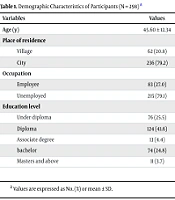
First, the sociodemographic characteristics of the participants (Table 1), their differences in the measured variables according to their sociodemographic characteristics, and the descriptive components of the studied variables in three groups of participants (Table 2) were reported to analyze the data. Then, the differences between the groups were analyzed using analysis of variance (ANOVA) (Table 3). Multiple comparisons of groups’ scores for each research variable are also presented (Table 4).
Table 1.
Sociodemographic Characteristics of Participants
| Characteristics | No. (%) |
|---|---|
| Employment status | |
| Housewife | 64 (66.7) |
| Employed | 24 (23) |
| Retired | 5 (4.8) |
| No answer | 3 (2.9) |
| Educational status | |
| Not finished school | 8 (7.68) |
| Diploma | 26 (24.96) |
| Bachelor’s degree | 36 (34.56) |
| Master’s degree and higher | 24 (23.04) |
| No answer | 2 (1.92) |
| Total | 96 |
| Marital status | |
| Married | 84 (80.64) |
| Single | 6 (5.76) |
| Divorced | 4 (3.84) |
| No answer | 2 (1.92) |
| Total | 96 |
Table 2.
Descriptive Components of Variables
| Variables | n | Mean ± Standard Deviation |
|---|---|---|
| Body cognitive distortions | ||
| Mastectomized | 36 | 26.555 ± 15.472 |
| Mammaplasty volunteer | 28 | 27.678 ± 13.749 |
| Underwent mammaplasty | 31 | 30.580 ± 13.462 |
| Total | 95 | 28.200 ± 14.292 |
| Body exposure during sexual activity | ||
| Mastectomized | 36 | 50.916 ± 22.846 |
| Mammaplasty volunteer | 28 | 65.857 ± 18.204 |
| Underwent mammaplasty | 31 | 45.967 ± 14.457 |
| Total | 95 | 53.705 ± 20.565 |
| Sexual assertiveness | ||
| Mastectomized | 36 | 45.166 ± 5.179 |
| Mammaplasty volunteer | 28 | 40 ± 3.990 |
| Underwent mammaplasty | 31 | 55.290 ± 4.852 |
| Total | 95 | 46.947 ± 7.786 |
Table 3.
Summary of Groups’ Analysis of Variance
| Variables | SS | df | MS | F | P-Value |
|---|---|---|---|---|---|
| Body cognitive distortions | 0.682 | 0.508 | |||
| Between groups | 280.656 | 2 | 140.328 | ||
| Within groups | 18920.544 | 92 | 205.658 | ||
| Total | 19201.22 | 94 | |||
| Body exposure during sexual activity | 8.614 | 0.001 | |||
| Between groups | 6270.601 | 2 | 3135.301 | ||
| Within groups | 33487.146 | 92 | 363.991 | ||
| Total | 39757.747 | 94 | |||
| Sexual assertiveness | 80.310 | 0.001 | |||
| Between groups | 3623.350 | 2 | 1811.75 | ||
| Within groups | 2075.387 | 92 | 22.559 | ||
| Total | 5698.737 | 94 |
Table 4.
Multiple Comparisons of Groups’ Scores regarding Each of Research Variables
| Variables | Group 1 | Group 2 | MD (I-J) | Std. Error | P-Value |
|---|---|---|---|---|---|
| Body cognitive distortions | A: Mastectomized | B | -1.123 | 3.613 | 0.757 |
| C | -4.025 | 3.513 | 0.255 | ||
| B: Mammaplasty volunteer | A | 1.123 | 3.613 | 0.757 | |
| C | -2.902 | 3.738 | 0.440 | ||
| C: Underwent mammaplasty | A | 4.025 | 3.513 | 0.255 | |
| B | 2.902 | 3.738 | 0.440 | ||
| Body exposure during sexual activity | A: Mastectomized | B | -14.940 a | 4.807 | 0.003 |
| C | 4.948 | 4.647 | 0.293 | ||
| B: Mammaplasty volunteer | A | 14.940 a | 4.807 | 0.003 | |
| C | 19.889 a | 4.974 | 0.000 | ||
| C: Underwent mammaplasty | A | -4.948 | 4.674 | 0.293 | |
| B | -19.889 a | 4.974 | 0.000 | ||
| Sexual assertiveness | A: Mastectomized | B | 5.166 a | 1.196 | 0.000 |
| C | -10.123 a | 1.163 | 0.000 | ||
| B: Mammaplasty volunteer | A | -5.166 a | 1.196 | 0.000 | |
| C | -15.290 a | 1.238 | 0.000 | ||
| C: Underwent mammaplasty | A | 10.123 a | 1.163 | 0.000 | |
| B | 15.290 a | 1.238 | 0.000 |
a Significant
Participants’ demographic features in outcome variables were compared using ANOVA. The results showed no statistically significant differences in the ABCD (employment: F(2,91) = 0.0491; P < 0.952; educational: F(2,91) = 0.130; P < 0.876; marital: F(2,91) = 0.037; P < 0.962), the BEASQ (employment: F(3,90) = 0.039; P < 0.989; educational: F(3,90) = 0.034; P < 0.991; marital: F(3,90) = 0.035; P < 0.992), and the HISA (employment: F(2,91) = 0.176; P < 0.838; educational: F(2,91) = 0.533; P < 0.588; marital: F(2,91) = 2.085; P < 0.129). There were no significant correlations between age with cognitive distortions (r = -0.148; P < 0.084), body exposure (r = -0.046; P < 0.590), and sexual assertiveness (r = -0.145; P < 0.074).
The descriptive components of variables (Table 2) showed that the mean age value of women in the three groups was equal to 46.55 ± 9.52 years. The average age of women was 8.21 ± 46.67, 8.91 ± 45.71, and 9.01 ± 46.01 years in mastectomized women, patients who volunteered for mammoplasty, and women who underwent mammoplasty, respectively. The minimum and maximum ages of the participants were 25 and 55 years, respectively. Most women (66.7%) were housewives, and 20.4% of participants did not announce their employment status. The educational status of most women (44.8%) was a bachelor’s degree, and 1% of participants did not declare their educational status. Most participants (80.64%) were married, and 1.92% of participants did not announce their marital status.
The pre-assumptions of data normal distribution and homogeneous variance were evaluated based on the Shapiro-Wilk test and Levene’s test. There were both normal distributions of the data (P > 0.05) and homogeneous variance (P > 0.05) for the variables.
For the comparison of body-image cognitive distortions, body exposure during sexual activities, and sexual assertiveness in the three groups, after the examination of the relevant assumptions, the data were analyzed by ANOVA using SPSS software (version 20). Table 3 shows a summary of ANOVA for groups’ scores.
Due to the significant differences between the scores of the groups and a better explanation of the data, the average scores of the groups in each of the research variables were compared in pairs (Table 4).
As can be observed in Table 4, there is no difference between the mastectomized patients, patients underwent mammaplasty, and patients who volunteered for mammoplasty in body image distortions. The patients with cancer who underwent mammaplasty had less body exposure during sexual activities than mammaplasty volunteers (P < 0.01). In this dimension, there was no difference between patients who underwent mastectomy and patients who underwent mammaplasty. The patients who underwent mammaplasty had more sexual assertiveness than those who underwent a mastectomy and volunteers for mammaplasty (P < 0.01). A comparison of the two groups regarding this variable showed that the mastectomized group had more sexual assertiveness than the patients who volunteered for mammoplasty (P < 0.01).
5. Discussion
This study aimed at comparing body image and body exposure during sexual activity and sexual assertiveness among mastectomized women with/without mammaplasty and patients who volunteered for mammoplasty. The findings showed no significant difference among mastectomized patients, patients who underwent mammaplasty, and mammaplasty volunteers in body image cognitive distortions. Although several studies have confirmed that mammaplasty can be effective in the body image of mastectomized patients (30, 31), some studies mentioned problems in integrating the reconstructed breast into the body image. In explaining this finding, it can be said that although mammaplasty favorably affects patients’ self-esteem, it is also affected by other factors, such as the patient’s age, radiotherapy, surgical success (32), and patient expectations (33). One of the factors affecting cognitive distortions of body image is the value that an individual gives to her appearance and attractiveness. The importance of the appearance and the value that the patient gives to it can be considered a major predictor of the resulting body image and satisfaction with clinical outcomes (34). There was a significant correlation between the breast shape and declined satisfaction with the breast following mammaplasty (35).
The women who decided to undergo mammaplasty revealed significantly higher importance for their femininity and attractiveness than mastectomized women who did not intend to have breast reconstruction. Women who care a lot about the appearance of their breasts are more prone to reconstruction, and the same high importance to the breast makes them less satisfied with the outcome of the surgery (35). Additionally, the findings suggested that satisfaction with the shape and appearance of the breast after mammaplasty is not always achieved. Although there was high satisfaction with overall cosmetic results, most women were not satisfied with the softness of the reconstructed breasts and expressed their dissatisfaction with breast hardness, numbness, and sexual intercourse (36).
On the other hand, emotional distress and somatic preoccupation can also affect the satisfaction of mammaplasty (37). The findings of a study conducted by Lotfi Kashani et al. indicated that patients volunteering for mammaplasty experienced more distress about their body defects than those undergoing mastectomy without requesting mammaplasty and volunteers for cosmetic surgery (38). In addition to all the aforementioned factors affecting satisfaction with the result of mammaplasty, the timing of the reconstruction is also an important consideration. Anxiety and depression are lower in individuals who underwent reconstruction immediately after mastectomy, and they feel more sexually attractive than those who delayed reconstruction (39). Immediate mammaplasty is more satisfying (40). Therefore, it can be concluded that the effect of mammaplasty on the self-body image cognitive distortions depends on several variables, such as the psychological status, the importance of appearance for the individual, satisfaction with the shape and appearance of the reconstructed breast, and the time of reconstruction. Consequently, the decision for mammaplasty should be made according to the patient’s psychosocial needs.
Another finding of the present study was that patients with cancer who have undergone mammaplasty focused frequently less on their body during sexual activity than breast reconstructive volunteers waiting for surgery. The women who underwent mammaplasty had more positive experiences in the context of sexual relations, experienced self-conscious less or anxious attentional focus on their body’s appearance, and expressed fewer desires/attempts to avoid the exposure of certain aspects of their body to partners than those who were waiting for mammaplasty. However, this finding is in line with clinical experiences that revealed that breast excision due to cancer negatively affected the perception of femininity (41), the quality of sexual life (42, 43), and sexual function (44). The noteworthy point in the present study is that there was no difference between those undergoing mammaplasty and mastectomized women in body exposure during sexual activities. For explaining this finding, referring to the previously mentioned research results, it can be said that the decision for mammaplasty and differences in the quality of sexual relations depends on the patients’ psychosocial characteristics and the importance that a patient gives to her appearance as an individual with sexual attraction.
Women seeking mammaplasty are more sexually conscious, interested, and active and pay more attention to breast shape and sexuality (45). The women undergoing mammaplasty are more preoccupied with how their bodies are evaluated than mastectomized women who do not intend to undergo mammaplasty. Gass et al. have shown that although there is no difference in sexual function between patients who underwent a mastectomy and those who had reconstructive surgery, mammaplasty is effective in feeling satisfied with their appearance and intimacy (46). Therefore, it can be stated that the importance that the patient pays to her physical appearance can affect the effectiveness of mammaplasty on body exposure during sexual activities as a modifying variable. The decision to have a mammaplasty and its effectiveness in a sexual positive experience is influenced by the individual’s concerns about the apparent attractiveness in sexual relationships.
The comparison of groups based on the degree of sexual assertiveness showed that patients who underwent mammaplasty had higher sexual assertiveness than those who underwent mastectomy and patients who volunteered for mammaplasty. According to Morokoff et al., sexual assertiveness means an individual’s ability to engage in sexual activity, refrain from unwelcome sexual activity, use contraceptives, and follow healthy sexual behaviors (47). Therefore, it can be concluded that mastectomy might inhibit women from asserting themselves in sexual situations. Mastectomy and physical appearance can act as psychological barriers and eliminate the opportunity for sexual intimacy and direct expression of sexual desires. Those who look more physically fit have a greater desire, sexual self-esteem, and courage to ask for sex.
Another notable finding is the higher rate of sexual assertiveness in mastectomized women than in women awaiting mammaplasty. This result confirms the previous explanation that the effectiveness of mammaplasty in different dimensions of sexual function depends on the importance that a woman gives to her breasts as an important factor in sexual attraction.
5.1. Conclusions
Considering the importance of the breast in femininity and sexual attractiveness, breast reconstruction surgery is one of the suggestions for mastectomized patients. According to the findings, the issue of body image and its relationship with different aspects of sexual function is complex and requires considering different personality traits and factors as moderators. The importance that a woman places on the breast as a symbol of femininity and sexuality is one of the aforementioned factors. Therefore, although mammaplasty can be effective in sexual assertiveness, not all mastectomized people need breast reconstruction surgery to maintain a positive body image and the quality of their sexual relationship.
In addition, it is necessary to consider the purpose of mammaplasty from the patient’s point of view and psychological characteristics. Several factors can affect the satisfaction with the result of mammaplasty and prevent a woman from achieving her purpose of reconstruction. A realistic view of the outcome of the reconstruction will help the individual make the right decision.
5.2. Limitations and Suggestions
This study had some limitations. Using a larger sample size can lead to more detailed results. In addition, researching on age-matched groups and various social classes can provide more comprehensive findings. Subsequent qualitative and longitudinal studies in this field can provide further detailed information.