
1. Background
In recent years, the prevalence of thyroid diseases has been significantly increased. Thyroid disease occurs in many women during pregnancy when the concentrations of estrogen and progesterone hormones are at maximum levels (1). In thyroid disease, the thyroid nodule appears as a lesion in the thyroid gland. The lesion is detectable by touching and ultrasounding the surrounding thyroid parenchyma. The thyroid nodule is found in almost 8.5% of the world population (2). In general, its prevalence in women is 4 times more than that of men (3). To this end, several attempts have been made to investigate the role of sex hormones in thyroid disease (4).
Expression levels of estrogen receptor alpha in patients with different thyroid neoplasms are higher than those of normal individuals (2). On the other hand, estrogen receptor beta expression levels are lower than those of normal ones (2). The rs2987983 polymorphism exists in the promoter region of the estrogen receptor beta (ESR2) (5). Thus, there could be the possibility of altering gene expression. Some studies have shown the association of this polymorphism with various diseases such as breast cancer (6), prostate cancer (7), and colorectal cancer (8).
Based on the mentioned points, it is necessary to introduce a new approach to diagnose for preventing and treating thyroid nodules and, consequently, apply new therapies to treat nodules and thyroid cancers based on the genotype of individuals.
2. Objectives
The present study investigates the association of rs2987983 polymorphism in the ESR2 gene and the nodular thyroid disease in the women population of the Markazi Province, Iran.
3. Methods
This research was conducted with the ethics code of 93-171-13 at Arak University of Medical Sciences. Participants completed the informed consent sheet. In this case-control study, a 4-mL blood sample was collected in an EDTA-containing tube from each of 146 patients with nodular thyroid and 151 healthy controls. The patients were chosen from the endocrinology clinic at Amir-Almomenin Hospital and the endocrinologist’s office. A doctor confirmed the thyroid nodule in the selected patients, using an ultrasound device. The control group was chosen from healthy women, who volunteered to visit Pars Ultrasound Center in Arak and had no thyroid nodules according to their thyroid ultrasound scan. DNA was extracted from whole blood, using DNG-Plus Kits, Sinaclon, Iran. The rs2987983 polymorphism was studied by the T-ARMS-PCR method and RFLP-PCR confirmed the genotyping. The sequences of the designed primers are shown in Table 1.
Table 1.
Characteristics of rs2987983 Polymorphism Primers
| Primers | Sequences | T (°C) |
|---|---|---|
| OF | ACAGCATGTTCTCTTTTCAGAGCAG | 59.1 |
| IF | GGTTTAATGCAGAGTGGAGAtGa | 56.4 |
| IR | ACAATTCAGGTAgAATTGGAATAATgAc | 56.2 |
| OR | TTCCTTTGCTTTCCCAGGTGA | 60.1 |
PCR experiment happened in 3 successive stages: (1) an initial denaturation stage (4 min at 94°C), which is important for perfect sample denaturation and enzyme activation; (2) an amplification stage with a repetition of denaturation/hybridization/elongation cycles (45 s at 94°C, 45 s at 56°C, and 45 s at 72°C, respectively); and (3) a terminal progressive denaturation stage (5 min at 72°C). These stages were followed to understand the nature of the amplified fragments. Then, the PCR product was electrophoresed in 8% polyacrylamide gel, stained with silver nitrate, and genotyped. The results were analyzed, using t test, logistic, regression, and chi-square statistics.
4. Results
The demographic characteristics of both groups of the case and control are summarized in Table 2. The mean age of the patients and healthy women were 42.57 and 40.83 years, respectively. Because of the close age of the samples, the association between age and nodular thyroid disease was avoided. Regarding the statistical analysis of the case-control study, parental relatives, smoking, and marital status had no association with nodular thyroid disease; however, the BMI value, menstrual cycle, education level, and the use of iodized salt showed associations with nodular thyroid disease (P ≤ 0.05).
Table 2.
Demographic Characteristics of Both Case and Control Subjects a
| Characteristics | Case Subjects | Control Subjects | P-Value |
|---|---|---|---|
| Age (mean) | 146 (42.57) | 151 (40.83) | 0.09 |
| Unrelated parents | 109 (48.7) | 115 (51.3) | 0.39 |
| Marital status | 118 (80.8) | 127 (84.1) | 0.86 |
| Non-Cigarette smoking | 136 (93.2) | 144 (95.4) | 0.31 |
| Education level (M.Sc. & higher) | 14 (9.6) | 17 (11.3) | 0.03 b |
| BMI > 25 | 102 (69.86) | 91 (60.26) | 0.04 b |
| Menstrual regularity | 70 (47.9) | 102 (67.5) | 0.03 b |
| Use of iodized salt | 53 (36.3) | 101 (66.9) | 0.00 b |
a Values are expressed as No. (%) unless otherwise indicated.
b The difference between the two groups was significant (P ≤ 0.05).
Figure 1 shows the genotype of some samples by T-ARMS-PCR. The lengths of PCR products of the AA and GG genotypes were 419 bp and 224 bp, respectively. The lengths of AG genotypes were 419 bp and 224 bp, where the band 593 bp appeared in all genotypes. This genotyping was confirmed by RFLP-PCR (Figure 2). When allele A is present in the rs2987983 polymorphism, the FOKI enzyme cleaves this polymorphism, using the RFLP-PCR method. Therefore, this enzyme cuts the genotype AA into two lengths, i.e., 208 bp and 385 bp. Also, it cuts genotype AG and produces into 3 sizes of 208 bp, 385 bp, and 59 bp. However, genotype GG is not cut by this enzyme and has only a length of 593 bp.
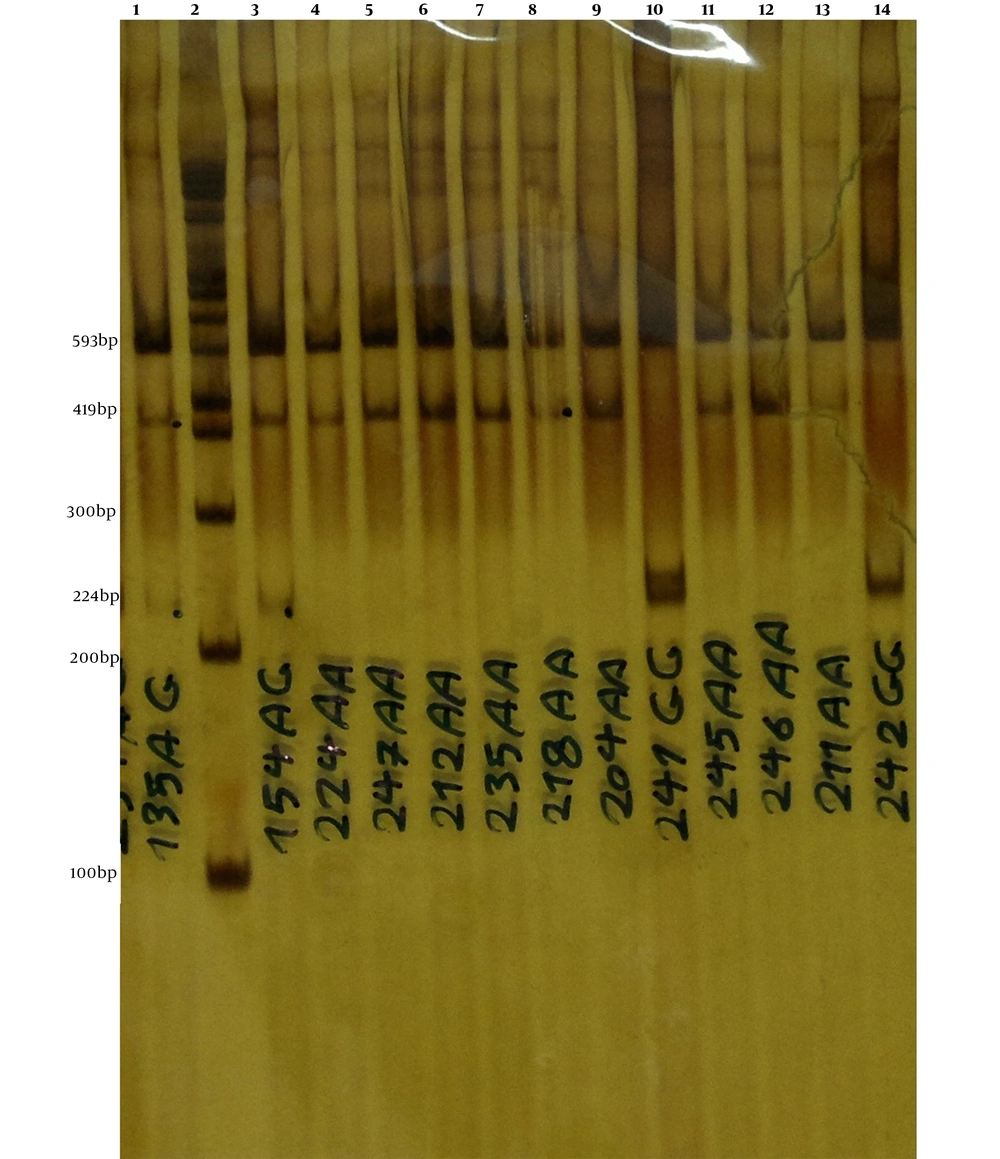
Figure 1.
Genotyping of rs2987983 polymorphism by T.ARMS-PCR. Lines 4 - 9 and 11 - 13 have AA genotype, lines 10 and 14 have GG genotype, and lines 1 and 3 have AG genotype. Line 2 has a 100pb size marker.
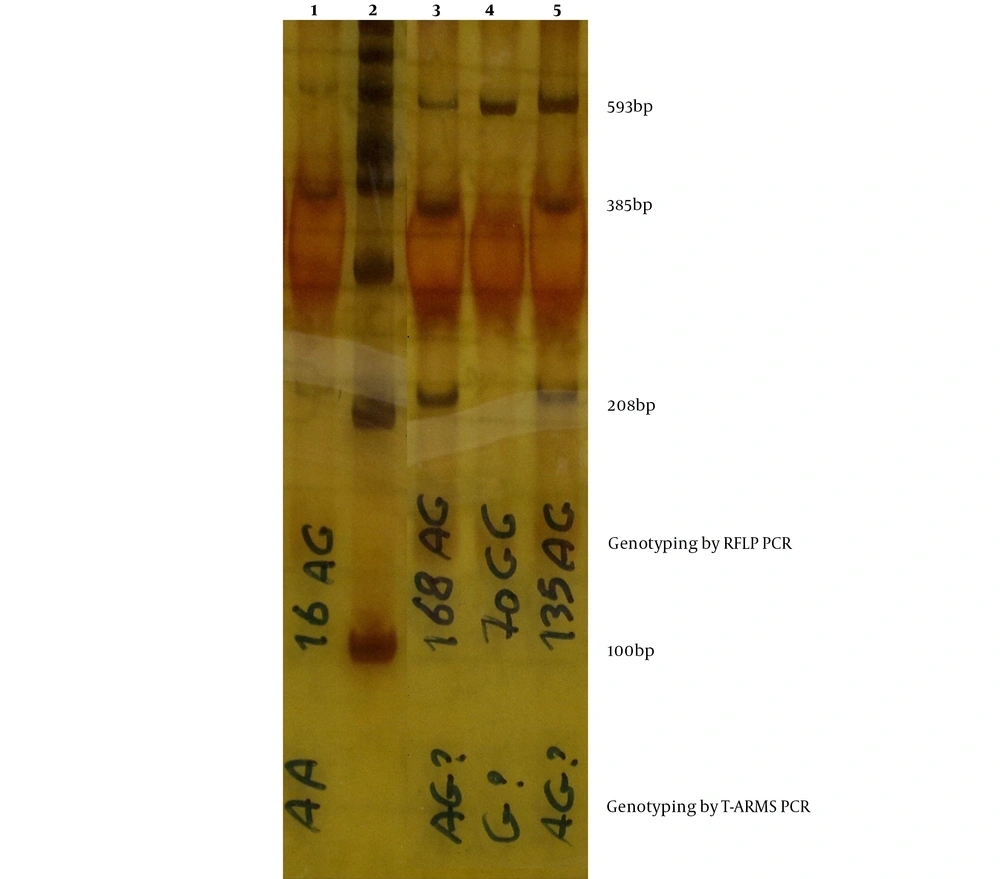
Figure 2.
Genotyping of rs2987983 polymorphism by RFLP-PCR. Lines 1, 3, and 5 have been confirmed as AG genotype, and line 4 has GG genotype. Line 2 has a 100pb size marker.
The results of genotypes and allelic frequencies of rs2987983 polymorphism are presented in Table 3 and Figure 3, respectively. A significant association was observed between rs2987983 polymorphism and thyroid nodular disease (df = 2, χ2 = 6.3, P-value = 0.042). Besides, the chance of having AG genotype was approximately 1.73 times higher than that of AA genotype in patients with thyroid nodules.
Table 3.
Genotype and Allelic Frequency of rs2987983 Polymorphism in Both Case and Control Subjects a
| Genotype | Case Subjects | Control Subjects | P-Value | OR (CI = 95%) |
|---|---|---|---|---|
| AG | 83 (56.8) | 64 (42.4) | 0.043 | |
| AA | 48 (32.9) | 64 (42.4) | 0.031 | 1.73 (1.05 - 2.84) |
| GG | 15 (10.3) | 23 (15.2) | 0.064 | 1.98 (0.96 - 4.11) |
| A frequency | 179 (0.61) | 192 (0.64) | 0.57 | |
| G frequency | 113 (0.39) | 110 (0.36) | 0.57 | 1.1 (0.65 - 1.26) |
a Values are expressed as No. (%) unless otherwise indicated.
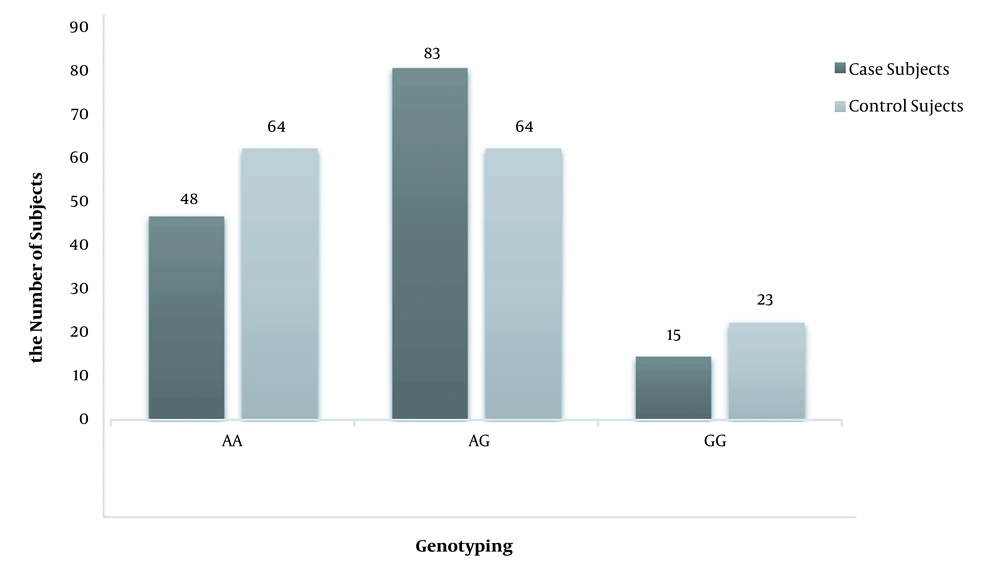
Figure 3.
Genotype frequency of rs2987983 polymorphism in both case and control subjects
5. Discussion
Thyroid nodules are common health issues, whose malignancy risk increases in patients with nodular thyroid disease (9). The epidemiology data have revealed a higher prevalence of nodular thyroid in women than men (3). Therefore, sex hormones such as beta estrogen receptors may be involved in thyroid disease (4). Previous investigation has shown that the ESR2 expression is lower in patients with different types of thyroid disease than in healthy individuals (2).
Our results provide the first evidence that rs2987983 polymorphism in the promoter region of the ESR2 gene was significantly associated with nodular thyroid disease. The -13950 A/G polymorphism was possibly associated with reduced ESR2 gene expression in thyroid nodular disease.
To the best of our knowledge, there is no study in Iran or other countries on the association between this polymorphism and thyroid nodular disease to be employed for comparison. However, some studies have found a significant association between rs2987983 polymorphism with various diseases, including breast cancer (10-12), colorectal cancer in postmenopausal women (8), and prostate cancer in men (7). Moreover, some researchers have examined the association of this polymorphism with pelvic prolapse (5), ovarian cancer (13), and uterine fibroids (14), though not finding any association between this polymorphism and these diseases.
In the Ensemble database, the global and Asian frequencies of allele A of rs2987983 polymorphism have been recorded 61 and 71%, respectively, and the frequencies of G allele in the global and Asian have been recorded 39 and 29%, respectively (https://www.ensembl.org/Homo sapiens/Variation/Population). In the present study, which was conducted in Markazi Province, Iran, the frequency of allele A in the patient and control groups was 60.6 and 64.8%, respectively, while they were respectively 37.4 and 37.1% for allele G. Therefore, there was a slight difference between the average of this study and the global and the Asian average.
According to the statistical analysis, there was an association between the use of iodized salt and thyroid nodular disease. In other words, using iodized salt could lead to a reduction in the risk of this disease. Seyfhashemi et al. (15) reported that the decrement of iodine intake increased the risk of thyroid nodules.
The results of the present study suggest that the risk of the thyroid nodules was increased with an increase in BMI. This trend is in agreement with the results reported by Rahimi et al. (16); they showed that the risk of thyroid nodules increased by 38% with a one-unit increase in BMI.
The results showed an association between regular menstruation and the thyroid nodules, suggesting that irregular menstrual because of sex hormones abnormality could increase the risk of the disease. Borna et al. (17) demonstrated that menstrual disorders are the most common symptoms of thyroid diseases. The statistical analysis showed a correlation between education and this disease. As the level of education increased, the disease risk deteriorated. An explanation for this result is that a higher education level of individuals may lead to paying more attention to their health by self-care, i.e., using iodized salt and visiting a doctor frequently.
5.1. Conclusions
The present work is the first study on the association between rs2987983 polymorphism in the estrogen receptor beta gene and nodular thyroid disease. The results suggest a correlation between this polymorphism and the disease; thus, it can be considered one of the diagnostic biomarkers of nodule thyroid. Concerning the possibility of the influence of the racial and geographical location on the incidence of the disease, the authors suggest that this study needs to be carried out for other populations with larger sample size.