
1. Background
Substance abuse and addiction have destructive physical (gastrointestinal, cardiac, respiratory, neurological diseases, and AIDS), psychological (stress, anxiety, apprehension, depression, restlessness, distress, and forgetfulness), familial (conflicts with family members, unhealthy familial relationships, rape, infidelity, and divorce), occupational (delay or absenteeism, dismissal, and unemployment), financial (debt, bankruptcy, and poverty), social (boycott, isolation, seclusion, loss of friends, lack of respect, and loneliness), and moral (lying, libel, and adultery) effects. It also leads to wrongdoing and crimes such as sexual abuse and rape, cheating, stealing, bribery, fraud, and murder (1).
The number of substance abusers among the 15 to 64-year-old population is estimated at 200 million, or 5% of the total world population, of which 15 million (4% of the population) use narcotics, while 11 million use heroin (2). In Iran, the number of substance abusers is estimated at about 1 - 3.3 million, the majority of whom take narcotics (3).
In recent decades, Iran has been greatly damaged by substance abuse and its consequences. Although opium use is not a new problem and has been going on in the country for years, it has recently become a serious social problem with numerous economic, familial, and psychological consequences. The emergence of intravenous injection is also associated with the transmission of infectious diseases such as AIDS and hepatitis (3).
Evidence shows that substance abuse is complex and multi-factorial. Meanwhile, a general theory is required to coordinate different etiologies and organize the large volume of etiological information. The self-perceived survival ability and reproductive fitness (SPFit) theory that directly pertains to substance abuse aims for this purpose (4).
Self-perceived evolutionary ability is a novel psychological construct rooted in evolutionary psychology that expresses one’s efforts to increase their survival and reproductive abilities. In human beings, self-perceived evolutionary ability is an internal perception comprising many characteristics, such as a sense of personal power, control, omnipotence, and sexual attraction. Specifically, the tendency to acquire and promote power is defined in this theory along the lines of survival ability. A person with a more sense of power can better overcome survival-threatening problems and obstacles in life. Reproductive fitness also plays a major role in human behaviors. Human beings try to increase their physical, social, and sexual attraction in different ways (5).
Substance abuse promotes a sense of self-perceived evolutionary ability artificially and by stimulating the cortico-mesolimbic DA (CMDA) in the brain (5). For instance, many cocaine users have expressed that they have experienced a heightened sense of omnipotence and sexual attraction when taking cocaine (6). The full sense of pleasure at the high stage of opium use also expresses full satisfaction with one’s survival ability and reproductive fitness in an unnatural way (5).
The CMDA system is not a reward center or reward pathway, as often assumed by addiction theories. It is a primary system for survival and reproduction that is artificially activated by drug use, and by situations that threaten survival and reproduction (e.g., stressor and new stimulants). Therefore, this system is not only based on hedonistic theory but also, it is rather a goal-directed model based on goal-directed motives and behaviors that promote survival and reproductive fitness. In the hierarchy of motives, survival and reproductive fitness are much more significant for people seeking pleasure. People will die without motivation but continue living without pleasure. In this theory, the pleasure resulting from substance use is a corollary attained upon an increased perception of evolutionary fitness; the feelings of fear, anxiety, and danger are also rooted in the same perception and stimulate a similar system in the brain (5).
Therefore, the main contradiction in the knowledge of addiction, that is, why people continue taking drugs despite the serious damage it incurs on them, can be explained by the SPFit theory: the temporary and artificial rise in the self-perceived survival and reproductive fitness that pertains to one's primary motives (power and sexuality) and its evolutionary mechanisms disrupt one's perception of the harms and problems caused by drug use (5). Although the relationship between substance use and evolutionary fitness has been demonstrated (5), the role of mediating variables that may contribute to the relationship between self-perceived evolutionary fitness and substance use and pertain to this topic is not clear yet.
Several studies have shown that the experience of boredom is associated with alcohol consumption, substance use, eating disorders, gambling, and addiction to mobile phones (7-11). Moreover, recovering addicts who are struggling with boredom suffer from relapse more (12). Thus, the question is whether boredom can have a mediating role in the relationship between evolutionary fitness and substance use.
A sense of fatigue and boredom is a bad feeling in which the person feels restless and finds no interest in doing anything in particular. In a study conducted in North America, it has been shown that 91% of people experience some sense of boredom. Although it is usually estimated as a transient sense that can be improved upon a slight change in the environment, boredom can have significant destructive psychological effects (7), such that it is even associated with early death, which is referred to with the term “bored to death” (6, 13, 14).
In newer definitions of this phenomenon, it is regarded as a bad state, where, initially, the person cannot successfully maintain their attention to internal (thoughts and feelings) and external information (environmental stimulants) for the successful performance of a task. Secondly, the person is aware that he/she cannot involve him/herself with a pleasurable activity, knows that he/she is using a lot of energy, and tries to involve him/herself with irrelevant activities (e.g., mind wandering). Thirdly, the person contributes this unpleasant feeling to the environment (e.g., he/she states that the activity is tiresome), while studies show that it is disrupted attention that leads to boredom, not the other way around (7).
Numerous studies have revealed that boredom can increase the chance of mind wandering. This status first decreases one's attention and then increases mind wandering (15). Mind wandering expresses the unwanted situation and a desperate appeal for some sort of different pleasant activity. This difference between the existing conditions and what the person desires makes the situation even worse, leading to boredom (16).
The content of mind wandering as a result of boredom is mostly related to one’s own problems, and in line with human being’s evolutionary issues about survival and sexual reproduction (17, 18).
One of the treatments that has been able to control mind wandering is mindfulness. Research has also shown that mindfulness can be effective in treating addiction (18). Also, many new studies have shown the very critical role of boredom in cell phone addiction (19-22). It must be pointed out that, conversely, gambling also increases mind wandering (22). All these studies can indicate the importance of the phenomena of boredom and mind wandering in the desire to use drugs.
2. Objectives
Thus, the present study aimed to examine the relationship between self-perceived evolutionary fitness and the tendency to substance use and the mediating role of boredom and mind wandering in this relationship.
3. Materials and Methods
This correlational study was performed by using structural equation modeling (SEM), which is a multivariate correlational method. The statistical population comprised of all students at state-run universities of medical sciences in Tehran. In structural equation, the minimum sample size is 200 (23); thus, a sample of 200 students studying at Iran University of Medical Sciences was selected via convenience sampling. After translation and back translation with satisfactory Cronbach’s alpha, the Evolutionary Fitness Scale (24), Short Boredom Proneness Scale (25), the Maladaptive Daydreaming Scale (26) and Addiction Potential Scale (27) were uploaded to docs.google.com, and then the link was sent to WhatsApp groups. Afterward, the subjects completed the questionnaires by receiving a gift. The data were analyzed by Pearson correlation test and structural equation path analysis in SPSS 20 and Lisrel 8.80.
4. Results
In this study, 200 participants with the age range of 21-50 years and the mean age of 28.02 ± 4.40 years took part, of whom 139 (69.5%) were men and 61 (30.5%) were women. Moreover, 144 (72%) were single, while 56 (28%) were married. The educational level of 91 (45.5%) participants was BS, 62% (31%) MS, and 47 (23.5%) PhD. Minimum, maximum, mean, and SD of scores of the variables of addiction potential, evolutionary fitness, boredom, and mind wandering can be seen in Table 1. Table 2 shows that a significant negative correlation exists between evolutionary fitness and addiction potential (r = -0.75).
Table 1.
Minimum, Maximum, and SD of Addiction Potential, Evolutionary Fitness, Boredom, and Mind Wandering
| Variables | Minimum | Maximum | Mean | SD |
|---|---|---|---|---|
| Addiction potential | 1 | 35 | 17.60 | 9.13 |
| Evolutionary fitness | 100 | 250 | 183.17 | 35.22 |
| Boredom | 7 | 37 | 23.99 | 5.88 |
| Mind wandering | 34 | 117 | 72.63 | 17.42 |
Table 2.
Correlation Matrix of Addiction Potential, Evolutionary Fitness, Boredom, and Mind Wandering a
| Row | Variable | 1 | 2 | 3 | 4 |
|---|---|---|---|---|---|
| 1 | Addiction potential | - | |||
| 2 | Evolutionary fitness | -0.75** | - | ||
| 3 | Boredom | 0.71** | -0.46** | - | |
| 4 | Mind wandering | 0.37** | -0.75** | 0.45** | - |
a ** P < 0.01.
Table 3 displays that the proposed model has a relatively proper fit. Figure 1 gives the direct effect factor of evolutionary fitness on addiction potential (β = -0.50, t = 7.90), boredom (β = -0.71, t = -14.12), and mind wandering (β = -0.46, t = -7.28). Moreover, the direct effect factors of boredom (β = 0.37, t = 5.94) and mind wandering (β = -0.02, t = -0.47) for addiction potential are presented. In the structural model, the significance of the path coefficient is specified by using the t value. If the value of t is > 1.96, the relationship between the two constructs was significant. Therefore, only the direct standard coefficient of mind wandering on addiction potential was not significant.
Table 4 presents the standard coefficients, limits of the bootstrap test, and error of estimating indirect paths for the model of boredom and mind wandering mediating the relationship between mind wandering and addiction potential. Evidently, based on the bootstrapping results with 5000 sample reproductions and the confidence interval of 95%, the indirect path of evolutionary fitness and addiction potential with the mediation of boredom was significant.
Table 3.
Fit Indices of the Model for Boredom and Mind Wandering Mediating the Relationship Between Evolutionary Fitness and Addiction Potential
| RMSEA | NNFI | NFI | IFI | CFI | χ2/df | Indices |
|---|---|---|---|---|---|---|
| 0.08 | 0.91 | 0.88 | 0.91 | 0.91 | 4.54 | Scores |
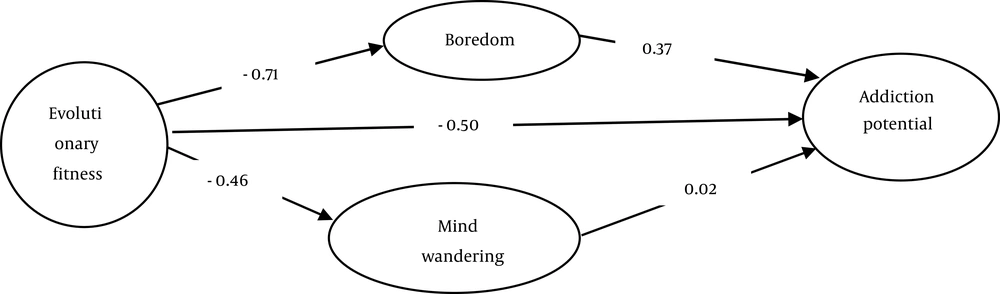
Figure 1.
The model for boredom and mind wandering mediating the relationship between and addiction potential
Table 4.
Coefficients of the Indirect Paths for the Hypothesized Model of the Research
| Indirect Paths | Indirect Beta | Number of Sample Reproduction | Bootstrap Limits | Confidence Percentage | Error of Estimation | |
|---|---|---|---|---|---|---|
| Upper Limit | Lower Limit | |||||
| Mediating role of boredom in the relationship between evolutionary fitness and addiction potential | -0.26 | 5000 | -0.12 | -0.38 | 95% | 0.078 |
| Mediating role of mind wandering in the relationship between evolutionary fitness and addiction potential | 0.01 | 5000 | 0.06 | -0.04 | 95% | 0.026 |
The upper and lower limits of the bootstrap test in the indirect path of the mediating role of boredom in the relationship between evolutionary fitness and addiction potential were -0.12 and -0.38, respectively. As these two limits had the same sign, the path of evolutionary fitness and addiction potential mediated by boredom was significant with the standard coefficient of -0.26 at P < 0.05 (Table 4).
The upper and lower limits of the bootstrap test in the indirect path of the mediating role of mind wandering in the relationship between evolutionary fitness and addiction potential were 0.06 and -0.04, respectively. As these two limits had the same sign, the path of evolutionary fitness and addiction potential mediated by mind wandering was not significant with the standard coefficient of 0.01 at P < 0.05 (Table 4).
5. Discussion
The results revealed that evolutionary fitness has a significant negative correlation with addiction potential. The model shows that boredom can play a salient mediating role in this relationship. However, mind wandering did not have a direct mediating role. Several studies have shown that mind wandering has a close relationship with boredom (28), and its causative effect has even been examined (29); therefore, it can be concluded that although mind wandering cannot directly play a mediating role between evolutionary fitness and addiction potential, in line with previous studies, it can increase boredom (30) which will eventually increase one's addiction potential.
The results of the present study were consistent with those of previous studies, showing that boredom is associated with impulse control disorders, alcohol consumption, and substance use (31-34). It has also been exhibited that boredom is associated with anxiety and depression (34). It has even been reported that boredom has a negative correlation with having a sense of purpose in life (35). People with higher social evolutionary fitness have better cognitive skills. One of the main reasons causing boredom is, in fact, reduced cognitive abilities, especially attention and focus (36). Therefore, it can be concluded that low evolutionary fitness may lead to a decline in cognitive skills, which will make one prone to boredom and addiction potential.
A sense of limitation and reduced agency are the core of boredom. People who feel bored also feel limited; they should do something they do not wish to do, or they cannot do something they wish to do (30). In the existential view, boredom is a sense of loss of efficiency (35). Therefore, it is believed that when people feel they have poor evolutionary fitness, they think that they do not have the power to do as they wish and feel bored. Boredom makes people aware of an unpleasant situation while also motivating them to pursue a newer goal (31).
Havermans et al. (2015) demonstrated that people who experienced a higher sense of boredom, compared to those in a neutral environment, eat more chocolate and give themselves a higher number and intensity of electrical shocks (37). They concluded that boredom is such an unpleasant feeling that some participants even prefer negative stimulants to release them from it (37). This study can somehow explain why people continue taking drugs even though they are aware of the destructive outcomes of addiction. One can express that people who experience a great deal of boredom are willing to escape it in any way, even with addiction.
Evolutionary fitness also showed a significant negative relationship with addiction potential. A consistent study showed that many cocaine consumers experience a sense of power, omnipotence, and sexual attraction (38). A sense of coasting and absolute satisfaction induced by opioids may reflect a sense of satisfaction with guaranteed survival and reproduction. Other substances cause a similar sensation. The motive for power in relationship to alcohol abuse revealed that alcohol abusers felt a higher sense of power and masculinity (7). In women, it increased a higher sense of femininity (39). Konovsky et al. (1982) showed that in parties in which people consumed alcohol, men experienced a higher increase in self-confidence, which happened to a lesser extent in women (40). Based on the results in line with this finding, one can conclude that substance use can increase one’s low evolutionary fitness falsely and temporarily. This is why people with poor evolutionary fitness are inclined to substance use.
The content of mind wandering is strongly dependent on the person and encompasses his/her most important concerns. It includes interpersonal feelings, goals that the person has not achieved, worries, internal conflicts, self-observation, imaginary social relations, personal beliefs, coping mechanisms, interfering memories, and future plans. Thus, some believe that this mind wandering has had an evolutionary value for human beings and helped solve their problems, despite taking a lot of energy and leading to boredom (17, 18). In other words, it seems that when a person feels poor evolutionary fitness, their mind begins wandering so that they can find a solution to promote this fitness; as this mind wandering is expensive and considerable energy is consumed by it, it eventually leads to boredom, while indirectly increasing people’s addiction potential.
Mind wandering is, in fact, a way to emphasize the incompatibility between the current situation and an unsatisfied desire for better conditions and situations. This incompatibility reinforces a sense of limitation and entrapment in an unpleasant condition, which is a major sign of boredom (31). This finding is in line with the study by Killingsworth and Gilbert (2019), who concluded that mind wandering causes a sense of boredom even if it is directed to pleasant events (31). Indeed, thinking independently of a stimulant or mind wandering may be a basic function of the brain. Although this ability is of evolutionary value and allows people to perform learning, planning, and reasoning, it is emotionally expensive (31). If people do not reach a suitable conclusion, they may convince themselves that the problem is solved artificially and by taking drugs.
In general, based on the results of this and similar studies, it can be concluded that poor evolutionary fitness starts mind wandering about fitness-related issues. Eventually, this wandering leads to the unpleasant sense of boredom. Taking drugs artificially and temporarily increases evolutionary fitness and reduces one’s sense of boredom. Therefore, it is important to pay attention to evolutionary fitness and take effective psychological measures for this variable in addiction psychotherapies.
The main limitations of this study were the small number of subjects and using virtual groups due to the conditions of Coronavirus. It is suggested that this research be performed with a larger sample size.